Introduction/Overview
Natural products have always been an important source of innovative drug discovery, among which alkaloids derived from traditional medicinal plants have attracted much attention due to their structural diversity and significant biological activity. Wilfornine A, as an alkaloid isolated from plants of the Tripterygium genus, has become a research hotspot in recent years due to its outstanding pharmacological activity in anti-inflammatory and other fields. Tripterygium wilfordii Hook. f., as a traditional Chinese medicine, has a long history in treating autoimmune diseases such as rheumatoid arthritis and systemic lupus erythematosus. The modern pharmacological research on its active ingredients is a bridge connecting traditional experience with modern medicine. The discovery of Tripterygium wilfordii alkaloids A provides a new candidate molecule for further elucidating the pharmacological substance basis of Tripterygium wilfordii and developing novel anti-inflammatory drugs. This article aims to systematically review the chemical structure, plant origin, pharmacological activity, mechanism of action, pharmacological evaluation, and clinical application prospects of Tripterygium wilfordii alkaloids A, in order to provide comprehensive academic references for the in-depth research and development of this compound.
Chemical structure and physicochemical properties
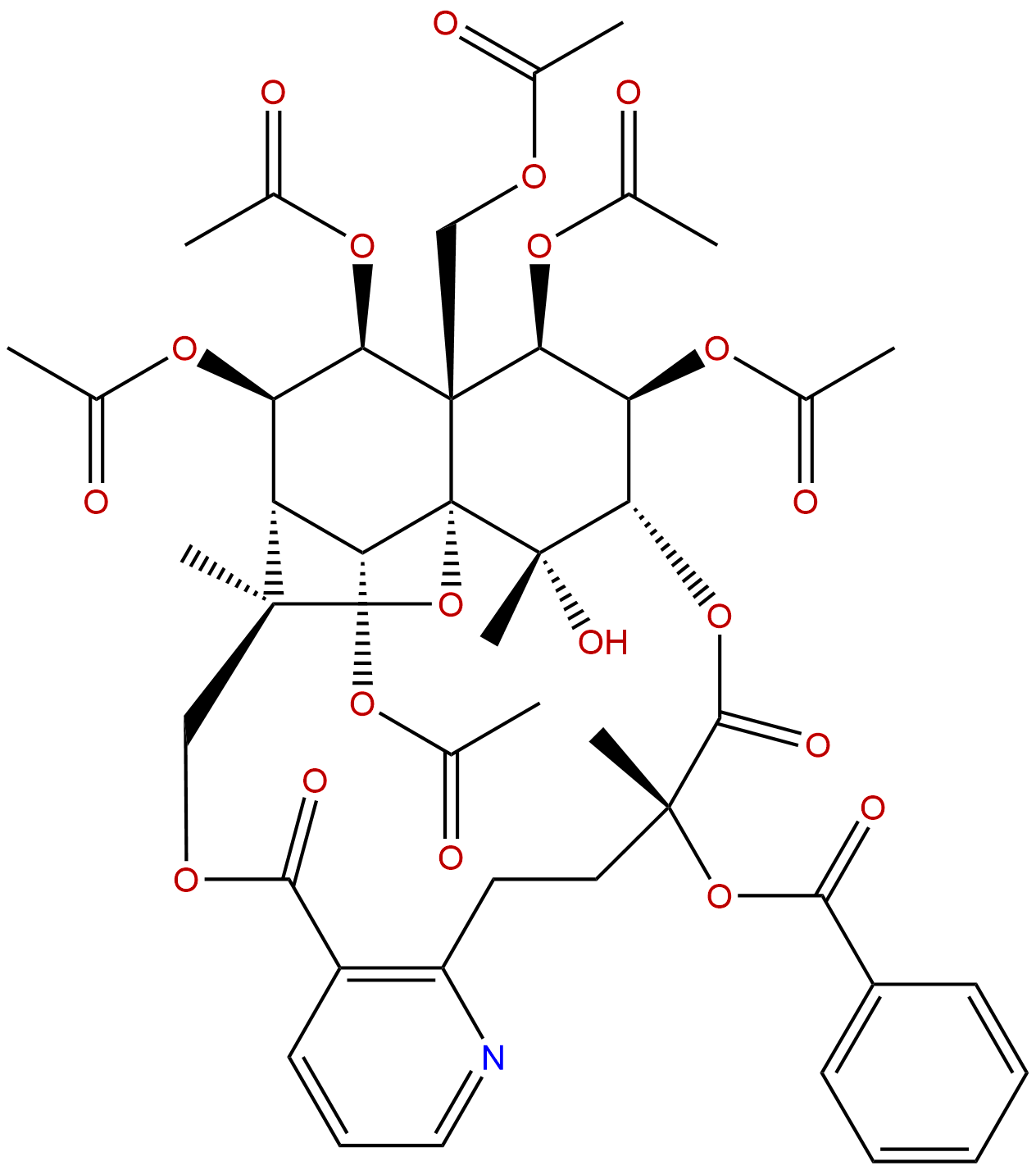
The CAS number of Tripterygium wilfordii alkaloids A is 345954-00-9, with a molecular formula of C ₄₈ H ₅₆ N ₂ O ₁₆ and a molecular weight of 925.8900 Da. This compound belongs to a complex sesquiterpene alkaloid, with a core skeleton composed of multiple fused ring systems and connected by multiple oxygen-containing functional groups (such as hydroxyl and methoxy) and glycosidic bonds, which determines its unique spatial conformation and biological activity.
From the analysis of physical and chemical properties, the lipid water partition coefficient (LogP) of Tripterygium wilfordii alkaloids A is 2.2610, indicating that it has a certain lipophilicity, but not highly hydrophobic. Its topological polar surface area (TPSA) is as high as 279.0500 Å ², which is mainly attributed to the presence of a large number of hydrogen bond acceptors and donors (such as O and N atoms) in the molecule, indicating strong molecular polarity and potential challenges for transmembrane permeation. This prediction is consistent with the water solubility data: its water solubility is only 0.0091 mg/mL, which is a poorly soluble compound. These properties pose major obstacles to its formulation development and in vivo absorption. In addition, preliminary pharmacological risk assessment showed that the compound had no significant inhibitory effect on hERG potassium channels (hERG inhibition: no), indicating a low potential risk of arrhythmia; The Ames test result was 0.0, indicating that it has no direct genetic toxicity, laying the foundation for further safety evaluation.
Plant sources and extraction methods
Tripterygium wilfordii Hook. f. is mainly derived from the root bark or whole plant of Tripterygium wilfordii Hook. f., a plant in the family Celastraceae. Tripterygium wilfordii is mainly distributed in the southern region of the Yangtze River Basin in China. Its medicinal parts contain various active ingredients, including alkaloids (such as Tripterygium wilfordii alkaloids A), diterpenes (such as Tripterygium wilfordii methyl), and triterpenes.
The extraction and separation of Tripterygium wilfordii alkaloids A from plant materials usually use multi-step chromatography technology. The classic extraction process begins with using polar solvents such as methanol or ethanol to extract or reflux dried Tripterygium wilfordii root bark, resulting in a total extract. Subsequently, the extract is subjected to systematic solvent extraction using solvents such as petroleum ether, ethyl acetate, and n-butanol. Tripterygium wilfordii alkaloids A are usually enriched in n-butanol or water-soluble fractions. Further purification depends on a variety of modern chromatographic technologies, such as silica gel column chromatography, reverse phase C18 column chromatography, Sephadex LH-20 column chromatography and high performance liquid chromatography (HPLC). Due to its large molecular weight and high polarity, reverse phase preparative HPLC has become a key step in obtaining high-purity Tripterygium wilfordii alkaloids A. The entire separation process requires real-time monitoring and identification using thin-layer chromatography (TLC) or liquid chromatography-mass spectrometry (LC-MS). Optimizing the extraction process and improving the yield and purity of the target compound are prerequisites for subsequent pharmacological research and development.
Pharmacological activity research
Numerous in vitro and in vivo pharmacological studies have shown that the core pharmacological activity of Tripterygium wilfordii alkaloids A is concentrated in the powerful anti-inflammatory effect In various acute and chronic inflammation models, this compound has shown significant therapeutic effects.
In vitro cell models, Tripterygium wilfordii alkaloids A can effectively inhibit macrophage activation induced by lipopolysaccharide (LPS) or other inflammatory stimuli (such as RAW264.7 cells), manifested by significantly reducing the production of nitric oxide (NO), prostaglandin E2 (PGE2), and key pro-inflammatory cytokines (such as TNF - α, IL-6). In acute inflammation models such as carrageenan induced paw swelling in rats and acetic acid-induced increased intra-abdominal capillary permeability in mice, pretreatment with Tripterygium wilfordii alkaloids A can dose dependently reduce tissue swelling and exudation. More importantly, in autoimmune inflammatory disease models such as collagen induced arthritis (CIA) mouse models, administration of Tripterygium wilfordii alkaloids A not only improves clinical symptoms such as redness, swelling, and deformity of joints, but also reduces synovial tissue proliferation, inflammatory cell infiltration, and soft bone and bone destruction. Its effect is comparable to some commonly used anti-inflammatory drugs in clinical practice.
In addition to its core anti-inflammatory activity, some studies also suggest that Tripterygium wilfordii alkaloids A may have auxiliary pharmacological effects such as immune regulation and analgesia, which are often intertwined with its anti-inflammatory mechanism and contribute to its overall therapeutic effect on inflammatory diseases.
Mechanism of action and molecular targets
The anti-inflammatory effect of Tripterygium wilfordii alkaloids A is not achieved through a single pathway, but acts on a complex inflammatory signaling network involving multiple key targets and pathways. According to existing research, its mechanism of action mainly includes the following aspects:
-
Inhibition of NF - κ B signaling pathway NF - κ B is the core transcription factor of inflammatory response. Tripterygium wilfordii alkaloids A can inhibit the activation of IKBKB (I κ B kinase β), prevent the phosphorylation and degradation of I κ B α, and thus inhibit the translocation of NF - κ B complexes (such as RELA/p65 subunits) to the nucleus. This directly leads to the inhibition of transcription of numerous pro-inflammatory genes downstream, such as TNF - α, IL-6, NOS2.
-
Regulating the JAK/STAT signaling pathway This pathway, especially the sustained activation of STAT3, is closely related to chronic inflammation and autoimmune diseases. Tripterygium wilfordii alkaloids A can inhibit the phosphorylation and activation of STAT3 induced by cytokines such as IL-6, and block the downstream transmission of pro-inflammatory and pro proliferative signals.
-
Intervention in inflammasome activation The assembly and activation of inflammasomes (such as NLRP3) are key steps leading to the mature release of potent inflammatory factors such as IL-1 β. Research has shown that Tripterygium wilfordii alkaloids A can inhibit the activation of CASP1 (cysteine protease-1), thereby reducing the cleavage and maturation of pro-IL-1 β and pro-IL-18, and alleviating inflammasome mediated inflammatory responses.
-
Affects the synthesis of inflammatory mediators synthase Tripterygium wilfordii alkaloids A can downregulate the expression of inducible nitric oxide synthase (NOS2) and reduce excessive NO production; Meanwhile, it may also regulate the synthesis of prostaglandin mediators by affecting the activity of cyclooxygenase-1 (PTGS1/COX-1).
-
Acting on ion channels related to pain perception Inflammation often accompanies pain. Research suggests that Tripterygium wilfordii alkaloids A may have a regulatory effect on transient receptor potential vanillic acid subtype 1 (TRPV1) and transient receptor potential anchor protein subtype 1 (TRPA1) channels, which are important sensors mediating inflammatory pain. This may be one of the mechanisms by which they exert analgesic effects.
In summary, Tripterygium wilfordii alkaloids A inhibit excessive inflammatory responses at multiple levels, including transcription, post-translational modification, and mediator release, through the synergistic action of multiple targets and pathways, reflecting the characteristic of multi-target action of natural products.
Evaluation of drug properties and pharmacokinetics
Despite the significant pharmacological activity of Tripterygium wilfordii alkaloids A, their drug like properties face challenges mainly due to their unfavorable physicochemical properties.
As mentioned earlier, its high TPSA and low water solubility suggest that oral bioavailability may be lower. Preliminary pharmacokinetic studies (mostly conducted in mice or rats) have confirmed that after oral administration, the exposure of Tripterygium wilfordii alkaloids A in plasma (AUC) is usually low, the peak time (Tmax) is late, and the absolute bioavailability is not ideal. Its high molecular weight and strong polarity also limit its ability to cross biological membranes, predicting its permeability to the blood-brain barrier (BBB)low This limits its direct application in central nervous system inflammatory diseases, but may also reduce the risk of central nervous system side effects.
In the body, Tripterygium wilfordii alkaloids A may undergo extensive metabolism, including oxidation, reduction, and II binding reactions (such as glucuronidation and sulfation) of the liver cytochrome P450 enzyme system. The excretion pathways of its prototype drug and metabolites may mainly be through bile and feces. At present, there is insufficient research on its detailed metabolite profile, major metabolic enzymes, and excretion kinetics.
Therefore, in order to improve its pharmacological properties, future research needs to focus on: 1)Formulation strategy Develop novel delivery systems such as nanocrystals, liposomes, solid dispersions, or prodrugs to enhance their solubility and oral absorption; 2)Structural modification On the premise of retaining its core pharmacophore, carry out reasonable chemical modifications, optimize its LogP, TPSA and other parameters, and improve its pharmacokinetic properties; 3)In depth ADME research The system elucidates the entire process of absorption, distribution, metabolism, and excretion in the body, providing a basis for preclinical and clinical research.
Clinical application prospects and prospects
The clinical application prospects of Tripterygium wilfordii alkaloids A mainly focus on Inflammation mediated related diseases Especially for chronic diseases that have poor response to existing therapies or severe side effects.
-
Rheumatoid arthritis (RA) and ankylosing spondylitis (AS)As one of the main active ingredients of Tripterygium wilfordii, the success of Tripterygium wilfordii alkaloids A in the CIA model provides direct evidence for its treatment of RA and AS. Its multi-target anti-inflammatory mechanism may have a broader regulatory effect than single target biologics, or it can serve as a supplement or alternative to traditional disease modifying antirheumatic drugs (DMARDs).
-
Inflammatory bowel disease (IBD)Crohn's disease and ulcerative colitis are closely related to abnormal activation of pathways such as NF - κ B and STAT3. The inhibitory effect of Tripterygium wilfordii alkaloids A on these pathways makes it potentially valuable in the treatment of IBD.
-
Neuroinflammatory related diseases Although its BBB penetration is poor, it may have indirect or direct therapeutic effects on peripheral inflammation associated with diseases such as Alzheimer's and Parkinson's, or by developing delivery systems that enhance BBB penetration.
-
pain management By acting on pain sensing channels such as TRPV1/TRPA1 and combining their anti-inflammatory effects, Tripterygium wilfordii alkaloids A may be developed for the treatment of inflammatory pain and neuropathic pain.
However, the path towards clinical application is still full of challenges: firstly, a systematic preclinical safety evaluation (including long-term toxicity, reproductive toxicity, etc.) must be completed to clarify its treatment window. Secondly, the bottleneck problem of low bioavailability must be addressed through pharmaceutical or chemical methods. Finally, rigorous clinical trials are needed to verify its effectiveness, safety, and optimal medication regimen in humans.
Future research prospects include: utilizing Chemical Biology Methods such as chemical proteomics can more comprehensively reveal its direct target network; Explore its relationship with other anti-inflammatory drugs combination therapy Strategy to increase efficiency and reduce toxicity; And pay attention to its potential applications in broader disease fields such as tumor microenvironment regulation and fibrotic diseases.
Conclusion
As an active natural product discovered from the traditional Chinese medicine Tripterygium wilfordii, Tripterygium wilfordii alkaloids A has become an important object in natural product pharmacology research due to its novel chemical structure and clear anti-inflammatory pharmacological activity. It exerts multi-target anti-inflammatory effects by intervening in multiple key signaling pathways such as NF - κ B, JAK/STAT, and inflammasomes, demonstrating great potential for the treatment of chronic inflammatory diseases. Although there are significant challenges in drug formulation, particularly in terms of solubility and oral bioavailability, this is precisely the direction that modern pharmacy and medicinal chemistry can focus on breaking through. With a deeper understanding of its mechanism of action, gradual breakthroughs in drug formulation, and the advancement of subsequent clinical research, Tripterygium wilfordii alkaloids A is expected to develop from a promising lead compound into a new type of drug for treating autoimmune and inflammatory diseases. It can not only provide patients with new treatment options, but also provide successful examples for innovative drug development based on traditional Chinese medicine.