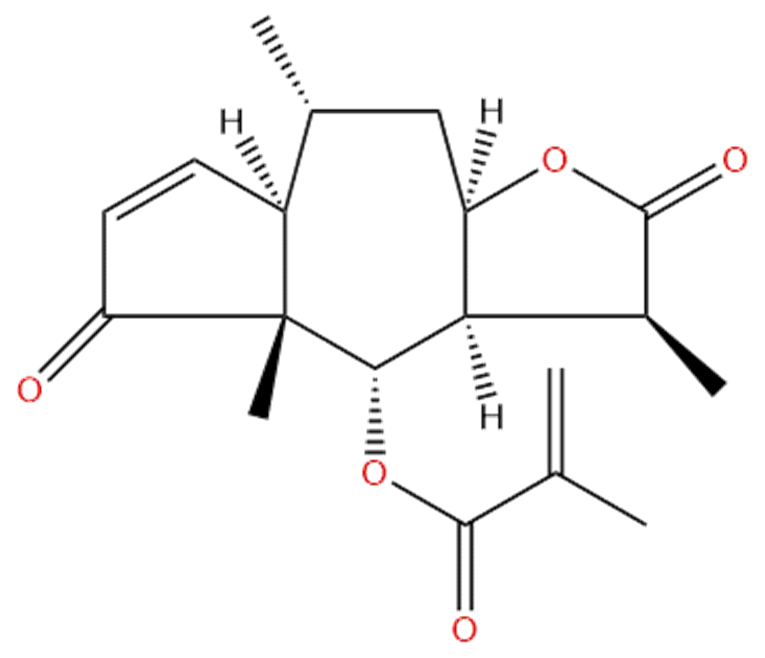


Product name: Arnicolide D
Synonym name: Plenolin methacrylate
Catalogue No.: BP4032
Cas No.: 34532-68-8
Formula: C19H24O5
Mol Weight: 332.396
Botanical Source: Centipeda minima(L.)A.Br.et Aschers.
Physical Description:
Type of Compound: Terpenoids
Purity: 95%~99%
Analysis Method: HPLC-DAD or/and HPLC-ELSD
Identification Method: Mass, NMR
Packing: Brown vial or HDPE plastic bottle
Storage: Store in a well closed container, protected from air and light. Put into refrigerate or freeze for long term storage.
Whenever possible, you should prepare and use solutions on the same day. However, if you need to make up stock solutions in advance, we recommend that you store the solution as aliquots in tightly sealed vials at -20℃. Generally, these will be useable for up to two weeks.
The product could be supplied from milligrams to grams
Inquire for bulk scale.
For Reference Standard and R&D, Not for Human Use Directly.
Storage conditions:Short-term storage at 2~8℃, long-term storage at -20 ~ -80℃
Arniclide D is a compound derived from the Asteraceae plant, Asteraceae(Centipeda minima)Natural products of sesquiterpene lactones. As a sesquiterpene lactone compound, Shan Jin Che lactone D has attracted widespread attention in the fields of natural medicinal chemistry and pharmacology due to its significant anti-tumor and anti-inflammatory activities. In recent years, with the deepening exploration of the potential of natural products in disease treatment, Shan Jin Che lactone D has become an important candidate molecule for the research and development of new anti-tumor and anti-inflammatory drugs due to its multi-target regulatory ability and good pharmacological parameters.
This review aims to systematically summarize the chemical structure and physicochemical properties, plant sources and extraction methods, pharmacological activity and mechanism of action, molecular targets, pharmacological evaluation, and pharmacokinetic characteristics of Shan Jin Che lactone D. Finally, it explores its clinical application prospects and future research directions, providing theoretical basis and reference for subsequent basic research and drug development.
The chemical name of Shan Jin Che lactone D is sesquiterpene lactone, with a molecular formula of C20H28O4 and a molecular weight of 332.3960. Its structural core is a sesquiterpene skeleton, containing a typical lactone ring structure that endows it with unique biological activity. According to molecular structure analysis, Shan Jin Che lactone D has moderate hydrophobicity with a LogP value of 2.2682, indicating its good lipid solubility, which is beneficial for cell membrane penetration and in vivo distribution.
Its topological polar surface area (TPSA) is 69.67 Å ², indicating that the molecule has moderate polarity, which is conducive to binding with biomolecules such as protein receptors. Low water solubility (0.0909 mg/mL) suggests limited solubility in aqueous phase, which may affect its bioavailability. It is worth noting that Shan Jin Che lactone D has a high blood-brain barrier penetration ability, which provides the possibility for its potential application in neurological diseases.
In terms of safety, the hERG channel inhibition experiment showed a negative result, indicating a low risk of cardiac toxicity; The Ames mutagenicity test result is 0.0, indicating that it has no significant mutagenicity and has a good safety basis.
Shan Jin Che lactone D is mainly derived from the small leaves of the Asteraceae plant, Qianli Guang(Centipeda minima)Obtained through separation.C. minima Widely distributed in some parts of Asia, traditional Chinese medicine is commonly used to treat diseases such as colds, inflammation, and tumors. This plant contains abundant sesquiterpenes, among which coumarin D is one of the important bioactive components.
During the extraction process, dried plant whole grass or aboveground parts are usually used as raw materials. First, ethanol or methanol is used for crude extraction, followed by multi-step separation and purification techniques such as liquid-liquid distribution, column chromatography (such as silica gel column, reverse phase C18 column), and high performance liquid chromatography (HPLC) to obtain high-purity coumarin D. Modern extraction techniques such as ultrasound assisted extraction and microwave-assisted extraction have also been applied to improve extraction efficiency and purity.
The optimization of extraction process not only affects the yield, but also relates to the maintenance of compound activity and the feasibility of subsequent drug development. Current research focuses more on improving extraction purity, reducing process costs, and achieving large-scale production.
Shan Jin Che lactone D exhibits significant anti-tumor activity and can inhibit the proliferation of various tumor cell lines. In vitro cell experiments have shown that Shan Jin Che lactone D induces cell cycle arrest in tumor cells, blocks cell cycle progression, and inhibits cell division. Its ability to induce apoptosis and oncosis further promotes the death of tumor cells.
The specific mechanism includes activating endogenous apoptotic pathways, regulating Bcl-2 family protein expression, promoting mitochondrial membrane potential loss, releasing cytochrome c, activating caspases cascade reaction, ultimately leading to cell apoptosis. In addition, Shan Jin Che lactone D can also induce cell apoptosis, which is a cell death mode different from apoptosis, manifested as cell swelling and membrane rupture, possibly achieved by regulating intracellular ion channels and energy metabolism.
Shan Jin Che lactone D also exhibits good anti-inflammatory activity. It reduces inflammatory response by regulating multiple inflammation related targets, inhibiting the production and release of inflammatory factors. Research has shown that Shan Jin Che lactone D can inhibit the expression of pro-inflammatory cytokines such as IL-6 and TNF - α, suppress the activation of signal transduction and transcription activator 3 (STAT3) and nuclear factor kappa B (NF - κ B) signaling pathways.
In addition, Shan Jin Che lactone D also has inhibitory effects on inflammatory mediators such as cyclooxygenase-1 (PTGS1), cyclooxygenase-2 (PTGS2), and nitric oxide synthase 2 (NOS2), reducing the production of inflammatory mediators such as prostaglandins and nitric oxide. Its regulation of inflammation related ion channels TRPV1 and TRPA1 further regulates inflammation and pain response.
In summary, Shan Jin Che lactone D exerts dual pharmacological effects of anti-inflammatory and anti-tumor through multi-target and multi pathway synergistic effects.
The pharmacological mechanism of Shan Jin Che lactone D involves multiple cellular signaling pathways and key molecular targets, reflecting its multi-target pharmacological characteristics.
Shanjin Chelide D can interfere with the expression of cell cycle regulatory proteins, block the progression of tumor cells in G0/G1 or G2/M phases, and inhibit cell proliferation. The specific mechanism may involve regulating the expression levels of cyclin dependent kinases (CDKs) and their inhibitors (such as p21, p27).
By activating caspase family proteins, Shan Jin Che lactone D induces the classical mitochondrial dependent apoptosis pathway. It promotes the release of cytochrome c, activates caspase-9 and caspase-3, leading to nuclear DNA fragmentation and the formation of apoptotic bodies.
In terms of cell swelling and apoptosis, Shan Jin Che lactone D may promote cell death by regulating cell membrane ion channels (such as TRPV1, TRPA1) and energy metabolism disorders, leading to cell swelling and membrane integrity damage.
Shanjin Chelide D significantly inhibits the activation of STAT3 and NF - κ B signaling pathways, reduces the expression of pro-inflammatory factors IL-6 and TNF - α, and alleviates inflammatory responses. Its regulation of CASP1 helps to inhibit inflammasome activation and reduce the release of inflammatory mediator IL-1 β.
In addition, Shan Jin Che lactone D alleviates inflammatory symptoms by inhibiting PTGS1, PTGS2, and NOS2, reducing the synthesis of prostaglandins and nitric oxide. Regulating TRPV1 and TRPA1 can help alleviate inflammation related pain.
From the perspective of drug properties, Shan Jin Che lactone D has superior medicinal properties. Its molecular weight of 332.4 conforms to Lipinski's rule, and LogP 2.27 shows moderate lipid solubility, which is beneficial for oral absorption and cell membrane penetration. TPSA 69.67 Å ² indicates moderate polarity, which facilitates binding to target proteins.
The low water solubility (0.0909 mg/mL) may limit its oral bioavailability, and pharmacological methods such as nanocarriers and solid dispersions are needed to improve solubility. Its high blood-brain barrier permeability provides the possibility for the treatment of central nervous system diseases.
In terms of safety, the hERG channel has no inhibitory effect and reduces the risk of cardiac toxicity; The Ames test is negative, indicating no significant mutagenicity and good safety.
Although the pharmacokinetic data is relatively limited, preliminary in vivo experiments have shown that coumarin D has good stability and metabolic characteristics, mainly excreted through liver metabolism, with a moderate half-life. Further systematic pharmacokinetic studies are needed in the future, including absorption, distribution, metabolism, excretion (ADME), and toxicological evaluation.
Shan Jin Che lactone D, with its unique sesquiterpene lactone structure and multi-target pharmacological activity, has shown broad application prospects in the fields of anti-tumor and anti-inflammatory. Its inhibitory effect on various tumor cells and ability to induce cell death provide important candidate molecules for the development of new anti-tumor drugs. Especially in the treatment of drug-resistant tumors and tumors related to the complex inflammatory microenvironment, Shan Jin Che lactone D may exert a synergistic effect.
The anti-inflammatory activity makes it potentially applicable in inflammatory diseases such as rheumatoid arthritis, inflammatory bowel disease, and neuroinflammation. Its high blood-brain barrier penetration provides new possibilities for the treatment of neurological diseases.
However, the clinical translation of Shan Jin Che lactone D still faces many challenges, including poor water solubility, limited bioavailability, insufficient in vivo metabolic stability and safety verification. Future research should focus on:
Through interdisciplinary collaboration, promote the clinical application of Shanjin Chelide D from the laboratory to benefit patients.
Shan Jin Che lactone D, as a source from Centipeda minima The natural products of sesquiterpene lactones have become a hot topic in the field of natural medicine research due to their significant anti-tumor and anti-inflammatory activities. Its unique chemical structure, multi-target mechanism of action, and good safety foundation endow it with the potential to become a new type of anti-tumor and anti-inflammatory drug.
Although there is a preliminary understanding of its pharmacological effects and drug properties, further in-depth research is still needed on its molecular mechanisms, pharmacokinetic characteristics, and clinical application potential. In the future, combining modern medicinal chemistry, molecular biology, and pharmaceutical technology, Shan Jin Che lactone D is expected to become an important breakthrough in the development of natural product drugs, providing new strategies and choices for the treatment of cancer and inflammatory diseases.
In summary, Shan Jin Che lactone D is a natural product with great research value and development potential, and it is expected to play a greater role in future drug development.
