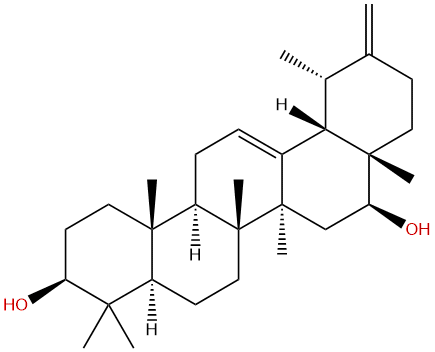
Product name: Arnidiol
Synonym name: Arnidenediol
Catalogue No.: BPF3111
Cas No.: 6750-30-7
Formula: C30H48O2
Mol Weight: 440.712
Botanical Source:
Physical Description:
Type of Compound: Triterpenoids
Purity: 95%~99%
Analysis Method: HPLC-DAD or/and HPLC-ELSD
Identification Method: Mass, NMR
Packing: Brown vial or HDPE plastic bottle
Storage: Store in a well closed container, protected from air and light. Put into refrigerate or freeze for long term storage.
Whenever possible, you should prepare and use solutions on the same day. However, if you need to make up stock solutions in advance, we recommend that you store the solution as aliquots in tightly sealed vials at -20℃. Generally, these will be useable for up to two weeks.
The product could be supplied from milligrams to grams
Inquire for bulk scale.
For Reference Standard and R&D, Not for Human Use Directly.
Storage conditions:Short-term storage at 2~8℃, long-term storage at -20 ~ -80℃
40.4600
6.7809
6.7809
.0002
7.5892
8.4089
High
91.1578
5.0047
No
No
No
No
No
No
0.0
No
No
Yes
No
Natural products, as an important source of drug discovery, play an indispensable role in the long history of human struggle against diseases. From the classic analgesic morphine to the antimalarial drug artemisinin, the rich chemical structures found in nature provide endless inspiration for modern pharmacology. Among numerous natural products, triterpenoids have attracted much attention due to their structural diversity and wide range of biological activities. Ainidiol, as a triterpenoid compound with a unique skeleton, has gradually entered the field of researchers in recent years, and its potential in the anti-inflammatory field is particularly prominent.
The systematic study of Shanjinche diol began with chemical exploration of Asteraceae plants. This compound originally originated from the genus Shanjinche(Arnica)Separated and identified from plants, hence named. Plants of the genus Shanjinche have a long history of application in traditional medicine, often used to treat injuries, inflammation, and pain caused by falls. However, the elucidation of its active ingredients has always been an important topic in modern natural product chemistry. The discovery of Shanjinche diol provides a new molecular basis for understanding the traditional functions of these plants. With the deepening of research, it has been found that kaempferol not only exists in plants of the kaempferol genus, but also in the Eupatorium genus(Inula)It is also distributed in other Asteraceae plants, indicating that it may have broader ecological and biological significance.
From a chemical structure perspective, Shanjinche diol belongs to the Lupane type triterpenoid, with its core skeleton consisting of five hexagonal rings and one pentagonal ring fused together, and having one hydroxyl group at the C-3 and C-28 positions, respectively. This unique structure endows it with specific physicochemical properties and biological activity. Early research mainly focused on its cytotoxicity and anti-tumor activity, but in recent years, its anti-inflammatory mechanism has gradually become a research hotspot. Research has shown that Shanjinche diol can inhibit the production of key inflammatory factors (such as TNF - α, IL-6) and inflammatory mediators (such as NO) by regulating multiple inflammatory signaling pathways, such as NF - κ B and STAT3 pathways, exhibiting multi-target and multi pathway anti-inflammatory properties.
However, despite the significant pharmacological activity of Shanjinche diol, its pharmacological development faces enormous challenges. Its extremely high lipid solubility (LogP>6) and extremely low water solubility (0.0002 mg/mL) severely limit its bioavailability and in vivo efficacy. In addition, its high blood-brain barrier permeability also suggests potential risks of central nervous system side effects. Therefore, how to overcome these deficiencies through structural modification or novel drug delivery systems is the key to promoting the clinical application of Shanjinche diol.
This article aims to provide a systematic review of the research progress on the chemical structure, plant sources, pharmacological activity, mechanism of action, and pharmacological evaluation of Shanjinche diol, and to look forward to its future clinical application prospects, in order to provide reference for the in-depth research and development of this natural product.
The chemical name of Shanjinche diol is (3 β, 28) - lup-20 (29) - ene-3,28-diol, and its chemical structure belongs to the lupine type pentacyclic triterpenoid. The skeleton is composed of five rings: A, B, C, D, and E. Among them, rings A, B, C, and D are six membered rings, and ring E is a five membered ring. There is a hydroxyl group (- OH) attached to each of the C-3 position (A ring) and C-28 position (E ring), which are two key functional groups in its structure. In addition, there is a terminal double bond (C=C) between C-20 and C-29, which is also one of the characteristic structures of lupine triterpenoids. Its molecular formula is C ∝₀ H ₄₈ O ₂, and its molecular weight is 440.7120 g/mol.
From the perspective of physical and chemical properties, Shanjinche diol exhibits typical lipid soluble molecular characteristics. Its oil-water partition coefficient (LogP) is as high as 6.7809, indicating that it strongly tends to be distributed in the oil phase (such as biofilm, organic solvents) in both water and oil phases. This characteristic is directly related to its large hydrophobic triterpenoid skeleton. The extremely high LogP value also directly leads to its extremely low water solubility, with a calculated water solubility of only 0.0002 mg/mL. This extremely poor water solubility is a common challenge in the study of natural products, which means that the solubility and transport capacity of Shanjinche diol in aqueous environments such as blood and cytoplasm are extremely poor, severely limiting its oral absorption and in vivo distribution.
Topological Polarity Surface Area (TPSA) is an important parameter for measuring the ability of molecules to penetrate cell membranes, typically associated with oral absorption and blood-brain barrier permeability. The TPSA of Shanjinche diol is 40.46 Å ², mainly derived from two hydroxyl groups. This value is relatively low, and it is generally believed that molecules with TPSA less than 60-70 Å ² have good cell membrane permeability. Based on its high LogP value, it can be inferred that Shanjinche diol is highly permeable to biological membranes, including the blood-brain barrier. In fact, its blood-brain barrier permeability is predicted to be "high", which is both an advantage (possibly for central nervous system diseases) and a potential risk (possibly causing central neurotoxicity).
In terms of chemical stability, Shanjinche diol, as a triterpenoid compound, usually has certain stability to light, heat, and air. But the two hydroxyl groups and the terminal double bond in its structure are potential chemical reaction sites. Hydroxyl groups can be esterified, etherified, or oxidized, while double bonds can undergo epoxidation, hydrogenation, or addition with electrophilic reagents. These chemical reactions provide the possibility of improving its pharmacokinetic properties through structural modifications. For example, esterification or phosphorylation of hydroxyl groups can introduce water-soluble functional groups to enhance their water solubility; Alternatively, epoxidation of the double bond may alter its interaction mode with the target.
Shanjinche diol mainly comes from Asteraceae plants, among which Shanjinche genus(Arnica)The genus Helix(Inula)Plants are the most common.
Shanjinche genus plants This genus of plants is a classic source of kaempferol. For example, the European Mountain Gold Car(Arnica montana L. ) is a famous plant used in traditional herbal medicine to treat inflammation and damage. Both its flowers and roots contain kaempferol, but the content is usually higher in the flowers. In addition, other species of the Shanjinche genus, such as Arnica chamissonis Less. and Arnica cordifolia Hook. has also been reported to contain this compound. Shanjinche diol usually coexists with other triterpenoids (such as Shanjinche lactone, lupinol, etc.) in plants of the Shanjinche genus.
Plants of the Convolvulus genus Plants of the genus Convolvulus are another important source of kaempferol. For example, wood fragrance(Inula helenium L. The rhizomes of the plant are rich in various triterpenoid compounds, among which kaempferol is one of them. In addition, the spiral flower(Inula japonica Thunb. and sheep ear chrysanthemum(Inula cappa Species such as Buch. - Ham. ex D. Don DC. have also been reported to contain this ingredient. The genus Convolvulus is also widely used in traditional Asian medicine to treat inflammation, cough, and digestive system diseases.
Other plants In addition to the two main genera mentioned above, Shanjinche diol is also occasionally found in other Asteraceae plants, such as certain species of the genus Seneca(Senecio)The genus of Ligustrum(Ligularia)In plants, but the content is usually low.
extraction method The extraction of Shanjinche diol usually follows the classic process of natural product chemistry, which mainly includes the following steps:
Raw material pretreatment Crush dry plant materials (usually flowers, rhizomes, or whole plants) to increase surface area and improve extraction efficiency.
Solvent extraction Due to the high lipid solubility of Shanjinche diol, non-polar or moderately polar organic solvents are usually used for extraction. The most commonly used solvents include:
Separation and purification After obtaining the crude extract, various chromatographic techniques are required for separation and purification.
Structural Identification The purified compound was structurally confirmed by techniques such as nuclear magnetic resonance spectroscopy (NMR, including ¹ H-NMR, ¹ ³ C-NMR, DEPT, COSY, HSQC, HMBC, etc.), high-resolution mass spectrometry (HR-MS), and infrared spectroscopy (IR).
The pharmacological activity research of Shanjinche diol mainly focuses on anti-inflammatory, anti-tumor, and neuroprotective aspects, among which anti-inflammatory activity is currently a hot research topic.
anti-inflammatory activity This is the pharmacological activity of Shanjinche diol that has received the most attention. Numerous in vitro and in vivo experiments have confirmed its significant anti-inflammatory effect.
Antitumor activity Early studies reported the cytotoxic effects of Shanjinche diol on various tumor cell lines.
Neuroprotective activity Due to its high blood-brain barrier permeability, the neuroprotective effect of Shanjinche diol has also attracted attention.
Other activities A few studies have also reported the antibacterial (such as against Staphylococcus aureus and Escherichia coli), antiviral (such as against influenza virus), and anti ulcer activities of Shanjinche diol, but these studies are not yet systematic and need further verification.
The pharmacological activity of Shanjinche diol, especially its anti-inflammatory effect, is achieved through the synergistic regulation of multiple targets and signaling pathways. Based on existing research, its core mechanism of action can be summarized as follows:
Inhibition of NF - κ B signaling pathway NF - κ B is the core transcription factor of inflammatory response. In the resting state, NF - κ B (usually a p50/p65/RELA heterodimer) binds to the inhibitory protein I κ B and exists in an inactive form in the cytoplasm. When cells are stimulated by LPS, TNF - α, etc., I κ B kinase (IKK, composed of subunits such as IKBKB) is activated, phosphorylating I κ B, leading to its ubiquitination degradation. The released NF - κ B immediately enters the nucleus, initiating the transcription of downstream inflammatory genes such as TNF - α, IL-6, iNOS, COX-2.
Regulating the STAT3 signaling pathway STAT3 (Signal Transduction and Transcription Activation Factor 3) is another transcription factor closely related to inflammation and tumors. When cytokines such as IL-6 bind to their receptors, they activate JAK kinase, which in turn phosphorylates STAT3. Phosphorylated STAT3 forms dimers and enters the nucleus, regulating downstream gene expression.
Adjust TRP channel Transient receptor potential (TRP) channels, especially TRPV1 and TRPA1, are important nociceptors and inflammatory mediator sensors. They play a crucial role in inflammatory pain and neurogenic inflammation. Many natural products exert analgesic and anti-inflammatory effects by regulating these channels.
Inhibition of Caspase-1 and NLRP3 inflammasomes Caspase-1 (CASP1) is a key effector protein of inflammasomes, such as NLRP3 inflammasome. After activation, inflammasomes will cleave pro-IL-1 β and pro-IL-18, causing them to mature and release, triggering a strong inflammatory response.
Inhibition of arachidonic acid metabolism Cyclooxygenase (COX, including COX-1/PTGS1 and COX-2/PTGS2) is a key enzyme involved in the metabolism of arachidonic acid to produce prostaglandins (such as PGE2). Prostaglandins are important inflammatory and painful substances.
Summary of Molecular Targets In summary, the anti-inflammatory effect of Shanjinche diol involves multiple key targets, including IKBKB(Inhibiting IKK activity)RELA(Inhibiting NF - κ B activation)STAT3(Inhibiting phosphorylation)TRPV1/TRPA1(Regulating channel activity)CASP1(Inhibiting inflammasomes) and NOS2/PTGS1(Downregulate expression). This multi-target synergistic mode enables it to block the inflammatory cascade reaction from multiple links, demonstrating unique therapeutic advantages.
Although Shanjinche diol exhibits encouraging pharmacological activity in vitro and in vivo, its pharmacological properties face severe challenges, mainly due to its extremely poor physicochemical properties and potential pharmacokinetic defects.
Drugability assessment:
pharmacokinetics At present, there is very limited systematic research on the pharmacokinetics of Shanjinche diol in vivo, such as the absorption, distribution, metabolism, and excretion (ADME) processes in rats or mice. Based on its physicochemical properties, it can be inferred that its pharmacokinetic characteristics are as follows:
Improvement strategy Given the above-mentioned drug defects, future research must focus on improving the pharmacokinetic properties of Shanjinche diol. Possible strategies include:
- Structural modification This is the most fundamental solution. For example, introducing water-soluble groups (such as phosphate groups, amino acids, sugar groups, polyethylene glycol chains) on the C-3 or C-28 hydroxyl groups to make prodrugs. The prodrug releases the original drug after enzymatic hydrolysis or hydrolysis in the body, which can significantly improve water solubility and oral bioavailability.
- New drug delivery system Using nanotechnology, such as liposomes, nanoemulsions, solid lipid nanoparticles, polymer micelles, etc., to encapsulate Shanjinche diol. These drug delivery systems can increase their apparent solubility, protect drugs from metabolism, and achieve targeted delivery.
- structural optimization By synthesizing a series of analogues and studying structure-activity relationships (SAR), we aim to identify derivatives with stronger activity and better water solubility. For example, while maintaining the mother core structure, introducing polar groups or changing the position of double bonds.
Although the pharmacological properties of Shanjinche diol face challenges, its unique pharmacological activity and multi-target mechanism of action still provide broad prospects for its clinical application, especially in the following fields:
Inflammatory diseases This is the most direct potential application area for Shanjinche diol.
Neurodegenerative diseases Its high blood-brain barrier permeability and neuroprotective activity make it a potential candidate drug for treating neurodegenerative diseases such as Alzheimer's disease and Parkinson's disease. The pathogenesis of these diseases involves neuroinflammation, oxidative stress, and abnormal protein aggregation. The anti-inflammatory and antioxidant effects of Shanjinche diol may help delay disease progression. However, its long-term central neurotoxicity must be evaluated first.
pain management By regulating TRPV1 and TRPA1 channels, Shanjinche diol may have analgesic effects. It can be developed into a local analgesic agent for the treatment of neuropathic pain (such as post herpetic neuralgia, diabetes peripheral neuropathy) or inflammatory pain.
Cancer adjuvant therapy Although its direct anti-tumor activity may not be sufficient to become a first-line anti-cancer drug, its anti-inflammatory properties make it potential as a chemopreventive or adjuvant therapy for cancer. Chronic inflammation is an important cause of various cancers, such as liver cancer and colorectal cancer. By inhibiting the inflammatory microenvironment, Shanjinche diol may delay the occurrence and development of tumors, enhance the efficacy of chemotherapy drugs, and alleviate the inflammatory response caused by chemotherapy.
Future research directions:
Shanjinche diol, as a type of lupine triterpenoid derived from Asteraceae plants, occupies a place in the field of natural product pharmacology due to its unique chemical structure and significant anti-inflammatory activity. Its mechanism of synergistic regulation of inflammatory response through multiple targets and pathways (such as NF - κ B, STAT3, TRP channels, inflammasomes) demonstrates great potential as a novel anti-inflammatory lead compound. However, the low oral bioavailability caused by its extremely poor water solubility and high lipid solubility, as well as potential central nervous system risks, are the two gaps that must be overcome for its clinical application.
Future research should not be limited to a simple description of its pharmacological activity, but should focus on "highlighting strengths and avoiding weaknesses". On the one hand, through structural modification and advanced drug delivery technology, efforts are made to solve the problem of drug formation and turn waste into treasure. On the other hand, further exploration of its structure-activity relationship is needed to find derivatives with stronger activity, lower toxicity, and better pharmacokinetic properties. Meanwhile, a rigorous evaluation of its potential central nervous system toxicity is conducted to ensure medication safety.
In summary, Shanjinche diol is a natural product of great research value. It is not only a modern confirmation of traditional herbal wisdom, but also a cutting-edge topic in modern medicinal chemistry and pharmacology research. Despite the numerous challenges ahead, through interdisciplinary integration and unremitting efforts, Shanjinche diol or its optimized derivatives are expected to provide new options for the treatment of complex diseases such as inflammatory diseases and neurodegenerative diseases in the future, ultimately achieving a magnificent transformation from "natural products" to "clinical drugs".
Batch can search by a CAS number,one per line