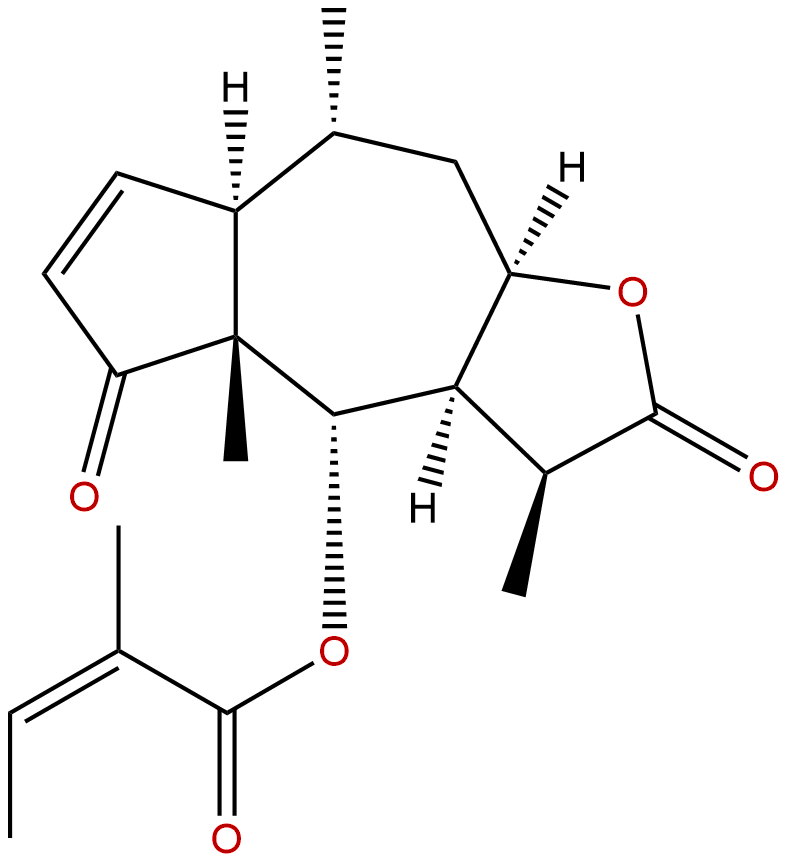


Product name: Brevilin A
Synonym name:
Catalogue No.: SBP00989
Cas No.: 16503-32-5
Formula: C20H26O5
Mol Weight: 346.423
Botanical Source:
Physical Description:
Type of Compound: Sesquiterpenoids
Purity: 95%~99%
Analysis Method: HPLC-DAD or/and HPLC-ELSD
Identification Method: Mass, NMR
Packing: Brown vial or HDPE plastic bottle
Storage: Store in a well closed container, protected from air and light. Put into refrigerate or freeze for long term storage.
The product could be supplied from milligrams to grams
Inquire for bulk scale.
For Reference Standard and R&D, Not for Human Use Directly.
Description:
Brevilin A is a strong impetus for the development of selective JAK-STAT inhibitors and therapeutic drugs in order to improve survival of patients with hyperactivated JAKs and STATs. Brevilin A shows antigiardial activity (IC50 = 16.1 μM) and is similarly active in vitro against Entamoeba histolytica (IC50 between 4.5 and 9 μM) and against Plasmodium falciparum (IC50 = 9.42 μM).
References:
Phytother. Res., 1994, 8(8):436-8.
Antiprotozoal activities of Centipeda minima.
METHODS AND RESULTS:
In vitro activity against Giardia intestinalis was used for bioassay-guided fractionation of crude extracts from C. minima. The sesquiterpene lactone, Brevilin A was isolated and found to have antigiardial activity (IC50 = 16.1 μM) and was similarly active in vitro against Entamoeba histolytica (IC50 between 4.5 and 9 μM) and against Plasmodium falciparum (IC50 = 9.42 μM).
CONCLUSIONS:
Three flavonoids, quercetin, quercetin 3-methyl ether and kaempferol 7-glucosylrhamnoside were also isolated.
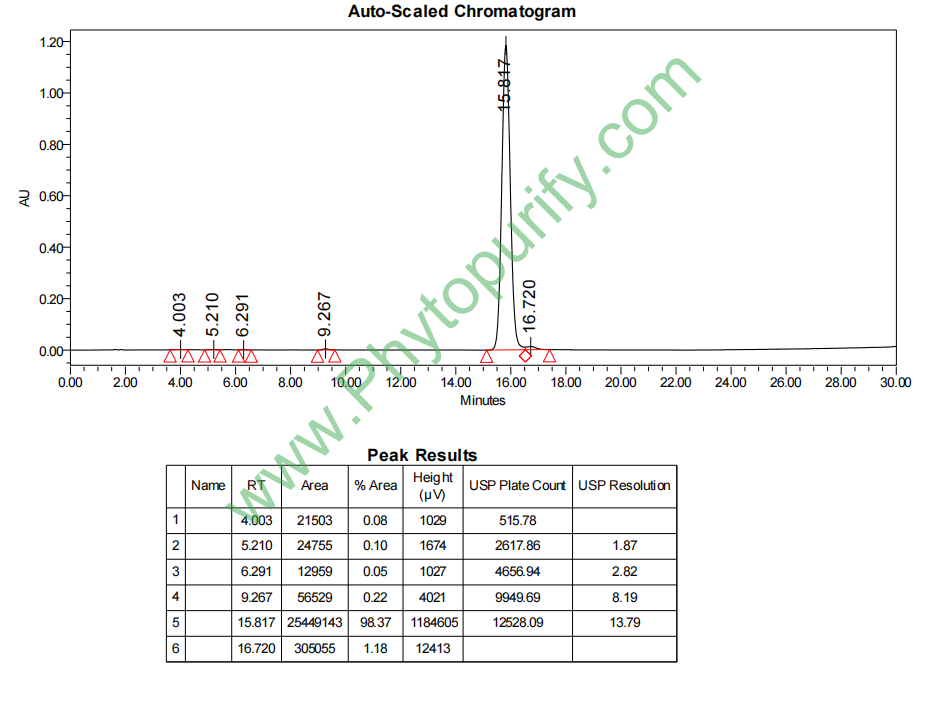
HPLC of Brevilin A
Storage conditions:Short-term storage at 2~8℃, long-term storage at -20 ~ -80℃
69.6700
2.7207
2.7208
.0701
4.3303
18.7791
High
63.6336
4.8709
No
Yes
No
No
Yes
No
0.0
No
Yes
Yes
Yes
Brevilin A (CAS number: 16503-32-5) is a plant derived from the Asteraceae family that does not feed on geese(Centipeda minima)The natural sesquiterpene lactones isolated from the medium have a molecular formula of C20H26O5 and a molecular weight of 346.4230 g/mol. In recent years, this compound has shown significant Oral activity and Multi target pharmacological effects And it has received widespread attention in the field of natural product pharmacy research. Research has shown that short leaved Gerakan A is an effective STAT3/JAK signaling pathway inhibitors The IC50 value for its inhibition of STAT3 is approximately 10.6 μ M. STAT3 (signal transduction and transcription activator 3) and JAK (Janus kinase) are important intracellular signaling proteins, and their abnormal activation is closely related to the occurrence, development, and drug resistance of various tumors. Therefore, targeting the STAT3/JAK pathway has become one of the important strategies for the development of anti-tumor drugs.
In addition to its anti-tumor activity, short leaved Gerakan A also exhibits broad-spectrum activity Antiparasitic activity In vitro experiments have confirmed its effect on Giardia lamblia(Giardia, IC50 = 16.1 μM)、 Entamoeba histolytica(Entamoeba histolytica, IC50 between 4.5-9 μ M) and Plasmodium falciparum(Plasmodium falciparum, IC50=9.42 μ M) all have inhibitory effects. In addition, the database target information suggests that the compound may act on GYRA、GYRB、FTSZ、DHFR、PBP2 Waiting for multiple bacterial targets to unleash their potential Antibacterial effect These diverse biological activities make it a highly valuable lead compound for research, providing new molecular frameworks and ideas for the development of novel anti-tumor, antiparasitic, and antibacterial drugs.
The chemical structure of shortleaf gibberellin A belongs to the guaiaceae type sesquiterpenoid lactone, and its SMILES string is: C/C=C (/C) C (=O) O [C @ H] 1 [C @ @ H] 2 C@HC(=O)O[C@@H]2CC@@H[C@@H]2C=CC(=O)[C@]21C。 This structure indicates that the molecule contains multiple chiral centers (indicated by the @ symbol) and has a complex stereochemical configuration, which is often closely related to its specific biological activity and precise recognition of the target. The α - methylene - γ - lactone ring in the molecule is a common feature of many sesquiterpene lactones with anti-inflammatory and anti-tumor activities, and may be a key pharmacophore for their pharmacological effects.
According to the analysis of drug parameters, its molecular weight (MW) is 346.42, which meets the requirement of less than 500 Da in Lipinski's "Five Rules" (Ro5). The calculated lipid water partition coefficient (LogP) is 2.72, indicating that the compound has moderate lipophilicity and is beneficial for penetrating cell membranes. The topological polar surface area (TPSA) is 69.67 Å ², far below the recommended upper limit of 140 Å ² in Ro5, indicating good membrane permeability. These parameters preliminarily indicate that it has good drug like properties. The water solubility parameter (0.0701) is relatively low, which is consistent with its LogP value, and may require consideration of solubilization strategies during formulation development. The permeability data of Caco-2 cells is 18.78, indicating that it has Good intestinal absorption potential This is consistent with its reported oral activity. Of particular note is that it The blood-brain barrier (BBB) penetration is predicted to be 'high'This suggests that Shortleaf Gerakan A may have the potential to treat central nervous system related diseases, such as certain brain tumors or infections. The plasma protein binding rate (PPB) is 63.63%, which is at a moderate level, indicating that a considerable portion exists in free form in the blood, which is beneficial for the efficacy of the drug.
Short leaved Gerakan A is mainly derived from plants of the Asteraceae family, the Goose Does Not Eat Grass genus Geese do not eat grass(Centipeda minima (L.) A. Braun & Asch.)This plant is widely distributed in East Asia, South Asia, Australia and other regions, and has a long history of medicinal use in Chinese folk culture. In traditional Chinese medicine theory, geese do not eat grass and have a pungent and warm nature. They return to the lung and liver meridians and have Dispelling wind and dispelling cold, dispelling dampness and relieving pain, unblocking the nasal cavity, relieving cough and phlegm The efficacy. Clinically, it is commonly used to treat conditions such as cold nasal congestion, allergic rhinitis, chronic bronchitis, rheumatism and rheumatism, traumatic injuries, and sores, abscesses, swelling, and toxins. In Guangdong, Guangxi and other places, pounding fresh grass and applying it externally is commonly used to treat malaria and snakebite.
Modern plant chemistry research has isolated and identified various active ingredients, including sesquiterpene lactones, flavonoids, volatile oils, and others, from goosegrass. These studies partially confirm the material basis of its traditional efficacy from a scientific perspective. For example, its anti-inflammatory and anti allergic effects may be related to inhibiting the release of inflammatory factors; The newly discovered antimalarial activity of short leaved Gerakan A echoes the interesting folk records of using it to treat malaria, reflecting the enormous value of discovering modern drugs from traditional knowledge.
The pharmacological activities of Shortleaf Gerakan A are diverse, and its mechanism of action involves multiple key cellular signaling pathways and targets.
4.1 Antitumor activity and STAT3/JAK inhibition mechanism
This is currently the most in-depth field of research on resveratrol A in short leaved geranium. The JAK-STAT signaling pathway is one of the most important intracellular signaling pathways mediated by cytokines, involved in regulating cell proliferation, differentiation, apoptosis, and immune response. In many cancers, this pathway is abnormally continuously activated, especially the sustained phosphorylation of STAT3, which can promote tumor cell survival, proliferation, angiogenesis, and inhibit anti-tumor immunity. Research has shown that short leaved Gerakan A can inhibit the activation of STAT3 with an IC50 of approximately 10.6 μ M. Its mechanism of action may include direct or indirect inhibition of JAK kinase activity, thereby blocking the tyrosine phosphorylation, dimerization, and nuclear translocation processes of STAT3, ultimately inhibiting the transcription of downstream target genes such as Bcl-2, Cyclin D1, VEGF, etc. Through this mechanism, shortleaf gibberellin A exhibits expression in various cancer cell lines Anti proliferation, induction of cell apoptosis, and autophagy The activity. Inducing autophagy is another important anti-tumor mechanism, which may be achieved by activating pathways such as AMPK/mTOR, synergistically inhibiting tumor growth with the apoptotic pathway.
4.2 Antiparasitic activity
Short leaved Gerakan A exhibits inhibitory activity against various protozoan parasites. Its anti malarial (IC50=9.42 μ M) and anti amoebic activities suggest that it may interfere with key metabolic processes of parasites. Although the specific target has not been fully elucidated, considering its structural characteristics, possible mechanisms of action include: interfering with the membrane structure of parasites, inhibiting the function of key enzymes (such as DHFR like enzymes), or inducing oxidative stress in parasites. These activities provide a basis for their use as lead compounds for novel antiparasitic drugs.
4.3 Potential antibacterial activity and target analysis
According to the provided target information, shortleaf gibberellin A may act on multiple key bacterial targets, which is why it Antibacterial The application of related diseases provides theoretical possibilities:
- GYRA and GYRB They are the A and B subunits of bacterial DNA gyrase. DNA gyrase is an essential topoisomerase II for bacterial replication and a classic target of quinolone antibiotics. Acting on this target can inhibit bacterial DNA replication.
- FTSZ: is a key protein for bacterial cell division, which assembles into a Z-ring at the division site and drives cytoplasmic division. Inhibiting FtsZ can prevent bacterial division and is a research hotspot for new antibiotics.
- DHFR Dihydrofolate reductase is a key enzyme in the folate synthesis pathway, and inhibiting this enzyme can block bacterial nucleic acid synthesis. Trimethoprim (TMP) is such an inhibitor.
- PBP2 Penicillin binding protein 2 is involved in the synthesis of bacterial cell wall peptidoglycans and is a target of β - lactam antibiotics.
The ability to interact with multiple conserved bacterial targets simultaneously suggests that shortleaf gibberellin A may have Multi targeted antibacterial The unique mechanism helps to delay the development of bacterial resistance. However, most of these target information are obtained through prediction or preliminary experiments, and their exact in vitro and in vivo antibacterial spectra, efficacy, and specific modes of action still need further experimental verification.
Based on the provided detailed pharmacological parameters, we can conduct a systematic evaluation of the development potential of Gerakan A in short leaved plants:
Preliminary assessment of Class 5.1 drug properties (based on Lipinski's Five Rules)
1. Molecular weight (MW): 346.42<500, Comply with。
2. Lipid water partition coefficient (LogP): 2.72<5, Comply with。
3. Hydrogen bond donor (HBD): Based on the structural formula, it may be 0 (without OH, NH, etc.),<5, Comply with。
4. Hydrogen bond acceptor (HBA): The molecule contains multiple carbonyl and ether oxygen groups, approximately 5,<10, Comply with。
5. Topological Polarity Surface Area (TPSA): 69.67<140 Å ², Comply with。
Short leaved Gerakan A fully complies with Lipinski's five rules, indicating its potential for oral absorption and bioavailability.
5.2 Absorption, distribution, metabolism, and excretion (ADME) characteristics
- absorb The high Caco-2 permeability (18.78) and effective prediction of human intestinal permeability (Peff: 4.33) strongly support its excellent performance Oral absorption。
- distribution High BBB penetration prediction is its prominent feature, which may bring possibilities for the treatment of central nervous system diseases. A moderate plasma protein binding rate (63.6%) is beneficial for drug distribution to tissues.
- Metabolism and toxicity This is a risk area that requires special attention. The data shows that it Ames test is negative(0.0) indicates no direct genetic point mutation induction. However,Chromosome aberration test positive It suggests that it may have genetic toxicity risks, which is a key issue that needs to be rigorously evaluated and addressed in drug development. In addition,HERG channel inhibition is negative It reduces the risk of causing QT interval prolongation and apical torsion type ventricular tachycardia in the heart. Skin sensitization (Skid_Sens) is positive, indicating caution in preparation and use.
- Hepatotoxicity warning Elevated indicators of serum glutamyl transferase (GGT), aspartate aminotransferase (AST), and alanine aminotransferase (ALT) are positive, suggesting that they may have Potential risk of liver cell damage In subsequent studies, a detailed evaluation of its hepatotoxic dose and reversibility needs to be conducted through animal experiments.
5.3 Comprehensive evaluation
Short leaved Gerakan A Oral absorption, brain penetration, and preliminary drug like properties Excellent performance in various aspects, possessing a solid physical and chemical foundation for becoming an oral medication. Its multi-target pharmacological activities (anti-tumor, antiparasitic, potential antibacterial) have increased its application value. However,Potential genetic toxicity (chromosomal aberration) and hepatotoxicity signals This is the main obstacle to its clinical development. Future structural optimization work should focus on eliminating or reducing these toxicity risks through chemical modifications while retaining core pharmacological activity.
At present, research on resveratrol A in short leaved geranium is still ongoing Preclinical stage It mainly focuses on in vitro and a small number of animal model levels, elucidating its activity and partial mechanism of action in anti-tumor and antiparasitic aspects. As a STAT3/JAK inhibitor, it has demonstrated research value in overcoming tumor drug resistance and inhibiting tumor stem cells. Its unique anti parasitic spectrum also makes it a candidate molecule for developing new anti infective drugs.
Looking ahead to the future, the research and application prospects of Gerakan A will revolve around the following directions:
1. Deepening the mechanism of action It is necessary to more accurately elucidate its direct binding mode with targets such as STAT3 and JAK (such as eutectic structure analysis), and verify its actual inhibitory activity and mechanism against bacterial targets (GYRA, FTSZ, etc.).
2. Structural optimization and improvement of drug properties Systematically address its potential toxic side effects, particularly genetic toxicity and hepatotoxicity Structure Activity Relationship (SAR) Research and Structural Modification The goal is to obtain derivatives or analogues with higher activity, lower toxicity, and better drug properties.
3. Indications expansion Based on its high BBB penetration, explore its application in the treatment of central nervous system tumors such as gliomas and brain metastases. Meanwhile, verify its antibacterial activity and explore its potential in the treatment of multidrug-resistant bacterial infections.
4. Combination therapy research Exploring the combined application of short leaved Gerakan A with existing chemotherapy drugs, targeted drugs, or immunotherapy, in order to generate synergistic effects and reduce their respective dosages and toxic side effects.
In summary, as a natural product derived from traditional herbal medicine, the short leaved geraniol A provides valuable lead compounds for innovative drug development due to its multi-target and multi activity characteristics. Despite facing toxicity challenges, it is expected to derive a new class of therapeutic drugs with independent intellectual property rights through modern medicinal chemistry and pharmacology optimization, which will play an important role in fields such as tumors, parasitic diseases, and even bacterial infections. The research process also perfectly reflects the transformation of medical value from traditional medical wisdom to modern scientific innovation.
