Introduction/Overview
Natural products are an important source of new drug discovery and development, among which the medicinal fungus Ganoderma lucidum(Ganoderma lucidum)Due to its long medicinal history and rich bioactive ingredients, it has attracted much attention. Ganoderma lucidum contains various active ingredients, such as polysaccharides, triterpenoids, sterols, and alkaloids, among which triterpenoids in Ganoderma lucidum are considered as one of the key material bases for its pharmacological effects. Lucidian acid LM1 (CAS number: 364622-33-3) is a tetracyclic triterpenoid compound with significant biological activity isolated and identified from Ganoderma lucidum fruiting bodies in recent years. Preliminary studies have shown that it exhibits cytotoxicity towards various tumor cells and displays acetylcholinesterase inhibitory activity, suggesting its potential application value in the fields of anti-tumor and neurodegenerative diseases. Of particular note is that its potential anti-aging activity is becoming a new research hotspot. Aging is a complex biological process involving multiple mechanisms such as oxidative stress, telomere depletion, genomic instability, epigenetic changes, and loss of protein homeostasis. Finding natural compounds that can intervene in these core aging pathways is of great significance for developing strategies to delay aging and prevent age-related diseases such as cancer, neurodegenerative diseases, metabolic syndrome, etc. This article aims to systematically review the chemical structure, sources, and pharmacological activities of LM1 gibberellic acid, especially focusing on its anti-aging potential, exploring its possible mechanisms of action and molecular targets, and conducting a preliminary evaluation of its pharmacological properties, in order to provide comprehensive scientific references for the in-depth research and future development of this compound.
Chemical structure and physicochemical properties
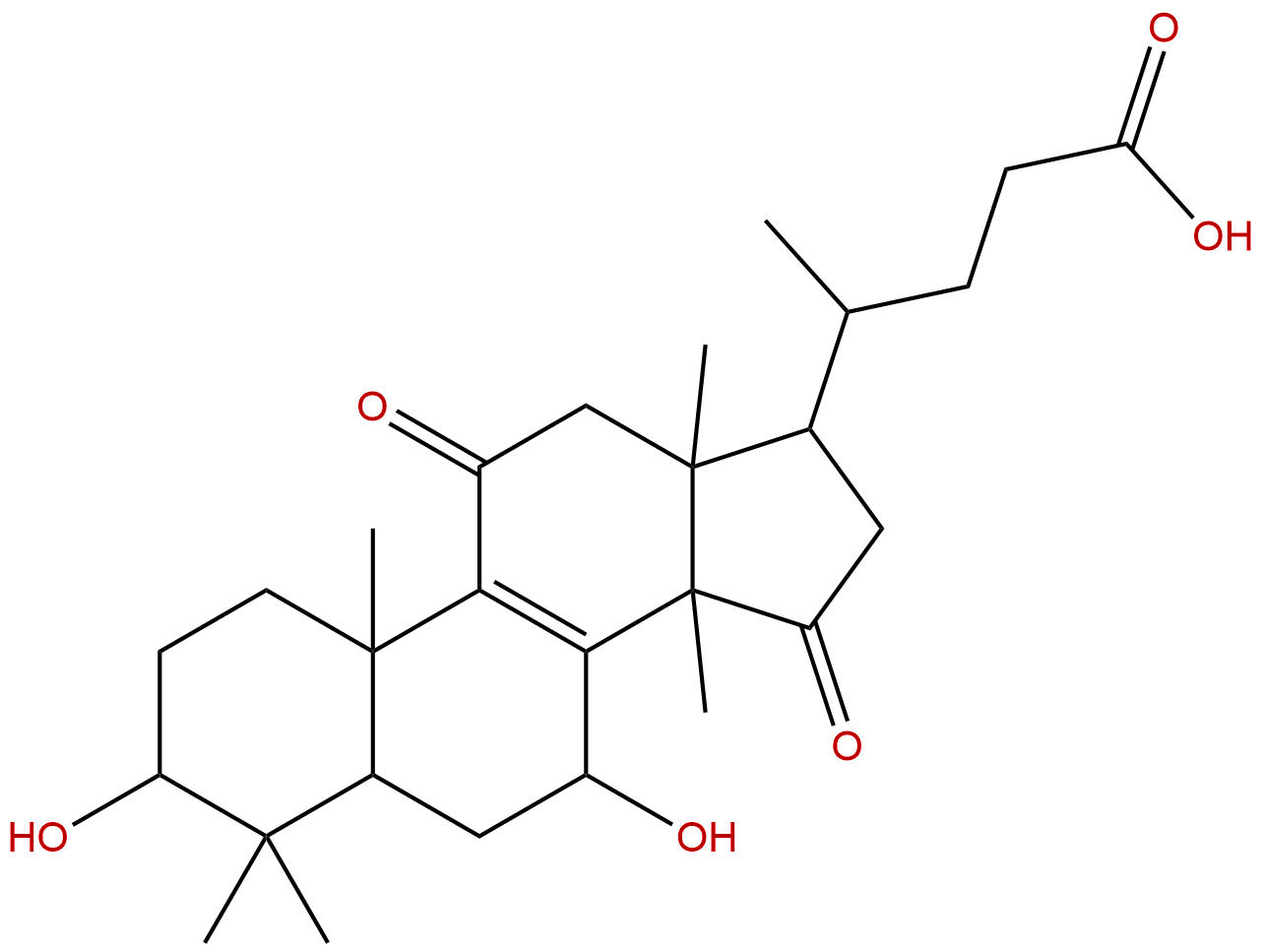
Gibberellic acid LM1 belongs to the highly oxidized tetracyclic triterpenoid class, and its systematic name is 25,26,27-trinorlanost-8-en-24-oic acid. It is substituted with hydroxyl groups at positions 3 and 7 of the parent nucleus, and with carbonyl groups at positions 11 and 15. Its stereoisomers are 3 β, 5 α, and 7 β. Its molecular formula is C27H40O7 and its molecular weight is 460.6110. This structural feature gives it a typical framework of ganoderic acid compounds, while the absence of C-25, 26, and 27 positions (nor -) and the introduction of multiple oxygen-containing functional groups endow it with unique physicochemical properties and biological activity.
From the analysis of physical and chemical properties, the calculated value of the lipid water partition coefficient (LogP) of LM1 gibberellic acid is 2.9549, indicating that the compound has moderate lipophilicity, which is beneficial for its penetration of cell membranes, but may also affect its solubility and distribution in aqueous media. Its topological polar surface area (TPSA) is 111.90 Å ², which is relatively large, mainly due to the presence of two hydroxyl groups, two carbonyl groups, and one carboxyl group in the molecule. Higher TPSA is usually associated with poorer membrane permeability. The predicted value of water solubility is relatively low, about 0.0428 mg/mL, indicating that it may face solubility challenges when developing oral or injectable formulations. In the preliminary screening of drug properties, the compound showed low blood-brain barrier permeability, which means it may be difficult to achieve effective therapeutic concentrations in the central nervous system. For diseases targeting the central nervous system, such as Alzheimer's disease, structural modifications or special delivery systems may be required. Encouragingly, the preliminary toxicity warning showed no significant risk of hERG potassium channel inhibition (hERG inhibition: No), and the Ames test predicted a value of 0.0, suggesting that it may not have direct genetic toxicity, providing a positive signal for further safety evaluation.
Plant sources and extraction methods
Red sesame acid LM1 mainly comes from the porous fungus Ganoderma lucidum in the family Fungi(Ganoderma lucidum)The sub entity. The growth environment, variety, harvesting period, and processing methods of Ganoderma lucidum all affect the composition and content of its secondary metabolites, which in turn affect the yield of LM1 gibberellic acid.
At present, the extraction of triterpenoids such as LM1 gibberellic acid from Ganoderma lucidum materials mainly uses organic solvent extraction method. Common solvents include methanol, ethanol, ethyl acetate, chloroform, etc. Ethanol is a commonly used choice for laboratory and industrial scale extraction due to its low toxicity, high extraction efficiency, and environmental friendliness. The typical extraction process is as follows: dry and crushed Ganoderma lucidum fruiting bodies are subjected to reflux extraction or ultrasound assisted extraction with a certain concentration of ethanol (such as 95% ethanol), and the extracted liquids are combined and concentrated under reduced pressure to obtain the crude extract. Crude extracts are usually rich in various triterpenoids, polysaccharides, pigments, and other components, which require further separation and purification.
Separation and purification of Ganoderma lucidum acid LM1 are often achieved through chromatographic techniques. Firstly, the crude extract may undergo liquid-liquid partitioning (such as extraction with petroleum ether, ethyl acetate, and n-butanol in sequence) for preliminary fractionation, with triterpenoid components mostly concentrated in the ethyl acetate fraction. Subsequently, silica gel column chromatography, reverse phase silica gel column chromatography (such as ODS), and dextran gel column chromatography (such as Sephadex LH-20) were used for repeated separation. High performance liquid chromatography (HPLC), especially preparative HPLC, is a key step in obtaining high-purity LM1 monomers of red sesame acid. C18 reverse phase chromatography columns are commonly used, with methanol water or acetonitrile water (usually containing a small amount of formic acid or acetic acid to improve peak shape) as the mobile phase for gradient elution. By means of nuclear magnetic resonance (NMR), mass spectrometry (MS), and comparison with standard samples, its chemical structure was finally identified. Optimizing extraction and separation processes to improve the yield and purity of target compounds is the foundation for subsequent pharmacological research and application development.
Pharmacological activity research
Although the pharmacological activity research of Ganoderma lucidum acid LM1 is still in its infancy, it has shown multiple potential, mainly focused on anti-tumor and neuroprotective fields, and its potential anti-aging activity is gradually being revealed.
-
Antitumor activity As an active ingredient isolated from Ganoderma lucidum, the most noteworthy activity of LM1 gibberellic acid is its cytotoxicity. Research reports that it has growth inhibitory and apoptosis inducing effects on various human tumor cell lines. Its anti-tumor effect may be achieved through various pathways, including inducing cell cycle arrest, activating apoptosis signaling pathways, and inhibiting tumor cell invasion and metastasis. Although the specific mechanism remains to be fully elucidated, preliminary evidence suggests that its effect may be related to interfering with the energy metabolism of tumor cells, inducing oxidative stress, and regulating the expression of related oncogenes/tumor suppressor genes.
-
Cholinesterase inhibitory activity The literature clearly indicates that LM1 has acetylcholinesterase (AChE, EC 3.1.1.7) and/or butyrylcholinesterase (BuChE, EC 3.1.1.8) inhibitory activity. Cholinesterase inhibitors are first-line drugs for treating cognitive disorders such as Alzheimer's disease, improving neural transmission by increasing acetylcholine levels in synaptic cleft. This activity suggests that LM1 or its structural analogues may serve as lead compounds for the development of novel neuroprotective or cognitive enhancers.
-
Potential anti-aging activity This is one of the most promising research directions for LM1 gibberellic acid. Aging is not a single process, but involves multiple interrelated molecular pathways. Based on its known chemical properties and preliminary pharmacological clues, LM1 gibberellic acid may exert anti-aging effects through the following ways:
- Antioxidant and activation of endogenous defense system The phenolic hydroxyl groups in its structure may endow it with the ability to scavenge free radicals. More importantly, it may upregulate the expression of downstream antioxidant enzymes such as superoxide dismutase 1 (SOD1), catalase (CAT), and heme oxygenase 1 (HMOX1) by activating the nuclear factor E2 related factor 2 (NRF2) pathway, thereby enhancing the cell's ability to resist oxidative damage, which is one of the core drivers of aging.
- Regulating energy metabolism and aging related pathways AMP activated protein kinase (AMPK) and deacetylase SIRT1 are key hubs for sensing cellular energy status and regulating metabolism, stress response, autophagy, and lifespan. Red sesame acid LM1 may act as an activator of the AMPK/SIRT1 pathway, simulating the heat restriction effect, promoting mitochondrial function, enhancing autophagy, and thereby delaying cellular aging.
- Affects cell cycle and senescence associated secretory phenotype (SASP)The tumor suppressor protein p53 (TP53) and its downstream target p21 (CDKN1A) play a dual role in cellular aging, inducing aging to suppress tumors and possibly promoting SASP. Fork head box protein O1 (FOXO1) is another important aging regulatory factor involved in stress resistance and lifespan regulation. Red sesame acid LM1 may achieve a balance between inhibiting abnormal proliferation and avoiding harmful chronic inflammation (SASP) by subtly regulating the TP53/CDKN1A and FOXO1 pathways.
- Telomere maintenance Telomerase reverse transcriptase (TERT) is a key maintainer of telomere length. Although direct evidence is lacking, some natural products have been reported to indirectly affect telomerase activity or telomere stability. Exploring whether LM1 gibberellic acid has an impact on TERT or telomere stability is a worthwhile direction to investigate.
Mechanism of action and molecular targets
The specific mechanism network of action of LM1 gibberellic acid has not been fully mapped, but based on its pharmacological activity and chemical informatics predictions, its possible molecular targets and pathways can be outlined, especially in the field of anti-aging.
-
Regulation of the core aging regulatory network:
- AMPK/SIRT1 axis AMPK and SIRT1 activate each other and jointly regulate downstream factors such as PGC-1 α, FOXO family, NF - κ B. Red sesame acid LM1 may activate SIRT1 by simulating energy stress (such as changing the AMP/ATP ratio) or directly conformational activation, promoting AMPK phosphorylation. The activated AMPK/SIRT1 axis can promote mitochondrial biosynthesis, fatty acid oxidation, inhibit mTOR signaling, induce autophagy, thereby clearing damaged organelles and macromolecules, maintaining cellular homeostasis, which is the potential core mechanism of its anti-aging effect.
- NRF2/KEAP1 pathway NRF2 is the main regulator of antioxidant reactions. Under oxidative stress, NRF2 dissociates from KEAP1 and initiates transcription of antioxidant genes such as SOD1, CAT, and HMOX1 upon nuclear entry. Red sesame acid LM1 may act as an electrophilic reagent or stabilize NRF2 by interfering with KEAP1-NRF2 interactions, thereby systematically enhancing cellular antioxidant defense capabilities and combating aging related oxidative damage accumulation.
- TP53-CDKN1A/p21 pathway TP53 is activated under stress such as DNA damage, inducing the expression of cell cycle inhibitor p21, leading to G1 phase arrest of the cell cycle, which is one of the important mechanisms of cellular aging. Red sesame acid LM1 may induce mild stress (such as oxidative stress), moderately activate the TP53-p21 axis, clear potential precancerous cells, and exert an "aging monitoring" effect, but at the same time, it is necessary to avoid harmful SASP caused by excessive activation.
- FOXO transcription factor FOXO1 is a downstream target of the insulin/IGF-1 signaling pathway, and its nuclear translocation and activation can promote the expression of antioxidant, DNA repair, and autophagy related genes. Red sesame acid LM1 may promote deacetylation and nuclear localization of FOXO1, enhance cellular stress resistance and lifespan by inhibiting upstream kinases such as Akt or activating AMPK/SIRT1.
-
Anti tumor related mechanisms In addition to the possible induction of tumor cell senescence mentioned above, its cytotoxicity may also be related to the following mechanisms:
- Inducing apoptosis Possible activation of Caspase cascade through mitochondrial pathway (affecting Bcl-2 family proteins, releasing cytochrome c) or death receptor pathway.
- Inhibition of cholinesterase In the tumor microenvironment, acetylcholine may act as a growth factor to promote the proliferation of certain tumors. Inhibiting cholinesterase and altering cholinergic signaling may indirectly affect tumor growth.
-
Mechanisms related to neuroprotection Its acetylcholinesterase inhibitory activity is a direct molecular target that can increase acetylcholine levels. In addition, its potential antioxidant (via NRF2), anti-inflammatory (possibly by inhibiting NF - κ B), and SIRT1 activation (promoting neuronal survival and synaptic plasticity) effects may collectively contribute to neuroprotective effects and combat age-related neurodegeneration.
Evaluation of drug properties and pharmacokinetics
Based on computational chemistry and preliminary experimental data, a preliminary evaluation of the pharmacological properties of LM1 gibberellic acid is conducted
-
Analysis of drug properties Its molecular weight (460.6) conforms to the five rules of class drugs (<500), and its LogP value (~2.95) is at the upper limit of the ideal range (1-3), indicating that it has a good membrane permeability foundation. However, higher TPSA (>100 Å ²) and lower water solubility are the main obstacles to its oral absorption. According to the empirical rule of "polar surface area - number of rotatable bonds", its oral bioavailability may be low.
-
Absorption, distribution, metabolism, excretion (ADME) prediction:
- absorb Moderate LogP is beneficial for passive diffusion, but high TPSA and low solubility may limit its dissolution and penetration in the gastrointestinal tract, leading to poor prediction of oral absorption. Formulation techniques (such as nanocrystals, solid dispersions, liposomes) or prodrug strategies may be needed to improve its bioavailability.
- distribution Predict low blood-brain barrier permeability, which is consistent with high TPSA and the presence of polar groups (carboxyl groups) in the molecule. This is an unfavorable factor for diseases targeting the central nervous system, but may reduce central side effects for peripheral effects. The degree of binding between it and plasma proteins is not yet clear.
- Metabolism As a triterpenoid compound, it may undergo phase I metabolism (such as oxidation, reduction, and hydrolysis of cytochrome P450 enzymes) and phase II metabolism (such as glucuronic acid binding and sulfation). The oxygen-containing groups at positions 7 and 11 may serve as binding reaction sites. Experimental identification of its main metabolites and metabolic enzymes is required.
- excretion The prototype drug and its metabolites may be mainly excreted through bile and kidneys. The presence of carboxyl groups makes it easier to form water-soluble complexes and excrete them through urine.
-
Preliminary safety warning The absence of hERG inhibition warning is a positive signal that reduces the risk of causing QT interval prolongation and apical torsion ventricular tachycardia in the heart. The negative prediction of Ames test indicates that it does not have direct mutagenicity, but a complete genetic toxicity test combination is still needed for confirmation. Its potential off target effects and long-term toxicity need to be systematically evaluated.
At present, there are few reports on the in vivo pharmacokinetic studies of the LM1 system of Ganoderma lucidum, which is a key gap that must be filled before its application. It is necessary to establish sensitive and reliable analytical methods (such as LC-MS/MS) to study their absolute bioavailability, half-life, tissue distribution, major metabolic pathways, and excretion kinetics in animal models.
Clinical application prospects and prospects
Red sesame acid LM1, as a natural compound with multi-target potential, has broad clinical application prospects but also faces challenges.
-
Potential application directions:
- Anti aging and prevention of age-related diseases This is the most attractive direction. It can be used as a dietary supplement or functional food ingredient to delay the aging process, improve body function, and prevent various age-related diseases (such as muscle loss, metabolic dysfunction, mild cognitive impairment, etc.). Its multi-target characteristics may produce synergistic effects.
- neoadjuvant therapy Combined with conventional chemotherapy/radiotherapy, it may enhance efficacy, reduce side effects, or reverse drug resistance. Further research is needed to investigate its interaction with existing therapies and its impact on tumor stem cells.
- Neurodegenerative diseases Based on its cholinesterase inhibition and potential neuroprotective mechanisms, it is expected to develop therapeutic or disease modifying drugs for diseases such as Alzheimer's disease and Parkinson's disease.
- Metabolic diseases It may improve insulin sensitivity by activating AMPK, which has potential application in type 2 diabetes and non-alcoholic fatty liver disease.
-
Development Challenges and Strategies:
- Improved bioavailability This is the primary challenge. Nanoformulations (such as polymer nanoparticles, lipid nanoparticles), phospholipid complexes, cyclodextrin inclusion complexes, and other techniques can be used to improve their solubility and stability. Reasonable structural modifications can also be made to improve its physicochemical properties while retaining the pharmacophore.
- Targeted delivery Targeted ligand modified delivery systems can be designed for specific diseases (such as tumors) to increase drug concentration at the lesion site, reduce systemic exposure and toxicity.
- Deep explanation of mechanism It is necessary to use techniques such as gene knockout/knockdown, reporter genes, proteomics, metabolomics, etc. to confirm its key targets and pathways in cell and animal models, and clarify the specific molecular events that exert anti-aging and other effects.
- Preclinical and clinical research Completing the pharmacodynamics, pharmacokinetics, and safety evaluation of the system (GLP toxicology study) is a necessary step towards advancing to clinical trials. Given its multi-target nature, biomarkers need to be carefully designed in clinical studies to evaluate their target engagement and biological effects.
-
Future Prospects With the deepening of aging biology and natural product research, the value of compounds with multi-target regulatory ability such as LM1 gibberellic acid is increasingly prominent. Future research should focus on: ① achieving efficient and green large-scale preparation; ② Conduct systematic ADME and toxicology research; ③ Using modern systems biology methods to comprehensively reveal its functional network; ④ Explore its combined effects with other anti-aging interventions such as exercise and calorie restriction mimetics. As the active ingredient of Ganoderma lucidum, a traditional medicinal and edible fungus, LM1 is expected to build a bridge between traditional wisdom and modern life sciences, providing new candidate molecules for healthy aging and chronic disease prevention and treatment.
Conclusion
Ganoderma lucidum LM1 is a unique and biologically active tetracyclic triterpenoid compound found in Ganoderma lucidum. It not only exhibits direct activity in anti-tumor and cholinesterase inhibition, but also has broad development prospects due to its potential regulation of core aging related pathways such as AMPK, SIRT1, NRF2, TP53, FOXO, especially in the fields of anti-aging and age-related disease prevention and treatment. Although it faces challenges such as low bioavailability in drug development, it is expected to be overcome through modern medicinal chemistry and formulation methods. At present, research on this compound is still in its early stages, and its precise molecular mechanism of action, in vivo metabolic fate, and long-term safety urgently need to be further explored. Systematic and in-depth basic and translational research will help fully explore the medicinal value of LM1, laying a solid scientific foundation for its ultimate development into innovative drugs or functional products that improve human health and delay aging.