


Product name: Saikosaponin D
Synonym name:
Catalogue No.: BP1242
Cas No.: 20874-52-6
Formula: C42H68O13
Mol Weight: 780.993
Botanical Source: Bupleurum falcatum, Bupleurum kummingense and Bupleurum chinense
Physical Description: Powder
Type of Compound: Triterpenoids
Purity: 95%~99%
Analysis Method: HPLC-DAD or/and HPLC-ELSD
Identification Method: Mass, NMR
Packing: Brown vial or HDPE plastic bottle
Storage: Store in a well closed container, protected from air and light. Put into refrigerate or freeze for long term storage.
Whenever possible, you should prepare and use solutions on the same day. However, if you need to make up stock solutions in advance, we recommend that you store the solution as aliquots in tightly sealed vials at -20℃. Generally, these will be useable for up to two weeks.
The product could be supplied from milligrams to grams, up to kilograms
Inquire for bulk scale.
Descriptions:
SaikosaponinD (SSd) is a major triterpenoid saponin derivative from Radix bupleuri, which has been long used in Chinese traditional medicine for treatment of various inflammation-related diseases; it shows potent anti-inflammatory activity through inhibitory effects on NF-κB activation and thereby on iNOS, COX-2 and pro-inflammatory cytokines.[1]
Saikosaponin D attenuates CCl4-induced hepatic fibrosis in rats, which may be related to its effects of hepato-protective and anti-inflammation properties,the down-regulation of liver TNF-α, IL-6 and NF-κBp65 expression and the increased I-κBα activity in liver.[2]
Saikosaponin D is an agonist of the glucocorticoid receptor (GR), and it possesses neuroprotective effects in corticosterone-treated PC12 cells; SSD exhibits its anti-apoptotic effects via differential regulation of mitochondrial and nuclear GR translocation, partial reversal of mitochondrial dysfunction, inhibition of the mitochondrial apoptotic pathway, and selective activation of the GR-dependent survival pathway.[3]
Saikosaponin D is a novel autophagic inducer, can increase cytosolic calcium level via direct inhibition of sarcoplasmic/endoplasmic reticulum Ca(2+) ATPase pump, leading to autophagy induction through the activation of the Ca(2+)/calmodulin-dependent kinase kinase-AMP-activated protein kinase-mammalian target of rapamycin pathway, which has the potential of being developed into an anti-cancer agent for targeting apoptosis-resistant cancer cells.[4]
References:
[1] Lu C N, Yuan Z G, Zhang X L, et al. Int Immun Pharmaco, 2012, 14(1):121-126.
[2] Dang S S, Wang B F, Cheng Y A, et al. World J Gastroentero, 2007, 13(4):557-63.
[3] Li Z Y, Jiang Y M, Liu Y M, et al. Prog neuro-psychoph, 2014, 53(1448):80-89.
[4] Wong V K, Li T, Law B Y, et al. Cell Death Dis, 2012, 4(7):e720-e720.
[5] Liu L Z, Xiao-Jun J I, Bang-Qin Y A. China Pharmacy, 2014, 25(23):2147-2149.
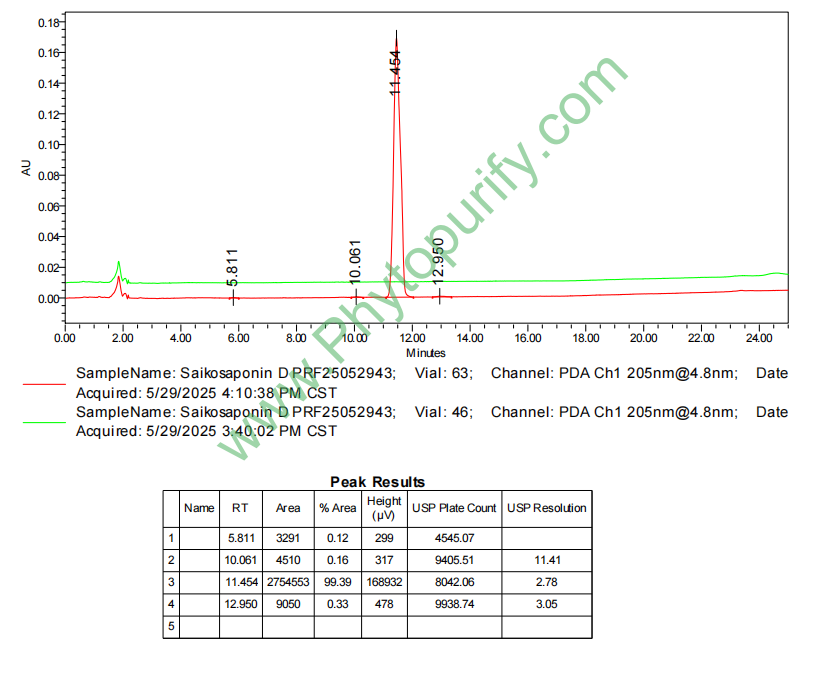
HPLC of Saikosaponin D
Storage conditions:Short-term storage at 2~8℃, long-term storage at -20 ~ -80℃
207.9900
2.9858
2.9857
.0243
.5914
1.4770
Low
75.1165
7.2591
No
No
No
No
No
No
0.0
Yes
No
Yes
No
Saikosaponin D (SSD) is a natural triterpenoid saponin isolated from the traditional Chinese medicine Bupleurum spp. Chaihu, as a commonly used medicinal herb in classic Chinese medicine formulas, has always been used to treat colds, fever, liver and gallbladder diseases, and inflammation related diseases. In recent years, with the development of natural product pharmacology and molecular biology techniques, SSD has received widespread attention due to its significant multi-target pharmacological activity. Research has shown that SSD not only possesses multiple biological activities such as anti-inflammatory, antibacterial, anti-tumor, and anti allergic effects, but also exerts its effects by regulating key molecular signaling pathways such as selectin, STAT3, NF - κ B, and activating estrogen receptor β (ER β).
Especially in the field of tumor treatment, SSD has shown potential inhibitory effects on breast cancer and other malignant tumors. Its targets include various molecules closely related to tumor occurrence, development, and drug resistance, such as AMPK, BCL2, STAT3, ESR2, ABCB1, ABCG2, etc., reflecting its complex and multidimensional mechanism of action. This article will systematically review the chemical structure and physicochemical properties of SSD, plant sources and extraction methods, pharmacological activity, mechanism of action and molecular targets, drug evaluation and pharmacokinetics, and finally explore its clinical application prospects and future research directions.
Chaihu saponin D belongs to the triterpenoid saponin class, with a molecular formula of C42H68O13 and a molecular weight of 780.9930. Its chemical structure consists of a pentacyclic triterpenoid nucleus connected to multiple glycosides through glycosidic bonds, and its typical saponin structure provides it with a good basis for biological activity. The LogP value of SSD is about 2.9858, indicating that it has moderate lipid solubility and is suitable for cell membrane permeation, but its water solubility is low (0.0243), which to some extent limits its bioavailability.
Its topological polar surface area (TPSA) is 207.9900, indicating that SSD has strong polar groups that may affect its transmembrane transport and oral absorption. The low permeability of the blood-brain barrier suggests that the role of SSD in the central nervous system is limited. The negative result of hERG channel inhibition experiment indicates a low risk of cardiac toxicity. The Ames test result was 0.0, indicating no significant genotoxicity.
The structural characteristics and physicochemical properties of SSD provide a basis for its multi-target action and safety, but also indicate challenges in drug delivery and bioavailability.
Chaihu saponin D mainly comes from plants of the Bupleurum genus (Bupleurum chinense DC., Bupleurum scorzonerifolium Willd., etc.), which are widely distributed in China and East Asia and are important components of traditional Chinese medicinal materials. The roots of Bupleurum chinense contain abundant triterpenoid saponins, and SSD, as one of the main active ingredients, varies in content with different plant species, growth environments, and harvesting times.
The common methods for extracting SSDs include:
The optimization of extraction process not only affects the yield and purity of SSD, but also relates to its biological activity and subsequent pharmacological research.
Chaihu saponin D exhibits a wide range of pharmacological activities, including anti-inflammatory, antibacterial, anti-tumor, and anti allergic effects.
SSD can significantly inhibit the production and release of inflammatory mediators, reducing the inflammatory response. The mechanism mainly includes inhibiting the activation of the NF - κ B signaling pathway and reducing the expression of pro-inflammatory cytokines such as TNF - α, IL-6, IL-1 β. In addition, SSD also reduces the adhesion between white blood cells and vascular endothelial cells by inhibiting the expression of selectin molecules, blocking the migration and infiltration of inflammatory cells.
Research has shown that SSD has inhibitory effects on various bacteria, especially exhibiting strong activity against Gram positive bacteria. Its antibacterial mechanism may be related to the destruction of bacterial cell membrane structure and inhibition of key enzyme activity, but the specific molecular mechanism still needs further clarification.
SSD has significant inhibitory effect in many tumor models, especially in breast cancer. Its anti-tumor activity includes:
SSD reduces allergic reactions by inhibiting degranulation of mast cells and histamine release. In addition, activating ER β receptors also participates in regulating immune responses and exerting anti allergic effects.
The multi-target mechanism of action of SSD is the basis for its diverse pharmacological activities. The main targets and related signaling pathways include:
Selectin family molecules play a crucial role in the adhesion and migration of inflammatory cells. SSD inhibits the expression of selectins, blocks the interaction between white blood cells and vascular endothelium, and reduces inflammatory reactions.
STAT3, as an important transcription factor for tumor cell proliferation, survival, and immune escape, is inhibited by SSD through its phosphorylation and nuclear translocation, thereby reducing the proliferation and anti apoptotic ability of tumor cells.
NF - κ B regulates the expression of various inflammatory factors and survival genes. SSD inhibits the degradation of I κ B α, prevents NF - κ B activation, reduces the release of inflammatory mediators, and decreases tumor cell survival.
SSD can activate estrogen receptor beta (ESR2), regulate related gene expression, and participate in anti-tumor and immune regulation. The activation of ER β helps to inhibit the proliferation of breast cancer cells and promote apoptosis.
In summary, SSD achieves its wide range of biological activities through multi-target and multi pathway synergistic effects.
The pharmacological parameters of SSD show both advantages and challenges in drug development:
In terms of pharmacokinetics, SSD has limited absorption after oral administration and is mainly metabolized through the liver, resulting in a certain first pass effect. Its bioavailability and in vivo half-life have not been systematically reported and further research is needed. Improvements in formulations such as nanocarriers and liposome encapsulation techniques may enhance their pharmacokinetic properties.
SSD, as a multi-target natural product, has broad clinical application potential, especially in the field of tumor therapy. Its regulation of breast cancer related targets provides a theoretical basis for the development of new anti breast cancer drugs. Combining traditional Chinese medicine theory with modern molecular pharmacology, SSD is expected to become a candidate drug for anti-tumor, anti-inflammatory, and immune regulation.
Future research directions include:
As an important active ingredient in Bupleurum chinense, saikosaponin D exhibits a wide range of pharmacological activities in anti-inflammatory, antibacterial, anti-tumor, and anti allergic fields due to its unique triterpenoid saponin structure and multi-target regulatory ability. Its mechanism of action involves selectin, STAT3, NF - κ B, ER β and other key molecules, especially in the treatment of breast cancer. Despite challenges in terms of drug efficacy and pharmacokinetics, with the development of modern drug research and development technology, SSD is expected to become an important candidate for natural product drug development through structural optimization and formulation innovation.
In the future, by combining research methods from systems biology and precision medicine, we will delve into the functional network and clinical value of SSD, providing a solid foundation for its translational applications and promoting the widespread use of natural products in modern medicine.
