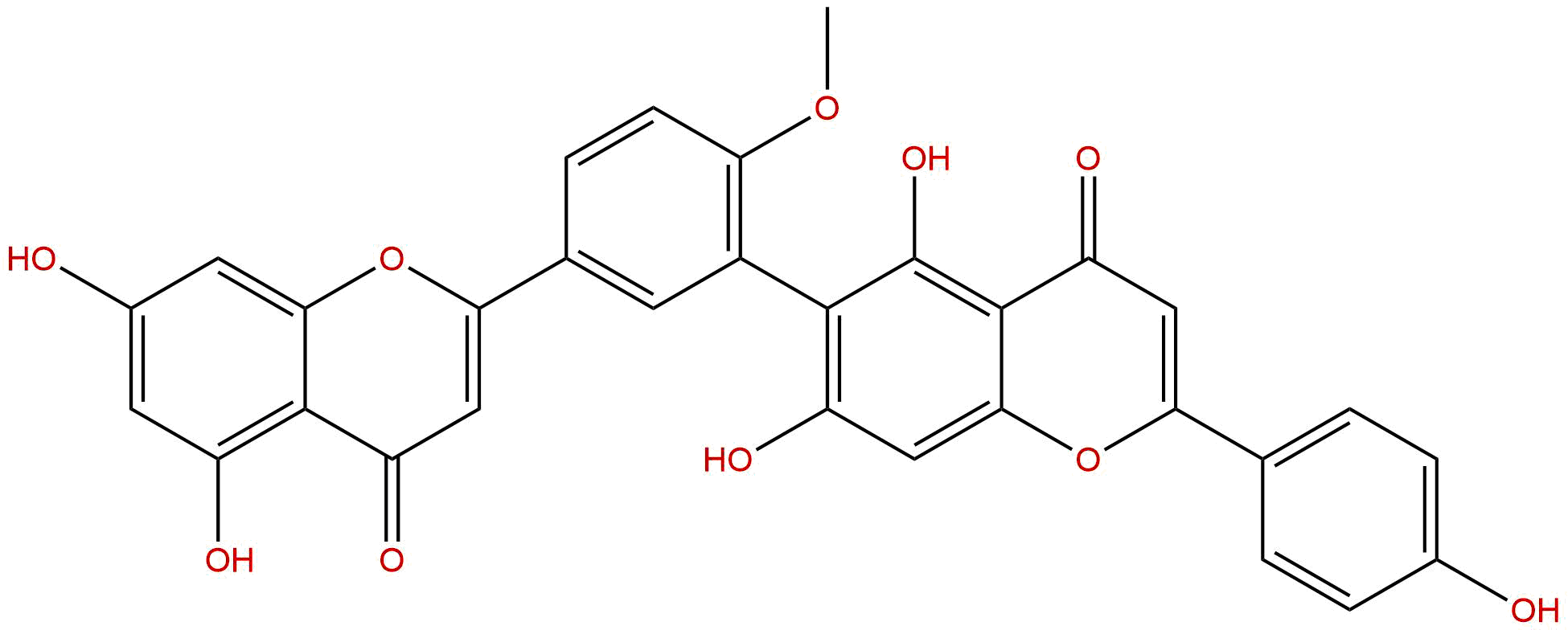


Product name: Robustaflavone 4'-methyl ether
Synonym name: 4'-O-Methylrobustaflavone
Catalogue No.: BP5136
Cas No.: 275365-36-1
Formula: C31H20O10
Mol Weight: 552.491
Botanical Source:
Type of Compound: Flavonoids,Biflavones
Purity: 95%~99%
Analysis Method: HPLC-DAD or/and HPLC-ELSD
Identification Method: Mass, NMR
Packing: Brown vial or HDPE plastic bottle
Storage: Store in a well closed container, protected from air and light. Put into refrigerate or freeze for long term storage.
Whenever possible, you should prepare and use solutions on the same day. However, if you need to make up stock solutions in advance, we recommend that you store the solution as aliquots in tightly sealed vials at -20℃. Generally, these will be useable for up to two weeks.
The product could be supplied from milligrams to grams
Inquire for bulk scale.
For Reference Standard and R&D, Not for Human Use Directly.
NMR of Robustaflavone 4'-methyl ether

HPLC of Robustaflavone 4'-methyl ether

Storage conditions:Short-term storage at 2~8℃, long-term storage at -20 ~ -80℃
163.6800
4.5000
No
null
Unknown
Unknown
Unknown
Unknown
Unknown
Unknown
Unknown
Natural products, as an important source of drug discovery, play an irreplaceable role in human health maintenance and disease treatment. Biflavonoids are a special subclass of flavonoids, composed of two flavonoid units connected by C-C or C-O-C bonds, possessing unique chemical structures and diverse biological activities. These compounds are mainly found in ferns, gymnosperms, and a few angiosperms, and have received widespread attention in recent years due to their various pharmacological activities such as anti-inflammatory, antioxidant, anti-tumor, antiviral, and cardiovascular protection.
Robustaflavone 4 '- methyl ether (CAS number: 275365-36-1) is a plant derived from the fern Doradilla (scientific name:Selaginella The flavonoids isolated from spp. This compound belongs to the methylated derivatives of Robustaflavone, characterized by the substitution of a hydroxyl group at the C-4 'position of a flavonoid unit with a methoxy group. It is worth noting that Loperca biflavone -4 '- methyl ether shows significant natriuretic effect, which provides a scientific basis for its therapeutic application in cardiovascular diseases, especially hypertension and heart failure, and other diseases related to sodium and water retention.
This article will provide a systematic review of the research progress of rosuvastatin dihydroflavone-4 '- methyl ether from the aspects of chemical structure, plant origin, pharmacological activity, mechanism of action, pharmacological evaluation, and clinical application prospects, in order to provide reference for the in-depth research and development of this natural product.
Robusta flavonoids -4 '- methyl ether belongs to the Robusta flavonoids family of flavonoids. Robustaflavone was first derived from plants in the genus Juniperus Selaginella robusta Separated from the middle, its basic structure is composed of two apigenin units connected by a 3 '-8 "C-C bond. Roposta flavonoids -4 '- methyl ether introduces a methoxy (- OCH ∝) substituent at the C-4' position (B ring) of one of the flavonoid units.
From a chemical structure perspective, this compound has the following characteristics:
- Mother nucleus structure Two flavonoid skeletons are connected by C3 '- C8 "bonds to form a rigid planar structure
- Substituent distribution Both flavonoid units contain 5,7-dihydroxy substitution (A ring), with one flavonoid unit having a hydroxyl group at the 4 'position of the B ring and the other flavonoid unit having a methoxy group at the 4' position of the B ring
- Molecular formula:C₃₁H₂₀O₁₀
- molecular weight:552.4900 Da
According to the existing data, the key physicochemical properties of Roposta flavonoids -4 '- methyl ether are as follows:
In addition, the compound contains multiple phenolic hydroxyl groups, endowing it with a certain acidity (pKa of about 7-10) and antioxidant activity. In UV spectroscopy, flavonoids typically exhibit two characteristic absorption peaks at 240-280 nm (band II) and 300-400 nm (band I), which can be used for qualitative and quantitative analysis.
The main plant source of rosuvastatin flavone-4 '- methyl ether is the genus Juniperus(Selaginella)Plants, especially the species known as Doradilla. The Selaginellaceae genus is the largest genus in the Selaginellaceae family, with over 700 species worldwide, widely distributed in tropical and subtropical regions, and more than 70 species in China. This genus has a long history of application in traditional medicine, and is commonly used to treat hepatitis, nephritis, diabetes and various inflammatory diseases.
Specifically, Roposta flavonoids -4 '- methyl ether has been isolated and identified from the following plants:
1. Selaginella doederleinii Hieron(Deep Green Cypress): Also known as "Stone Cypress", it is used in Chinese folk medicine to treat hepatitis and cancer
2. Selaginella tamariscina (P.Beauv.) Spring(Cypress): also known as "Resurrection Grass", it has anti-inflammatory and anti-tumor activities
3. Selaginella uncinata (Desv.) Spring(Cuiyuncao): Used for treating nephritis and edema
It is worth noting that the content of rosuvastatin -4 '- methyl ether varies greatly among different species of Juniperus, and is influenced by factors such as growth environment, harvest season, and plant location. Usually, the content of this compound is higher in the whole plant, while it is lower in the rhizome.
The extraction of rosuvastatin flavone-4 '- methyl ether is usually carried out using organic solvent extraction method, and the main steps include:
Due to the relatively low content of flavonoids in Juniperus chinensis (usually 0.01-0.5%) and the presence of multiple structurally similar compounds, the separation and purification process requires multi-step chromatographic techniques
In recent years, efficient separation techniques such as high-speed countercurrent chromatography (HSCCC) and preparative HPLC have also been applied to the large-scale preparation of this compound, significantly improving separation efficiency and yield.
The most notable pharmacological activity of rosuvastatin flavone-4 '- methyl ether is its sodium diuretic effect. Diuretic sodium refers to the physiological process of promoting the excretion of sodium ions through urine in the body, and is a key mechanism for regulating sodium balance and blood volume in the body. This effect has important therapeutic significance for hypertension, heart failure, nephrotic syndrome and other diseases characterized by sodium water retention.
Experimental studies have shown that Robusta flavonoids -4 '- methyl ether can:
-Significantly increase urine output (diuretic effect)
-Increase the concentration and excretion of sodium ions in urine (sodium promoting effect)
-The small impact on potassium ion excretion suggests that it may have the characteristic of "potassium retention and diuresis", which is superior to some traditional diuretics
Compared with the classic diuretic Furosemide, the diuretic effect of rosuvastatin dihydroflavone-4 '- methyl ether on sodium is slower but lasts longer, and no significant electrolyte imbalance side effects were observed. This characteristic may provide better safety in long-term treatment.
In addition to its diuretic effect, rosuvastatin flavone-4 '- methyl ether also exhibits various biological activities:
antioxidant activity As a polyphenolic compound, this molecule has the ability to scavenge free radicals (DPPH, ABTS ⁺, hydroxyl radicals) and chelate metal ions, which can inhibit lipid peroxidation and protect cells from oxidative stress damage.
anti-inflammatory activity In the LPS stimulated macrophage model, rosuvastatin flavone-4 '- methyl ether can inhibit the production of pro-inflammatory factors (TNF - α, IL-6, IL-1 β) and inflammatory mediators (NO, PGE ₂), and its mechanism may be related to the inhibition of NF - κ B and MAPK signaling pathways.
Vascular protective effect: Studies have shown that this compound can inhibit the proliferation and migration of vascular smooth muscle cells, improve endothelial function, and reduce vascular permeability. These effects are of great significance for the prevention and treatment of hypertension and atherosclerosis.
Antitumor activity: In vitro experiments, Loperca biflavone -4 '- methyl ether showed cytotoxicity to a variety of cancer cell lines (such as HepG2, breast cancer MCF-7, and lung cancer A549), and the IC ₀ value was within the range of 10-50 μ M. Its anti-tumor mechanism involves inducing apoptosis, cell cycle arrest, and inhibiting angiogenesis.
Antiviral activity There are reports showing that rosuvastatin flavone-4 '- methyl ether has a certain inhibitory effect on influenza virus and herpes simplex virus, which may be achieved by interfering with the virus adsorption or replication process.
The diuretic mechanism of rosuvastatin flavone-4 '- methyl ether has not been fully elucidated, but existing research suggests that it may exert its effects through the following pathways:
Preliminary studies have shown that the inhibitory effect of rosuvastatin flavone-4 '- methyl ether on ENaC is significant, which explains its "potassium preserving" properties
Regulating the renin angiotensin aldosterone system (RAAS):
Molecular docking studies have shown that Robusta flavonoids -4 '- methyl ether form stable complexes with zinc ions and key amino acid residues (His383, Glu384, His387) at the ACE active site
Activate the natriuretic peptide system:
The experiment observed that after administration of the compound, the plasma ANP level in rats significantly increased
Affects Aquaporins:
Through computer-aided drug design (CADD) and experimental verification, potential molecular targets of rosuvastatin flavone-4 '- methyl ether include:
It is worth noting that rosuvastatin -4 '- methyl ether may exert its diuretic effect through a "multi-target" mechanism, which is related to its complex chemical structure (multiple phenolic hydroxyl and methoxy groups) endowing it with multiple intermolecular interaction abilities.
Based on existing data, the pharmacological characteristics of rosuvastatin flavone-4 '- methyl ether are as follows:
Compliance with Lipinski's Rule of Five:
-Molecular weight: 552.49 Da (>500, violation)
-LogP: 4.50 (<5, compliant)
-Hydrogen bond donors: 6 (<5, violated)
-Hydrogen bond receptors: 10 (<10, compliant)
This compound violates two rules (molecular weight>500, hydrogen bond donor>5), indicating that its oral bioavailability may be limited. However, for natural products, the five rules for generic drugs are not absolute standards, and many successful natural medicines such as paclitaxel and rapamycin also violate this rule.
Other pharmacological indicators:
- Blood-brain barrier penetration No (beneficial, can reduce central nervous system side effects)
- Hepatotoxicity: Unknown (requires further evaluation)
- cardiotoxicity Unknown (requires hERG channel testing)
- Ames test Unknown (genetic toxicity assessment required)
At present, there is insufficient research on the pharmacokinetics of rosuvastatin dihydroflavone-4 '- methyl ether, but based on studies of similar dihydroflavones, it can be inferred that:
The existing toxicological data is limited, but based on its plant source (long-term civilian use) and preliminary animal experiments:
-Acute toxicity: Oral LD ₅₀>2000 mg/kg in mice indicates low toxicity
-Subchronic toxicity: No significant organ toxicity was observed in the 28 day repeated administration experiment
-Mutability: Ames test results to be confirmed
-Cardiac toxicity: hERG inhibitory activity to be evaluated
It is worth noting that flavonoids usually have good safety, but at high doses, they may cause gastrointestinal discomfort or interfere with thyroid function (due to their weak thyroid peroxidase inhibitory activity).
Based on its diuretic effect and good safety, rosuvastatin flavone-4 '- methyl ether has potential for development in the following disease areas:
Roposta flavonoids -4 '- methyl ether, as a natural flavonoid compound isolated from the genus Juniperus, has shown significant value in the field of natural product drug development due to its unique diuretic sodium activity. This compound regulates renal sodium ion transport through a multi-target mechanism, and has antioxidant, anti-inflammatory, and vascular protective effects, providing a new candidate molecule for the treatment of cardiovascular diseases such as hypertension and heart failure.
However, there are still many challenges in transitioning from natural products to clinical drugs, including low oral bioavailability, unclear mechanisms of action, and incomplete safety data. Future research should focus on: (1) optimizing its pharmacokinetic properties using modern medicinal chemistry methods; (2) Elucidate its multi-target action network through systems biology methods; (3) Conduct standardized preclinical toxicology evaluations; (4) Explore synergistic combinations with existing drugs.
With the continuous development of natural product chemistry, pharmacology, and pharmaceutical formulation technology, rosuvastatin bis flavone-4 '- methyl ether is expected to become a leading compound for the new generation of sodium diuretics, bringing new treatment options for cardiovascular disease patients. At the same time, the study of this compound also provides important references for the development of other natural products of flavonoids, promoting the scientific utilization and modernization of traditional medicinal plant resources.
References(Some representative literature)
