Introduction/Overview
Malignant tumors, especially liver cancer, are a major public health challenge worldwide. Their incidence rate and mortality remain high, and their treatment methods are limited, with poor prognosis. Traditional chemotherapy drugs often suffer from serious toxic side effects and drug resistance issues. Therefore, searching for efficient and low toxicity anti-cancer lead compounds from natural products has always been an important direction for drug development. Garcinia spp., as a treasure trove of traditional medicinal plant resources, have attracted much attention for their abundant xanthone compounds due to their wide range of biological activities. As one of the structurally unique derivatives of bicyclic xanthenone, ferulic acid B has attracted continuous exploration from pharmacological researchers due to its significant anti-tumor activity, especially anti angiogenic activity, since its isolation and identification. This article aims to provide a systematic review of the chemical properties, plant sources, pharmacological activities, mechanisms of action, medicinal properties, and application prospects of ferulic acid B in the treatment of liver cancer and other diseases, in order to provide comprehensive academic references for the in-depth research and development of this compound.
Chemical structure and physicochemical properties
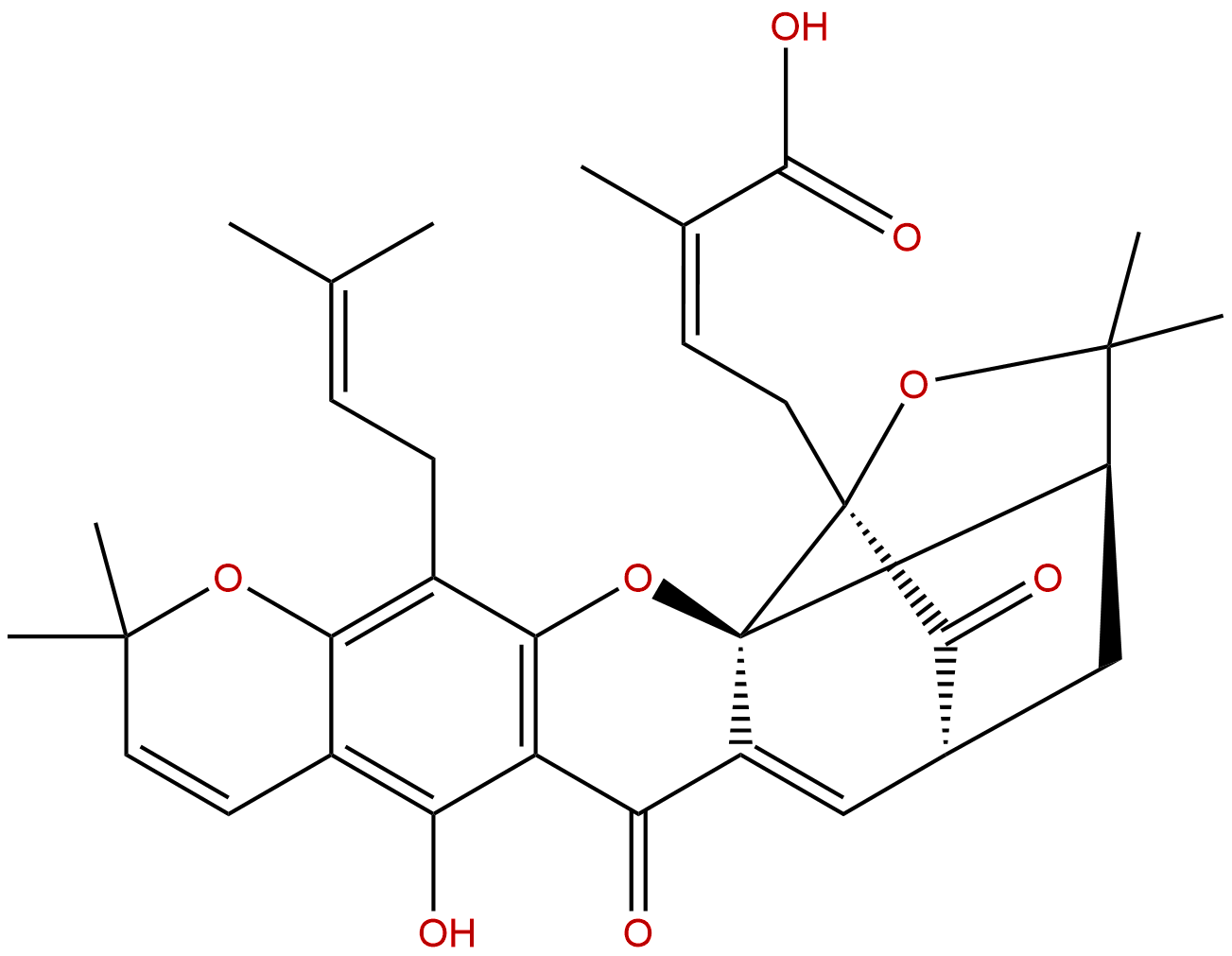
Tenghuang acid B, also known as 1,3,6-trihydroxy-7-methoxy-2,4-bis (3-methylbut-2-enyl) -9H-hexane-9-one, is a structurally complex bicyclic xanthone compound. Its molecular formula is C33H36O7 and its molecular weight is 560.6430. Its core structure is the parent nucleus of xanthenone, which is substituted by hydroxyl groups at positions 1, 3, and 6, methoxy at position 7, and connected to an isoprene side chain (3-methylbut-2-enyl) at positions 2 and 4. This unique isoprene modification is the key structural basis for its high lipid solubility and biological activity.
Based on its chemical structure, ferulic acid B exhibits typical hydrophobic characteristics. Its calculated lipid water partition coefficient (LogP) is 5.1616, indicating its high lipophilicity. The topological polar surface area (TPSA) is 119.36 Å ², which is relatively low, further confirming its strong ability to penetrate cell membranes. The water solubility is extremely low, only 0.0285 mg/mL, which poses a challenge for its formulation development. Preliminary pharmacological predictions indicate that its ability to cross the blood-brain barrier is low, suggesting that its application in central nervous system related diseases may be limited. In the early toxicity screening, the hERG channel inhibition risk was negative, and the Ames mutagenicity test result was 0.0, indicating a low risk of cardiac and genetic toxicity and preliminary safety basis as a lead compound.
Plant sources and extraction methods
Fujionic acid B mainly comes from plants of the Fujiaceae family and the Fujiaceae genus, with the most reported source being from Morella Vine Yellow Separated from the middle. In addition, it has also been found in other plants of the same genus, such as large leaved rattan. This compound usually coexists with other structurally similar xanthones (such as ferulic acid, mangosteen, etc.) in plants, with relatively low levels.
Its extraction and separation usually follow the classic process of natural product chemistry. Firstly, the dried parts of the plant (such as bark and fruit) are crushed and subjected to extraction or reflux extraction using organic solvents (such as methanol, ethanol, or acetone) to obtain the crude extract. Subsequently, the crude extract was preliminarily separated using solvent partitioning methods such as petroleum ether, ethyl acetate, and n-butanol fractional extraction. Due to its strong hydrophobicity, ferulic acid B was mainly enriched in the petroleum ether or ethyl acetate fractions. Further purification relies on various chromatographic techniques, including silica gel column chromatography, reverse phase silica gel column chromatography, and high-performance liquid chromatography. The separation process is often tracked and detected by thin-layer chromatography or high-performance liquid chromatography. Due to the numerous structurally similar compounds, obtaining high-purity monomers of ferulic acid B requires precise separation strategies and repeated chromatographic purification.
Pharmacological activity research
Vinegar B exhibits diverse and significant pharmacological activities, with its core research focused on the field of anti-tumor.
-
Antitumor activity A large number of in vitro studies have shown that ferulic acid B has strong cytotoxicity against various human tumor cell lines, especially exhibiting the most prominent inhibitory activity against liver cancer cells such as HepG2, Hep3B, and SMMC-7721. Its IC50 value is often in the micromolar or even nanomolar range, and its efficacy is superior or similar to some clinical chemotherapy drugs. In vivo studies have also confirmed that ferulic acid B can effectively inhibit the growth of liver cancer xenografts in mice in a dose-dependent manner, and no significant systemic toxicity such as weight loss was observed, suggesting that its therapeutic window may be wide.
-
Anti angiogenic activity This is one of the most notable characteristics of B - ferulic acid. Angiogenesis is a crucial step in tumor growth and metastasis. Research has shown that ferulic acid B can effectively inhibit the proliferation, migration, and tubular formation ability of human umbilical vein endothelial cells. In in vivo models such as chicken embryo chorioallantoic membrane and zebrafish embryos, it can significantly inhibit the formation of new blood vessels. This anti angiogenic effect is an important mechanism of its anti-tumor efficacy, exerting its effect by cutting off the tumor's "nutrient supply".
-
Other activities In addition to anti-tumor effects, research also suggests that ferulic acid B may have anti-inflammatory, antioxidant, and antibacterial activities, but there is relatively little research in these areas, and its potential application value needs to be further explored.
Mechanism of action and molecular targets
The anti-tumor effect of ferulic acid B is the result of multi-target and multi pathway synergy, and its molecular mechanism research has been deepened to the level of signaling pathways and key target proteins. Regarding liver cancer, its mechanism of action mainly revolves around the following aspects:
-
Inducing cell apoptosis Vinegar B can significantly upregulate pro apoptotic proteins (such as Bax) and downregulate anti apoptotic proteins BCL2 The expression of caspase can disrupt mitochondrial membrane potential, trigger cytochrome C release, activate Caspase cascade reaction, and ultimately lead to programmed cell death in tumor cells. In addition, it can also inhibit STAT3 The activation of signaling pathways, and STAT3 is an important survival signal transcription factor, whose inhibition further promotes apoptosis.
-
Inhibition of cell proliferation and DNA damage Vinegar B has been confirmed to be Topoisomerase I and Topoisomerase II αEffective inhibitors. By stabilizing DNA topoisomerase complexes, DNA replication and transcription are hindered, leading to DNA double strand breaks, cell cycle arrest (usually in the G2/M phase), and cell death.
-
Inhibit tumor angiogenesis Its anti angiogenic effect and inhibition HIF-1αThe expression is closely related. HIF-1 α is a core regulatory factor for cells to cope with hypoxic environments, which can activate the transcription of angiogenic genes such as VEGF. Vinegar B downregulates VEGF expression and blocks angiogenesis signals by inhibiting HIF-1 α. At the same time, it can also inhibit NF-κB Signal pathway (through influence)IKBKB and RELA)This pathway plays a crucial role in inflammation and angiogenesis.
-
Interference with cellular signal transduction Vinegar B can affect multiple key survival and proliferation signaling pathways. It can inhibit MAPK/ERK Pathways (such as MAPK1)The activation of this pathway is related to cell growth and differentiation. At the same time, it can also interfere PI3K/Akt Pathways (such as acting on)PIK3CA)This pathway is the core of regulating cell metabolism, growth, and survival.
-
Telomerase inhibition Research suggests that ferulic acid B may inhibit Telomerase reverse transcriptase The activity. Telomerase is highly expressed in most cancer cells to maintain telomere length, and its inhibition can lead to cell aging and death.
In summary, ferulic acid B forms a complex regulatory network by simultaneously acting on multiple key targets such as BCL2, STAT3, TOP1/2A, HIF1A, NF - κ B, MAPK, PI3K, etc., synergistically exerting its powerful anti liver cancer effect.
Evaluation of drug properties and pharmacokinetics
Despite exhibiting excellent activity in vitro and preclinical models, the pharmacological development of B ferulic acid still faces challenges, and related pharmacokinetic studies are not yet sufficient.
-
Absorption, distribution, metabolism, excretion Due to its high LogP and low water solubility, the oral bioavailability of ferulic acid B may be poor. The distribution in the body may lean towards adipose tissue and organs rich in blood vessels, but specific tissue distribution data is lacking. As a derivative of xanthenone, it is likely to undergo extensive metabolism through the liver cytochrome P450 enzyme system (such as CYP3A4), generating hydroxylated or dealkylated products. The activity and toxicity of its metabolites need to be clarified. The estimated excretion pathway is mainly through bile and feces, with renal excretion accounting for a relatively small proportion. Comprehensive ADME research is urgently needed.
-
Formulation Challenge The extremely low water solubility is the biggest obstacle to developing it into injectable or oral formulations. Advanced drug delivery technologies are needed to improve its solubility and bioavailability, such as the production of nanocrystals, liposomes, polymer micelles, or cyclodextrin inclusion complexes.
-
Preliminary Safety Assessment The preliminary data available (hERG negative, Ames negative) is encouraging, but systematic preclinical toxicology studies, including acute toxicity, long-term toxicity, reproductive toxicity, etc., are necessary to advance its development. The multi-target nature of its action may also pose a risk of off target effects, which requires careful evaluation.
Clinical application prospects and prospects
As a natural lead compound with clear anti liver cancer activity, ferulic acid B has broad clinical application prospects, but the road ahead is long.
-
Liver cancer treatment Given its dual impact on liver cancer cells and their microenvironment (blood vessels), ferulic acid B has the greatest potential to be developed as a novel anti liver cancer drug, especially for advanced liver cancer patients who are insensitive or resistant to traditional chemotherapy. It can be used as a monotherapy or in combination with existing drugs such as sorafenib to achieve synergistic effects, reduce dosage and toxicity.
-
Combination therapy and sensitizers Its mechanism of action is different from existing targeted drugs and may reverse certain resistance mechanisms. Studying its combined application with emerging therapies such as immune checkpoint inhibitors is a highly attractive direction.
-
Structural optimization and derivative development Based on the parent nucleus structure of ferulic acid B, rational drug chemical modification is a key strategy to enhance its pharmacological properties. For example, by introducing hydrophilic groups to improve water solubility and pharmacokinetic properties; By modifying the side chains to enhance target selectivity and reduce potential toxicity. Previous studies have begun to explore its semi synthetic derivatives and have achieved preliminary results in maintaining or even enhancing their activity.
-
New delivery system Using nanotechnology to develop targeted delivery systems, it is possible to specifically deliver ferulic acid B to tumor tissues, increase local drug concentration, and reduce the side effects caused by systemic exposure.
Future research should focus on: 1) completing systematic preclinical pharmacological and toxicological evaluations; 2) Thoroughly elucidate its metabolic processes and main active metabolites in the body; 3) Accelerate the design and screening of derivatives based on their structure; 4) Explore advanced formulation technologies. Only by overcoming these bottlenecks in the development of traditional Chinese medicine can Tenghuang Acid B potentially move from the laboratory to clinical practice, benefiting patients.
Conclusion
Tenghuang acid B is a natural xanthenone compound with unique chemical structure and significant biological activity discovered from traditional medicinal plants. Its potential in anti liver cancer, especially its ability to inhibit tumor cell proliferation, induce apoptosis, and block angiogenesis through a multi-target mechanism, makes it a highly valuable anti-cancer lead molecule. Despite facing challenges such as poor water solubility and unclear pharmacokinetic properties, with the rapid development of modern medicinal chemistry, pharmacy, and pharmacology technologies, these challenges are expected to be overcome one by one through structural optimization, dosage form improvement, and in-depth mechanism of action research. The continuous in-depth research on ferulic acid B not only has the potential to provide new candidate drugs for the treatment of liver cancer, but also provides a classic example for the discovery of multi-target therapeutic drugs from complex natural products.