


Synonym name:
Catalogue No.: BP0135
Cas No.: 87701-68-6
Formula: C15H26O2
Mol Weight: 238.371
Botanical Source: Alisma plantago-aquatica and Alisma orientale
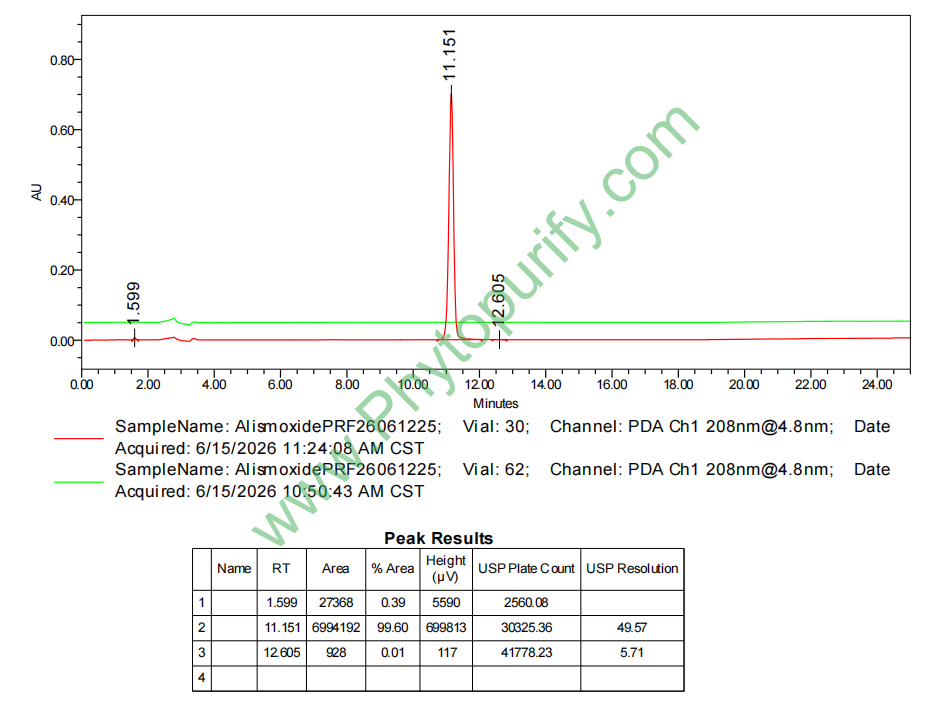
Purity: 95%~99%
Analysis Method: HPLC-DAD or/and HPLC-ELSD
Identification Method: Mass, NMR
Packing: Brown vial or HDPE plastic bottle
Can be supplied from milligrams to grams.
For Reference Standard and R&D, Not for Human Use Directly.
Inquire for bulk scale.
HPLC of Alismoxide
Storage conditions:Short-term storage at 2~8℃, long-term storage at -20 ~ -80℃
40.4600
2.9657
2.9659
.2073
4.3788
4.9209
High
62.7873
4.3516
No
Yes
No
No
No
No
0.0
Yes
No
Yes
Yes
Natural products, as an important treasure trove for drug discovery and development, play an irreplaceable role in the long history of human fight against diseases. Among them, terpenoids have always been a hot topic in medicinal chemistry and pharmacology research due to their structural diversity and wide range of biological activities. Alismoxie (CAS: 87701-68-6), as a natural sesquiterpene compound, has attracted much attention in recent years due to its multi-target and multi pathway pharmacological activities. The initial research revealed its inhibitory effect on the contraction of isolated smooth muscles (such as bladder and blood vessels), suggesting its potential value in urinary and cardiovascular diseases. Subsequent studies further revealed that the compound exhibited growth inhibitory activity at the cellular level and demonstrated significant effects in anti-inflammatory and anti allergic models. What is particularly noteworthy is that its pharmacological action network intersects extensively with key targets of major health problems such as metabolic diseases, inflammation, and tumors, such as AMPK, STAT3, NFE2L2, etc. This suggests that epoxides may not only be a single active lead compound, but also a molecule with potential for pleiotropic therapy. This article aims to provide a systematic review of the chemical properties, plant sources, pharmacological activities, mechanisms of action, pharmacological properties, and clinical application prospects of epoxides, in order to provide comprehensive scientific references for the in-depth research and development of this compound.
Epoxy Zexiene is an oxygen-containing sesquiterpene compound with the chemical name (1S, 4R, 5S, 10S) -10-vinyl-5-isopropylbicyclo [4.4.0] -1-decen-7-one-1,8-epoxide. Its molecular formula is C15H22O2 and its molecular weight is 238.3710. Structurally, its core skeleton is a bicyclic [4.4.0] decene system, which contains a key epoxyethane group (1,8-epoxide) and an α, β - unsaturated ketone structure (7-keto group). Epoxy groups and α, β - unsaturated ketones are important pharmacophores, often related to the reactivity of nucleophiles and the covalent or non covalent binding ability with biological targets, which may be the structural basis for their various biological activities.
Its physicochemical properties have a decisive impact on its bioavailability and medicinal properties. Calculation and experimental data indicate that the lipid water partition coefficient (LogP) of epoxyzeolitic acid is about 2.97, belonging to the moderate lipophilic category, which is conducive to its penetration of cell membranes. The topological polar surface area (TPSA) is 40.46 Å ², which is relatively low, indicating that the molecular polarity is not large, which is consistent with its good membrane permeability prediction. The predicted value of water solubility is about 0.21 mg/mL, which belongs to slight solubility, indicating that solubilization strategies may need to be considered in formulation development. It is worth noting that its blood-brain barrier (BBB) penetration is predicted to be "high", indicating that the compound has the potential to act on central nervous system related targets. In terms of early safety warning, the hERG inhibition risk prediction is "no", and the Ames mutagenicity test prediction value is 0.0, indicating a low risk of cardiac toxicity and genetic toxicity, providing preliminary positive signals for its safety as a lead compound.
Epoxy Zexieene is mainly derived from the traditional Chinese medicine Zexie(Alisma orientale (Sam.) Juz., Commonly classified as Alisma plantago-aquatica subsp. orientale)Dry tubers. Zexie, in traditional Chinese medicine theory, has the effects of promoting diuresis and dampness, relieving heat, and reducing turbidity and cholesterol. It is commonly used to treat conditions such as difficulty urinating, edema and fullness, diarrhea and oliguria, phlegm induced dizziness, and hyperlipidemia. Modern research has shown that the chemical composition of Alisma is complex, mainly including triterpenoids (such as Alismatal alcohols A, B, C, etc.), sesquiterpenes (such as epoxides and sesquiterpenes), diterpenes, and sugars, among which sesquiterpenes are considered as one of its important active substance bases.
Organic solvent extraction combined with various chromatographic separation techniques is commonly used to extract and separate epoxyhexene from Alisma. The conventional process is as follows: first, the dried tubers of Alisma are crushed, and then subjected to reflux extraction or ultrasound assisted extraction with ethanol or methanol. The extracted liquids are combined and concentrated under reduced pressure to obtain the total extract. Subsequently, the extract was suspended in water and extracted sequentially with organic solvents such as petroleum ether and ethyl acetate. Epoxyalisene is mainly enriched in petroleum ether or ethyl acetate fractions. Further purification relies on column chromatography technology, often using silica gel as the stationary phase and gradient elution with solvents such as petroleum ether ethyl acetate or n-hexane acetone in different ratios. By monitoring with thin layer chromatography (TLC) or high performance liquid chromatography (HPLC), collecting the fractions containing the target components, and then repeatedly performing preparative thin layer chromatography (PTLC) or semi preparative/preparative HPLC, high-purity epoxyhexene monomer can ultimately be obtained. In recent years, modern separation techniques such as high-speed countercurrent chromatography (HSCCC) have also been applied to the efficient preparation and separation of such natural products. Optimizing the extraction process, such as using response surface methodology to optimize extraction temperature, time, solvent ratio, etc., can help improve the yield of the target compound.
A large number of in vitro and in vivo pharmacological studies have revealed the extensive biological activities of epoxides, covering multiple fields such as the urinary system, cardiovascular system, anti-inflammatory and anti allergic effects, anti-tumor effects, and metabolic regulation.
Relaxing effect on smooth muscles One of the earliest activities of epoxides that received attention was their regulation of smooth muscle function. Research has shown that it can significantly inhibit isolated bladder smooth muscle contraction induced by carbachol (a cholinergic receptor agonist), suggesting that it may alleviate bladder overactivity symptoms through anticholinergic or intracellular calcium signaling pathways. Meanwhile, the compound also has an inhibitory effect on high concentration KCl induced vasoconstriction. KCl mainly induces calcium influx and vasoconstriction by depolarizing the cell membrane and opening voltage dependent calcium channels. The inhibitory effect of epoxides on this suggests that they may have the potential to block calcium channels or affect intracellular calcium release, providing preliminary evidence for the development of their cardiovascular protective effects (such as anti hypertension).
Anti inflammatory and anti allergic activity Epoxyalisene has shown clear inhibitory effects in a type III allergic reaction model. In the direct passive Arthus response (DPAR) model of rats, this compound can significantly inhibit local inflammatory responses. The DPAR reaction involves a series of processes such as immune complex deposition, complement activation, neutrophil infiltration, and release of inflammatory mediators. The inhibitory effect of epoxides suggests that they may intervene in the inflammatory pathway mediated by immune complexes. In addition, the α, β - unsaturated ketones in its structure may act as Michael reaction receptors, interacting with nucleophilic groups in inflammatory key proteins such as NF - κ B or related kinases, thereby exerting anti-inflammatory effects.
Antitumor and Cell Growth Inhibition Activity Research has shown that epoxides can inhibit cell growth in cell lines such as HeLa (human cervical cancer cells). This cytotoxic or growth inhibitory effect reveals its potential application value in the field of anti-tumor. Especially in the context of the potential use of "virus suppression cocktails", their effects may not be limited to directly killing tumor cells, but may also involve inhibiting virus related cell transformation or proliferation pathways. Its mechanism of action may be related to interfering with the cell cycle, inducing apoptosis, or autophagy.
Metabolic regulation related activities Although systematic research directly targeting the role of epoxides in metabolic diseases is still developing, its potential in metabolic regulation cannot be ignored based on its traditional use (turbidity reduction and lipid-lowering) as a source of traditional Chinese medicine, Alisma, and its known target associations. It may exert its effect by affecting energy metabolism, insulin signaling, lipid metabolism, and oxidative stress, and the specific mechanism will be described in detail in the next section.
The multiple pharmacological activities of epoxides derived from their interactions with multiple key biomolecule targets. According to existing research and bioinformatics analysis, its potential mechanism of action network involves multiple core biological processes such as energy metabolism, inflammation, oxidative stress, cell proliferation, and survival.
AMPK (PRKAA1) signaling pathway AMPK is the core sensor and regulator of cellular energy metabolism. Activation of AMPK can promote fatty acid oxidation, glucose uptake, inhibit lipid and protein synthesis, thereby improving insulin resistance and metabolic disorders. Alismanene epoxide may be used as an activator of AMPK, which provides a strong molecular basis for its treatment of metabolic diseases such as obesity, type 2 diabetes and non-alcoholic fatty liver disease.
STAT3 signaling pathway STAT3 is an important transcription factor, and sustained activation of STAT3 is closely related to tumor occurrence, development, immune escape, and chronic inflammation. Inhibiting the abnormal activation of STAT3 can induce tumor cell apoptosis, inhibit proliferation, and regulate the immune microenvironment. The potential inhibitory effect of epoxides on STAT3 may be one of the core mechanisms underlying its anti-tumor and anti-inflammatory activities.
Nrf2/NFE2L2 signaling pathway Nrf2 is the main transcription factor that regulates cellular antioxidant stress response. It protects cells from oxidative damage by inducing the expression of a series of phase II detoxifying enzymes and antioxidant proteins. Activating the Nrf2 pathway has a protective effect on metabolic diseases, neurodegenerative diseases, and inflammation related diseases. Epoxylactone may enhance the antioxidant defense ability of cells by activating Nrf2.
Other related targets:
Epoxyalisene may interact with specific structural domains of these target proteins through its active groups (such as covalent modification or allosteric regulation), forming a synergistic network that exerts its multifaceted regulatory effects on smooth muscle, inflammation, metabolism, and tumors. However, further biochemical and structural biology research is needed to confirm the direct binding evidence and precise mode of action with most targets.
Based on its physical and chemical parameters and preliminary biological activity data, a preliminary evaluation of the pharmacological properties of epoxyzeolitic acid was conducted.
Advantage:
1. Moderate molecular weight(238 Da), Meet the basic requirements of the "Five Rules" for drug properties.
2. Good permeability Moderate LogP values and low TPSA indicate good cell membrane permeability, and high BBB penetration predicts the possibility of treating central nervous system related diseases such as neuroinflammation.
3. Preliminary safety signal positive Predicting no hERG inhibition and Ames mutagenicity reduces the main safety risks of early development.
4. Multi-target activity May bring multiple therapeutic benefits, especially suitable for complex diseases such as metabolic syndrome.
Challenges and unknowns:
1. Poor water solubility The micro solubility characteristics may affect its oral absorption and in vivo distribution. In the development of formulations, technologies such as nanocrystals, solid dispersions, liposomes, or cyclodextrin inclusion should be used to improve its dissolution and bioavailability.
2. chemical stability Epoxy groups and α, β - unsaturated ketone structures may undergo ring opening or addition reactions under specific conditions (such as strong acids, strong bases, or nucleophilic environments), and their stability in gastrointestinal environments, plasma, and formulations needs to be investigated.
3. Lack of pharmacokinetic (PK) data Currently, there is very limited publicly available systematic PK research on epoxides such as absorption, distribution, metabolism, and excretion. The key PK parameters such as oral bioavailability, plasma protein binding rate, major metabolic organs, metabolites, and elimination half-life are still unknown. Its epoxy structure may become a metabolic site, which is metabolized by cytochrome P450 enzymes or hydrolytic enzymes. Conducting comprehensive in vitro metabolism (such as liver microsomal incubation) and in vivo PK studies is a necessary step to advance its development.
4. Potential off target effects The multi-target characteristic is a double-edged sword. While it brings synergistic therapeutic effects, it may also increase the risk of unforeseeable off target side effects, which needs to be carefully evaluated in preclinical studies.
As a natural lead compound with multi-target regulatory potential, epoxides have broad clinical application prospects, but the development path needs to be clearly planned.
Main therapeutic areas:
Future research directions and prospects:
Epoxy Zexieene is a sesquiterpene compound with a unique epoxy structure isolated from the traditional Chinese medicine Alisma. It not only inherits the traditional efficacy connotation of the source medicinal herbs of "promoting diuresis, eliminating turbidity and lowering cholesterol", but also demonstrates diverse biological activities beyond traditional cognition in modern pharmacological research, including smooth muscle relaxation, anti-inflammatory and anti allergic effects, cell growth inhibition, and potential metabolic regulation. Its mechanism of action involves multiple signaling pathways closely related to major diseases, such as AMPK, STAT3, Nrf2, highlighting its important value as a leading molecule for multi-target therapy. Despite facing challenges such as water solubility and lack of systematic pharmacokinetic data in drug development, its excellent membrane permeability, positive preliminary safety prediction, and clear multi effect activity have laid a solid foundation for its further development. In the future, through deep interdisciplinary cooperation, the molecular mechanism of its action will be thoroughly elucidated, and its in vivo efficacy and safety will be systematically evaluated. Based on this, rational drug chemistry optimization will be carried out. Epoxylaxene is expected to develop from an interesting natural product into a new drug candidate for the treatment of metabolic diseases, urinary system diseases, and related inflammations and tumors, injecting the wisdom of traditional medicine into modern drug development.
