


Product name: Ginsenoside Rg6
Synonym name:
Catalogue No.: BP1472
Cas No.: 147419-93-0
Formula: C42H70O12
Mol Weight: 767.01
Botanical Source: Ginseng Radix Et Rhizoma
Physical Description:
Type of Compound: Triterpenoids
Purity: 95%~99%
Analysis Method: HPLC-DAD or/and HPLC-ELSD
Identification Method: Mass, NMR
Packing: Brown vial or HDPE plastic bottle
Storage: Store in a well closed container, protected from air and light. Put into refrigerate or freeze for long term storage.
Whenever possible, you should prepare and use solutions on the same day. However, if you need to make up stock solutions in advance, we recommend that you store the solution as aliquots in tightly sealed vials at -20℃. Generally, these will be useable for up to two weeks.
The product could be supplied from milligrams to grams
Inquire for bulk scale.
Chengdu Biopurify Phytochemicals Ltd. is a leading company in the research, development, manufacture and marketing of High Quality Phytochemicals and Extracts(especially Active Ingredients from Traditional Chinese Medicine,TCM), Natural Active Pharmaceutical Ingredients worldwide.
The main services:
A. Supply active ingredients and reference standards of TCM, from mgs to kgs scale
B. Custom extraction and purification, target Herb Active Ingredients
C. Custom synthesis and semi-synthesis for Natural Active Ingredients
D. CR(contract research), CM(contract manufacture) and PD(process development) services from lab scale, pilot scale to commercial scale(GMP is also available)
E. TCM compounds library for drug screen,more than 3000 compounds available, many of them are rare and unique.
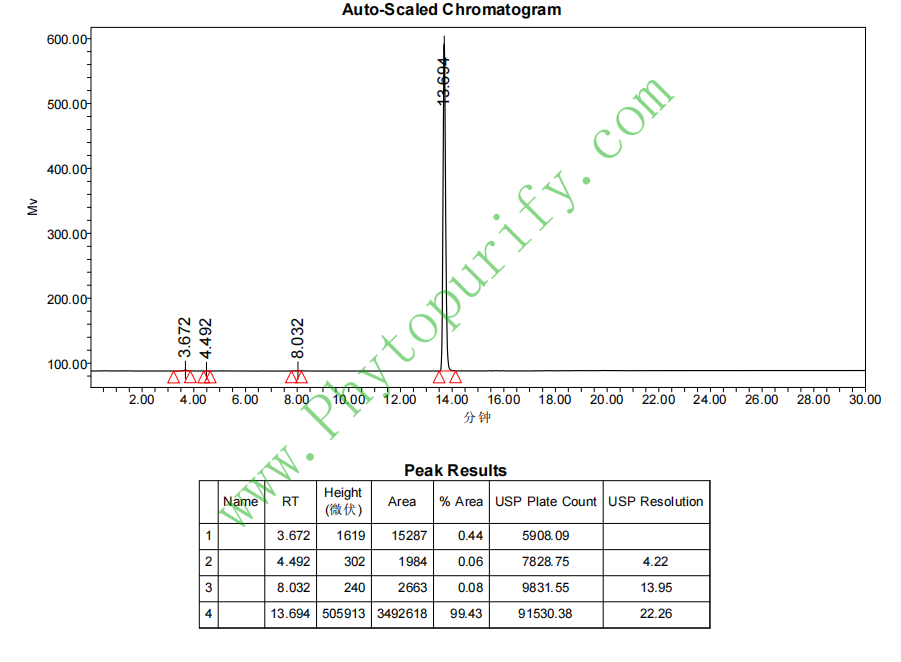
HPLC of Ginsenoside Rg6
Storage conditions:Short-term storage at 2~8℃, long-term storage at -20 ~ -80℃
198.7600
3.3122
3.3124
.0238
.6399
.2883
Low
71.9630
5.9551
No
No
No
No
No
No
0.0
Yes
No
Yes
No
Ginseng(Panax ginseng C. As a treasure of traditional medicine, the pharmacological activity of A. Mey. has attracted much attention. Its core active ingredient, ginsenosides, constitutes a diverse and complex family of natural compounds. Ginsenoside Rg6 (CAS number: 147419-93-0) is one of the rare and significantly biologically active protopanaxatriol saponins. Compared with common ginsenosides Rb1, Rg1, etc., the research on Rg6 started relatively late. However, in recent years, its unique pharmacological effects, especially in the field of anti-tumor potential, are increasingly becoming a hot topic in natural product pharmacology research. Preliminary studies have shown that ginsenoside Rg6 can effectively inhibit the transcription activity of nuclear factor kappa B (NF - κ B) induced by tumor necrosis factor - α (TNF - α) (IC50 of 29.34 μ M), and exhibits a clear induction of cell apoptosis, laying a solid theoretical foundation for its anti-tumor application. This article aims to systematically review the chemical structure, plant sources, extraction methods, pharmacological activity, mechanism of action, pharmacological evaluation, and clinical application prospects of ginsenoside Rg6, in order to provide comprehensive scientific references for the in-depth research and development of this compound.
Ginsenoside Rg6 belongs to the original panaxatriol type saponin, with a molecular formula of C42H70O13 and a molecular weight of 767.0100. Its chemical structure is characterized by its aglycone being protopanaxatriol, with the sugar chain partially connected at positions C-3 and C-20. Specifically, its C-3 position is connected to a disaccharide chain composed of glucose and rhamnose (Glc (2-1) Rha), while its C-20 position is connected to a single glucose unit. This specific glycosylation pattern is the key that distinguishes it from other ginsenosides such as Rg3, Rh2, etc., and profoundly affects its physicochemical properties and biological activity.
From the analysis of pharmacological parameters, the lipid water partition coefficient (LogP) of ginsenoside Rg6 is 3.3122, indicating its lipophilicity but not high hydrophobicity. Its topological polar surface area (TPSA) is as high as 198.7600 Å ², which is mainly attributed to the abundant hydroxyl groups and oxygen atoms on the sugar ring in the molecule, leading to its strong ability to form hydrogen bonds. The water solubility data is 0.0238, reflecting its low solubility in water, which is a common challenge faced by most ginsenoside compounds and a key issue that needs to be overcome in formulation development. In terms of absorption and distribution, its blood-brain barrier (BBB) permeability is predicted to be "low", indicating that it may not easily enter the central nervous system. This may reduce the risk of central nervous system side effects for the treatment of peripheral tumors. Preliminary safety predictions indicate that it does not inhibit hERG potassium channels (hERG inhibition: No), and the Ames test result is 0.0, suggesting a low potential mutagenic risk and a relatively good safety starting point.
Ginsenoside Rg6 is not the main saponin component in ginseng, and its content is relatively low. It mainly exists in ginseng (especially red ginseng) and American ginseng(Panax quinquefolius)And Sanqi(Panax notoginseng)Among the ginseng plants in the Araliaceae family. During the processing of red ginseng, such as steaming and drying, the original ginsenosides undergo conversion reactions such as deglycosylation and isomerization. As one of the products of these reactions, the content of Rg6 may increase. Therefore, red is often considered a good source of Rg6.
Due to its rare natural content, the acquisition of ginsenoside Rg6 mainly relies on isolation and purification from plant materials or preparation through biological/chemical transformation methods. The traditional extraction method usually uses solvent extraction, and commonly used solvents include methanol, ethanol, or ethanol water mixed solutions in different proportions. The crude extract is initially enriched by macroporous adsorption resins such as D101 and AB-8, and then finely separated using various modern chromatographic techniques, including normal/reverse phase silica gel column chromatography, high performance liquid chromatography (HPLC), and high-speed countercurrent chromatography (HSCCC). For example, by optimizing the conditions of preparative HPLC, high-purity Rg6 can be effectively isolated from total saponins of ginseng.
In addition, utilizing abundant saponin precursors (such as ginsenoside Rb1, Rg3, etc.) for biotransformation (such as microbial or enzymatic hydrolysis) or mild acid/alkali hydrolysis is an effective strategy for targeted preparation of Rg6. These methods can improve yield and provide a more sufficient material basis for pharmacological research and application development.
The pharmacological activity research of ginsenoside Rg6 is currently mainly focused on the field of anti-tumor, and has shown multiple effects.
Inhibition of NF - κ B pathway and anti-inflammatory effects NF - κ B is a key transcription factor that regulates inflammation, cell survival, and proliferation, and its abnormal activation is closely related to tumor occurrence, development, and drug resistance. Research has confirmed that ginsenoside Rg6 can dose dependently inhibit TNF - α - induced NF - κ B transcriptional activity in HepG2 liver cancer cells, with an IC50 value of 29.34 μ M. This effect means that Rg6 can block an important pro-inflammatory and pro survival signaling pathway, creating conditions for inhibiting tumor growth and enhancing chemotherapy sensitivity.
Inducing cell apoptosis Inducing tumor cell apoptosis is an important mechanism of anti-tumor drugs. Multiple studies have shown that ginsenoside Rg6 has apoptosis inducing effects on various cancer cell lines. It can cause a decrease in mitochondrial membrane potential, promote the release of cytochrome C, activate the caspase cascade reaction, and ultimately lead to cell apoptosis. This pro apoptotic effect is one of the core manifestations of its anti-tumor activity.
Inhibit cell proliferation, migration, and invasion In addition to inducing apoptosis, Rg6 can also effectively inhibit the proliferation of a variety of tumor cells (such as breast cancer, liver cancer, colon cancer cells, etc.). Further experiments have shown that it can also inhibit the migration and invasion ability of tumor cells, which is related to its regulation of matrix metalloproteinases (such as MMP2) activity, suggesting that Rg6 has potential anti-tumor metastasis effects.
Other potential activities Based on the activity of its structurally similar compounds, it is speculated that ginsenoside Rg6 may also have antioxidant, neuroprotective, and immune regulating effects, but direct experimental evidence in these areas is still needed to be enriched.
The anti-tumor effect of ginsenoside Rg6 involves synergistic regulation of multiple targets and pathways, and its known and potential targets include:
Apoptosis regulatory targets:
Transfer and angiogenesis related targets:
Nuclear targets and hormone regulation:
In summary, ginsenoside Rg6 forms a networked pharmacological mode of action by simultaneously acting on multiple key targets such as MCL1, BCL2, STAT3, MMP2, HIF1A, MAPK1, etc., synergistically exerting a comprehensive effect of inhibiting tumor cell proliferation, inducing apoptosis, anti migration invasion, and anti angiogenesis.
Although ginsenoside Rg6 has shown good anti-tumor activity in vitro, its pharmacological development still faces a series of challenges, which is also a bottleneck shared by most natural saponin compounds.
Absorption, distribution, metabolism, excretion (ADME) characteristics:
Challenges and Strategies in Pharmaceutical Science In order to improve its bioavailability, advanced drug delivery technology must be utilized. Potential strategies include: preparation into nano formulations (such as liposomes, polymer nanoparticles, solid lipid nanoparticles), self microemulsion delivery systems, phospholipid complexes, or cyclodextrin inclusion complexes. These technologies can improve its solubility, enhance intestinal absorption, and provide sustained release or targeted effects.
Preliminary evaluation of safety The existing computational prediction data (without hERG inhibition, Ames negative) provide preliminary positive signals for its safety. However, comprehensive preclinical safety evaluation, including acute toxicity, long-term toxicity, reproductive toxicity, and specific organ toxicity studies, is an essential part of future development.
Ginsenoside Rg6, as a multi-target anti-tumor natural lead compound, has broad clinical application prospects, but the road ahead is long.
Antitumor therapy The most direct application prospect of Rg6 is as an anti-tumor drug or adjuvant therapy drug. Its multi-target mechanism of action helps overcome the problem of resistance to single target drugs. It may be applicable to liver cancer, breast cancer, colon cancer and other solid tumors. Especially its inhibition of the NF - κ B and STAT3 pathways suggests that it may be used in combination with conventional chemotherapy or radiotherapy to enhance sensitivity and reduce toxicity.
Combination therapy and sensitizer Given its ability to induce apoptosis and inhibit survival signals, Rg6 has the potential to serve as a sensitizer for chemotherapy or targeted therapy in the treatment of drug-resistant tumors.
Functional Foods and Health Products On the basis of ensuring safety, low-dose Rg6 or its ginseng extract rich in Rg6 may be developed into functional foods or dietary supplements with anti fatigue, immune regulation, or cancer prevention potential.
Future research directions and challenges:
Ginsenoside Rg6 is an active natural product derived from the traditional medicinal plant ginseng, and its unique chemical structure endows it with multi-target anti-tumor pharmacological activity. By inhibiting key signaling pathways such as NF - κ B and STAT3, regulating BCL2 family proteins, and affecting metastasis related factors such as MMP2 and HIF1A, Rg6 can effectively inhibit tumor cell proliferation, induce apoptosis, and resist invasion and metastasis, demonstrating great potential for development. However, the low bioavailability caused by its poor solubility and permeability is the main bottleneck restricting its clinical application. Future research should focus on in-depth analysis of its molecular mechanism of action, systematic in vivo pharmacokinetics and safety evaluation, and using modern drug delivery technology to overcome formulation challenges. With the continuous deepening of these studies, ginsenoside Rg6 is expected to gradually develop from a promising lead compound into an important member of the anti-tumor drug family, or as an effective adjuvant therapy, providing new options for tumor treatment.
