


Product name: Ginkgolide A
Synonym name:
Catalogue No.: BP0646
Cas No.: 15291-75-5
Formula: C20H24O9
Mol Weight: 408.403
Botanical Source: Ginkgo biloba L.
Physical Description:
Type of Compound: Diterpenoids
Purity: 95%~99%
Analysis Method: HPLC-DAD or/and HPLC-ELSD
Identification Method: Mass, NMR
Packing: Brown vial or HDPE plastic bottle
Storage: Store in a well closed container, protected from air and light. Put into refrigerate or freeze for long term storage.
The product could be supplied from milligrams to grams
Inquire for bulk scale.
Description:
Ginkgolide A is a platelet-activating factor antagonist, it can inhibit the neurotoxicity of prions or amyloid-beta1-42, may be relevant treatments for prion or Alzheimer's diseases.Ginkgolide A has neuroprotective, and anxiolytic-like effects, it is widely used for the treatment of cardiovascular diseases and diabetic vascular complications, which might be achieved through regulating the STAT3-mediated pathway.
References:
Int Immunopharmacol. 2015 Apr;25(2):242-8.
Ginkgolide A reduces inflammatory response in high-glucose-stimulated human umbilical vein endothelial cells through STAT3-mediated pathway.
High-glucose-induced low-grade inflammation has been regarded as a key event in the onset and progression of endothelial dysfunction in diabetic vascular complications. Ginkgolide A (GA), a major compound from Ginkgo biloba extract, is widely used for the treatment of cardiovascular diseases and diabetic vascular complications. Here, its effect on high-glucose-stimulated vascular inflammation in human umbilical vein endothelial cells (HUVECs) was investigated.
METHODS AND RESULTS:
In the present study, the optimal stimulation conditions for HUVECs were screened for inducing endothelial inflammation, namely, high glucose at the concentration of 30mM for continuous 8h. The endothelial production of high-glucose-induced interleukin (IL)-4, IL-6, IL-13 and signal transducer and activator of transcription-3 (STAT-3) phosphorylation were significantly inhibited by the pretreatment with GA at concentrations of 10, 15 and 20μM based on enzyme-linked immunosorbent assay (ELISA), western blot or/and RT-PCR experiments. These senescent alterations induced by high glucose were significantly attenuated by the specific STAT3 inhibitor S3I-201 at the concentration of 20μM. Furthermore, the phosphorylation of STAT3, IL-4, IL-6, IL-13 and intercellular cell adhesion molecule-1 (ICAM-1) protein as well as mRNA levels were attenuated by the pretreatment of cells with STAT3 siRNA. Our results demonstrated that GA improved high-glucose-caused low-grade vascular inflammation, which might be achieved through regulating the STAT3-mediated pathway.
CONCLUSIONS:
These findings indicated that GA might be a promising candidate for attenuating vascular inflammation in diabetic vascular complications.
J Nat Prod. 2003 Oct;66(10):1333-7.
An anxiolytic-like effect of Ginkgo biloba extract and its constituent, ginkgolide-A, in mice.
The anxiolytic-like effects of Ginkgo biloba extract (GBE) and its four terpenoid components (Ginkgolide A, ginkgolide B, ginkgolide C, and bilobalide) were assessed using the elevated plus-maze test in mice.
METHODS AND RESULTS:
Administration of GBE as a single oral dose (0.5 or 1 g/kg, po) caused a state of suppressed motor activity and, thus, shortened the time spent in the open-sided arms. However, when GBE (0.063-1 g/kg, po) was administered daily for 7 days and the plus-maze test was carried out 24 h after the final administration, the time spent in the open-sided arms was prolonged, with the peak anxiolytic-like effect at 0.125 g/kg. A combination of seven-day administration of GBE (0.125 g/kg) and a single dose of diazepam (1 mg/ kg, po, 10 min before testing) enhanced the anxiolytic-like effect. Flumazenil (0.3 mg/kg, ip, 10 min before testing) blocked the effect of diazepam, but not of GBE. Daily administration of Ginkgolide A (1 or 2 mg/kg, po) resulted in an anxiolytic-like effect by the third treatment, with the maximal effect observed after the fifth administration. Neither ginkgolide B, ginkgolide C, nor bilobalide produced any anxiolytic-like effects. At doses higher than 0.5 g/kg, GBE not only inhibited motor activity but also suppressed active avoidance behavior, reduced caffeine-induced stimulation, and enhanced pentobarbital-induced sleep, while Ginkgolide A (up to 20 mg/kg) did not exhibit these effects. Diazepam (1 mg/kg) is known to enhance pentobarbital-induced sleep.
CONCLUSIONS:
These results suggest that GBE produces a significant anxiolytic-like effect following repeated administration and that Ginkgolide A is most likely responsible for this effect. There are also indications that although GBE exerts a sedative effect at comparatively higher doses, Ginkgolide A has a relatively weak tendency to produce benzodiazepine-like side effects.
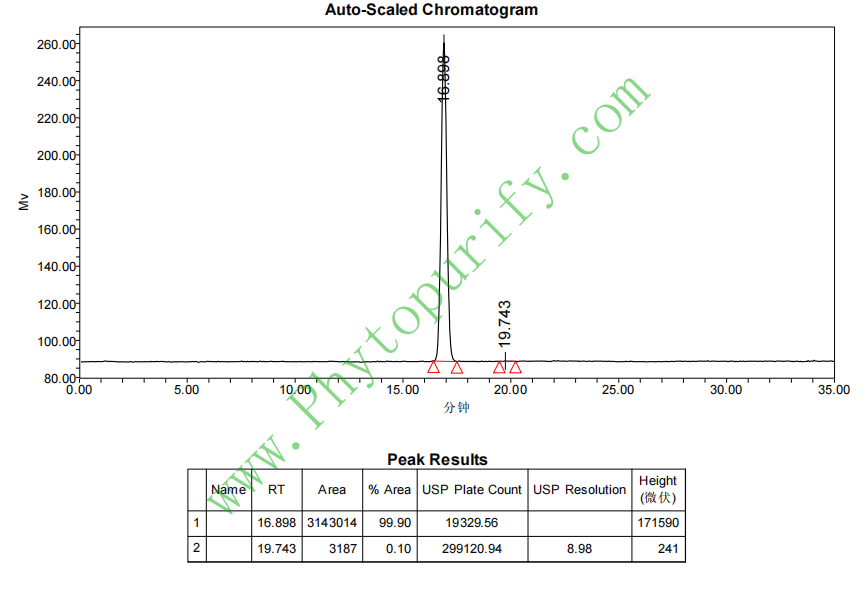
HPLC of Ginkgolide A
Storage conditions:Short-term storage at 2~8℃, long-term storage at -20 ~ -80℃
128.5900
.7444
.7442
.1950
1.6191
6.4200
High
28.3921
6.2377
Yes
No
No
No
Yes
No
0.9
Yes
No
No
Yes
Ginkgolide A (CAS number: 15291-75-5), as one of the important terpenoid lactones in Ginkgo biloba leaves, has received widespread attention since its isolation and identification in the late 20th century due to its unique chemical structure and diverse biological activities, especially its potential in the field of neuroprotection. Ginkgo biloba leaf extract has been widely used in traditional medicine for a long time. Modern pharmacological studies have revealed that its main active ingredients, ginkgolides, have multiple pharmacological effects such as anti platelet aggregation, anti-inflammatory, antioxidant, and neuroprotective properties. Ginkgolide A, as a natural GABA receptor antagonist, has shown the ability to regulate neurotransmitter function and protect nerve cells from damage, making it a hot molecule in the study of neurodegenerative diseases and related neurological pathological states.
This article aims to systematically review the chemical structure and physicochemical properties, plant sources, and extraction methods of ginkgolide A, explore its pharmacological activity and mechanism of action, focus on analyzing its molecular targets related to neuroprotection, evaluate its pharmacological and pharmacokinetic characteristics, and look forward to its potential and challenges in clinical applications. By integrating the latest research progress, provide theoretical basis and research direction for the drug development and clinical translation of ginkgolide A.
Ginkgolide A has a molecular formula of C20H24O9 and a molecular weight of 408.4030, belonging to the sesquiterpene lactone class. Its structural feature is a unique triterpenoid skeleton containing multiple lactone rings and hydroxyl groups, endowing it with strong biological activity. There are multiple oxidative functional groups in the chemical structure, including lactone rings and alcohol hydroxyl groups, which have important effects on the hydrophilicity of molecules and their binding to biological targets.
In terms of physicochemical properties, the LogP value of ginkgolide A is 0.7444, indicating its moderate lipid solubility, which is beneficial for penetrating cell membranes and the blood-brain barrier. Its topological polar surface area (TPSA) is 128.59 Å ², indicating high polarity characteristics that may affect its oral absorption and bioavailability. The water solubility is 0.1950 mg/mL, which belongs to low solubility compounds, indicating the need to consider solubility enhancement strategies in formulation development. Importantly, ginkgolide A has a high blood-brain barrier permeability, which lays the foundation for its neurological function. In addition, the hERG channel inhibition experiment showed a negative result, indicating a low risk of cardiac toxicity; The Ames mutagenicity test score is 0.9, indicating a low risk of genotoxicity and good safety potential.
Ginkgolide A mainly comes from the leaves of Ginkgo biloba L., which is a living fossil plant rich in various bioactive components. The content of ginkgolides in Ginkgo biloba leaves is relatively low, usually accounting for a small portion of the total terpenoid lactones, but their biological activity is significant.
The extraction of ginkgolide A is usually carried out using organic solvent extraction combined with chromatographic separation and purification techniques. Common extraction solvents include ethanol, methanol, and their aqueous solutions to ensure the dissolution of active ingredients. The extraction process generally includes the following steps:
In recent years, green and efficient technologies such as ultrasound assisted extraction and microwave-assisted extraction have gradually been applied to the extraction of ginkgolide A, significantly improving extraction efficiency and reducing solvent usage. In addition, molecular imprinting technology and membrane separation technology have also been explored for high-purity separation of ginkgolides.
The pharmacological activity of ginkgolide A mainly focuses on neuroprotective effects, and also exhibits anti-inflammatory, antioxidant, and neurotransmitter regulating functions. Its properties as a GABA receptor antagonist make it potentially valuable in regulating neural excitability and improving cognitive function.
Numerous in vitro and in vivo studies have shown that ginkgolide A can exert neuroprotective effects through multiple signaling pathways. Its main manifestations are:
The neuroprotective effect of ginkgolide A involves multi-target and multi pathway synergistic regulation. The main targets and their mechanisms of action are as follows:
Ginkgolide A exerts a comprehensive neuroprotective effect through the synergistic action of multiple targets mentioned above, demonstrating its advantages as a multi-target drug.
The pharmacological evaluation of ginkgolide A shows that it has good potential for drug development:
In the future, further systematic research is needed on its pharmacokinetic parameters, including absorption, distribution, metabolism, excretion (ADME) characteristics and potential drug interactions, to provide a basis for clinical dose design.
Ginkgolide A has shown broad application prospects in the treatment of neurodegenerative diseases, cerebrovascular diseases, and cognitive impairments due to its significant neuroprotective effects. Especially in disease models such as Alzheimer's disease, Parkinson's disease, and ischemic brain injury, ginkgolide A regulates neuropathological processes through multiple targets, improves neurological function, and has potential disease modifying effects.
Preclinical studies support that ginkgolide A, as an active ingredient in monomeric drugs or Ginkgo biloba leaf extracts, has the potential to be developed as a therapeutic drug for neurological diseases. Combining modern drug delivery technologies such as nanocarriers, liposomes, etc., it is expected to overcome their solubility limitations, enhance bioavailability and targeting.
Future research directions include:
In summary, ginkgolide A, as a multi-target neuroprotective natural product, has great potential as a drug and is expected to become an important candidate for the treatment of neurological diseases in the future.
Ginkgolide A, as an important active ingredient in Ginkgo biloba leaves, has become a focus of natural product pharmacology research due to its unique chemical structure and multi-target neuroprotective effects. Its comprehensive effects in antioxidant, anti-inflammatory, anti apoptotic, and neurotransmitter regulation provide new ideas and strategies for the treatment of neurodegenerative diseases. Although there are still certain challenges in pharmacokinetics and clinical applications, with the continuous progress of extraction technology, drug delivery systems, and molecular mechanism research, the drug development prospects of ginkgolide A are broad. In the future, through interdisciplinary collaborative research, it is expected to promote the transition of ginkgolide A from laboratory to clinical use, benefiting a large number of patients with neurological diseases.
