| Catalog No | Package | Original Price | Price | Inventory | Quantity | Operating |
|---|---|---|---|---|---|---|
| BP3914-5mg | 5mg | $290.00 | Sign in |
|


Storage conditions:Short-term storage at 2~8℃, long-term storage at -20 ~ -80℃
277.9100
2.5658
2.5655
.0534
.5623
.3512
Low
74.7766
6.4788
No
No
No
No
No
No
0.0
Yes
No
Yes
Yes
Natural products, as an important source of drug discovery, have always played an irreplaceable role in the long struggle between humans and diseases. Among the numerous natural compounds with biological activity, those from the Apiaceae family belong to the genus Bupleurum(Bupleurum L. The triterpenoid saponins in plants have attracted much attention due to their extensive pharmacological activities and long clinical application history. Chaihu, as one of the most commonly used herbs in traditional Chinese medicine, was first recorded in the "Shennong Bencao Jing" and is listed as a top-grade herb. It has the effects of harmonizing the exterior and interior, soothing the liver and relieving depression, and elevating yang qi. Modern pharmacological research has confirmed that Chaihu and its active ingredients exhibit significant activities in antipyretic, anti-inflammatory, hepatoprotective, antiviral, immunomodulatory, and anti-tumor aspects.
Saikosaponins are the main active ingredient group in Bupleurum chinense, belonging to the oleanane type pentacyclic triterpenoid saponins. Since the 1960s, over 100 monomers of saikosaponin have been isolated and identified, among which saikosaponin a, c, and d are the most extensively studied representative components. However, with the advancement of separation techniques and structural identification methods, some trace saponins with low content but unique biological activity have gradually entered the field of researchers. Saikosaponin I (SSI) is one of them. This compound was first synthesized in 1986 Bupleurum falcatum L. The unique chemical structure and potential pharmacological activity of it, especially its enormous potential in the field of antiviral research in recent years, have made it an emerging hotspot in natural product pharmacology research.
This article aims to provide a systematic review of the research status of saikosaponin I, covering its chemical structure and physicochemical properties, plant sources and extraction methods, pharmacological activity, mechanism of action, drug evaluation, and clinical application prospects, in order to provide comprehensive scientific basis for the in-depth development and utilization of this compound.
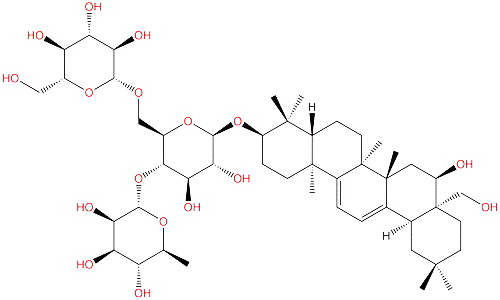
The chemical structure of saikosaponin I belongs to the oleane type pentacyclic triterpenoid saponin. Its aglycone is a derivative of epoxyoleanolic acid. Specifically, its parent nucleus structure forms a double bond between the C-11 and C-13 positions of oleanolic acid, and a unique ether bridge between the C-13 and C-28 positions, forming a 13,28-epoxyoleanane skeleton. This characteristic structure is one of the key distinguishing features of saikosaponin from other triterpenoid saponins.
In the sugar chain, saikosaponin I is connected to a straight chain oligosaccharide chain consisting of two sugar units at position C-3. Normally, this sugar chain is composed of β - D-glucose and β - D-fucose, where fucose is directly connected to the hydroxyl group at position C-3 of the glycoside, while glucose is connected to fucose through a (1 → 3) glycosidic bond. In addition, there may be an acetyl group (- OAc) attached to the C-16 position, which further increases the complexity of its structure. Its specific chemical structural formula can be expressed as: 3 β, 16 β, 23,28-tetrahydroxy-13,28-epoxyolean-11-ene-3-O - β - D-glucopyranosyl - (1 → 3) - β - D-fucosyl glycoside. Its molecular formula is C ₄₈ H ₇₈ O ₁₇, and its molecular weight is 927.1350 g/mol.
From the perspective of physicochemical properties, saikosaponin I exhibits typical saponin characteristics. It is a white or off white amorphous powder with certain hygroscopicity. Its lipid water partition coefficient (LogP) is 2.5658, indicating that it has a certain degree of lipophilicity, but also a certain degree of hydrophilicity, which is related to the presence of multiple hydroxyl and sugar groups in its molecule. Its total polar surface area (TPSA) is as high as 277.91 Å ², mainly attributed to the large number of hydroxyl and ether oxygen atoms in the molecule. A high TPSA value usually indicates that the compound is difficult to passively diffuse through the cell membrane, especially the blood-brain barrier (BBB). Its solubility has been calculated to be 0.0534 mg/mL, which belongs to the category of slight solubility. In addition, the compound may have weak end absorption under ultraviolet light, and the conjugated system in its structure (such as 11,13-ene) makes it detectable at specific wavelengths. These physicochemical properties lay the foundation for its subsequent extraction, separation, analysis, and biological activity research.
Chaihu saponin I was originally derived from plants of the Bupleurum genus in the Umbelliferae family Bupleurum falcatum L. Separated from (Chaihu Mishima). However, as research deepened, it was found that the compound was not B. falcatum Unique to it. It is widely present in the roots and rhizomes of various Bupleurum plants, including but not limited to Bupleurum chinense DC. (Bupleurum chinense)Bupleurum scorzonerifolium Willd. (South Chaihu)Bupleurum marginatum Wall. ex DC. (Zhuye Chaihu) and Bupleurum kaoi Liu, Chao&Chuang (Gao's Chaihu) and others. There are significant differences in the content of saikosaponin I among different species, origins, harvest seasons, and medicinal parts (roots, stems, leaves). Usually, the content in the roots is higher than that in the aboveground parts, and as the plant grows for more years, its accumulation also changes. It is worth noting that the content of saikosaponin I in plants is usually much lower than that of the main components such as saikosaponin a, c, and d, and it belongs to trace or secondary metabolites, which poses certain challenges for its large-scale preparation.
For the extraction of saikosaponin I, the classic solvent extraction method combined with modern separation and purification techniques is currently mainly used. The selection of extraction solvent is crucial. Given its slight solubility in water and easy solubility in polar organic solvents such as methanol and ethanol, methanol or different concentrations of ethanol (such as 70% ethanol) are often used as extraction solvents. The extraction methods include:
After obtaining the crude extract of total saponins, further separation and purification are required to obtain high-purity monomers of saikosaponin I. Common separation and purification strategies include:
In recent years, there has been an increasing amount of research on the pharmacological activity of saikosaponin I, which has shown potential biological activity in multiple fields such as antiviral, anti-inflammatory, hepatoprotective, and anti-tumor effects. Among them, the research on antiviral effects is the most prominent.
1. Antiviral activity
This is currently the most concentrated area of research on saikosaponin I. Research has shown that SSI has inhibitory effects on various viruses.
2. Anti inflammatory activity
Inflammation is a common pathological basis for many diseases, such as hepatitis and nephritis. SSI inherits the typical anti-inflammatory properties of the saikosaponin family. Research has shown that SSI can significantly inhibit the production of nitric oxide (NO), prostaglandin E2 (PGE2), as well as pro-inflammatory cytokines such as tumor necrosis factor - α (TNF - α) and interleukin-6 (IL-6) in macrophages stimulated by lipopolysaccharide (LPS). Its mechanism of action is closely related to the inhibition of the activation of nuclear factor kappa B (NF - κ B) and mitogen activated protein kinase (MAPK) signaling pathways. By blocking these key inflammatory signaling pathways, SSI can effectively alleviate inflammatory responses.
3. Liver protective activity
Chaihu is an essential medicine in traditional Chinese medicine for treating liver disease. SSI, as one of the active ingredients of Bupleurum chinense, also exhibits significant hepatoprotective effects. In animal models of acute liver injury induced by carbon tetrachloride (CCl ₄) or D-galactosamine (D-GalN), SSI pretreatment can significantly reduce the levels of alanine aminotransferase (ALT) and aspartate aminotransferase (AST) in serum, alleviating pathological damage to liver tissue such as necrosis and steatosis. Its hepatoprotective mechanism may be related to its antioxidant, anti-inflammatory, and inhibition of liver cell apoptosis. SSI can eliminate free radicals, increase the activity of endogenous antioxidant enzymes in the liver (such as superoxide dismutase (SOD) and glutathione peroxidase (GSH Px)), and inhibit the activation of hepatic stellate cells, thereby exerting its potential in anti liver fibrosis.
4. Antitumor activity
Some preliminary studies have explored the anti-tumor activity of SSI. The results showed that SSI could inhibit the proliferation of many human cancer cell lines (such as HepG2, A549 and MCF-7 of breast cancer). Its mechanism of action may involve inducing cell cycle arrest (such as G0/G1 phase arrest) and promoting cell apoptosis (through the mitochondrial pathway or death receptor pathway). However, compared to classic anti-tumor saponins such as saikosaponin d, SSI has relatively weaker cytotoxicity, but its toxicity to normal cells is also lower, demonstrating a certain degree of selectivity. In the future, SSI may be used as a low toxicity adjuvant therapy drug or as a lead compound for structural modification.
The pharmacological activity of saikosaponin I is the result of its interaction with multiple molecular targets. Its mechanism of action exhibits the characteristics of multi-target and multi pathway.
1. Mechanism of antiviral action
The antiviral mechanism of SSI is complex and not a single target. According to existing research, its potential targets include:
2. Anti inflammatory mechanism
The anti-inflammatory effect of SSI is mainly achieved through the regulation of key inflammatory signaling pathways.
3. Liver protective mechanism
To develop natural products into clinical drugs, a systematic evaluation of their drug like and pharmacokinetic (ADME) properties is necessary.
1. Analysis of pharmacological parameters
Based on the provided pharmacological parameters, a preliminary evaluation of SSI can be conducted:
Overall, the challenges of SSI's pharmaceutical potential mainly lie in its high molecular weight, high polarity, and poor water solubility, which may result in low oral absorption and bioavailability. But its good safety (low hERG risk, no mutagenicity) provides a foundation for its development.
2. Pharmacokinetic characteristics
At present, there are few direct research reports on the pharmacokinetics of SSI in vivo, but it can be inferred based on the ADME characteristics of its structural analogues (such as saikosaponin a, d).
Although saikosaponin I faces challenges in drug development, its unique pharmacological activities, especially broad-spectrum antiviral and anti-inflammatory activities, have opened up broad prospects for its clinical application.
1. Development of antiviral drugs
Given that SSI has inhibitory effects on various viruses such as HSV, HIV, HCMV, and its mechanism of action involves multiple targets, making it less likely to develop drug resistance, it is expected to be developed as a novel antiviral drug. Especially for HSV infection, the commonly used nucleoside analogues in clinical practice, such as acyclovir, have resistance issues. SSI, as a non nucleoside inhibitor, may provide a new treatment option for drug-resistant HSV infections. In addition, the anti HIV activity of SSI is also worthy of further exploration, as its multi-target properties (inhibition of RT and INT, downregulation of co receptors) make it a potential complementary or alternative component to highly effective antiretroviral therapy (HAART).
2. Development of anti-inflammatory and hepatoprotective drugs
The anti-inflammatory and hepatoprotective activities of SSI make it potentially valuable in the treatment of inflammation related diseases such as chronic hepatitis, liver fibrosis, and nephritis. Its low toxicity and multi-target action characteristics make it a safe and effective adjuvant therapy drug. For example, it can be developed into oral formulations (although with low bioavailability, effective ingredients may be produced through gut microbiota metabolism) or injections for long-term management of chronic liver disease.
3. Research on drug delivery systems
In order to overcome the bottleneck of low oral bioavailability of SSI, future research should focus on developing novel drug delivery systems. For example:
4. Research on Structure Modification and Structure Activity Relationship
The systematic structural modification of SSI and the study of its structure-activity relationship (SAR) are key to discovering derivatives with stronger activity and better drug properties. For example, you can explore:
Chaihu saponin I, as an important trace triterpenoid saponin component in plants of the Chaihu genus, exhibits enormous pharmacological potential beyond its content due to its unique 13,28-epoxyoleanane skeleton and diverse sugar substitutions. From antiviral, anti-inflammatory to hepatoprotective, its multi-target mechanism of action gives it unique advantages in treating complex diseases. However, its inherent physicochemical properties, such as high molecular weight, high polarity, and low water solubility, result in low oral bioavailability, becoming the main obstacle on its clinical translation path.
Future research needs to focus on improving its drug properties through medicinal chemistry (structural modification, prodrug design) and pharmacology (novel delivery systems) based on a deeper understanding of its mechanism of action and pharmacokinetic characteristics in vivo. Meanwhile, utilizing modern omics technologies such as proteomics and metabolomics, as well as systems biology methods, to comprehensively reveal its functional network and metabolic fate in vivo, will provide scientific guidance for more precise development of SSI and its derivatives. Despite the numerous challenges ahead, saikosaponin I is undoubtedly a highly valuable natural product lead compound, and its application prospects in the fields of antiviral and anti-inflammatory are worth looking forward to. With the continuous deepening of research, this "new star" in ancient Chinese medicine is expected to shine brightly in future clinical treatments.
Batch can search by a CAS number,one per line
