


Product name: Ginsenoside Rg1
Synonym name: Ginsenoside A2; Panaxoside A; Sanchinoside C1
Catalogue No.: BP0664
Cas No.: 22427-39-0
Formula: C42H72O14
Mol Weight: 801.024
Botanical Source: Panax ginseng (ginseng)
Physical Description: White powder
Type of Compound: Triterpenoids
Purity: 95%~99%
Analysis Method: HPLC-DAD or/and HPLC-ELSD
Identification Method: Mass, NMR
Packing: Brown vial or HDPE plastic bottle
Storage: Store in a well closed container, protected from air and light. Put into refrigerate or freeze for long term storage.
Whenever possible, you should prepare and use solutions on the same day. However, if you need to make up stock solutions in advance, we recommend that you store the solution as aliquots in tightly sealed vials at -20℃. Generally, these will be useable for up to two weeks.
The product could be supplied from milligrams to grams, up to kilograms
Inquire for bulk scale.
Descriptions:
Ginsenoside Rg1 is the main pharmacologically active compound of ginsenosides and has demonstrated pharmacological effects in the cardiovascular system, central nervous system and immune system; Rg1 has protective effect against Aβ25-35-induced toxicity in PC12 cells,might be through the insulin-like growth factor-I receptor (IGF-IR) and estrogen receptor (ER)signaling pathways.[1]
Ginsenoside Rg1 is often recommended for its antiaging effects,Rg1 supplementation improved the performance of aged mice in behavior test and significantly upregulated the expression of synaptic plasticity-associated proteins in hippocampus, including synaptophysin, N-methyl-D-aspartate receptor subunit 1, postsynaptic density-95, and calcium/calmodulin-dependent protein kinase II alpha, via promoting mammalian target of rapamycin pathway activation.[2]
Ginsenoside Rg1 increases the expression of the vascular endothelial growth factor (VEGF) mRNA and reduces expression of transforming growth factor beta (TGF-B) mRNA in wounded skin , suggests that Rg1 should be helpful for the promotion of wound healing.[3]
Ginsenoside Rg1 is a desirable agent for enhancing CD4+ T-cell activity, as well as the correction of Th1-dominant pathological disorders, which by increasing Th2 specific cytokine secretion and by repressing Th1 specific cytokine production.[4]
Ginsenoside Rg1 promotes proliferation, migration, adhesion and in vitro vasculogenesis.[5] Rg1 inhibits platelet activation via the inhibition of ERK pathway, and attenuates arterial thrombus formation in vivo.[6]
Ginsenoside Rg1 possesses the neuroprotective effects on inducing differentiation of ES cells into neurons in vitro via the GR-MEK-/2-K-signaling pathway.[7]
References:
[1] Chen W F, Zhou L P, Chen L, et al. Neurochem Int, 2013, 62(8):1065-71.
[2] Yang L, Zhang J, Zheng K, et al. Journals of Gerontology, 2014, 69(3):282-94.
[3] ???, ???, ???, et al. ??????????, 2010, 39(10):437-45.
[4] Lee E J, Ko E, Lee J, et al. Int Immunopharmaco, 2004, 4(4):235-44.
[5] Shi A W, Wang X B, Lu F X, et al. Acta Phamacol Sin, 2009, 30(3):299-306.
[6] Zhou Q, Jiang L, Xu C, et al. Thromb Res?, 2014, 133(1):57-65.
[7] Wu J, Pan Z, Cheng M, et al. Neurochem Int , 2012, 62(1):92-102.
[8] Jia G, Li M A, Han F. Journal of Tianjin University of Traditional Chinese Medicine, 2011(1):41-42.
HPLC of Ginsenoside Rg1
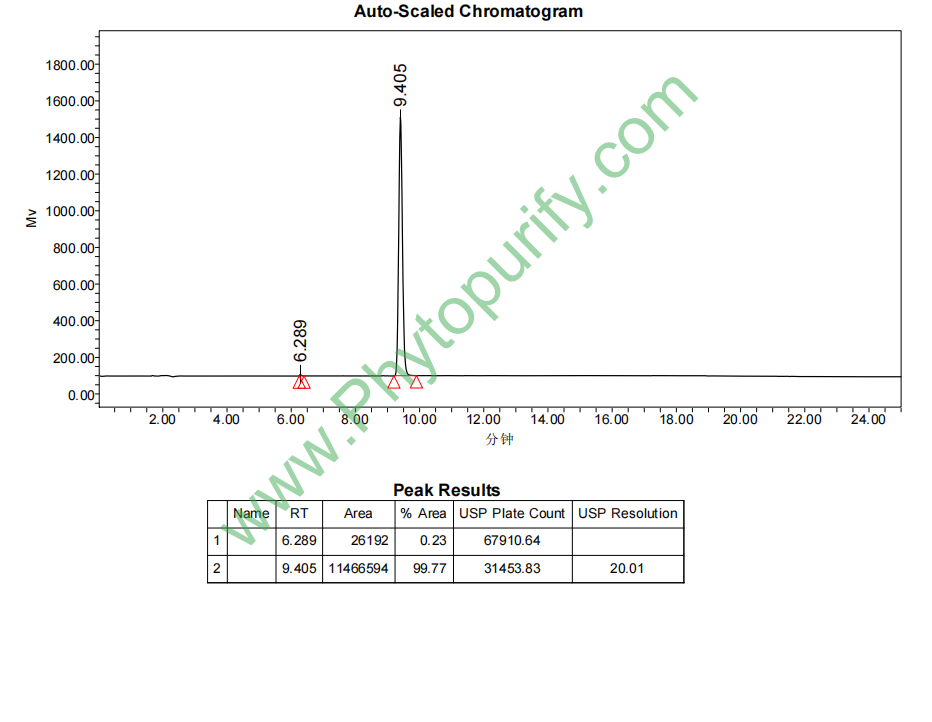
Storage conditions:Short-term storage at 2~8℃, long-term storage at -20 ~ -80℃
239.2200
2.6183
2.6183
.0772
.5324
.2168
Low
70.0582
6.0425
No
No
No
No
No
No
0.0
Yes
No
No
No
Ginseng(Panax ginseng C. As a treasure of traditional medicine, A. Mey. has a long history of medicinal use. Modern pharmacological research reveals that the extensive pharmacological activity of ginseng is mainly attributed to a class of triterpenoid saponins it is rich in - ginsenosides. Ginsenoside Rg1 (CAS: 22427-39-0) is a representative component of protopanaxatriol saponins and one of the core active substances in ginseng for its "intelligence enhancing and calming" effects. With the acceleration of global aging process, the incidence of neurodegenerative diseases such as Alzheimer's disease (AD) is increasing year by year, and the need for effective prevention and treatment strategies is increasingly urgent. In recent years, a large number of studies have focused on the neuroprotective effects of ginsenoside Rg1, confirming its significant potential in improving cognitive function and reducing neuropathological damage. This article aims to systematically review the chemical properties and pharmacological activities of ginsenoside Rg1, especially its multi-target and multi pathway neuroprotective mechanism, and evaluate and prospect its pharmacological properties and clinical application prospects.
The molecular formula of ginsenoside Rg1 is C42H72O14, with a molecular weight of 801.0240. Its chemical structure belongs to the damaane type tetracyclic triterpenoid saponin, with a sugar chain connected at positions C-3 and C-20. Specifically, its C-3 position is connected to a disaccharide chain composed of two molecules of glucose (Glc β 1 → 2Glc), and its C-20 position is connected to one molecule of glucose. This unique glycosylation pattern is a key characteristic that distinguishes it from other ginsenosides such as Rb1 and Re, and profoundly affects its physicochemical properties and biological activity.
From the analysis of parameters related to drug properties, the lipid water partition coefficient (LogP) of ginsenoside Rg1 is 2.6183, indicating that it has a certain degree of lipophilicity, but not high lipid solubility. Its topological polar surface area (TPSA) is as high as 239.2200 Å ², which is mainly attributed to the abundant hydroxyl and sugar structures in the molecule, resulting in strong polarity. The water solubility data is 0.0772, which belongs to slightly soluble or poorly soluble in water. These physical and chemical properties collectively determine its poor membrane permeability. More importantly, despite its neuroprotective activity, the predicted blood-brain barrier (BBB) permeability is "low", which has become one of the main pharmacokinetic barriers for its development as a therapeutic drug for central nervous system diseases. In addition, preliminary safety screening of the drug showed that the risk of hERG inhibition was "no", and the Ames test result was 0.0 (negative), indicating a low potential risk of cardiac and genetic toxicity and a good safety foundation.
Ginsenoside Rg1 is mainly derived from plants of the Panax genus in the Araliaceae family, including Asian ginseng(Panax ginseng)Western ginseng(Panax quinquefolius)And Sanqi(Panax notoginseng)Wait. The content varies in different varieties and parts, usually higher in the main roots and reed heads of ginseng.
The extraction and separation method follows the conventional process of natural product chemistry. Firstly, the dried ginseng raw materials were subjected to reflux extraction or ultrasound assisted extraction using methanol, ethanol, or ethanol water mixed solvents to obtain crude total saponins extract. Subsequently, enrichment and purification were carried out using macroporous adsorption resins (such as D101, AB-8), and gradient elution was performed using ethanol water solutions of different concentrations. Ginsenoside Rg1 is usually concentrated in specific elution segments. Further purification relies on techniques such as silica gel column chromatography, reverse phase silica gel column chromatography (such as ODS), and high-performance liquid chromatography (HPLC). Modern analytical techniques such as high-performance liquid chromatography evaporative light scattering detector/mass spectrometry (HPLC-ELSD/MS) have become the standard method for content determination and quality control. In recent years, green and efficient technologies such as supercritical fluid extraction and high-speed countercurrent chromatography have also shown potential for application in their extraction and separation.
Ginsenoside Rg1 has a wide range of pharmacological activities, including anti fatigue, immune regulation, anti-inflammatory, antioxidant, anti-tumor, cardiovascular protection, and endocrine regulation. among which,Neuroprotective activity It is the most widely studied and extensively researched direction, forming the core of this article's discussion.
Numerous in vitro and in vivo experiments have confirmed that ginsenoside Rg1 has a clear protective effect against nerve damage induced by multiple factors. In AD model studies, Rg1 significantly improved learning and memory impairments induced by APP/PS1 transgenic mice, A β oligomers, or scopolamine, and performed well in behavioral tests such as water maze and new object recognition. The effect of improving cognitive function is closely related to reducing the level of β - amyloid protein (A β) in the brain. In addition, in Parkinson's disease models, cerebral ischemia-reperfusion injury models, and stress-induced or drug-induced neuronal apoptosis models, Rg1 also demonstrated significant effects in reducing dopaminergic neuron loss, reducing cerebral infarction volume, and inhibiting neuronal apoptosis. These studies collectively establish a solid experimental foundation for ginsenoside Rg1 as a neuroprotective candidate drug.
The neuroprotective effect of ginsenoside Rg1 is not achieved through a single target, but through a complex network involving inhibition of A β production and aggregation, inhibition of tau protein hyperphosphorylation, anti apoptosis, antioxidant stress, anti neuroinflammation, and promotion of neuroplasticity.
In summary, ginsenoside Rg1 forms a synergistic neuroprotective network by acting on multiple key targets such as APP, BACE1, MAPT, GSK3B, BCL2, CASP9, NFE2L2, NF - κ B, SIRT1, MAPK1, etc. This is the molecular basis for its multi-level therapeutic effect.
Although the pharmacological activity of ginsenoside Rg1 is clear, there are significant challenges in its pharmacological and pharmacokinetic properties.
Absorption and bioavailability: Rg1 is rapidly but incompletely absorbed after oral administration, with low absolute bioavailability (usually<5%). This is mainly attributed to its large molecular weight, high polarity (high TPSA), and being excreted from the intestine as a substrate for P-glycoprotein (P-gp). It may also be partially hydrolyzed or metabolized by gut microbiota in the gastrointestinal tract.
Distribution: Rg1 is widely distributed in the body, but its predicted blood-brain barrier permeability is low, which is related to its high polarity and potential as a substrate for efflux transporters. This severely limits its effective exposure in the central nervous system and is a core bottleneck in the development of drugs for brain diseases. Research attempts to improve its brain targeting through structural modification, nano drug delivery systems, or the combined use of P-gp inhibitors.
Metabolism and excretion: Rg1 mainly undergoes deglycosylation metabolism in the liver and intestine, gradually losing its glycation and converting into secondary glycosides (such as Compound K), which may have different activities. The prototype drug and its metabolites are mainly excreted through the kidneys.
Formulation and delivery strategy: To improve its pharmacological properties, researchers have developed various novel delivery systems, including liposomes, nanoparticles, microemulsions, self microemulsifying systems, and phospholipid complexes. These strategies aim to improve its solubility, membrane permeability, delay metabolism, and enhance brain targeting, thereby enhancing its in vivo efficacy.
Ginsenoside Rg1 has shown broad clinical application prospects in the prevention and treatment of cognitive impairment and related neurodegenerative diseases. At present, ginseng extracts or compound preparations containing Rg1 have been circulated in the market as dietary supplements or health drugs for improving memory and anti fatigue. However, developing it into an innovative drug for treating diseases such as AD and vascular dementia still requires crossing the following key steps:
Ginsenoside Rg1, as the core active ingredient of ginseng, has demonstrated unique value in addressing the global health challenge of cognitive impairment and neurodegenerative diseases through its multi-target and multi pathway neuroprotective mechanisms. From inhibiting A β pathology and excessive phosphorylation of tau protein, to activating the Nrf2 antioxidant pathway, inhibiting NF - κ B-mediated inflammatory response, and regulating key signaling molecules such as SIRT1 and MAPK, Rg1 has constructed a synergistic neural defense network. Although its poor bioavailability and low blood-brain barrier permeability constitute the main obstacles on the path of drug development, modern pharmaceutical and medicinal chemistry strategies provide feasible solutions for this. In the future, through interdisciplinary deep integration, in-depth analysis of its system pharmacology mechanism, and advanced delivery technology to promote clinical translation, ginsenoside Rg1 is expected to transform from a traditional herbal active molecule into a modern drug for the prevention and treatment of neurodegenerative diseases, bringing new hope to the global aging society.
