


Product name: Ginsenoside Rc
Synonym name:
Catalogue No.: BP0660
Cas No.: 11021-14-0
Formula: C53H90O22
Mol Weight: 1079.28
Botanical Source: Panax ginseng (ginseng)
Physical Description: White powder
Type of Compound: Triterpenoids
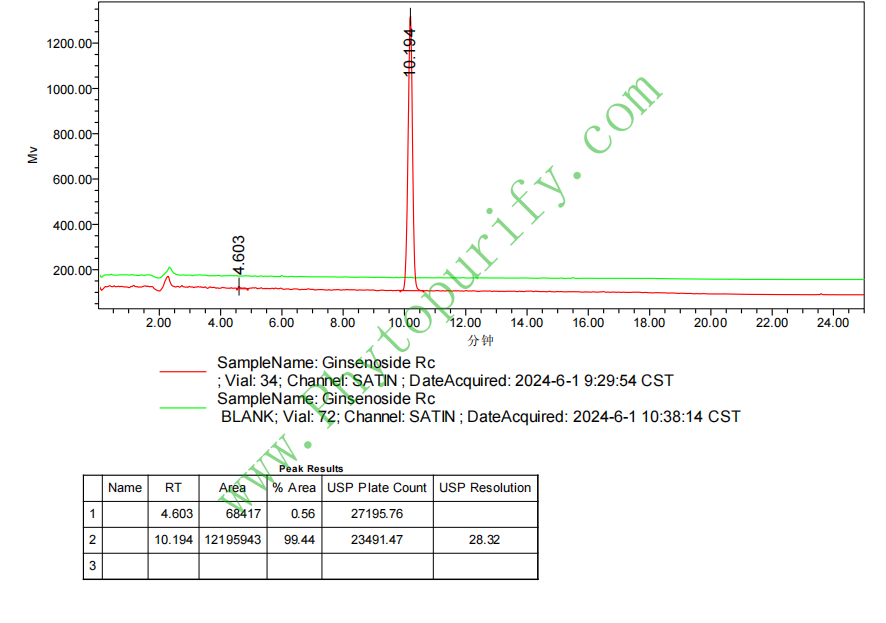
Purity: 95%~99%
Analysis Method: HPLC-DAD or/and HPLC-ELSD
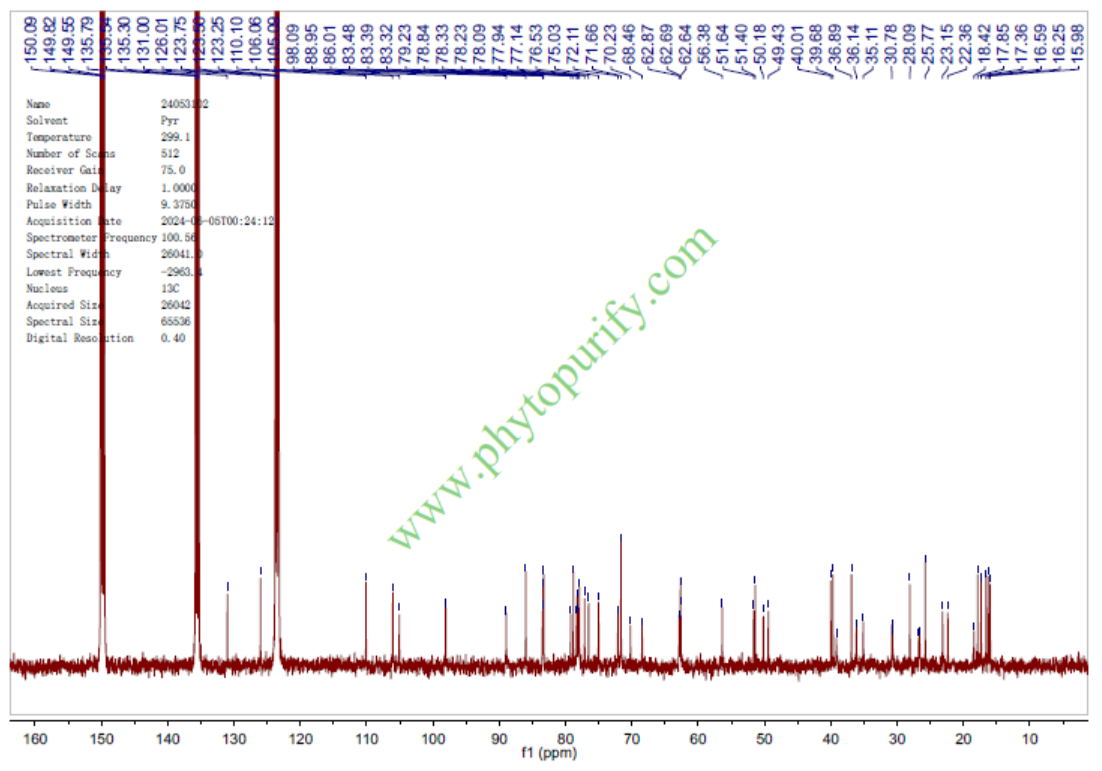
Identification Method: Mass, NMR
Packing: Brown vial or HDPE plastic bottle
Storage: Store in a well closed container, protected from air and light. Put into refrigerate or freeze for long term storage.
Whenever possible, you should prepare and use solutions on the same day. However, if you need to make up stock solutions in advance, we recommend that you store the solution as aliquots in tightly sealed vials at -20℃. Generally, these will be useable for up to two weeks.
The product could be supplied from milligrams to grams, up to kilograms
Inquire for bulk scale.
Descriptions:
Ginsenoside Rc (Rc), a protopanaxadiol type ginsenoside, is the active component mainly responsible for the therapeutic and pharmacologic properties of ginseng, which are derived from its suppression of superoxide-induced free radicals, Rc can modulate Forkhead box O (FoxO1)phosphorylation through activation of PI3K/Akt and inhibition of AMPK and FoxO1 acetylation through interaction with CBP and SIRT1, and that this leads to upregulation of catalase under conditions of oxidative stress.[1]
Ginsenoside Rc from Korean Red Ginseng (Panax ginseng C.A. Meyer) exhibits anticancer and anti-inflammatory activities, can attenuate inflammatory symptoms of gastritis, hepatitis and arthritis.[2]
Ginsenoside Rc and Re induce c-fos in MCF-7 human breast carcinoma cells at both the mRNA and protein levels, they act via other transcription factors and not via estrogen receptor in c-Fos expression.[3]
Ginsenoside Rc significantly enhances glucose uptake by inducing ROS generation, which leads to AMPK and p38 MAPK activation.,consequently, it can be used as a potent natural anti-diabetic agent.[4]
Ginsenoside Rc can promote anti-adipogenic activity on 3T3-L1 adipocytes by down-regulating C/EBPα and PPARγ.[5]
References:
[1] Kim D H, Chan H P, Park D, et al. Arch Pharm Res, 2014, 37(6):813-20.
[2] Tao Y, Man H R, Lee J, et al. Am J Chinese Med, 2016:1-21.
[3] Lee Y J, Jin Y R, Lim W C, et al. Arch Pharm Res, 2003, 26(1):53-7.
[4] Lee M S, Hwang J T, Kim S H, et al. J Ethnopharmacol, 2010, 127(3):771-6.
[5] Yang J W, Kim S S. Molecules, 2015, 20(1):1293-303.
[6] Gao Y, Zang P, Hao J, et al. J Med Plants Res. 2012,6(15):3030-6.
NMR of Ginsenoside Rc
HPLC of Ginsenoside Rc
Storage conditions:Short-term storage at 2~8℃, long-term storage at -20 ~ -80℃
357.0600
2.0931
2.0933
.1565
.4767
.1246
Low
68.5970
6.7865
Yes
No
No
No
No
No
0.0
Yes
No
No
No
Ginseng(Panax ginseng C. As a treasure of traditional medicine, A. Mey. has a medicinal history spanning thousands of years. Modern pharmacological research reveals that the extensive pharmacological activity of ginseng is mainly attributed to a class of triterpenoid saponins it is rich in - ginsenosides. Ginsenoside Rc is one of the important members of protopanaxadiol (PPD) saponins, which is abundant in ginseng, American ginseng and other plants of the Panax genus in the Araliaceae family. With the deepening of modern separation and identification techniques and molecular biology research, the various biological activities of ginsenoside Rc have gradually been revealed, especially in the field of neuroprotection, showing remarkable potential. Its function not only involves classic anti-inflammatory and antioxidant pathways, but has also been found to specifically regulate the function of gamma aminobutyric acid type A (GABAA) receptors and affect key pathological proteins in neurodegenerative diseases such as Alzheimer's Disease (AD). This article aims to systematically review the chemical properties, plant sources, pharmacological activities, molecular mechanisms of action, pharmacological evaluation, and clinical application prospects of ginsenoside Rc, in order to provide comprehensive scientific references for the in-depth research and development of this compound.
The chemical name of ginsenoside Rc is 3 β, 12 β, 20 (S) - trihydroxydamam-24-en-3-O - [β - D-glucopyranosyl (1 → 2) - β - D-glucopyranosyl] -20-O - β - D-xylopyranosyl (1 → 6) - β - D-glucopyranoside, and its CAS number is 11021-14-0. Structurally speaking, it belongs to the Damane type tetracyclic triterpenoid saponin and is a typical representative of PPD type saponins. Its aglycone is 20 (S) - protopanaxadiol, which is connected to a disaccharide chain consisting of two molecules of glucose (Glc (1 → 2) Glc) at the C-3 position and a disaccharide chain consisting of xylose and glucose (Xyl (1 → 6) Glc) at the C-20 position. The structure of these polyhydroxy and polysaccharide chains determines their basic physicochemical properties.
The molecular weight of ginsenoside Rc is 1079.2810, and the theoretical lipid water partition coefficient (LogP) is 2.0931, indicating that it has a certain lipophilicity, but not high lipid solubility. Its topological polar surface area (TPSA) is as high as 357.0600 Å ², which is mainly attributed to the large number of hydroxyl groups and oxygen atoms on the sugar ring in the molecule, resulting in strong polarity. The water solubility data is 0.1565 mg/mL, which belongs to the category of slightly soluble to poorly soluble, which poses challenges for its formulation development. Crystals are usually white powders. In terms of spectral characteristics, its structure can be confirmed by the chemical shifts of characteristic protons and carbon signals on glycosides and glycosides in nuclear magnetic resonance hydrogen (¹ H NMR) and carbon (¹ ³ C NMR) spectra. Excimer ion peaks such as [M+Na] ⁺ or [M-H] ⁻ can be observed in mass spectrometry (MS).
Ginsenoside Rc mainly comes from plants of the Panax genus in the Araliaceae family, including Asian ginseng(Panax ginseng)Western ginseng(Panax quinquefolius)And Sanqi(Panax notoginseng)Among them, the content is relatively high in ginseng roots. Its content is significantly affected by factors such as plant variety, growth period, harvest season, place of origin, and processing methods (such as red ginseng and white ginseng). Usually, the longer the growth period, the more abundant the accumulation of some rare saponins (including Rc) may be.
The extraction of ginsenoside Rc from plant materials usually follows the general extraction process of total ginsenosides, combined with precision separation techniques. The conventional extraction methods include:
1. Solvent extraction method The most commonly used method. Usually, methanol, ethanol, or ethanol water systems are used for hot reflux extraction or ultrasound assisted extraction. Ethanol has become the preferred choice due to its safety, low cost, and high extraction efficiency.
2. Purification and Separation After vacuum concentration, the crude extract was extracted sequentially with solvents such as petroleum ether, ethyl acetate, and n-butanol. Ginsenoside Rc was mainly enriched in the n-butanol fraction. Further separation and purification rely on column chromatography techniques, such as macroporous adsorption resin columns (such as D101, AB-8), silica gel column chromatography, reverse phase silica gel column chromatography (such as ODS-C18), and high-performance liquid chromatography preparative chromatography (HPLC). Among them, reverse phase chromatography has become a key step in obtaining high-purity ginsenoside Rc due to its excellent separation effect.
In recent years, some green extraction techniques such as microwave-assisted extraction and supercritical fluid extraction have also been applied research, aiming to improve extraction efficiency and reduce the amount of organic solvents used.
Numerous in vitro and in vivo pharmacological studies have shown that ginsenoside Rc has multiple biological activities, with its core research area focusing on neuroprotection and extending to associated effects such as anti-inflammatory and antioxidant effects.
Neuroprotective effect This is the activity of ginsenoside Rc that has received the most attention. Rc exhibits clear protective effects in various neural injury models. In the A β 25-35-induced PC12 cell or primary cortical neuron injury model, ginsenoside Rc can significantly improve cell survival rate and reduce lactate dehydrogenase leakage. In MPP ⁺ or rotenone induced Parkinson's disease cell models, it can also alleviate apoptosis of dopaminergic neurons. In animal experiments, Rc has an improving effect on memory impairment induced by scopolamine or A β in mice, and can prolong the escape latency and increase the target quadrant dwell time in water maze experiments.
GABAA receptor regulation Ginsenoside Rc has been shown to enhance GABAA receptor-mediated chloride ion influx (IGABA) activated by GABA. This effect does not rely on the binding sites of benzodiazepines or barbiturates, and may enhance the affinity of GABA to receptors or affect receptor gating dynamics through allosteric regulation mechanisms, thereby producing potential anti anxiety, sedative, and neuroprotective effects.
anti-inflammatory effect Rc can significantly inhibit the overexpression of pro-inflammatory cytokines tumor necrosis factor - α (TNF - α) and interleukin-1 β (IL-1 β) induced by stimuli such as lipopolysaccharide (LPS) in microglia (such as BV2 cells) or macrophages. This anti-inflammatory effect is crucial for alleviating neuroinflammation and indirectly protecting neurons.
anti-oxidative stress Rc can enhance the activity of nerve cells under oxidative stress (such as H ₂ O ₂ treatment), reduce reactive oxygen species (ROS) levels, and enhance the activity of endogenous antioxidant enzymes such as superoxide dismutase (SOD) and glutathione peroxidase (GSH Px).
Other potential activities Preliminary studies also suggest that ginsenoside Rc may have certain effects in improving metabolic syndrome and protecting myocardial cells, but further research is needed.
The neuroprotective effect of ginsenoside Rc is not achieved through a single pathway, but involves a complex multi-target network, and its core mechanism can be summarized as follows:
Inhibit neuroinflammation By inhibiting the activation of the nuclear factor kappa B (NF - κ B) signaling pathway, the transcription and expression of downstream pro-inflammatory mediators such as TNF - α and IL-1 β are reduced. Meanwhile, it may activate deacetylases such as SIRT1, indirectly inhibiting NF - κ B activity and forming an anti-inflammatory circuit.
Relieve oxidative damage Its antioxidant effect is closely related to the activation of the nuclear factor E2 related factor 2 (Nrf2) pathway. Rc may promote the translocation of Nrf2 from the cytoplasm to the nucleus, thereby upregulating the expression of phase II detoxifying enzymes and antioxidant proteins such as heme oxygenase-1 (HO-1) and quinone oxidoreductase 1 (NQO1), enhancing the cell's antioxidant defense ability.
Regulating cell apoptosis Rc upregulates the expression of anti apoptotic protein Bcl-2 and downregulates pro apoptotic protein Bax, maintaining mitochondrial membrane stability and inhibiting the release of cytochrome C. In addition, it can inhibit the cascade activation of caspase-9 and caspase-3, thereby blocking the mitochondrial dependent endogenous apoptotic pathway.
Affects AD related pathology:
Directly regulate neural excitability As mentioned earlier, by conformational enhancement of GABAA receptor function, stabilizing neuronal membrane potential, and combating excitotoxicity, it provides the possibility for its rapid onset of neural regulation.
In summary, ginsenoside Rc forms a three-dimensional neuroprotective network by acting on multiple key targets such as NF - κ B, Nrf2, Bcl-2/Bax, GSK-3 β, BACE1, and GABAA receptors, from inhibiting inflammatory oxidation, reducing pathological protein production, to anti apoptosis and direct neural regulation.
Although the pharmacological activity of ginsenoside Rc is clear, its medicinal properties face a series of challenges, mainly due to its unique physical and chemical properties.
Absorption, distribution, metabolism, excretion:
Preliminary evaluation of safety:
Formulation strategy To improve its drug efficacy, especially in enhancing oral bioavailability and brain targeting, researchers are exploring various novel drug delivery systems, such as nanoliposomes, polymer nanoparticles, solid dispersions, self microemulsions, etc. These technologies can significantly enhance the in vivo efficacy of Rc by increasing solubility, enhancing intestinal lymphatic absorption, and promoting blood-brain barrier penetration through surface modifications such as Tween 80 and transferrin receptor targeting peptides.
The in-depth study of ginsenoside Rc has outlined a potential blueprint for its future clinical application, but also pointed out the obstacles that need to be overcome.
Potential indications:
Development Challenge:
Future research directions:
Ginsenoside Rc, as an important active ingredient in ginseng, has become a highlight in the pharmacological research of natural products due to its multi-target and multi pathway neuroprotective mechanism. From enhancing GABAergic neural inhibition to inhibiting neuroinflammation and oxidative stress, from regulating apoptosis pathways to intervening in A β and Tau pathology, its broad biological activity provides new ideas for addressing complex neurodegenerative diseases. However, its inherent physicochemical properties result in low oral bioavailability and low blood-brain barrier permeability, which is the main gap between laboratory research and clinical application. Future research should strive to break through its delivery bottleneck, clarify its in vivo fate, and explore its interactions with other components through interdisciplinary approaches such as modern pharmacy, medicinal chemistry, and molecular biology. Only in this way can the therapeutic potential of this ancient phytochemical be fully unleashed, driving it from the laboratory to the hospital bed and providing better natural medicine choices for the prevention and treatment of neurological diseases.
