


Product name: Ginsenoside Re
Synonym name:
Catalogue No.: BP0662
Cas No.: 52286-59-6
Formula: C48H82O18
Mol Weight: 947.166
Botanical Source: Panax ginseng (ginseng) and Panax japonicus (Japanese ginseng)
Physical Description: White powder
Type of Compound: Triterpenoids
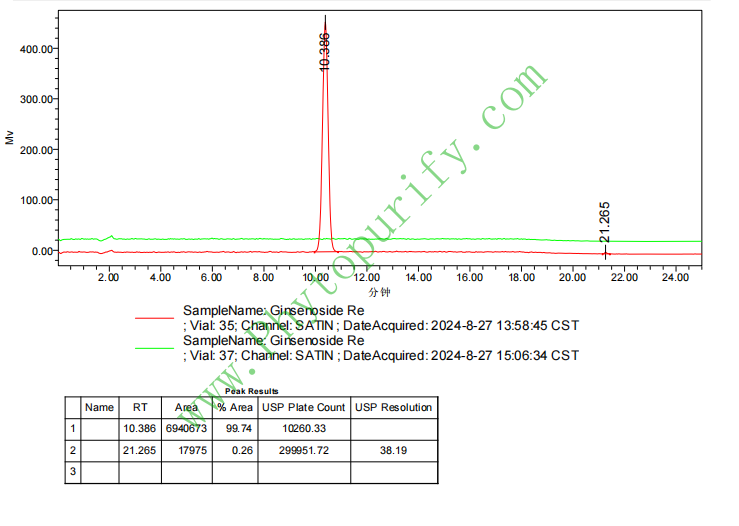
Purity: 95%~99%
Analysis Method: HPLC-DAD or/and HPLC-ELSD
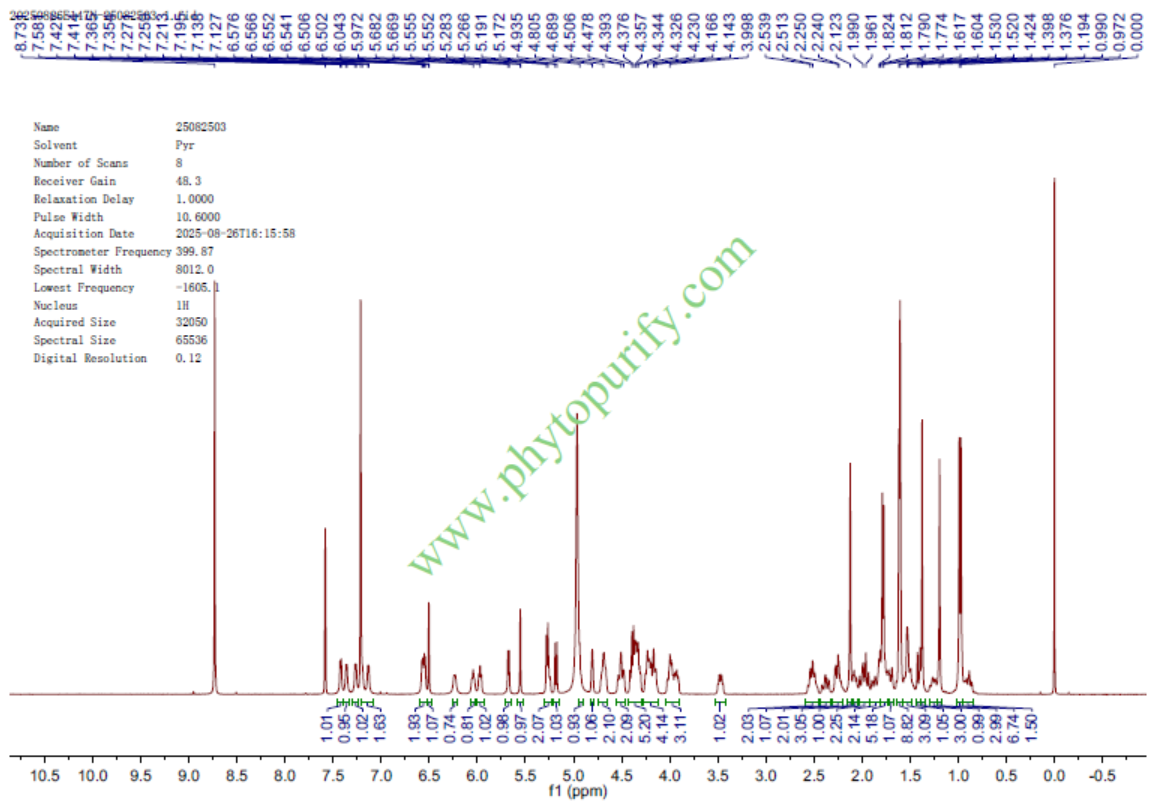
Identification Method: Mass, NMR
Packing: Brown vial or HDPE plastic bottle
Storage: Store in a well closed container, protected from air and light. Put into refrigerate or freeze for long term storage.
Whenever possible, you should prepare and use solutions on the same day. However, if you need to make up stock solutions in advance, we recommend that you store the solution as aliquots in tightly sealed vials at -20℃. Generally, these will be useable for up to two weeks.
The product could be supplied from milligrams to grams, up to kilograms
Inquire for bulk scale.
Descriptions:
Ginsenoside Re, a main phytosterol of Panax ginseng, inhibits Ca(2+) accumulation in mitochondria during cardiac ischemia/reperfusion, which is attributable to nitric oxide (NO)-induced Ca(2+) channel inhibition and K(+) channel activation in cardiac myocytes, acts as a specific agonist for the nongenomic pathway of sex steroid receptors, and NO released from activated eNOS underlies cardiac K(+) channel activation and protection against ischemia-reperfusion injury, G-Re also exerts antiischemic effect and induces angiogenic regeneration.[1,2]
Ginsenoside Re has anti-diabetic and anti-hyperlipidemic activities ,can improve hyperglycemia and hyperlipidemia through activation of AMPK, and confer beneficial effects on type 2 diabetic patients with insulin resistance and dyslipidemia. [3]
Ginsenoside Re can improve the cognition of streptozotocin-induced diabetic rats,the mechanism is by its anti-inflammation and antioxidation; glycemic control benefits the attenuation of diabetes-associated cognitive decline.[4]
Ginsenoside Re can hyperpolarize HCAECs,and this effect can be reversed by apamin, suggests ginsenoside Re increases HCAEC outward current via SKCa channel activation, and NSC channel is not involved.[5]
Ginsenoside Re increases the proliferation of CD4 + T cells with decreases cell death, and enhances viability of CD4 + T cells through the regulation of IFN-γ-dependent autophagy activity.[6]
Ginsenoside Re exhibits potent neuroprotective effects against neuroinflammation in a murine model of ALS, ginsenoside Re treatment can reduce the loss of motor neurons and active-microglia-related expression of Iba-1 in the spinal cord of symptom.
References:
[1] Furukawa T, Bai C X, Kaihara A, et al. Mol Pharmacol, 2006, 70(6):1916-24.
[2] Peng L, Sun S, Xie L H, et al. Cardiovasc Ther , 2012, 30(4):e183–e188.
[3] Quan H Y, Yuan H D, Jung M S, et al. Int J of Mol Med, 2012, 29(1):73-80.
[4] Liu Y W, Zhu X, Li W, et al. Pharmacol Biochem, 2012, 101(1):93-98.
[5] Sukrittanon S, Watanapa W B, Ruamyod K. Life Sci, 2014, 115(1–2):15-21.
[6] Son Y M, Kwak C W, Lee Y J, et al. Int Immunopharmaco, 2010, 10(5):626-631.
[7] Cai M, Yang E J. Am J Chinese Med, 2016, 44(2):401-413.
[8] Huang X, Liang T. Chinese Medicine Modern Distance Education of China, 2011, 09(21):131-132.
HPLC of Ginsenoside Re
HNMR of Ginsenoside Re
Storage conditions:Short-term storage at 2~8℃, long-term storage at -20 ~ -80℃
298.1400
2.3919
2.3919
.1336
.4928
.1437
Low
64.0335
6.5029
No
No
No
No
No
No
0.0
Yes
No
No
No
Ginsenoside Re is a plant of the Panax genus in the Araliaceae family, such as ginseng Panax ginseng Sanqi Panax notoginseng An important dammarane type tetracyclic triterpenoid saponin extracted from (etc.), with a CAS number of 52286-59-6. As one of the main members of the ginsenoside Rb group, ginsenoside Re has a long history of application in traditional medicine, and modern pharmacological research has gradually revealed its biological activities in various aspects such as neuroprotection, anti-inflammatory, and cardiovascular regulation. Especially with the acceleration of global aging process, the incidence rate of neurodegenerative diseases such as Alzheimer's disease (AD) is increasing year by year, and finding safe and effective neuroprotective agents has become a research hotspot. Ginsenoside Re has attracted widespread attention in the pharmacology community due to its significant neuroprotective potential, as it can reduce levels of β - amyloid (A β) and inhibit neuroinflammation. This article aims to systematically review the chemical structure, plant origin, pharmacological activity, molecular mechanism of action, pharmacological evaluation, and clinical application prospects of ginsenoside Re, in order to provide comprehensive scientific references for the in-depth research and development of this natural product.
Ginsenoside Re belongs to the original panaxatriol type saponin, with a molecular formula of C48H82O18 and a molecular weight of 947.1660. Its basic skeleton is a damaane type tetracyclic triterpene, with sugar groups connected at positions C-3 and C-20, respectively. Specifically, its C-3 position is connected to a glucose group (Glc), while its C-20 position is connected to a disaccharide chain composed of rhamnose (Rha) and glucose (Glc) (Rha (1 → 6) Glc). This unique glycosylation pattern has a decisive impact on its biological activity and physicochemical properties.
In terms of physical and chemical properties, the theoretical lipid water partition coefficient (LogP) of ginsenoside Re is 2.3919, indicating that it has a certain lipophilicity, but not high lipid solubility. Its topological polar surface area (TPSA) is as high as 298.1400 Å ², which is mainly attributed to the abundant hydroxyl and sugar structures in the molecule, resulting in strong polarity. The calculated water solubility is about 0.1336 mg/mL, belonging to the category of slightly soluble to poorly soluble, which poses challenges for its oral absorption and formulation development. These parameters collectively determine the basic behavior of ginsenoside Re in vivo: a moderate LogP value suggests that it may have some membrane permeability, but its extremely high TPSA and low water solubility limit its transmembrane diffusion efficiency, especially its ability to pass through the blood-brain barrier (BBB) is predicted to be "low", which constitutes a major obstacle to its central nervous system protective effect. In addition, preliminary pharmacological screening showed no significant inhibitory effect on hERG potassium channels (hERG inhibition: No), and the Ames test result was 0.0, suggesting that it may not have mutagenicity and potential cardiac toxicity risks, and has a good safety basis.
Ginsenoside Re is mainly present in various plants of the Panax genus in the Araliaceae family and is one of its characteristic active ingredients.
1. Main source:
* Ginseng(Panax ginseng C. A. Mey.)Mainly produced in Northeast China, South Korea, and other regions, ginsenoside Re is an important saponin component in its roots, stems, and leaves, and its content varies depending on the place of origin, growth period, and location.
* Sanqi(Panax notoginseng (Burk.) F. H. Chen)As a traditional precious medicinal herb, the content of ginsenoside Re in Panax notoginseng is also relatively abundant, which is one of the material bases for its functions of promoting blood circulation, removing blood stasis, and neuroprotection.
* American ginseng(Panax quinquefolius L.)It also contains a certain amount of ginsenoside Re.
Numerous in vitro and in vivo studies have shown that ginsenoside Re has a wide range of pharmacological activities, with neuroprotective and anti-inflammatory effects being the most prominent.
Neuroprotective effect:
This is the most concerned area of activity for ginsenoside Re. Research has confirmed that it exhibits clear protective effects in various AD cell and animal models.
anti-inflammatory effect:
Chronic neuroinflammation is an important driving factor for neurodegenerative diseases. Ginsenoside Re exerts anti-inflammatory effects through multiple targets.
Other activities:
The neuroprotective effect of ginsenoside Re is not achieved through a single target, but acts on a complex network, and its core mechanism and key molecular targets are as follows:
Regulating the A β metabolic pathway:
Regulating the phosphorylation balance of tau protein:
Activate cellular self-protection pathways:
Inhibition of apoptotic signaling pathway:
Regulating inflammation and stress signaling network:
In summary, ginsenosides Re form a multidimensional and synergistic neuroprotective network by acting on multiple key targets such as APP/ACE1, GSK3 β/tau, Nrf2, SIRT1, Bcl-2/Aspase, NF - κ B/JNK, jointly combating the "multilevel" pathological process of AD, including A β toxicity, tau pathology, oxidative stress, inflammation, and apoptosis.
Although the pharmacological activity of ginsenoside Re is clear, its pharmacological properties, especially pharmacokinetic properties, are the main challenges facing its conversion into drugs.
absorb As a highly polar molecule, the oral bioavailability of ginsenoside Re is generally low. This is mainly attributed to:
distribution After entering the systemic circulation, ginsenoside Re can be distributed to multiple tissues, but its Low blood-brain barrier permeability It is a key bottleneck that restricts its direct central nervous system efficacy. Although studies have shown that it can be detected in the brain, the concentration is usually very low. The strategy includes developing prodrugs, using nanocarrier systems (such as liposomes, polymer nanoparticles), or combining with BBB penetration enhancers.
Metabolism In addition to gut microbiota metabolism, it may undergo Phase I (such as hydroxylation) and Phase II (such as glucuronidation and sulfation) metabolism in the liver. Its metabolites may be active and form a part of its overall pharmacological effect.
excretion Mainly excreted through the kidneys and bile.
Formulation strategy To improve its medicinal properties, current research focuses on:
Ginsenoside Re, as a natural compound with clear multi-target neuroprotective activity, has broad clinical application prospects, but further exploration is needed.
Potential application areas:
challenges faced:
Future research directions:
Ginsenoside Re, as a natural active ingredient derived from traditional medicinal plants, has shown great potential in the field of neuroprotection due to its unique advantages of multi-target and multi pathway synergistic effects. It forms a comprehensive defense network against neurodegenerative diseases by regulating key pathological processes such as A β metabolism, tau protein phosphorylation, oxidative stress, neuroinflammation, and cell apoptosis. However, its inherent pharmacological defects, especially poor bioavailability and blood-brain barrier penetration ability, are the main obstacles that restrict its translation into clinical drugs. Future research should focus on improving its pharmacokinetic properties through strategies such as drug chemical modification and innovative drug delivery systems, while utilizing modern scientific technology to further elucidate its precise in vivo mechanism of action and actively promote standardized clinical evaluation. As these challenges are gradually overcome, ginsenoside Re is expected to evolve from a promising candidate molecule into an innovative drug for treating neurodegenerative diseases such as Alzheimer's disease, bringing new hope to the growing number of elderly patients with neurological disorders worldwide.
