


Product name: 20(R)-Ginsenoside Rg3
Synonym name:
Catalogue No.: BP0040
Cas No.: 38243-03-7
Formula: C42H72O13
Mol Weight: 785.025
Botanical Source: Panax ginseng (ginseng)
Physical Description: White powder
Type of Compound: Triterpenoids
Purity: 95%~99%
Analysis Method: HPLC-DAD or/and HPLC-ELSD
Identification Method: Mass, NMR
Packing: Brown vial or HDPE plastic bottle
Storage: Store in a well closed container, protected from air and light. Put into refrigerate or freeze for long term storage.
Whenever possible, you should prepare and use solutions on the same day. However, if you need to make up stock solutions in advance, we recommend that you store the solution as aliquots in tightly sealed vials at -20℃. Generally, these will be useable for up to two weeks.
The product could be supplied from milligrams to grams, up to kilograms
Inquire for bulk scale.
Descriptions:
20(R)-Ginsenoside Rg3 has shown multiple pharmacological activities and been considered as one of the most promising approaches for fatigue treatment, however, 20(R)-Ginsenoside Rg3 has a low bioavailability after oral administration in human, so, 20(R)-Rg3 can be by intranasal administration, the mechanism was related to the increase of the storage of hepatic glycogen, and the decrease of the accumulation of metabolite such as lactic acid and serum urea nitrogen.[1]
20(R)-Ginsenoside Rg3 shows significant effect on the differential expression of cell signaling genes and other related genes in human lung cell line A549.[2]
20(R)-Ginsenoside Rg3 and PEG-PLGA-Rg3 nanoparticles can supress the tumor angiogenesis in vivo,which is perhaps related to the inhibition of expression in MMP-9,HIF-1α,VEGF,IL-1,IL-6 and TNF-α.The PEG-PLGA nanoparticles could improve Rg3's ability on inhibiting the tumor angiogenesis in vivo.[3]
20(R)-Ginsenoside Rg3 has anticarcinogenic effects on Induced Hepatocellular Carcinoma in Rats.[4]
20(R)-Ginsenoside Rg3 elicits a significant inhibition of in vitro cell adhesion and invasion of U87 cells, is attributed to its decreasing the enzymatic activity of MMP-2.[5]
20(R)-Ginsenoside Rg3 can restrain A549/DDP cell invasion and metastasis,and it may have relationship with the upregulation of nm23;Rg3 can enhance the A549/DDP cell chemosensitivity to cisplatin,and it may have relationship with the upregulation of caspase-3 and the cell membrane lipid fluidity decreased.[6]
References:
[1] Tang W, Zhang Y, Gao J, et al. Biol Pharm Bull, 2008, 31(11):2024-7.
[2] Chen M W, Yang L, Lei N I, et al. Chinese Journal of Tuberculosis and Respiratory Diseases, 2005, 28(1):37-40.
[3] Geng L, Xing S L, Jing Y U, et al. China Journal of Traditional Chinese Medicine & Pharmacy, 2014(02):601-4.
[4] Xiao L I, Guan Y S, Zhou X P, et al. Journal of Sichuan University. Medical science edition, 2005, 36(2):217-20.
[5] Liu Y, Liu X, Shi L, et al. Clinical Journal of Medical Officers, 2014, 42(11):4-7.
[6] Wang Y, Liu J L, Liu L, et al. Chinese Journal of Health Laboratory Technology, 2011(03):609-11.
[7] Tang M H, Jiang Z H, Zhao Z Z, et al. Chinese herbal medicine, 2004, 35 (03): 280-2.
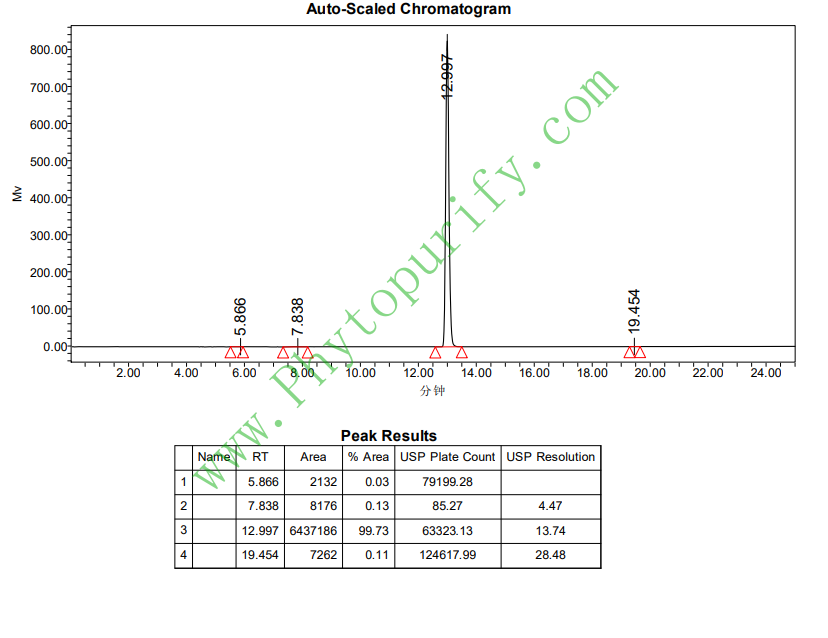
HPLC of 20(R)-Ginsenoside Rg3
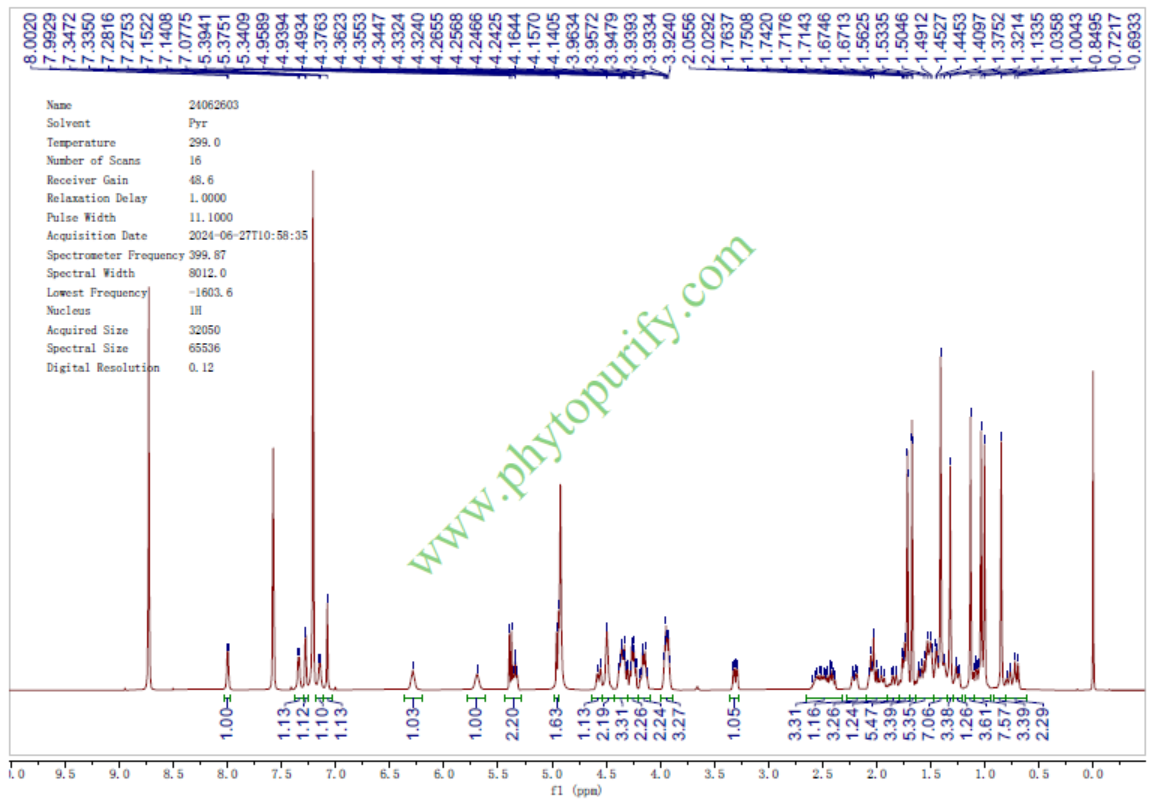
HNMRof 20(R)-Ginsenoside Rg3
Storage conditions:Short-term storage at 2~8℃, long-term storage at -20 ~ -80℃
218.9900
3.1449
3.1454
.0331
.5971
.1908
Low
73.5528
5.8482
No
No
No
No
No
No
0.0
Yes
No
No
No
Ginseng, as a traditional precious Chinese medicinal herb, is well-known for its pharmacological activity and health value. Ginsenosides, as the main active ingredient of Panax plants, have always been a hot topic in natural product pharmacology research due to their diverse chemical structures and extensive biological activities. Among numerous ginsenosides, 20 (R) - ginsenoside Rg3 (CAS: 38243-03-7) has attracted much attention due to its unique stereoconfiguration and significant pharmacological effects. Compared with the common 20 (S) - isomer, the content of 20 (R) - Rg3 is relatively low in nature, but its biological activity studies have revealed its enormous potential in the prevention and treatment of metabolic diseases, especially hyperglycemia and its complications. With the advancement of modern separation and identification techniques and the deepening of molecular pharmacology research, the target and signaling pathway network of 20 (R) - Rg3 are gradually being elucidated. This article aims to systematically review the chemical properties, plant sources, pharmacological activities, molecular mechanisms of action, medicinal characteristics, and clinical application prospects of 20 (R) - Rg3, in order to provide comprehensive scientific references for the deep development and transformation research of this natural product.
20 (R) - Ginsenoside Rg3 belongs to the dammarane type tetracyclic triterpenoid saponins, with a molecular formula of C42H72O13 and a molecular weight of 785.0250. Its core structure is a Damatane skeleton, which is replaced by hydroxyl groups at positions 3 β, 12 β, and 20pro-R. The uniqueness of its chemical structure is mainly reflected in two aspects: firstly, a β - D-glucopyranosyl - (1 → 2) - β - D-glucopyranoside is attached to the hydroxyl group at C-3 position, forming a disaccharide chain; The second is the R configuration at C-20, which forms stereoisomerism with 20 (S) - Rg3. In addition, its structure contains a double bond between positions C-24 and C-25.
These structural features determine its physicochemical properties. The calculated lipid water partition coefficient (LogP) is 3.1449, indicating that the compound has a certain degree of lipophilicity, but not high hydrophobicity. Its topological polar surface area (TPSA) is as high as 218.99 Å ², mainly attributed to the abundant oxygen atoms on hydroxyl and sugar groups in the molecule, indicating its strong ability to form hydrogen bonds. The water solubility data is 0.0331 (usually measured in mg/mL or mol/L, depending on the source), indicating that its solubility in water is low and it belongs to insoluble compounds. These physicochemical parameters are key factors affecting the absorption, distribution, metabolism, and excretion (ADME) process of drugs.
20 (R) - Ginsenoside Rg3 is mainly derived from plants of the Panax genus in the Araliaceae family. According to literature records, it is Panax japonicus var.Discovered in the Japanese bamboo ginseng variety. In addition, traditional medicinal plant ginseng(Panax ginseng C. A. Mey.)、 American ginseng(Panax quinquefolius L. And Sanqi(Panax notoginseng)It has also been detected, but the content is usually much lower than its isomer 20 (S) - Rg3. In fresh or traditionally processed ginseng, the content of Rg3 type saponins is extremely low, and it is more of a degradation product of other ginsenosides (such as Rb1, Rb2, Rc, etc.) during heating, acid-base treatment, or microbial transformation.
At present, the main ways to obtain 20 (R) - Rg3 include:
1. Plant extraction, separation and purification Total saponins were extracted from the rhizomes of Panax plants and separated using various chromatographic techniques such as silica gel column chromatography and reverse phase preparative liquid chromatography (RP-HPLC). Due to the close physical and chemical properties of the isomers of 20 (R) and 20 (S), separation is difficult and usually requires the use of chiral chromatography columns or multi-step fine purification.
2. Biotransformation method The use of specific microorganisms or enzymes (such as glycosidases) to selectively hydrolyze the glycosyl groups of ginsenosides (such as Rb1) is an efficient pathway for preparing Rg3, especially for obtaining specific configurations of Rg3. By controlling the conversion conditions, the yield of the 20 (R) - configuration can be improved to a certain extent.
3. Chemical synthesis and semi synthesis Starting from inexpensive and readily available ginsenosides or intermediates, the stereoselective glycosylation reaction is used to synthesize 20 (R) - Rg3, which is the fundamental way to solve the problem of insufficient natural sources. However, it still faces challenges such as cumbersome steps and low yield.
A large number of pharmacological studies in vitro and in vivo have shown that 20 (R) - Rg3 has various biological activities, especially in regulating glucose metabolism, improving insulin resistance, protecting islet β cells, and preventing and treating complications of diabetes.
The anti hyperglycemic and multi organ protective effects of 20 (R) - Rg3 involve a complex multi-target regulatory network. According to existing research, its key mechanism of action and molecular targets can be summarized as follows:
In summary, 20 (R) - Rg3 forms a synergistic network by simultaneously acting on multiple targets such as EHMT2, UBP2, PAI1, AMPK, SGLT2, GCK, APP/ACE1, CES1, PTPN1, etc., exerting anti hyperglycemic and organ protective effects from multiple dimensions including energy sensing, insulin signaling, glucose and lipid metabolism, inflammatory oxidative stress, and neuroprotection.
Based on the provided pharmacological parameters and existing research, a preliminary evaluation of the pharmacological properties of 20 (R) - Rg3 is conducted
At present, there is relatively little systematic research on the pharmacokinetics of 20 (R) - Rg3, and its detailed characteristics of absorption, distribution, metabolism, and excretion, especially the differences from the 20 (S) - configuration, need further clarification.
20 (R) - Ginsenoside Rg3 shows broad clinical application prospects, but also faces many challenges.
prospect:
1. Prevention and treatment of type 2 diabetes and its complications As a natural product with multiple targets and pathways, 20 (R) - Rg3 has comprehensive advantages in improving insulin resistance, protecting islet function, anti inflammation and anti-oxidation, and is expected to be developed into a new type of anti diabetes drug or functional food, especially suitable for early diabetes and early intervention of diabetes. Its inhibitory effect on PAI-1, BACE1, etc. also suggests that it has potential in the prevention and treatment of complications such as diabetes nephropathy, cardiovascular disease and cognitive impairment.
2. Adjuvant therapy for Alzheimer's disease Targeting the APP/ACE1 target, it may become a candidate molecule for AD prevention or adjuvant therapy.
3. combination therapy Due to its different mechanism of action from existing mainstream hypoglycemic drugs such as metformin, SGLT2 inhibitors, DPP-4 inhibitors, etc., there may be synergistic effects, and the development of compound formulations is a direction worth exploring.
4. Development of Big Health Products Based on its antioxidant, anti fatigue, neuroprotective and other effects, it can be used to develop health products that improve sub-health status and enhance the body's resistance.
Challenges and Prospects:
1. Source and Cost Low natural content and difficulty in chemical synthesis result in high raw material costs, which restrict its large-scale industrialization. In the future, it is necessary to vigorously develop efficient biotransformation processes or economically feasible total synthesis routes.
2. Optimization of drug properties Low solubility and low bioavailability are its main bottlenecks. The development of new delivery systems (such as oral nano formulations, transdermal formulations, injectable liposomes, etc.) using modern pharmaceutical technology is the only way to improve their efficacy.
3. Structure Activity Relationship and Isomer Differences There may be differences in activity, intensity, and target selectivity between 20 (R) and 20 (S) - Rg3, and more detailed parallel comparative studies are needed to clarify their respective advantageous indications and achieve precise development.
4. In depth mechanism research At present, the known targets are only a part of their complex network of action. Utilizing omics technologies (proteomics, metabolomics) and gene editing tools for more systematic and in-depth mechanism exploration will help discover new targets and applications.
5. Accumulation of clinical evidence At present, research is mainly focused on the preclinical stage, and there is an urgent need to design rigorous clinical trials to verify its effectiveness, safety, and pharmacokinetic characteristics in humans.
20 (R) - Ginsenoside Rg3, as a unique three-dimensional structure of dammarane type saponin, has shown significant potential in regulating glucose metabolism, improving insulin resistance, and preventing related complications due to its multi-target and multi pathway pharmacological effects. The systematic study of chemical structure, plant origin, pharmacological mechanism, and medicinal characteristics has depicted the scientific path from traditional medicinal plants to modern innovative drugs. Although there are still challenges in raw material supply, formulation technology, and clinical translation, with the rapid development of synthetic biology, pharmacy, and molecular pharmacology, these bottlenecks are expected to be overcome one by one. In the future, in-depth research on 20 (R) - Rg3 is expected to not only lead to new disease treatment strategies, but also provide classic examples for elucidating the complex action network of natural products, promoting the development of natural product pharmacology towards more precise and in-depth directions.
