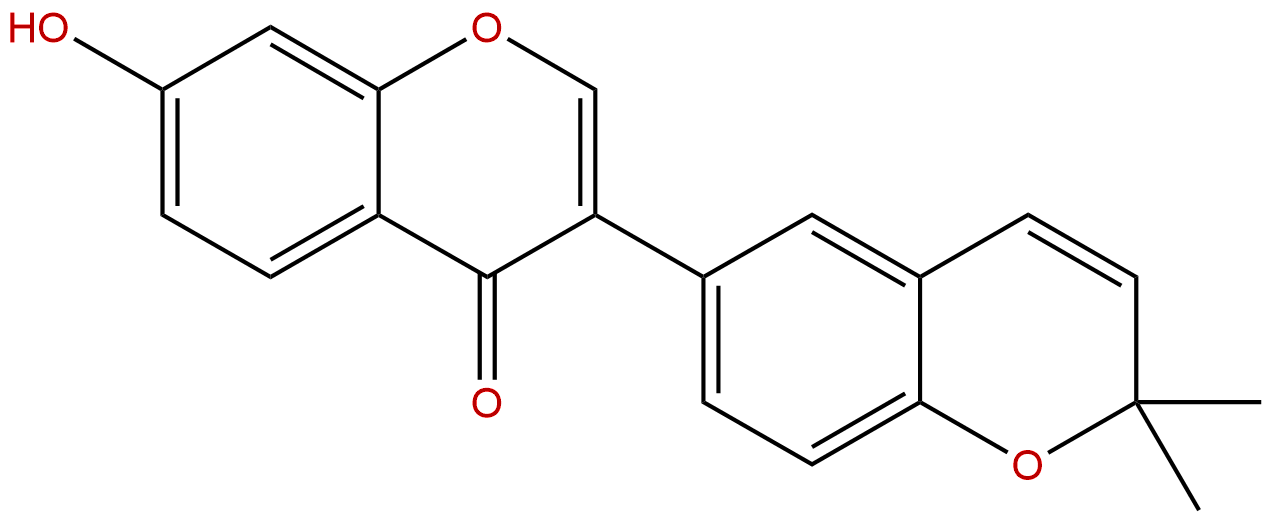


Product name: Corylin
Synonym name:
Catalogue No.: BP3101
Cas No.: 53947-92-5
Formula: C20H16O4
Mol Weight: 320.344
Botanical Source:
Physical Description: Powder
Type of Compound: Flavonoids
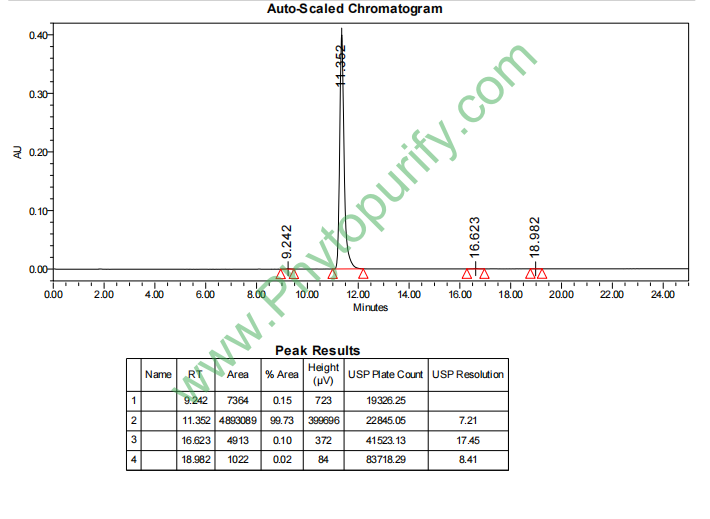
Purity: 95%~99%
Analysis Method: HPLC-DAD or/and HPLC-ELSD
Identification Method: Mass, NMR
Packing: Brown vial or HDPE plastic bottle
The product could be supplied from milligrams to grams. Inquire for bulk scale.
We provide solution to improve the water-solubility of compounds, thereby facilitating the variety of activity tests and clinic uses.
For Reference Standard and R&D, Not for Human Use Directly.
HPLC of Corylin
Storage conditions:Short-term storage at 2~8℃, long-term storage at -20 ~ -80℃
59.6700
3.9516
3.8827
.0076
2.7850
24.2289
High
92.3174
2.6659
Yes
No
Yes
No
Yes
Yes
1.2
No
Yes
Yes
Yes
Natural products have always been an important source of innovative drug discovery, among which flavonoids have attracted much attention due to their broad biological activity and low toxicity. Corylin (CAS number: 53947-92-5) is a traditional Chinese medicine derived from Fructus Psorale(Psoralea corylifolia L. Isoflavones isolated from the compound. In recent years, with the deepening of modern pharmacological research, Psoralen Ning has demonstrated remarkable multi-target pharmacological activity beyond its traditional application scope. Studies have shown that it is not only a lead compound with oral anti-inflammatory and osteogenic effects, but also shows great potential in anti-cancer, anti atherosclerosis, regulating metabolic syndrome (such as improving hyperlipidemia and insulin resistance), and inducing adipocyte browning. Of particular note is its potential therapeutic value in skin pigmentation disorders such as vitiligo, which is attracting increasing research attention. This article aims to systematically review the chemical properties, plant sources, pharmacological activities, molecular mechanisms of action, pharmacological evaluation, and clinical application prospects of Psoralen Ning, in order to provide comprehensive academic references for the in-depth research and development of this compound.
The chemical name of Psoralen Ning is 5,7-dihydroxy-4 '- methoxyflavone, with a molecular formula of C ₁₇ H ₁₄ O ₅ and a molecular weight of 320.3440. Its core structure is a typical isoflavone skeleton, where the 2-position of benzopyran-4-one (C ring) is connected to the B ring. The A ring contains two phenolic hydroxyl groups at positions 5 and 7, while the 4 'position of the B ring is replaced by a methoxy group. This specific substitution pattern of hydroxyl and methoxy groups is crucial for its biological activity, affecting its ability to interact with various enzymes and receptors.
From the analysis of physical and chemical properties, the lipid water partition coefficient (LogP) of Psoralen Ning is 3.9516, indicating its good lipophilicity, which is beneficial for its penetration of cell membranes, but may also affect its water solubility. Its topological polar surface area (TPSA) is 59.6700 Å ², which is relatively small and further supports its good membrane permeability. The calculated water solubility is relatively low (about 0.0076 mg/mL), indicating that strategies such as salt formation, inclusion complex formation, or nanoformulation may be needed in formulation development to improve its bioavailability. Preliminary drug risk assessment shows that its blood-brain barrier permeability is predicted to be "high", suggesting that it may have an impact on central nervous system related targets; Negative in hERG channel inhibition test reduces the risk of inducing QT interval prolongation in the heart; The Ames test result is 1.2, indicating that it has no significant mutagenicity and has favorable safety characteristics.
Psoralen Ning mainly comes from the leguminous plant Psoralen(Psoralea corylifolia L. Dry and ripe fruits. Psoralea, as a traditional Chinese medicine, has the effects of warming the kidneys and promoting yang, regulating qi and relieving asthma, warming the spleen and stopping diarrhea. It is commonly used in clinical Chinese medicine to treat vitiligo, psoriasis, osteoporosis, and kidney yang deficiency syndrome. Psoralen Ning is another important active ingredient in Psoralea, in addition to Psoralen and Isopsoralen.
Its extraction and separation usually use organic solvent extraction combined with chromatographic separation technology. The conventional process is as follows: after crushing the fruit of Fructus Psorale, it is heated and refluxed with ethanol or methanol or extracted by ultrasound. The extracted liquids are combined and concentrated under reduced pressure to obtain the extract. The extract was then segmented and extracted using different polar solvents such as petroleum ether, ethyl acetate, and n-butanol. Psoralen Ning is mainly enriched in the ethyl acetate extraction site. Further, repeated separation and purification were carried out by silica gel column chromatography, Sephadex LH-20 gel column chromatography, high performance liquid chromatography (HPLC) or preparative thin layer chromatography (PTLC) to finally obtain high-purity psoralen monomer. Modern extraction techniques such as supercritical CO ₂ extraction and microwave-assisted extraction have also been applied to improve extraction efficiency and protect thermosensitive components.
The pharmacological activity research of Psoralen Ning reveals its multifaceted therapeutic potential, mainly covering the following aspects:
Anti inflammatory and immune regulatory activity Psoralen Ning has been identified as an orally active anti-inflammatory agent. Its core function is to inhibit the activation of signal transduction and transcription activator 3 (STAT3) induced by interleukin-6 (IL-6), including the inhibition of STAT3 promoter activity and its tyrosine phosphorylation. STAT3 is a key hub molecule that connects inflammation with tumors and autoimmune diseases, thus laying the common foundation for its anti-inflammatory and anticancer activities.
Promoting osteogenic and anti osteoporosis activity Psoralen Ning can significantly promote the differentiation and mineralization of osteoblasts, inhibit the generation of osteoclasts and bone resorption function. In a rat model of osteoporosis induced by ovariectomy, treatment with psoralen can effectively increase bone density and improve bone microstructure. Its pro bone formation effect is believed to be related to the activation of osteogenic signaling pathways such as Wnt/β - catenin and BMP/Smad.
anticancer activity Research shows that Buguzhining can inhibit the proliferation and promote apoptosis of many cancer cell lines (such as breast cancer, lung cancer, liver cancer, colon cancer, prostate cancer, etc.). Its anti-cancer mechanism involves inducing cell cycle arrest (such as G0/G1 phase arrest), mitochondrial pathway apoptosis, inhibiting survival signaling pathways such as STAT3 and NF - κ B, as well as inhibiting tumor angiogenesis and metastasis.
Regulating metabolism and cardiovascular protective activity:
Potential activity in vitiligo treatment Vitiligo is an autoimmune disease characterized by depigmentation caused by the destruction of melanocytes in the skin. The target network of Psoralen Ning suggests its potential for multi pathway intervention: promoting melanin production by upregulating tyrosinase (TYR) and microphthalmia related transcription factors (MITF); By activating nuclear factor E2 related factor 2 (NFE2L2/Nrf2) and superoxide dismutase 1 (SOD1) to combat oxidative stress; Reduce local inflammation by inhibiting nuclear factor kappa B (NFKB1) and tumor necrosis factor (TNF); By regulating B-cell lymphoma 2 (BCL2) and caspase 3 (CASP3), it affects the balance of cell apoptosis; It may also regulate immunity through aromatic hydrocarbon receptors (AHR) and inhibit immune cell infiltration mediated by chemokines such as CXCL10. These multiple effects make it a promising new multi-target candidate drug for the treatment of vitiligo.
The core of the multifunctional pharmacological effects of Psoralen Ning lies in its regulation of multiple key signaling pathways and molecular targets.
STAT3 signaling pathway This is one of the most clear targets of Psoralen Ning. It directly or indirectly inhibits the phosphorylation of STAT3 by JAK kinases induced by cytokines such as IL-6, preventing STAT3 dimerization, nuclear translocation, and transcription of downstream target genes (such as Bcl-2, Cyclin D1, VEGF, etc.), thereby exerting anti-inflammatory and anticancer effects.
SIRT1 dependent pathway SIRT1 is an NAD ⁺ - dependent deacetylase that plays a central role in energy metabolism, stress response, and aging. Psoralen Ning has been confirmed to be an activator of SIRT1. Activation of SIRT1 can deacetylate and activate peroxisome proliferator activated receptor gamma co activator 1 alpha (PGC-1 alpha), thereby promoting mitochondrial biosynthesis and fatty acid oxidation, which is the key mechanism for inducing fat browning and improving insulin sensitivity. Meanwhile, SIRT1 can also exert anti-inflammatory effects by deacetylating factors such as NF - κ B.
β 3-AR signaling pathwayβ 3-AR is mainly distributed in adipose tissue, and its activation can trigger the cAMP/PKA cascade reaction, which in turn phosphorylates and activates p38 MAPK and ATF2, ultimately upregulating the expression of PGC-1 α and uncoupling protein 1 (UCP1), driving fat browning and thermogenesis. Psoralen Ning, as an agonist or regulator of β 3-AR, promotes energy expenditure through this pathway.
Wnt/β - catenin and BMP/Smad pathway In osteogenic differentiation, Psoraleae activates the classic Wnt/β - catenin pathway, stabilizes β - catenin protein, and promotes osteogenic gene expression by allowing it to enter the nucleus. Meanwhile, it can also enhance bone morphogenetic protein (BMP) signaling, promote phosphorylation and nuclear translocation of Smad1/5/8, and synergistically promote osteogenesis.
Nrf2/ARE antioxidant pathway Psoralen Ning can activate Nrf2, freeing it from Keap1 and transferring it to the nucleus. It binds to antioxidant response elements (ARE) and initiates the transcription of a series of phase II detoxifying enzymes and antioxidant enzymes, including SOD and heme oxygenase-1 (HO-1), thereby enhancing the cell's ability to resist oxidative stress. This is particularly important in protecting melanocytes, neurons, and endothelial cells.
NF - κ B inflammatory pathway Psoraleae prefers to inhibit the activity of I κ B kinase (IKK), prevent the degradation of I κ B α and nuclear translocation of NF - κ B p65 subunit, thereby downregulating the expression of pro-inflammatory factors such as TNF - α, IL-6, IL-1 β, and exerting a wide range of anti-inflammatory effects.
Although Psoralen Ning has shown excellent multi-target activity in preclinical studies, its pharmacological properties still require systematic evaluation.
The diversified pharmacological activities of Psoralen Ning have depicted broad prospects for its application in multiple disease fields:
The future research focus should include: 1) conducting systematic preclinical pharmacokinetic and toxicological studies to clarify their in vivo fate and safety window; 2) Accurately identify its direct target proteins using chemical biology methods such as affinity fishing and molecular docking binding point mutation verification; 3) Optimize formulations and conduct standardized clinical trials for specific indications such as vitiligo and osteoporosis; 4) Explore its structural modifications, improve its water solubility and metabolic stability while retaining the core pharmacophore, and obtain better candidate drugs.
As an isoflavone compound derived from traditional Chinese medicine, Psoralen Ning has shown new vitality in modern pharmacological research due to its unique chemical structure and multi-target mechanism of action. From anti-inflammatory and osteogenic effects to anti-cancer and metabolic regulation, and to its potential for multi pathway intervention in the treatment of vitiligo, it fully embodies the characteristics of natural products' "multi-component multi-target multi pathway" effects. Although there are still challenges in optimizing drug properties and conducting systematic evaluations on the path towards clinical drug development, existing research results have laid a solid scientific foundation for its in-depth development. With the continuous deepening of research and the advancement of translational medicine, Psoralen Ning is expected to develop from an excellent pharmacological active molecule into a new type of drug for treating various major chronic diseases, demonstrating the enormous value of modernization and internationalization of traditional Chinese medicine.
