


Product name: Glycitin
Synonym name: Glycitein 7-glucoside
Catalogue No.: BP0680
Cas No.: 40246-10-4
Formula: C22H22O10
Mol Weight: 446.408
Botanical Source: Glycine max (soy beans)
Physical Description: Powder
Type of Compound: Flavonoids
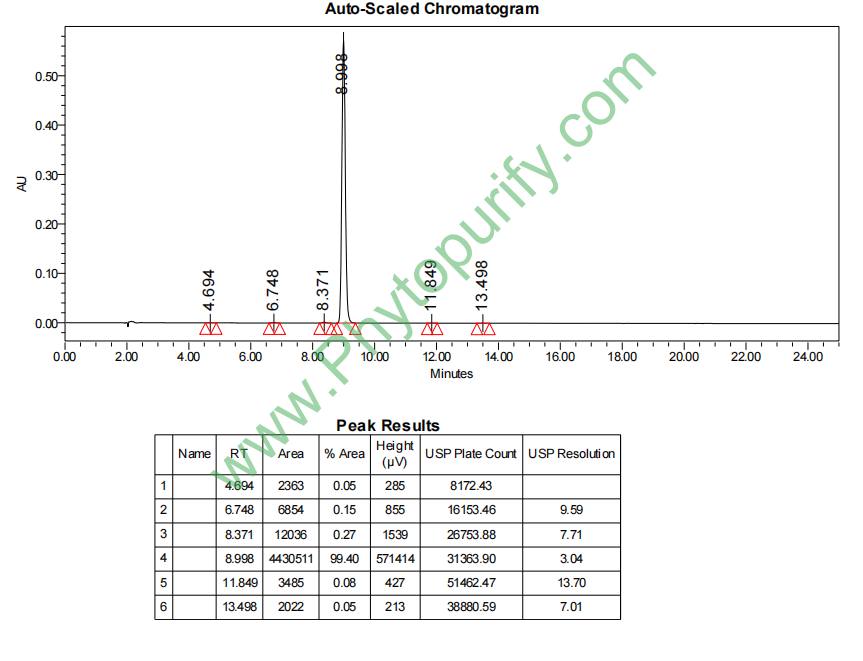
Purity: 95%~99%
Analysis Method: HPLC-DAD or/and HPLC-ELSD
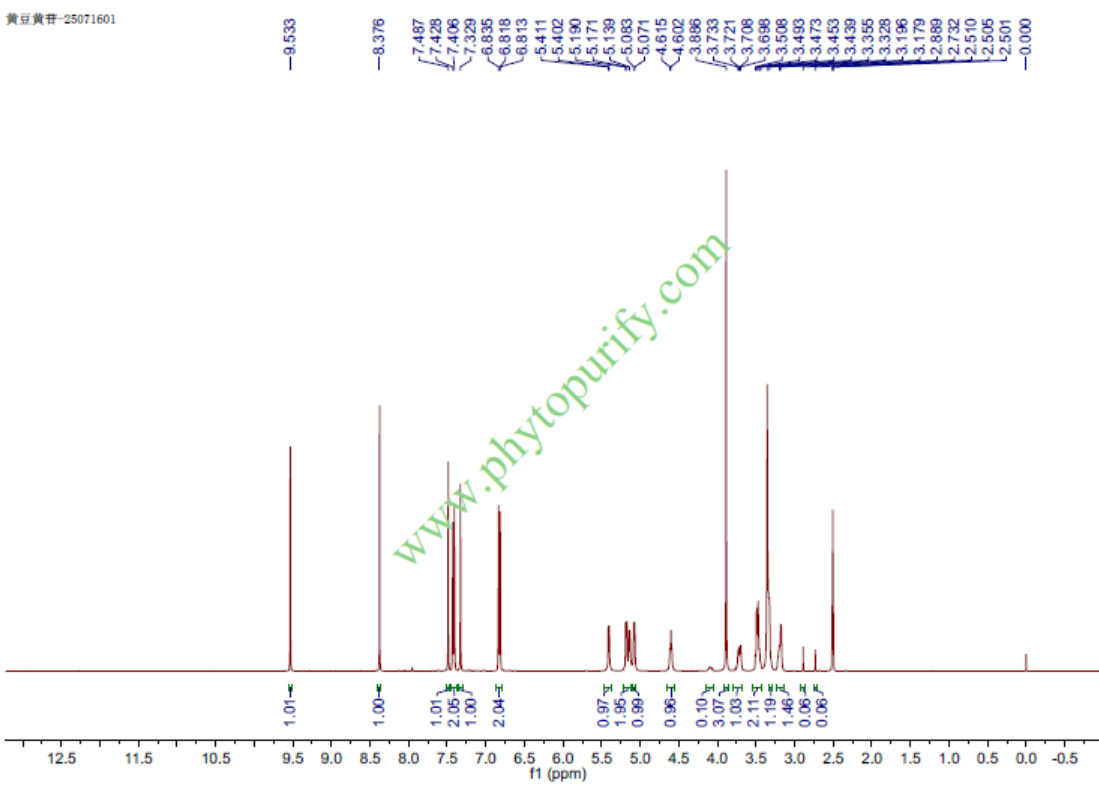
Identification Method: Mass, NMR
Packing: Brown vial or HDPE plastic bottle
Storage: Store in a well closed container, protected from air and light. Put into refrigerate or freeze for long term storage.
Whenever possible, you should prepare and use solutions on the same day. However, if you need to make up stock solutions in advance, we recommend that you store the solution as aliquots in tightly sealed vials at -20℃. Generally, these will be useable for up to two weeks.
The product could be supplied from milligrams to grams, up to kilograms
Inquire for bulk scale.
Descriptions:
An isoflavone glycitin is isolated from the licorice, which has good inhibitory effect on α-glucosidase with IC50of 0.5646 mg·mL- 1, better than the position control acarbose. [1]
Glycitin, daidzin, and genistin may modulate differentiation of MSC to cause a lineage shift toward the osteoblast and away from the adipocytes, and could inhibit adipocytic transdifferentiation of osteoblasts, they could also be helpful in preventing the development of osteonecrosis.[2]
Glycitein has a protective effect on skin aging by inhibiting of MMP-1 and increasing of collagen through ERK/JNK/P38 down-regulation, which may be mediated by the inhibition of ERK, JNK, and p38 mitogen-activated protein kinases, suggests that glycitin is a potential agent for the treatment of skin ageing.[3]
A mixture of daidzin and glycitin has anti-obese and anti-diabetic effects on C57BL/6J mice fed with a high-fat diet by the regulation of oxidative stress .[4]
References:
[1] Feng C, Weiwei Y U, Gan Q, et al. Sci Technol Rev, 2014, 32(16):29-33.
[2] Xiang-Hui L I, Zhang J C, Sui S F, et al. Acta Pharmacol Sin, 2005, 26(9):1081-6.
[3] Seo G Y, Park S, Huh J S, et al. J Korean Soc App Bi, 2014, 57(4):463-8.
[4] Zang Y, Igarashi K, Yu C. Biosci Biotech Bioch, 2014, 79(1):117-23.
[5] Bo R U, Zhang Y H, Zhang Y. Practical Pharmacy & Clinical Remedies, 2011, 14(2):138-40.
HPLC of Glycitin
HNMR of Glycitin
Storage conditions:Short-term storage at 2~8℃, long-term storage at -20 ~ -80℃
159.0500
.2238
.2219
.9851
.5155
.4498
Low
79.7882
3.7271
Yes
No
No
No
Yes
No
1.5
Yes
Yes
Yes
Yes
Osteoporosis is a systemic bone disease characterized by reduced bone mass, destruction of bone microstructure, and increased bone fragility, and has become an increasingly serious public health problem worldwide. At present, although mainstream anti osteoporosis drugs are effective, long-term use often accompanies adverse reactions such as mandibular necrosis and atypical femoral fractures. Therefore, finding highly effective and low toxicity prevention and treatment drugs from natural products has become a research hotspot. Isoflavones have attracted much attention due to their wide range of biological activities and good safety, among which soy isoflavones are the most extensively studied. Glycitin, also known as daidzein-7-O - β - D-glucoside, is a relatively low content but unique active member of the soy isoflavone family. In recent years, it has shown significant potential in the field of anti osteoporosis. It not only retains the classic pharmacological activities of isoflavone compounds, such as estrogen like effects, anti-inflammatory, antioxidant effects, but also exhibits specificity in regulating bone metabolism balance. This article aims to systematically review the chemical properties, plant sources, pharmacological activities of daidzein, with a focus on its anti osteoporosis effect. It deeply analyzes its multi-target mechanism of action, evaluates its medicinal properties, and looks forward to its clinical application prospects, in order to provide scientific basis for the deep development and utilization of this natural product.
Daidzein (CAS number: 40246-10-4) is an O-glycosylated isoflavone. Its parent nucleus is genistein, which is a 4 ′, 7-dihydroxy-6-methoxyflavone. On the 7th hydroxyl group of its parent nucleus, a D-glucose group is connected through a β - glycosidic bond to form its aglycone form. Its molecular formula is C22H22O10 and its molecular weight is 446.4080.
Its physical and chemical properties determine its bioavailability and functional characteristics. The calculated lipid water partition coefficient (LogP) is 0.2238, indicating that the molecule has moderate lipophilicity but overall leans towards hydrophilicity. The topologically polar surface area (TPSA) is as high as 159.0500 Å ², mainly attributed to the numerous hydrogen bond acceptors (oxygen atoms) in the molecule, which significantly affects its transmembrane absorption ability. Its water solubility value is 0.9851 (usually referring to LogS or related solubility indicators), indicating that it has a certain solubility in water, but as a glycoside, its solubility is usually better than its aglycone. These properties collectively determine that the absorption efficiency of daidzein after oral administration may be limited, and it needs to be hydrolyzed into aglycones (daidzein) by β - glucosidase in the gut microbiota or tissues in order to be better absorbed and exert biological effects. In addition, its blood-brain barrier permeability is predicted to be "low", suggesting that its direct effects on the central nervous system may be limited.
Daidzein mainly comes from leguminous plants, especially soybean (Glycine max (L.) Merr.) and its products. In soybeans, isoflavones mainly exist in the form of β - glucosides, and the content of daidzin is usually lower than its counterparts daidzin and genistein, accounting for about 5% -10% of the total isoflavones in soybeans. Its content is significantly affected by soybean variety, planting area, growth conditions, and processing technology. In addition to soybeans, trace amounts of isoflavones are also present in other plants rich in isoflavones such as kudzu root and alfalfa.
The extraction of daidzein from plant materials mainly follows the general extraction principles of isoflavones. The conventional methods include:
1. Solvent extraction method The most commonly used method is to use methanol, ethanol, acetone or their aqueous solutions as extraction solvents, and improve extraction efficiency through heating reflux, ultrasound assisted or microwave-assisted methods. Ethanol water system is commonly used for safety and environmental protection.
2. Enzymatic hydrolysis Using cellulase, pectinase, and other enzymes to destroy plant cell walls and promote the release of daidzein can improve extraction efficiency.
3. Supercritical fluid extraction method Using supercritical CO ₂ and sometimes adding entrainers (such as ethanol), this method has mild conditions and no solvent residue, but the cost is relatively high.
The crude extract after extraction needs further separation and purification to obtain high-purity daidzein. The commonly used techniques include macroporous resin adsorption (such as AB-8 and D101 resins) for enrichment, followed by fine separation using preparative high-performance liquid chromatography (HPLC) or high-speed countercurrent chromatography (HSCCC). Modern analysis and identification often combine liquid chromatography-mass spectrometry (LC-MS) and nuclear magnetic resonance (NMR) techniques.
Soyasaflavins and their metabolites, daidzein, exhibit a wide range of pharmacological activities, forming the pharmacological basis for their multi pathway anti osteoporosis effects.
The mechanism of action of daidzein against osteoporosis is complex, involving bidirectional regulation of bone formation mediated by osteoblasts and bone resorption mediated by osteoclasts. Its target network covers the core signaling pathways and key functional molecules of bone metabolism.
1. Promote bone formation (osteogenic differentiation)
Soy yellow glycosides activate osteogenic differentiation pathways through multiple targets:
* Core transcriptional regulation Significant upregulation of key osteogenic transcription factors RUNX2 and SP7(Osterix) The expression. RUNX2 is the main regulator of osteogenic differentiation, while SP7 is a downstream key factor of RUNX2, which together drive mesenchymal stem cells to differentiate into osteoblasts.
* Classic osteogenic markers: Promote COL1A1 (type I collagen alpha 1 chain) and BGLAP (Osteocalcin) Synthesis and secretion. COL1A1 is the main organic component of bone matrix, while BGLAP is a late stage marker of osteoblast maturation and mineralization. Elevated levels of both directly reflect enhanced osteogenic function.
* Signal pathway activation:
* TGF - β/BMP signaling pathway As outlined, daidzein may promote osteogenic differentiation by activating TGF - β signaling in bone marrow mesenchymal stem cells (BMSCs), thereby regulating downstream Smad proteins.
* PI3K/AKT signaling pathway Activating AKT signaling not only promotes cell survival, but also positively regulates the activity of RUNX2 and the expression of osteogenic related genes by regulating downstream molecules such as GSK-3 β and mTOR.
* Wnt/β - catenin signaling pathway Research suggests that isoflavones may inhibit SOST (sclerosing protein) To release the inhibition of the Wnt pathway through expression. SOST is a potent inhibitor of bone formation, and its downregulation can activate Wnt/β - catenin signaling, promoting osteogenesis.
2. Inhibit bone resorption (osteoclastogenesis)
Soy isoflavones inhibit bone resorption by interfering with the differentiation and function of osteoclasts
* Nuclear factor kappa B receptor activator ligand/osteoprotegerin system: Upregulation TNFRSF11B (OPG, osteoprotegerin) The expression. OPG acts as a bait receptor and binds to RANKL, blocking the binding of RANKL to RANK receptors on osteoclast precursor cells, thereby inhibiting the differentiation and activation of osteoclasts.
* Osteoclast specific enzyme inhibition: Direct or indirect inhibition CTSK (Cathepsin K) The activity. CTSK is a key protease secreted by osteoclasts for the degradation of bone matrix type I collagen, and is an effector molecule for its bone resorption function.
* Inflammatory and matrix degradation associated targets: Inhibition MMP9 (matrix metalloproteinase-9) Expression and activity. MMP9 not only participates in the degradation of extracellular matrix, but also plays an important role in the migration of osteoclasts and the formation of bone resorption cavities. Its inhibitory effect complements the anti-inflammatory effect of daidzein.
3. Hormones and Vitamin D System Regulation
* Estrogen receptor (ESR)As a plant estrogen, some of its bone benefits are activated through activation ESR1(ERα) Realize with ER β to simulate the protective effect of estrogen on bone.
* Vitamin D receptor (VDR)Vitamin D is crucial in calcium and phosphorus metabolism and bone health. Soy yellow glycosides may be regulated by VDR Enhance the expression or activity of active vitamin D (1,25- (OH) 2D3), promote intestinal calcium absorption and bone mineralization.
In summary, daidzein exerts its anti osteoporosis effect by acting on a target network consisting of ESR1, VDR, RUNX2, SP7, TNFRSF11B, SOST, CTSK, MMP9, COL1A1, BGLAP, etc., synergistically regulating the processes of osteogenesis and osteoclastogenesis, restoring bone metabolism balance, which is the molecular basis for its anti osteoporosis effect.
Based on the provided parameters and existing research, a preliminary evaluation of the pharmacological properties of daidzein is conducted
Challenges and Strategies in Drug Development The main challenge lies in the low oral bioavailability. Improvement strategies include: ① developing prodrugs or structural modifications to enhance their lipid solubility and membrane permeability; ② Using nanocarrier systems (such as liposomes, polymer nanoparticles) or phospholipid complex technology to package and promote their absorption and targeted delivery; ③ Combined with β - glucosidase inhibitors to control its hydrolysis in specific parts of the intestine and optimize the absorption window.
Soybean yellow glycosides have broad application prospects in the prevention and treatment of osteoporosis and related bone diseases:
Future research should focus on: ① using gene knockout animal models and cell specific knockout techniques to accurately elucidate their targets and pathway cross-talk mechanisms in different bone cells; ② Conduct standardized preclinical pharmacodynamic, toxicological, and human pharmacokinetic studies to obtain key data supporting their clinical development; ③ Innovative drug delivery systems to address the core bottleneck of drug development; ④ Explore the optimal compatibility scheme with other active ingredients or drugs.
Isoflavones, a unique flavonoid glycoside found in soybeans, have shown significant development value in the field of osteoporosis due to their multiple pharmacological activities and multi-target regulatory ability on the bone metabolism balance network. From chemical structure to plant origin, from a wide range of estrogen like, anti-inflammatory, and antioxidant activities to in-depth molecular mechanisms targeting core targets such as RUNX2, OPG, and CTSK, research has gradually revealed its scientific significance as a natural bone protectant. Despite facing challenges in drug development such as oral bioavailability, these challenges are expected to be overcome through the empowerment of modern medicinal chemistry and pharmaceutical technology. With the continuous deepening of research, daidzein is expected to develop from a dietary component into an innovative drug or functional product for the prevention and treatment of osteoporosis and related bone diseases, providing a safe and effective new option for solving global bone health problems. Its research and development process also fully reflects the enormous potential and value of exploring modern drug lead compounds from natural products.
