


Synonym name:
Catalogue No.: BP1174
Cas No.: 18642-23-4
Formula: C20H16O5
Mol Weight: 336.343
Botanical Source: Psoralea corylifolia, Dolichos biflorus and Phaseolus lunatus
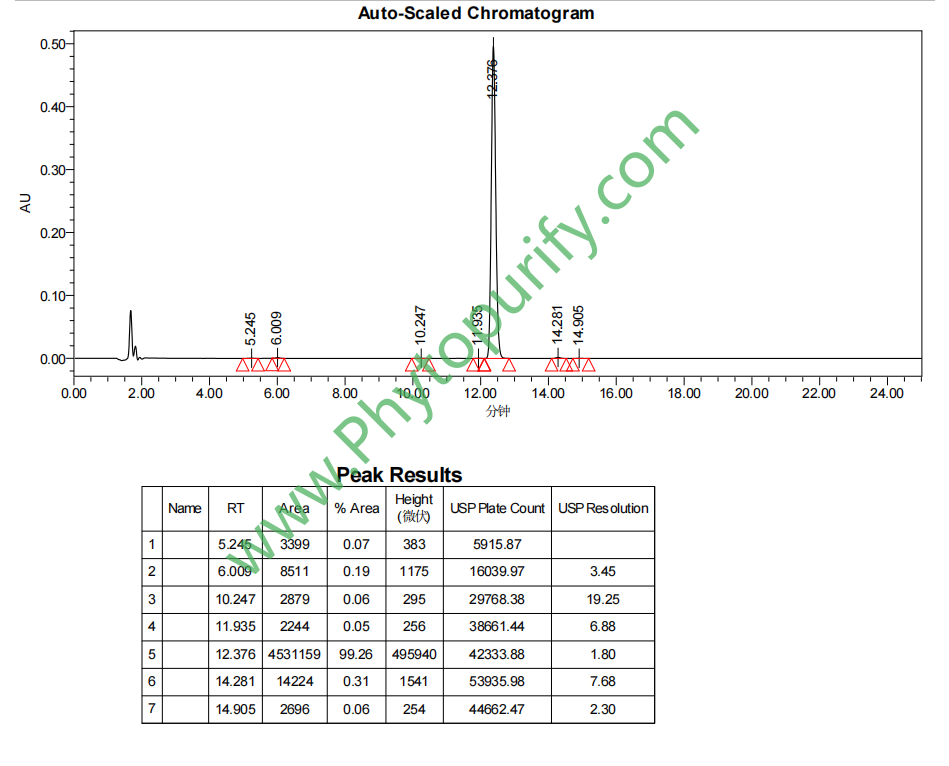
Purity: 95%~99%
Analysis Method: HPLC-DAD or/and HPLC-ELSD
Identification Method: Mass, NMR
Packing: Brown vial or HDPE plastic bottle
Can be supplied from milligrams to grams.
For Reference Standard and R&D, Not for Human Use Directly.
Inquire for bulk scale.
HPLC of Psoralidin
Storage conditions:Short-term storage at 2~8℃, long-term storage at -20 ~ -80℃
83.8100
4.3478
4.2964
.0079
1.2582
11.8078
Low
91.9042
2.8170
No
No
Yes
No
Yes
Yes
1.2
Yes
Yes
Yes
Yes
Natural products, as an important source of drug discovery, play an irreplaceable role in the history of human disease prevention and treatment. Psoralidin, a traditional medicinal plant derived from Psoralidin(Psoralea corylifolia L.)The coumarin compounds isolated from the middle have become a hot topic in pharmacological research in recent years due to their unique and extensive biological activities. Its CAS number is 18642-23-4. Early studies have revealed its antibacterial and anti-inflammatory properties, while more in-depth research has found that psoralen is a dual inhibitor of cyclooxygenase-2 (COX-2) and 5-lipoxygenase (5-LOX), which gives it a unique advantage in the anti-inflammatory field. Of particular note is that Psoralen has shown significant anti-cancer activity in various tumor models, involving the induction of reactive oxygen species (ROS) production, regulation of key apoptotic proteins such as MCL1 and BCL2, inhibition of STAT3, HIF1A signaling pathways, and significant downregulation of NOTCH1 signaling. Despite facing challenges such as poor water solubility, its rich pharmacological activity and clear multi-target mechanism of action make it have broad development prospects in the fields of anti-tumor and anti-inflammatory. This article aims to systematically review the chemical properties, pharmacological activities, molecular mechanisms, and pharmacological properties of Fructus Psorale, in order to provide reference for the in-depth research and development of this compound.
Psoralen is a coumarin derivative substituted with isopentenyl, with the chemical name 3- (2,4-dihydroxy-5- (3-methylbut-2-en-1-yl) phenyl) -7-hydroxy-2H-benzopyran-2-one. The molecular formula is C20H16O5 and the molecular weight is 336.3430. Its core structure is benzo [a] - pyranone (coumarin nucleus), with hydroxyl groups attached at positions 7 and 3 ', and an isopentenyl side chain attached at position 5'. This structural feature is an important basis for its biological activity, and the introduction of isopentenyl groups is often associated with enhanced lipid solubility and target binding ability.
From the analysis of physical and chemical properties, the calculated lipid water partition coefficient (LogP) of Fructus Psorale is 4.3478, indicating its strong lipophilicity. Its topological polar surface area (TPSA) is 83.81 Å ². These parameters collectively determine its poor water solubility, with a calculated value of approximately 0.0079 mg/mL, which poses a challenge for its formulation development. In pharmacokinetic predictions, the ability of psoralen to penetrate the blood-brain barrier is relatively low, suggesting that its direct effect on central nervous system related diseases may be limited. In early safety evaluations, the predicted risk of hERG inhibition was negative, indicating a low potential risk of arrhythmia. The Ames test value is 1.2, indicating a low risk of mutagenicity, but further experimental verification is still needed.
Psoraleae is mainly derived from the leguminous plant Psoraleae(Psoralea corylifolia L.)Dry and ripe fruits. Psoralea, as a traditional Chinese medicine, has the effects of warming the kidneys and promoting yang, regulating qi and relieving asthma, warming the spleen and stopping diarrhea. It has a long history of clinical application in traditional Chinese medicine. Psoralen is one of the important active ingredients in Fructus Psorale, often coexisting with coumarins and flavonoids such as psoralen and isopsoralen.
The extraction and separation methods mainly follow the conventional process of natural product chemistry. Firstly, the fruit of Fructus Psorale is crushed and subjected to reflux extraction or ultrasound assisted extraction using organic solvents such as methanol, ethanol, or acetone. After obtaining the crude extract, the system solvent extraction method (such as sequentially extracting with petroleum ether, ethyl acetate, and n-butanol) was used for preliminary separation, and Fructus Psoraleae was mainly enriched in the ethyl acetate fraction. Further purification depends on a variety of chromatographic techniques, including silica gel column chromatography, gel column chromatography (such as Sephadex LH-20) and high performance liquid chromatography (HPLC). Silica gel column chromatography is often performed with gradient elution using chloroform methanol or petroleum ether ethyl acetate systems. Preparation HPLC can obtain high-purity monomers of Fructus Psoraleae for in-depth pharmacological and mechanistic studies. In recent years, green extraction techniques such as supercritical fluid extraction have also been explored to improve extraction efficiency and selectivity.
Psoralen extract exhibits diverse pharmacological activities, among which anti-cancer, anti-inflammatory, and antibacterial effects are the most prominent.
1. Antitumor activity: Psoralea corylifolia can significantly inhibit the proliferation and induce apoptosis of many human cancer cell lines, including breast cancer, prostate cancer, lung cancer, liver cancer, colon cancer and leukemia. Its anti-cancer effect has multiple effects: in breast cancer, it can inhibit the growth of estrogen receptor positive (ER+) and negative (ER -) cells; In prostate cancer, it can induce cell cycle arrest in the G2/M phase and trigger apoptosis; In liver and colon cancer, it can inhibit cell migration and invasion, demonstrating anti metastatic potential.
2. Anti inflammatory activity: Psoralen is a known dual inhibitor of COX-2 and 5-LOX. COX-2 and 5-LOX are key enzymes involved in the metabolism of arachidonic acid to produce pro-inflammatory mediators such as prostaglandins and leukotrienes. Compared to single inhibitors, dual inhibitors may provide more comprehensive anti-inflammatory effects and reduce side effects caused by compensatory pathway activation. In inflammatory cell models such as macrophages, psoralen can effectively inhibit the production of nitric oxide (NO), prostaglandin E2 (PGE2), and various pro-inflammatory cytokines induced by lipopolysaccharide (LPS).
3. Antibacterial activity: Early studies have confirmed that Fructus Psorale has inhibitory effects on various Gram positive bacteria (such as Staphylococcus aureus and Bacillus subtilis) and some fungi, and its mechanism may be related to the disruption of microbial cell membrane integrity or interference with their metabolic processes.
4. Other activities: The study also suggests that Fructus Psorale has potential activities such as antioxidant, anti osteoporosis, and neuroprotective effects, but further research is needed in these areas.
The pharmacological effects of Fructus Psoraleae, especially its anti-tumor effect, are achieved by intervening in multiple key signaling pathways and molecular targets, reflecting the characteristics of multi-target action.
1. Inducing oxidative stress and apoptosis: Psoraleae can significantly induce an increase in intracellular reactive oxygen species (ROS) levels. Excessive ROS can cause oxidative damage, disrupt mitochondrial membrane potential, and activate endogenous apoptotic pathways. This process is accompanied by upregulation of pro apoptotic proteins (such as Bax) and downregulation of anti apoptotic proteins, particularly inhibition of MCL1 and BCL2. BCL2 and MCL1 are important anti apoptotic proteins, and their downregulation makes cells more sensitive to apoptotic signals.
2. Inhibition of survival and proliferation signaling pathways:
* STAT3 signaling pathway: Signal transducer and activator of transcription factor 3 (STAT3) is a key oncogenic transcription factor. Psoraleae can inhibit the phosphorylation (activation) of STAT3, prevent its nuclear translocation and the transcription of downstream target genes (such as Cyclin D1, Bcl-2, Survivor), thereby inhibiting cell proliferation and promoting apoptosis.
* NOTCH1 signal pathway: NOTCH1 signaling plays an important role in cell differentiation, proliferation, and apoptosis, and its abnormal activation is associated with various cancers. Psoraleae can significantly downregulate the expression of NOTCH1 and its downstream target gene Hes-1, which is one of its important mechanisms for inhibiting tumor growth.
* MAPK/ERK pathway: The inhibition of MAPK1 (i.e. ERK2) by Fructus Psoralis affects cell proliferation and survival signaling.
* HIF1A pathway: Under hypoxic conditions, Fructus Psorale can inhibit the stability and activity of hypoxia inducible factor 1 alpha (HIF1A), thereby interfering with tumor adaptation and angiogenesis.
3. Intervention of estrogen related signals: Psoraleae can interact with estrogen receptor 1 (ESR1) and inhibit the activity of aromatase CYP19A1. Aromatase is the key enzyme of estrogen synthesis, and its inhibition is of great significance for the treatment of hormone dependent breast cancer.
4. Inhibit invasion, metastasis, and DNA damage:
*Psoraleae can downregulate the expression of matrix metalloproteinase 2 (MMP2), thereby reducing the ability of cancer cells to degrade extracellular matrix and inhibiting invasion and metastasis.
*Research suggests that psoralen may interfere with DNA replication and repair by affecting the activity of topoisomerases I (TOP1) and II α (TOP2A), leading to DNA damage and ultimately causing cell death.
5. Anti inflammatory targets: The core mechanism of its anti-inflammatory effect lies in directly or indirectly inhibiting the enzymatic activity of COX-2 and 5-LOX, reducing the production of pro-inflammatory mediators from the source.
In summary, Fructus Psorale exerts its effects through a complex "network pharmacology" model, while attacking multiple vulnerable links of cancer cells, which helps overcome the problem of drug resistance that can easily arise from single target drugs.
Despite the significant pharmacological activity of Fructus Psoraleae, its pharmacological development still faces a series of challenges, mainly due to its inherent physicochemical properties.
Pharmacokinetic characteristics: Existing studies have shown that oral administration of Fructus Psorale is rapidly absorbed, but its absolute bioavailability may be limited by its low water solubility and first pass effect. It is widely distributed in the body, but due to its high LogP value and relatively large TPSA, its blood-brain barrier permeability is low. Metabolic studies have shown that Fructus Psorale is mainly metabolized through the liver cytochrome P450 enzyme system (such as CYP3A4), undergoing reactions such as hydroxylation, dealkylation, and glucuronidation to produce various metabolites. Its prototype drug and metabolites are mainly excreted through bile and urine. Overall, its metabolism in the body is relatively fast, and its half-life may be short.
Challenges and optimization strategies for drug development:
1. Poor water solubility: This is the biggest obstacle to developing its oral or injectable formulations. The strategy includes: preparing salts, using solubilizers (such as cyclodextrin inclusion), creating new drug delivery systems such as nanocrystals, liposomes, micelles, or solid dispersions to improve their solubility and dissolution rate.
2. Metabolic stability: Faster metabolism may lead to insufficient exposure in the body. Improvement can be achieved through structural modifications, such as introducing stabilizing groups at easily metabolized sites or co administration with metabolic enzyme inhibitors.
3. Targeting and safety: Developing targeted delivery systems (such as folate and antibody modified nanoparticles) is an important direction to improve efficacy and reduce systemic toxicity. Although the initial prediction of hERG inhibition and Ames test risks is low, comprehensive preclinical toxicology evaluation is still needed, including long-term toxicity, reproductive toxicity, etc.
As a multi-target natural active molecule, the clinical application prospects of Fructus Psoraleae mainly focus on the following fields:
1. Anti tumor therapy: Psoralen is the most promising lead compound or adjuvant therapy for anti-tumor drugs. Its multiple action mechanisms, especially inducing ROS, inhibiting STAT3/NOTCH1 and anti inflammation (double inhibition of COX-2/5-LOX), may make it effective for traditional chemotherapy resistant or aggressive tumors (such as triple negative breast cancer and castration resistant prostate cancer). In the future, the combination application of it with existing chemotherapy drugs and targeted drugs can be explored to enhance efficacy, reduce dosage and toxic side effects.
2. Anti inflammatory treatment: As a dual COX-2/5-LOX inhibitor, psoralen has unique potential in the treatment of chronic inflammatory diseases such as rheumatoid arthritis and inflammatory bowel disease, and may have better gastrointestinal safety and a wider anti-inflammatory spectrum than selective COX-2 inhibitors.
3. Other fields: Its value in antibacterial (especially anti drug resistant bacteria), osteoporosis prevention and treatment is also worth further exploration.
Future research priorities should include:
* In depth mechanism exploration: By utilizing techniques such as proteomics and chemical proteomics, we can identify its direct target and create a more accurate network diagram of its effects.
* Reasonable structural optimization: Based on computer-aided drug design and structure-activity relationship research, structural modification of Fructus Psoraleae can significantly improve its water solubility, metabolic stability, and targeting while retaining or enhancing its activity.
* Advanced delivery system development: Vigorously invest in research on delivery systems based on nanotechnology to overcome their physical and chemical defects and achieve precise delivery and controlled release.
* Solid preclinical and clinical research: Complete pharmacological, pharmacokinetic, and safety evaluations that comply with regulations, and gradually advance clinical trials to verify their human efficacy and safety.
Psoralen extract is a coumarin compound with important research value discovered from the traditional Chinese medicine Psoralen. As a dual inhibitor of COX-2/5-LOX and exerting anti-tumor effects through inducing ROS, inhibiting NOTCH1/STAT3 and other pathways, it embodies the essence of multi-component and multi-target synergistic effects of natural products. Despite the urgent need to overcome bottlenecks such as low water solubility in drug development, the rapid development of modern pharmaceutical chemistry, pharmacy, and biology technologies provides powerful tools for this. Through in-depth analysis of its mechanism of action, rational structural optimization, and innovative formulation strategies, Fructus Psorale is expected to be developed into a new type of drug for the treatment of cancer and inflammatory diseases, achieving the transformation from traditional medicinal experience to modern innovative drugs, further demonstrating the immortal value of natural products in drug discovery.
