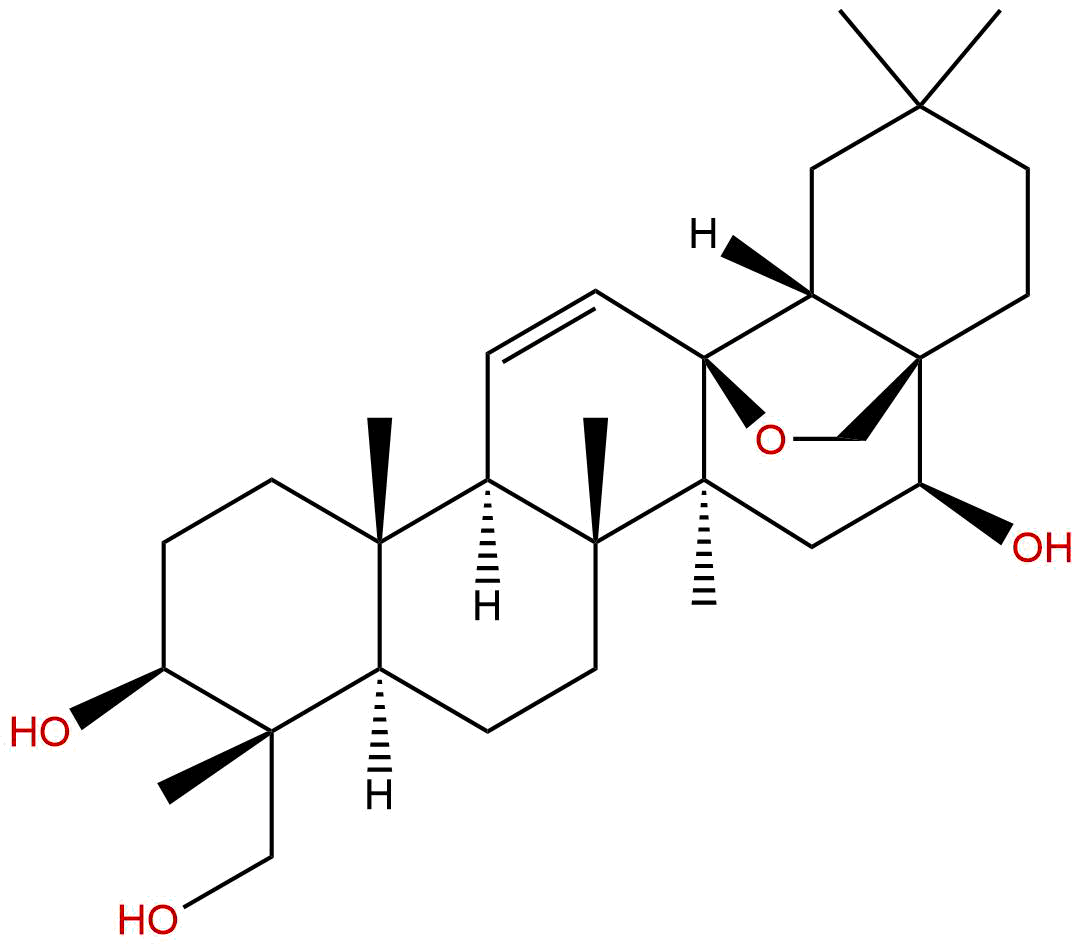


Product name: Saikogenin F
Synonym name:
Catalogue No.: BP2126
Cas No.: 14356-59-3
Formula: C30H48O4
Mol Weight: 472.71
Botanical Source: Bupleuri Radix
Type of Compound: Triterpenoids
Purity: 95%~99%
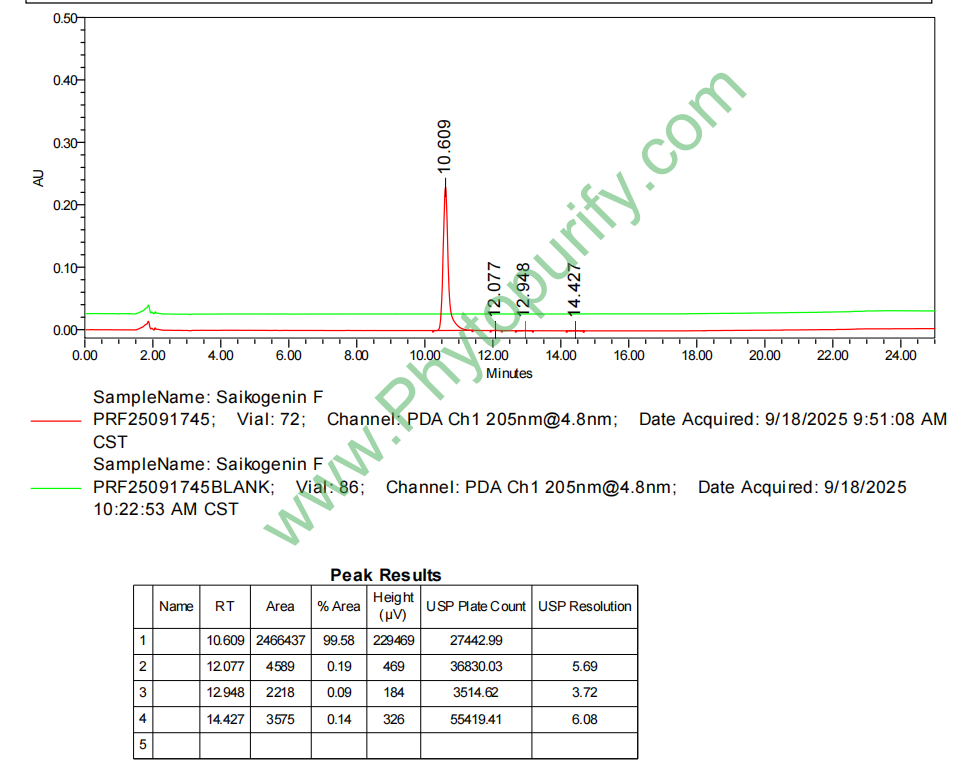
Analysis Method: HPLC-DAD or/and HPLC-ELSD
Identification Method: Mass, NMR
Packing: Brown vial or HDPE plastic bottle
Storage: Store in a well closed container, protected from air and light. Put into refrigerate or freeze for long term storage.
Whenever possible, you should prepare and use solutions on the same day. However, if you need to make up stock solutions in advance, we recommend that you store the solution as aliquots in tightly sealed vials at -20℃. Generally, these will be useable for up to two weeks.
The product could be supplied from milligrams to grams
Inquire for bulk scale.
For Reference Standard and R&D, Not for Human Use Directly.
HPLC of Saikogenin F
Storage conditions:Short-term storage at 2~8℃, long-term storage at -20 ~ -80℃
69.9200
5.1527
5.1527
.0010
5.3390
10.6939
High
88.2254
6.4236
No
No
No
No
No
No
0.0
Yes
No
Yes
Yes
Saikogenin F, CAS number 14356-59-3, is an important triterpenoid saponin derived from the traditional Chinese medicine Bupleurum spp. Chaihu, as the main herb in classic Chinese medicine formulas, has always been used for various therapeutic purposes such as fever reduction, anti-inflammatory, and immune function regulation. In recent years, with the advancement of natural product pharmacology and molecular biology techniques, saikosaponin F has received widespread attention due to its significant anti-cancer activity and antipyretic effect. This article aims to systematically review the chemical structure, plant origin, pharmacological activity, mechanism of action, and pharmacological evaluation of saikosaponin F, and explore its potential and clinical application prospects in modern drug development.
Chaihu saponin F belongs to the triterpenoid saponin group, with a molecular formula of C30H48O5 and a molecular weight of 472.71. Its structure is based on a pentacyclic triterpenoid skeleton and has typical steroid triterpenoid characteristics. The LogP value of saikosaponin F is 5.1527, indicating strong lipid solubility. Its TPSA (topological polar surface area) is 69.92 Å ², suggesting moderate polarity that facilitates membrane penetration. The extremely low water solubility (0.0010 mg/mL) poses a certain challenge to its bioavailability. It is worth noting that saikosaponin F has a high blood-brain barrier permeability, indicating its potential role in central nervous system diseases. This compound does not exhibit hERG channel inhibition, and the Ames mutagenicity test result is 0.0, indicating its high safety and good potential for drug development.
Chaihu saponin F mainly exists in plants of the Chaihu genus, especially in the roots of Bupleurum chinense DC. and Bupleurum scorzonerifolium Willd. Chaihu, as a traditional Chinese medicinal herb, is widely distributed in northern China and East Asia. Its roots contain abundant triterpenoid saponins, among which saikosaponin F is one of the important active ingredients.
The extraction method usually uses organic solvent extraction combined with column chromatography separation technology. The specific process includes: first, crude extraction is carried out using ethanol or methanol, followed by removal of impurities through liquid-liquid distribution, and further purification is performed using silica gel column chromatography or high-performance liquid chromatography (HPLC). In recent years, ultrasound assisted extraction and supercritical CO2 extraction techniques have also been applied to improve the extraction efficiency and purity of saikosaponin F. In addition, the identification methods mainly rely on modern analytical techniques such as mass spectrometry (MS), nuclear magnetic resonance (NMR), and infrared spectroscopy (IR) to ensure the structural accuracy of the compounds.
The anticancer effect of saikosaponin F is one of its most significant pharmacological properties. In vitro cell experiments showed that saikosaponin F could significantly inhibit the proliferation of many tumor cell lines, including breast cancer, liver cancer, lung cancer and colorectal cancer cells. Its anti-tumor mechanism involves inducing cell apoptosis, blocking cell cycle progression, and inhibiting tumor cell migration and invasion ability.
Animal model studies further confirm that saikosaponin F exerts anti-tumor effects by regulating immune cell activity and inflammatory cytokine expression in the tumor microenvironment. Some studies have shown that saikosaponin F can enhance the efficacy of chemotherapy drugs, reduce chemotherapy related side effects, and demonstrate its potential application value in combination therapy.
Chaihu saponin F also exhibits good activity in antipyretic and anti-inflammatory aspects. By regulating the expression of inflammatory mediators such as prostaglandin E2 (PGE2) and cyclooxygenase-2 (PTGS2) in the body, saikosaponin F can effectively reduce fever response. In addition, its regulation of multiple molecular targets such as estrogen receptor (ESR1), progesterone receptor (PGR), and oxytocin (OXT) suggests that it may achieve antipyretic and anti-inflammatory effects through multi-target synergistic effects.
The pharmacological mechanism of Chaihu Saponin F is complex, involving multiple signaling pathways and molecular targets. Existing research indicates that its main targets include:
In terms of anti-cancer, saikosaponin F promotes tumor cell apoptosis and inhibits proliferation by activating apoptosis related proteins (such as the Caspase family), inhibiting the NF - κ B signaling pathway, and regulating the MAPK/ERK pathway. In addition, its inhibition of tumor cell migration and invasion may be closely related to regulating the expression of matrix metalloproteinases (MMPs).
The pharmacological evaluation of saikosaponin F shows that it has certain advantages and challenges. Its molecular weight of 472.71 and LogP 5.15 indicate that it has high lipid solubility, which is beneficial for cell membrane permeability, but its low water solubility (0.0010 mg/mL) may limit oral absorption and bioavailability. The high blood-brain barrier permeability provides possibilities for its application in neurological diseases, but potential central nervous system side effects also need to be considered.
In terms of safety, saikosaponin F did not exhibit hERG channel inhibition, indicating a low risk of cardiac toxicity; The negative Ames test further supports its genotoxic safety. Pharmacokinetic studies are still in the preliminary stage, and existing data indicate that saikosaponin F is widely distributed in the body, mainly metabolized through the liver enzyme system, with a moderate half-life and certain pharmacokinetic advantages.
Future research needs to further improve its oral bioavailability enhancement strategy, such as nanocarriers, liposome encapsulation, and structural modification, to optimize its pharmacokinetic properties and clinical application potential.
Chaihu saponin F, as a multi-target and multifunctional natural product, has broad clinical application prospects. Its significant anti-cancer activity makes it a potential candidate drug in the field of tumor therapy, especially in combination chemotherapy and targeted therapy, which may exert synergistic effects. In addition, the antipyretic and anti-inflammatory effects of saikosaponin F provide a theoretical basis for its application in infectious diseases and inflammatory diseases.
With the deepening of pharmacological research on natural products, the mechanism of action of saikosaponin F will become clearer. With the optimization of related structures and advances in drug formulation technology, it is expected to overcome its limitations of poor water solubility and low bioavailability. In the future, combining modern molecular pharmacology and clinical pharmacology research, saikosaponin F is expected to be transformed into a safe and effective new drug.
In addition, the potential application of saikosaponin F in neurological diseases is also worth paying attention to, especially its good blood-brain barrier penetration, which may provide new ideas for the treatment of neuroinflammation and neurodegenerative diseases. Multidisciplinary interdisciplinary research will promote the transition of saikosaponin F from the laboratory to clinical practice.
Saikosaponin F, as an important triterpenoid saponin component in Bupleurum chinense, exhibits significant anti-cancer and antipyretic effects due to its unique chemical structure and diverse biological activities. Its mechanism of action involves multi-target regulation, reflecting the advantages of natural product multi-target synergistic therapy. Despite challenges in terms of water solubility and bioavailability, its good safety and blood-brain barrier penetration provide a solid foundation for its drug development.
In the future, through in-depth pharmacological mechanism research, pharmacokinetic optimization, and preclinical evaluation, saikosaponin F is expected to become an important candidate for natural product drug development, providing new strategies for the treatment of tumors and inflammation related diseases. The modern development and application of natural products will further promote the scientific utilization and innovative development of traditional Chinese medicine resources.
