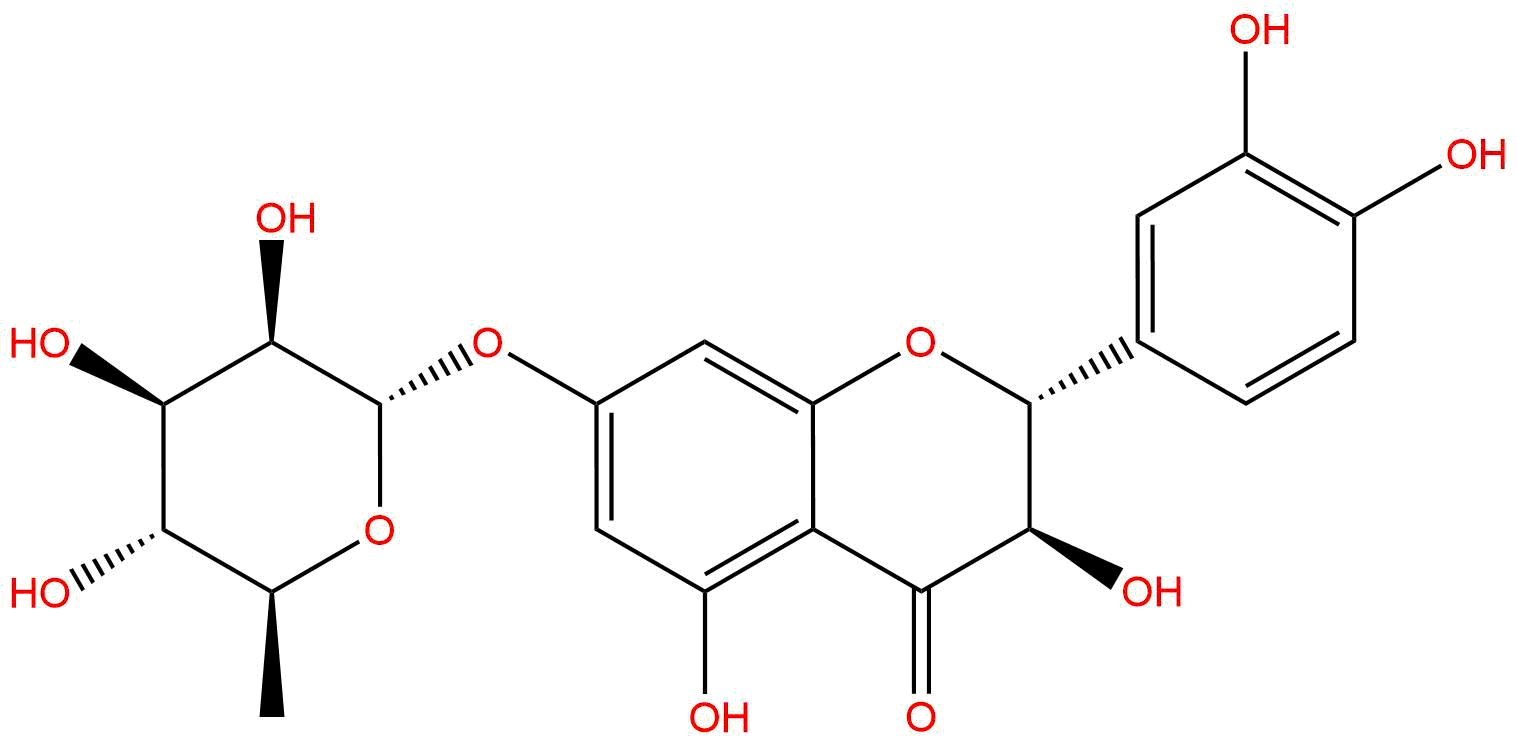


Product name: Taxifolin 7-rhamnoside
Synonym name: Dihydroquercetin 7-rhamnoside
Catalogue No.: BP2001
Cas No.: 137592-12-2
Formula: C21H22O11
Mol Weight: 450.396
Botanical Source:
Physical Description:
Type of Compound:
Purity: 95%~99%
Analysis Method: HPLC-DAD or/and HPLC-ELSD
Identification Method: Mass, NMR
Packing: Brown vial or HDPE plastic bottle
The product could be supplied from milligrams to grams. Inquire for bulk scale.
We provide solution to improve the water-solubility of compounds, thereby facilitating the variety of activity tests and clinic uses.
For Reference Standard and R&D, Not for Human Use Directly.
Description:
Taxifolin 7-O-rhamnoside is a natural product from Hypericum japonicum.
References:
Phytochemistry, 1991, 30(30):3152-3.
A flavanonol rhamnoside from Hypericum japonicum.
A new flavanonol (2R,3R)-taxifolin-7-rhamnoside(Taxifolin 7-O-rhamnoside), from whole plant of Hypericum japonicum has been isolated together with the known quercitrin and vincetoxicoside B. Their structures were elucidated using spectral techniques.
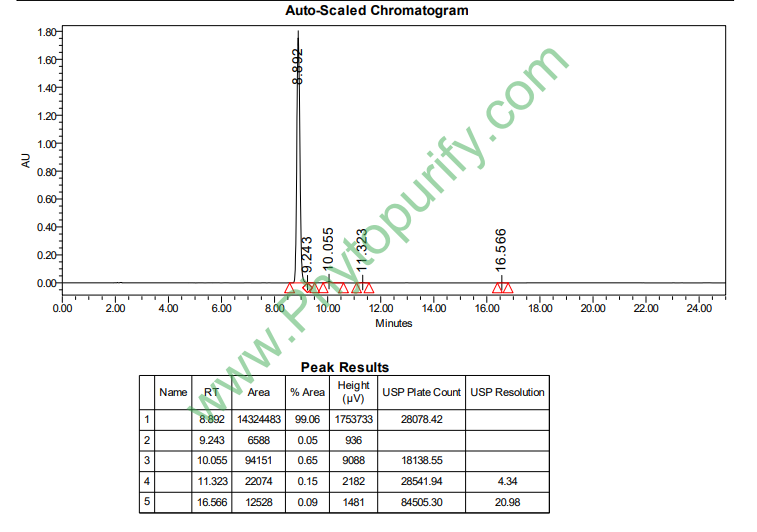
HPLC of Taxifolin 7-rhamnoside
Storage conditions:Short-term storage at 2~8℃, long-term storage at -20 ~ -80℃
186.3700
.4301
.3556
4.1195
.6690
.1440
Low
74.8815
4.3017
Yes
No
No
No
Yes
No
0.0
Yes
No
Yes
No
Taxifolin 7-rhamnoside, also known as (+) - Dihydroquercetin 7-O - α - L-rhamnoside, is a naturally occurring dihydroflavonol glycoside compound. Its CAS number is 137592-12-2, molecular formula is C21H22O11, and molecular weight is approximately 450.39 g/mol. This compound is mainly derived from traditional medicinal plants Tianji Huang It was isolated from Hypericum japonicum (family Hypericum). Tianjihuang is commonly used in folk medicine to treat hepatitis, jaundice, and traumatic injuries. The modern pharmacological research on its active ingredients provides a scientific basis for traditional applications.
In recent years, with the deepening of research on natural products, dihydrotianjihuang glycoside has attracted attention due to its wide range of biological activities. Existing research reveals that it not only has significant antioxidant and free radical scavenging Ability, still there Antityrosinase、Inhibition of collagenase、anti-fibrotic It exhibits significant activity in various aspects. Its function involves multiple targets, including NQO1, SOD1, CAT, CYP2E1, and GSTP1, which are closely related to pathological processes such as oxidative stress, inflammatory response, and chemical liver injury. Therefore, dihydrotianjihuang glycoside is regarded as a lead compound with multi-target therapeutic potential, especially showing good application prospects in the fields of liver protection, skin photoprotection, and anti-inflammatory. This article will systematically elaborate on its chemical structure, plant origin, pharmacological mechanism, evaluation of medicinal properties, and research prospects.
The chemical structure of dihydrotianjihuang glycoside is based on the Taxifolin skeleton, and an α - L-rhamnose group is attached to its hydroxyl group at position 7. The SMILES string is:C[C@H]1O[C@@H](Oc2cc(O)c3c(c2)O[C@@H](c2ccc(O)c(O)c2)[C@H](O)C3=O)[C@H](O)[C@@H](O)[C@H]1OIt displays its stereochemical configuration (multiple chiral centers) and glycosidic bond connection mode. This glycosylation modification typically affects the water solubility, bioavailability, and target selectivity of compounds.
From the analysis of pharmacological parameters:
- Molecular weight (MW):450.3960 g/mol, Slightly higher than the 500 Da threshold recommended by Lipinski's Five Rules, but still within an acceptable range (usually natural products can be moderately relaxed).
- Lipid water partition coefficient (LogP)0.4301 indicates that the compound has moderate lipophilicity and leans towards hydrophilicity. Its LogD (at pH 7.4) is 0.3556, further confirming its good water solubility tendency in physiological pH environments.
- Topological Polarity Surface Area (TPSA)Up to 186.37 Å ², mainly due to the presence of multiple hydroxyl and sugar groups in the molecule, resulting in high polarity. High TPSA is usually unfavorable for passive transmembrane diffusion, but may be beneficial for interactions with polar targets.
- Water solubility The value is 4.1195 (usually measured in mg/mL or log mol/L, indicating good solubility), which is consistent with its high TPSA and multiple hydroxyl structures.
- Permeability The permeability of Caco-2 cells is 0.1440 (usually measured in units of × 10 ⁻⁶ cm/s), which is a low value, indicating that its oral absorption may be limited. BBB permeability is' low ', indicating that it is not easily able to penetrate the blood-brain barrier, which has a lower risk of central nervous system side effects, but also limits its use in brain diseases.
- Plasma protein binding rate (PPB)74.88%, belonging to moderate binding, may affect its free blood drug concentration and distribution.
- Toxicity warning Ames test is negative (0.0), indicating no mutagenicity; HERG inhibition is' no ', indicating a low risk of cardiac toxicity; However, the chromosomal aberration test is' present 'and further assessment of its genetic toxicity risk is needed. Other parameters such as skin sensitization, respiratory sensitization, and phototoxicity are all negative, indicating good safety.
In summary, dihydrotianjihuang glycoside is a natural glycoside compound with high polarity, good water solubility, but low membrane permeability. The glycosylation in its structure may affect its pharmacokinetic behavior in vivo through active transport or hydrolysis by gut microbiota (generating glycosides).
The main plant source of dihydrotianjihuang glycoside is Tianji Huang(Hypericum japonicum Thunb.), Also known as ground ear grass or sparrow tongue grass, it belongs to the Hypericaceae family and the Hypericaceae genus of plants. This plant is widely distributed in East Asia and grows in various provinces south of the Yangtze River in China. It is commonly found in moist areas near fields and ditches.
In traditional medicine, the whole herb of Tianji Huang is used as medicine, with a bitter, pungent, and cool nature, and is associated with the liver, gallbladder, and large intestine meridians. Its application history is long, and its main functions include:
- Clear heat and eliminate dampness Used for treating liver and gallbladder diseases such as damp heat jaundice, hepatitis, cirrhosis ascites, etc. It is commonly consumed orally or externally by pounding it into soup in folk medicine.
- Detoxification and swelling reduction Used for carbuncles, sores, venomous snake bites, and injuries caused by falls, it has anti-inflammatory and analgesic effects.
- Relieve blood stasis and relieve pain Treat bruising, swelling, and pain caused by traumatic injuries.
Modern plant chemistry research has isolated various active ingredients from tianjihuang, including flavonoids (such as dihydrotianjihuang glycoside, quercetin derivatives), phloroglucinol, volatile oils, etc. Among them, flavonoids are considered to be an important material basis for their hepatoprotective and anti-inflammatory effects. Dihydrotianjihuang glycoside, as its characteristic glycoside component, directly links traditional applications with modern pharmacological activities (such as anti liver injury and antioxidant), reflecting the research paradigm of "traditional knowledge guiding modern discovery".
It is worth noting that the plant Hypericum perforatum, belonging to the same genus, is known for its antidepressant activity. Its main active ingredients are naphthoquinone compounds such as hyperoxin, which have significant differences in chemical composition spectrum from Tianjihuang. This suggests that the plants of the Primula genus have rich chemical diversity, and different species have different medicinal values.
Dihydrotianjihuang glycoside has a wide range of pharmacological activities, and its mechanism of action involves multi-target regulation. The core lies in its strong antioxidant capacity and regulatory effect on key enzymes.
The five targets provided by the database (NQO1, SOD1, CAT, CYP2E1, GSTP1) reveal the core role of dihydroquercetin in the cellular defense system:
Chemical liver injury Liver cell damage is caused by drugs, alcohol, environmental toxins, etc. Its core mechanism includes: ① CYP450 metabolism produces active intermediates; ② Oxidative stress and lipid peroxidation; ③ Inflammatory response; ④ Mitochondrial dysfunction.
Dihydrotianjihuang Glycoside Multi target synergistic effect Combat these pathological processes:
1. Source suppression Inhibit CYP2E1 and reduce toxin activation.
2. Antioxidant defense Directly eliminate free radicals and upregulate endogenous antioxidant enzymes such as SOD1, CAT, GSTP1, enhancing the liver's antioxidant capacity.
3. Detoxification enhancement Inducing NQO1 and GSTP1 to accelerate the harmless treatment and excretion of toxins and their metabolites.
4. Anti inflammation and anti fibrosis Reduce inflammatory cell infiltration and hepatic stellate cell activation, prevent acute injury from developing into chronic liver fibrosis.
Therefore, the protective effect of dihydrotianjihuang glycoside on chemical liver injury is Multidimensional and networked This reflects the advantage of multi-target action of natural products.
Based on the provided pharmacokinetic parameters, combined with the Lipinski Rule of Five (Ro5) and general standards for drug development, the potential for the development of dihydrotianjihuang glycoside as a drug is evaluated as follows:
Conclusion Dihydrotianjihuang glycoside violates the HBD and HBA rules in Ro5, which is consistent with its glycoside structure and high polarity characteristics. Ro5 is mainly used to predict the passive diffusion absorption of oral small molecules, and violating the rules usually indicates that the oral bioavailability may be low. However, many successful natural product drugs (such as cardiac glycosides and antibiotics) also violate Ro5, and they may be administered through active transport, prodrug modification, or non oral routes.
Dihydrotianjihuang glycoside as lead compound Has clear multi-target pharmacological activity, especially suitable for development as Liver protective drugs or External skin preparation(such as anti-aging and whitening cosmetics). Its oral drug development faces challenges, and possible optimization strategies include:
1. Prodrug design Esterification and alkylation modification of polar hydroxyl groups to improve lipid solubility and membrane permeability, and release the active ingredient through hydrolysis in vivo.
2. Selection of administration route Develop injections (such as for acute liver injury), transdermal delivery systems, or topical formulations to avoid oral absorption issues.
3. Simplified structure Study its aglycone (dihydroquercetin) or simplified analogues to improve its pharmacological properties while maintaining its activity.
4. Formulation technology Using delivery technologies such as nanocrystals, liposomes, and cyclodextrin inclusion to improve its solubility and bioavailability.
At present, research on dihydrotianjihuang glycoside is still in progress Preclinical stage Mainly focused on:
- Activity screening and mechanism research It has been confirmed that it has in vitro and animal model activities in antioxidant, anti-inflammatory, hepatoprotective, and skin protective aspects, and its multi-target mechanism of action has been preliminarily elucidated.
- Extraction, Separation, and Synthesis Efficient extraction and separation from Tianjihuang have been achieved, and there have been reports of total synthesis routes, laying the foundation for its large-scale supply.
- Pharmacokinetic study Preliminary data suggests that its oral bioavailability may be low, and the metabolic pathway is mainly combined with II, requiring more systematic ADME research.
Dihydrotianjihuang glycoside, as a natural active ingredient discovered from traditional medicinal plants, perfectly embodies the value of natural products in drug discovery: providing novel chemical frameworks and multi-target modes of action. Despite facing challenges in physicochemical properties and pharmacokinetics on its path to becoming a drug, these challenges are expected to be overcome through modern medicinal chemistry and pharmaceutical methods. With the increasing emphasis on multi-target and network pharmacology treatment strategies, compounds such as dihydrotianjihuang glycoside that can simultaneously regulate oxidative stress, detoxifying enzyme systems, and inflammatory pathways may have advantages over single target drugs in the treatment of complex diseases such as metabolic liver disease and chronic inflammation. In the future, it is expected to be developed into a new type of liver protective drug or skin protectant, bringing new choices to human health.
Statement This article is based on existing public data and scientific research, and its content is for professional communication and reference only. It does not constitute any medical or investment advice. The development of compounds requires rigorous preclinical and clinical trial validation.
