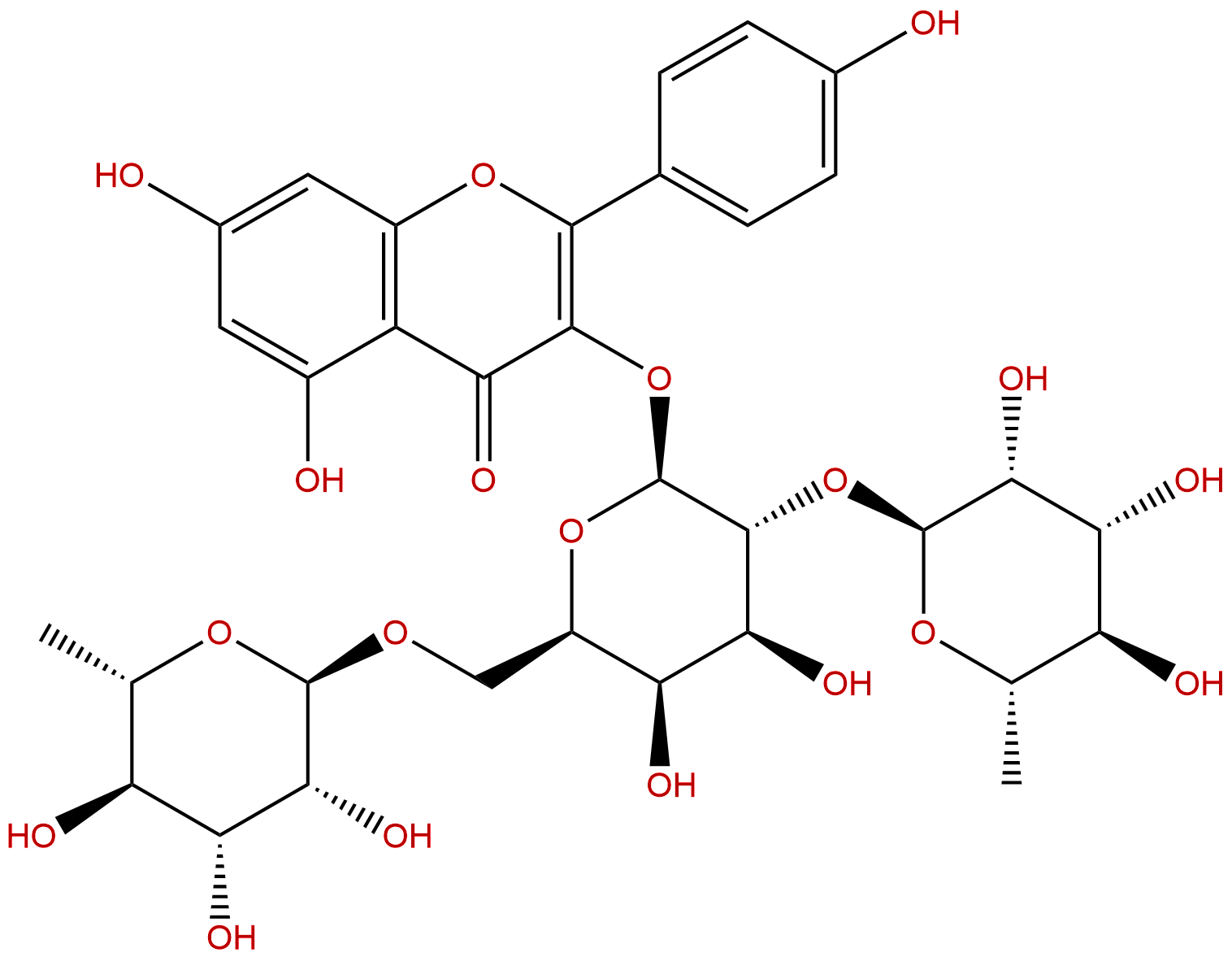
Mauritianin: a natural flavonoid glycoside with multiple pharmacological activities
1. Overview
Mauritianin, CAS number 109008-28-8, is a natural compound with complex structure and significant biological activity. Its chemical essence belongs to kaempferol glycoside, with a molecular formula of C33H40O19 and a molecular weight of up to 740.6640 g/mol. This compound was originally derived from plants Acalypha indica(Iron amaranth) was isolated from its flowers and leaves, and subsequent studies have also found its presence in Tianji Huang (Hypericum japonicum)In the middle. As an orally active ingredient, Mauritius weed extract has shown remarkable potential in multiple biological activity screenings. One of its core pharmacological effects is to act as Topoisomerase I inhibitor This characteristic has attracted much attention in the field of anti-tumor research. In addition, extensive in vitro and in vivo studies have confirmed that the compound has significant Liver protection, neuroprotection, and kidney protection At a concentration of 60 μ g/mL, its cell protective effect is comparable to that of the classic hepatoprotective drug silymarin. More interestingly, research has found that when used in combination with another compound, Alcesefoliside, it can increase vascular tension, indicating its potential application value in cardiovascular regulation. In recent years, with the deepening of research on tropical diseases, the activity of Mauritian weed extract against multiple malaria parasite targets (such as PFCRT, PFDHFR, etc.) has been revealed, providing it with potential applications as against malaria Lead compounds provide new scientific evidence. This article will provide a systematic and professional interpretation of this multifunctional natural product from the aspects of its chemical structure, plant origin, pharmacological mechanism, medicinal evaluation, and research prospects.
2. Chemical structure and physicochemical properties
The chemical structure of Mauritius weed extract is the material basis for its multifunctional biological activity. Its SMILES string (C [C @ @ H] 10)C@@HC@HC@H[C @ H] 1O) revealed its highly glycosylated characteristics. This molecule uses kaempferol as a glycoside element and connects multiple sugar units through glycosidic bonds, forming a large glycosidic molecule. The multiple chiral centers in the structure (represented by the @ @ @ symbol) indicate that it has a specific stereoconfiguration, which is crucial for its specific recognition and binding to biological targets.
From the analysis of medicinal parameters, its physicochemical properties exhibit typical characteristics of high polarity and large molecule natural products:
- Molecular weight (MW):740.6640 g/mol, Significantly exceeding the standard of 500 Da for conventional small molecule drugs.
- Lipid water partition coefficient (LogP/LogD)LogP is -0.4343 and LogD is -0.5120, both negative values, indicating that the compound has Extremely strong hydrophilicity It tends to be distributed in the aqueous phase, which is completely consistent with the structural characteristics of having multiple hydroxyl and sugar groups attached to the molecule.
- Topological Polarity Surface Area (TPSA)Up to 308.120 Å ², far exceeding the threshold commonly believed to be easy to penetrate cell membranes (about 140 Å ²), strongly suggesting its Poor membrane permeability。
- Water solubility The value is 3.7959 (usually measured in mg/mL or log mol/L, indicating good water solubility), consistent with its high TPSA and negative LogP values.
- Penetration data The permeability of Caco-2 cells is 0.1721, and the Peff value is 0.3473, both of which are relatively low. This confirms from an experimental perspective that Oral absorption may face challenges The blood-brain barrier (BBB) penetration is predicted to be "low", meaning it is difficult to enter the central nervous system, which may be a limiting factor for the expression of neuroprotective activity, but also reduces the risk of central neurotoxicity.
These physical and chemical parameters collectively depict a High polarity, high molecular weight, strong water solubility but weak membrane permeability The image of the compound directly affects its pharmacokinetic properties and potential for drug development.
3. Plant sources and traditional applications
Mauritius weed extract is mainly isolated from two types of plants:Acalypha indica L.(Iron amaranth, Euphorbiaceae) and Hypericum japonicum Thunb. ex Murray(Tianji Huang, Tenghuang family).
Acalypha indica Widely used in traditional medical systems in Asia and Africa. In Ayurvedic medicine, it is used to treat bronchitis, pneumonia, asthma, and skin diseases. The extract of its leaves is often used as a expectorant, emetic, and deworming agent. Modern pharmacological research also supports its anti-inflammatory, antibacterial, antifungal, and hepatoprotective effects. The discovery of Mauritian weed extract from this plant provides a possible chemical basis for some of its traditional effects, especially liver protection.
Tianji Huang (Hypericum japonicum) It is a traditional medicinal plant in China, belonging to the genus Hypericum. The most famous member of this genus is St. John's wort, known for its antidepressant activity. Tianjihuang is commonly used in traditional Chinese medicine for treatment Hepatitis, jaundice, dysentery, and sores and toxins It is commonly used in folk medicine to decoct whole herbs in water for the treatment of acute and chronic hepatitis, with significant therapeutic effects. The isolation of Mauritius weed extract from Tianjihuang scientifically confirms its traditional efficacy of "clearing heat and detoxifying, promoting diuresis and reducing jaundice", especially its liver protective activity, which is highly consistent with clinical experience in treating hepatitis. This research model of tracking active ingredients from traditional medicinal plants is an important pathway for the discovery of natural product drugs.
The cross validation of two plant sources not only increases the universality of the existence of Mauritian weed extract, but also suggests that it may play an important role in plant defense or signal transduction, and its biological activity is the result of long-term plant evolution.
4. Pharmacological activity and mechanism of action
Mauritius weed extract exhibits diverse pharmacological activities, and its mechanism of action involves multiple molecular targets and pathways.
4.1 Topoisomerase I inhibition and potential anti-tumor activity
Topoisomerase I is a key enzyme in DNA replication and transcription processes, which temporarily cleaves and rewinds DNA single strands to alleviate supercoiled tension. This enzyme is an important target for various anticancer drugs, such as camptothecin. Mauritius weed extract has been identified as a new topoisomerase I inhibitor. Its mechanism of action may be similar to other flavonoids: the planar structure (kaempferol glycoside) in the molecule can be inserted into DNA base pairs, stabilizing the "enzyme DNA cleavage complex", preventing DNA reconnection, leading to the accumulation of DNA single strand breaks, thereby triggering cell cycle arrest and apoptosis. This mechanism has the potential to Anti tumor application Provided a theoretical basis, although the publicly available cytotoxicity and in vivo anti-tumor data are not yet sufficient, the confirmation of this target makes it an attractive anti-cancer lead compound.
4.2 Cellular protective effects: liver, nerve, kidney
This is the most extensively studied active area of glyphosate in Mauritius.
- Liver protection In the experimental model, its activity is equivalent to that of silymarin. The mechanism of action may involve:① Antioxidant The phenolic hydroxyl group on flavonoid glycosides is an effective free radical scavenger that can alleviate oxidative stress damage to liver cells;② Anti inflammatory Inhibiting inflammatory signaling pathways such as NF - κ B and reducing the production of pro-inflammatory cytokines;③ Inhibition of hepatic stellate cell activation, anti liver fibrosis;④ Membrane stabilization effect。
- neuroprotection Although its BBB penetration is low, it still has the potential to exert neuroprotective effects in diseases with blood-brain barrier damage (such as cerebral ischemia, encephalitis) or indirectly through peripheral anti-inflammatory/antioxidant effects. The mechanism may include inhibiting excessive activation of microglia, reducing excitotoxicity, and combating A β protein aggregation.
- Kidney protection: Similarly, it can alleviate the damage of glomerular and tubular epithelial cells through antioxidant and anti-inflammatory pathways, which may improve diabetes nephropathy, drug-induced renal injury, etc.
4.3 Anti malaria activity and multi-target effects
This is a highly distinctive research direction for Mauritian weed extract. The database information shows that it acts on 5 malaria specific targets:
- PFCRT Plasmodium chloroquine resistance transporter protein. Inhibiting this protein may reverse the resistance of malaria parasites to drugs such as chloroquine, or directly affect the parasite's metabolic waste excretion and ion balance.
- PFDHFR Dihydrofolate reductase. This is the target of the classic antimalarial drugs ethambutol and sulfamethoxazole. Inhibiting this enzyme will block the folate synthesis of malaria parasites and affect nucleic acid replication.
- PFK13 Kelch13 protein. Its mutation is the main biomarker of artemisinin resistance. Acting on this target may provide a new strategy for overcoming artemisinin resistance.
- PFATP6 Calcium ion ATPase in sarcoplasmic/endoplasmic reticulum. Considered as one of the targets of artemisinin.
- PFCYTBC Cytochrome bc1 complex. It is a target of the antimalarial drug atorvastatin and participates in the mitochondrial electron transport chain.
Simultaneously targeting multiple key targets is an ideal strategy for overcoming and delaying drug resistance in malaria parasites The multi-target feature of Mauritian weed extract makes it potentially effective against drug-resistant strains of malaria parasites and has great potential for development as a new generation of antimalarial drugs. The mechanism of action may be that different pharmacophores in the molecule bind to these targets separately and work synergistically.
4.4 Regulating effect on vascular tension
The combination with Alcesefoliside can increase vascular tension, suggesting that it may affect the contraction mechanism of vascular smooth muscle, such as by affecting calcium ion channels, adrenergic receptors, or endothelial derived contraction factors. This discovery opens up new avenues for its application in regulating blood pressure, treating circulatory system diseases such as shock, and more.
5. Evaluation of drug properties
Based on the provided pharmacological parameters and in combination with classic drug design rules such as Lipinski's Five Rules and the Five Principles of Generic Drugs, a systematic evaluation of the pharmacological potential of Mauritius Atractylodes macrocephala can be conducted
5.1 Compliance analysis of Lipinski's Rule of Five
This rule is typically used to predict the oral absorption characteristics of small molecule compounds, requiring at least three of the following: ① MW ≤ 500; ② LogP ≤ 5; ③ Hydrogen bond donor (HBD) ≤ 5; ④ Hydrogen bond acceptor (HBA) ≤ 10.
- MW:740.664 >> 500,Severe violation。
- LogP:-0.4343 < 5,Comply with。
- HBD/HBA Based on its molecular formula C33H40O19 and structure, it is inferred that it contains a large number of hydroxyl (- OH) and ether oxygen atoms, with HBD and HBA numbers far exceeding 5 and 10, respectively,Severe violation。
Conclusion Mauritius weed extract Severe deviation The Lipinski Five Rules are consistent with their chemical nature as large molecule glycosides. Therefore, it is unlikely to have the ideal pharmacokinetic properties of small molecule oral drugs.
5.2 Interpretation of Key Medicinal Parameters
- absorb The extremely low permeability of Caco-2 (0.1721) and Peff (0.3473) directly confirm its Oral bioavailability is likely to be very low High TPSA (308) and strong hydrophilicity are the main reasons for poor absorption. As an orally active ingredient, its activity may depend on local intestinal action, gut microbiota metabolism (hydrolysis of glycosides), or special transporter mediated absorption.
- distribution The plasma protein binding rate (PPB) is 76.31%, which is a moderately high level and can affect its free drug concentration. BBB has low penetration, which limits its direct action on the central axis, but as mentioned earlier, it may not have a significant impact on peripheral or indirect effects.
- Metabolism and toxicity:
-Ames test is 0.0, usually indicating No mutagenicity Low risk of genetic toxicity.
-The result of chromosome aberration test is' yes', which requires high vigilance Potential genotoxic signals It must be validated through more in-depth in vitro and in vivo studies.
-HERG inhibition is' no ', indicating that it Low risk of cardiac toxicity (QT interval prolongation)This is a favorable security feature.
-Elevated serum biochemical indicators (ALK, GGT, AST, ALT) are marked as "yes", which is consistent with Liver protection The report seems contradictory. One possible explanation is that at specific high doses or in specific models, it may exhibit an increase in liver cell injury markers, suggesting that The treatment window may need to be carefully defined The liver protective effect may be dose-dependent (low-dose protection, high-dose may cause burden or toxicity).
-Respiratory sensitization (Resp_Sens) is "yes", indicating a possible risk of inducing respiratory allergies, which should be taken into account during formulation development and clinical use.
-No phototoxicity, no skin sensitization, these are good characteristics.
5.3 Comprehensive Evaluation and Development Strategy
Mauritius weed extract is a typical natural product with strong activity but significant challenges in developing medicinal properties. its The value of multiple pharmacological activities, especially anti malaria and cell protection, is high But Poor membrane permeability and oral absorption characteristics are the main obstacles to its progress towards drugs。
Possible optimization and development strategies include:
1. Prodrug strategy Modify its polar groups (especially hydroxyl groups) through esterification, acylation, and other methods to prepare more lipophilic prodrugs, in order to improve membrane permeability and oral absorption, and metabolize them back into the original drug in vivo.
2. Simplified structure Study its essential structure for activity. Can active aglycones (kaempferol) be obtained through hydrolysis or small molecule fragments that retain some sugar groups? These fragments may have better drug like properties. However, it should be noted that glycosylation often increases water solubility, targeting, and stability, and complete removal may alter activity.
3. New drug delivery system Develop nano formulations (such as liposomes, polymer nanoparticles), microemulsions, cyclodextrin inclusion complexes, etc., using formulation technology to improve their solubility, stability, and transmembrane transport ability, and even achieve targeted delivery.
4. Non oral administration route Consider injecting medication (such as intravenous injection for acute liver protection or anti malaria) to bypass absorption barriers. But it has good water solubility and is suitable for making injections.
5. As a lead compound Using it as a template, conduct systematic structure-activity relationship research and structural modification, optimize its physicochemical properties while retaining the core pharmacophore, and obtain new compounds with better drug properties.
6. Research Status and Application Prospects
Research status:
At present, research on Mauritian weed extract is still in progress Preclinical stage The existing literature mainly focuses on the following aspects: ① Isolation and identification from different medicinal plants; ② Preliminary in vitro activity screening (topoisomerase inhibition, cell protection, antimalarial target binding); ③ Partial in vivo pharmacological validation (such as liver protection model). The mechanism of action, especially the specific molecular details of multi-target antimalarial activity, in vivo pharmacokinetics, and long-term toxicity data, still lacks systematic and in-depth research. The potential risks of chromosomal aberration positivity and elevated serum enzymes also need further experimental clarification.
Application Prospects:
Despite facing challenges in developing medicinal properties, the application prospects of Mauritius herbicide are still broad, mainly reflected in the following directions:
- Development of antimalarial drugs Its simultaneous action on multiple key targets of malaria parasites, including resistance related targets PFCRT and PFK13, makes it a response Plasmodium multidrug-resistant A highly valuable precursor compound for crises. Through rational drug chemical modification or advanced drug delivery systems, it is expected to develop a new generation of antimalarial drugs that are not easily resistant to drug resistance.
- Liver disease adjuvant therapy drugs Its clear liver protective activity, as well as the background derived from the traditional liver protecting plant Tianjihuang, support its development as a therapeutic agent Drug induced liver injury, alcoholic liver disease, or viral hepatitis Auxiliary drugs. It can be explored for combined use with existing hepatoprotective drugs, or developed into an injection for acute liver injury.
- Multi organ protectants Its neuroprotective and renal activity suggests that Ischemia reperfusion injury, sepsis, or multiple organ dysfunction syndrome In pathological processes involving systemic oxidative stress and inflammation, it may play a multi organ protective role.
- A model of modernization research in traditional Chinese medicine The research on Mauritian weed extract is a successful case of translating the experience and therapeutic effects of traditional medicinal plants (such as Tianjihuang) into modern scientific language. It can serve as a template for the study of active ingredients in traditional Chinese medicine, promoting the elucidation of the material basis and mechanism of action of more traditional medicines.
Future research directions:
- In depth mechanism research Using techniques such as molecular docking, surface plasmon resonance, and X-ray crystallography, elucidate the precise binding modes with topoisomerase I and various malaria parasite targets.
- Research on the Structure Activity Relationship of the System Synthesize a series of structurally similar compounds or hydrolyzed fragments, clarify their pharmacophores and toxic groups, and guide structural optimization.
- Comprehensive preclinical development Complete pharmacokinetic and toxicological studies that meet the requirements for new drug registration, especially in-depth evaluations of genetic toxicity and organ toxicity.
- Pharmaceutical research Actively exploring strategies such as nanomedicine and prodrugs to overcome the bottleneck of low bioavailability.
Summary:
Mauritius weed extract is a natural treasure trove molecule containing multiple biological activities. It is like a 'multi-target key', demonstrating the potential to unlock multiple disease fields such as anti-tumor, anti malaria, and organ protection. However, its massive glycoside structure also constitutes a physical barrier for delivering this' key 'into the human body. Future research requires the collaboration of medicinal chemists, pharmacologists, and pharmacologists, who not only deeply understand the mysteries of its effects, but also skillfully utilize modern drug design techniques to overcome its own shortcomings, ultimately transforming this natural gift into drugs that benefit human health. The research process also vividly reflects the typical path of natural product drug development: from traditional wisdom to activity tracking, from structural analysis to mechanism exploration, and finally through redesign and optimization, crossing the gap from "active compounds" to "drugs".