


Product name: Quercitrin
Synonym name: Quercitroside; Quercitronic acid; Thujin
Catalogue No.: BP1192
Cas No.: 522-12-3
Formula: C21H20O11
Mol Weight: 448.38
Botanical Source: Occurs widely in plants
Physical Description: Yellow powder
Type of Compound: Flavonoids
Purity: 95%~99%
Analysis Method: HPLC-DAD or/and HPLC-ELSD
Identification Method: Mass, NMR
Packing: Brown vial or HDPE plastic bottle
Storage: Store in a well closed container, protected from air and light. Put into refrigerate or freeze for long term storage.
Whenever possible, you should prepare and use solutions on the same day. However, if you need to make up stock solutions in advance, we recommend that you store the solution as aliquots in tightly sealed vials at -20℃. Generally, these will be useable for up to two weeks.
The product could be supplied from milligrams to grams, up to kilograms
Inquire for bulk scale.
Descriptions:
Quercetin is a common antioxidant flavonoid found in vegetables, which is usually present in glycosylated forms, such as quercitrin (3-rhamnosylquercetin), has anti-inflammatory effect which is mediated through the inhibition of the NF-kappaB pathway, inhibits cytokine and inducible nitric oxide synthase expression through inhibition of the NF-kappaB pathway without modification of c-Jun N-terminal kinase activity (both in vitro and in vivo). [1]
Quercetin has prevention of H2O2-induced apoptosis via anti-oxidant activity and heme oxygenase 1 gene expression in macrophages. [2]
Quercitrin exhibits a scavenger and antioxidant role, and these effects probably are mediated via different mechanisms, which may involve the negative modulation of the Fenton reaction and NMDA receptor. [3]
Quercetin( 50 μM)can reduce UVB-induced cell death and apoptosis in HaCaT cells, also similarly reduce UVB-induced ROS generation and cell death in live zebrafish. [4]
Quercitrin exhibits strong antioxidant and anti-carcinogenic activities, it contributes to the inhibition of neoplastic transformation by blocking activation of the MAPK pathway and stimulation of cellular protection signaling. [5]
Quercitrin and Taxifolin can stimulate osteoblast differentiation in MC3T3-E1 cells and inhibit osteoclastogenesis in RAW 264.7 cells, shows a positive effect of these flavonoids on bone metabolism. [6]
References:
[1] Comalada M, Camuesco D, Sierra S, et al. Eur J Immun, 2005, 35(2):584–92.
[2] Chow J M, Shen S C, Huan S K, et al. Biochem Pharmacol, 2005, 69(12):1839-51.
[3] Wagner C, Fachinetto R, Corte C L D, et al. Brain Res, 2006, 1107(1):192-8.
[4] Yang H M, Ham Y M, Yoon W J, et al. J Photoch Photobio B , 2012, 114(5):126-31.
[5] Ding M, Zhao J, Bowman L, et al. Int J Oncol, 2010, 36(1):59-67.
[6] Satué M, Arriero M D M, Monjo M, et al. Biochemical Pharmacology, 2013, 86(10):1476-1486.
[7] Li J, Wang Z W, Zhang L, et al. Biomedical Chromatography, 2008, 22(4):374-8.
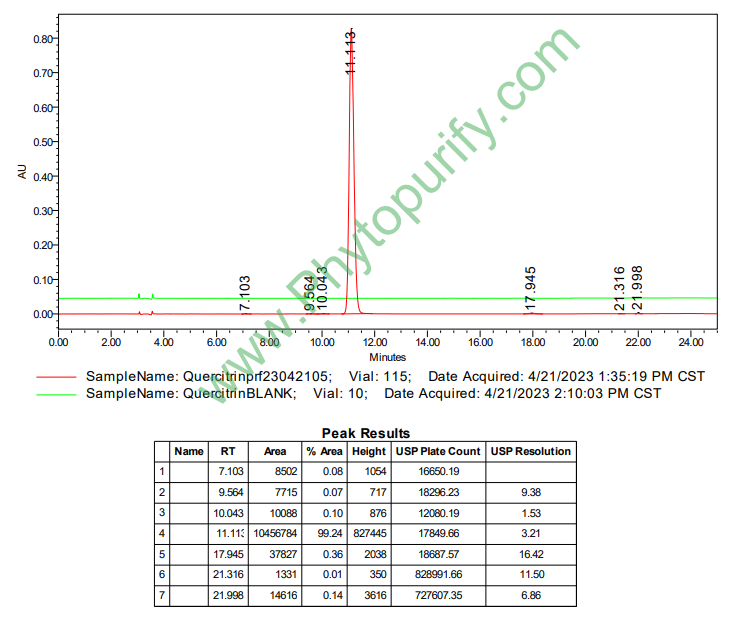
HPLC of Quercitrin
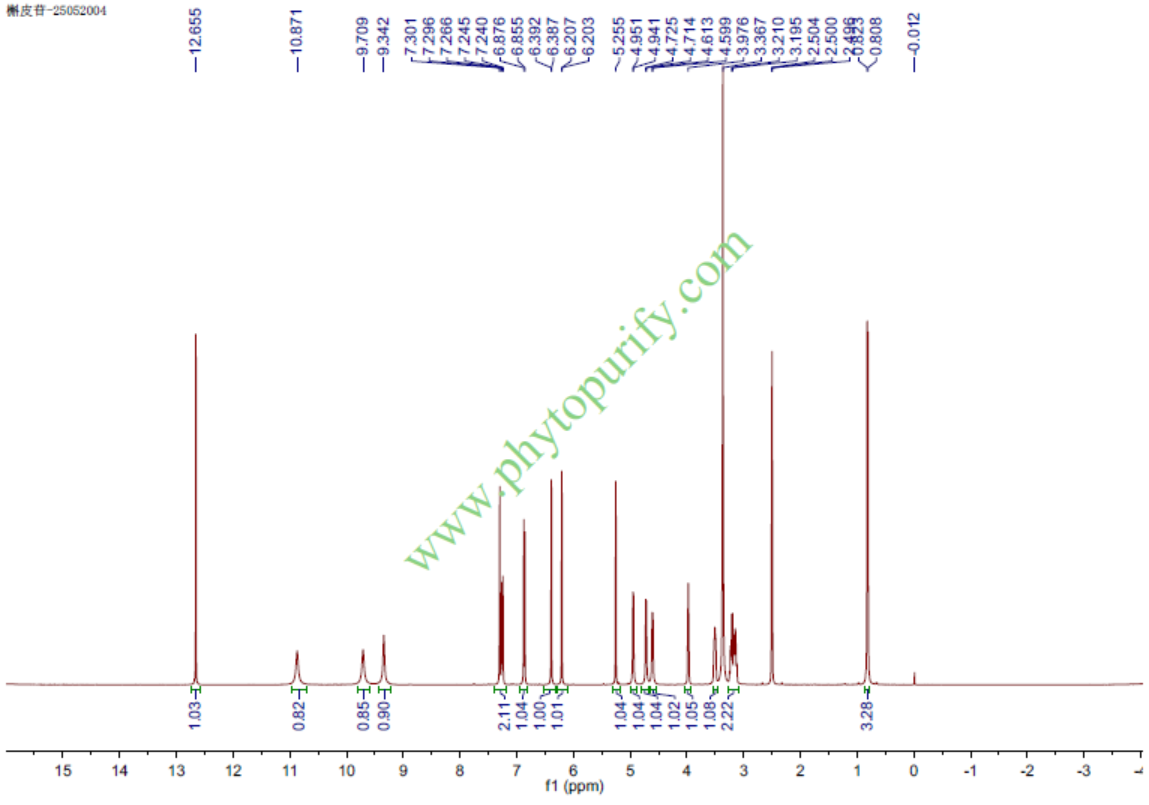
HNMR of Quercitrin
Storage conditions:Short-term storage at 2~8℃, long-term storage at -20 ~ -80℃
190.2800
.7891
.5458
.9831
.5041
.4574
Low
78.8419
4.0084
Yes
No
Yes
No
Yes
No
0.6
Yes
No
Yes
No
Natural products are an important treasure trove for the discovery and development of new drugs, among which flavonoids have attracted much attention due to their extensive biological activity and low toxicity. Quercetin, also known as Quercetin-3-O - α - L-rhamnoside, is one of the important glycoside derivatives of flavonol quercetin, with a CAS number of 522-12-3. As a bioactive ingredient widely present in various medicinal plants, quercetin has long been used in traditional medicine for anti-inflammatory, antipyretic, and analgesic purposes. Modern pharmacological research has gradually revealed that quercetin not only has significant anti-inflammatory, antioxidant, and neuroprotective effects, but also shows great potential in anti-tumor (such as inducing apoptosis of colon cancer cells), cardiovascular protection, and other aspects. Its core biological activity is closely related to its strong free radical scavenging ability and regulation of key cellular signaling pathways, especially in combating oxidative stress damage. It maintains intracellular redox balance by acting on key targets such as NRF2, SOD, CAT, etc. This article aims to systematically review the chemical properties, plant sources, pharmacological activities, molecular mechanisms of action, pharmacological evaluation, and clinical application prospects of quercetin, in order to provide comprehensive scientific references for the in-depth research and drug development of this natural product.
The molecular formula of quercetin is C21H20O11, with a molecular weight of 448.38 g/mol. Its chemical structure is based on 2-phenylchromenone as the parent nucleus, specifically quercetin (3,5,7,3 ', 4' - pentahydroxyflavone) with an α - L-rhamnose group attached to the C-3 hydroxyl group. This glycosylation modification significantly altered the physicochemical properties and bioavailability of its parent nucleus quercetin.
From the analysis of physical and chemical properties, the theoretical lipid water partition coefficient (LogP) of quercetin is about 0.79, indicating that it has a certain lipophilicity, but overall it still leans towards hydrophilicity. Its topological polar surface area (TPSA) is as high as 190.28 Å ², mainly attributed to the numerous oxygen atoms on the hydroxyl and sugar groups in the molecule, which are the main sources of hydrogen bond donors and acceptors, and also determine its solubility in water. Both computational and experimental data show that quercetin has good water solubility (approximately 0.98 mg/mL), which is superior to its glycoside quercetin and beneficial for its dissolution and distribution in body fluids. However, its high polarity also poses a challenge to its transmembrane absorption. Preliminary pharmacological predictions indicate that quercetin has a lower ability to penetrate the blood-brain barrier, which to some extent limits its direct effects on central nervous system diseases. However, structural modifications or drug delivery system modifications are expected to improve its efficacy. In terms of safety, the hERG inhibition risk is negative, indicating a low risk of cardiac toxicity; The Ames test value is 0.6, indicating a low risk of mutagenicity and providing preliminary safety evidence for its further development.
Quercetin is widely distributed in nature and is one of the main active ingredients in many medicinal and edible plants. Its rich plant sources include but are not limited to:Lipstick family Plants like summer grass(Prunella vulgaris)The whole grass;Fabaceae Plants like locust trees(Sophora japonica)Flower buds (locust);Polygonaceae family Plants like flatworms(Polygonum aviculare)The whole grass;Rhododendron family Plants are as red as mountains(Rhododendron dauricum)The leaves; and Shell family Plants like oak(Quercus acutissima)Tree bark, etc. In addition, trace amounts are also present in some fruits (such as apples, berries) and tea leaves.
Solvent extraction method is commonly used to extract quercetin from plant materials. Due to the high polarity of quercetin,Methanol, ethanol, acetone and their aqueous solutions It is a commonly used extraction solvent. In order to improve extraction efficiency, modern extraction techniques such as Ultrasound assisted extraction、Microwave assisted extraction and Pressurized solvent extraction It has been widely applied. These methods destroy plant cell walls through physical means, accelerate solvent permeation and solute diffusion, and can achieve higher yields of quercetin in a shorter time and with less solvent.
The crude extract after extraction usually requires further separation and purification. The conventional purification steps include: first, enrichment is carried out using macroporous adsorption resins (such as AB-8, D101 type), and gradient elution is performed using ethanol water solutions of different concentrations to preliminarily remove impurities such as polysaccharides and proteins. Subsequently, adopting silica gel column chromatography、Polyamide column chromatography or Sephadex gel column chromatography Perform segmentation. The final high-purity preparation depends on Preparation type high-performance liquid chromatography By optimizing the mobile phase (commonly methanol water or acetonitrile water system, adding a small amount of formic acid or acetic acid to adjust the pH), the separation of quercitrin from other structurally similar flavonoid glycosides can be achieved. The optimization of extraction and purification processes is the basis for ensuring sufficient and high-purity quercetin for pharmacological and clinical research.
A large number of pharmacological experiments in vitro and in vivo have confirmed that quercetin has various biological activities, and its application research involves multiple disease fields.
Antioxidant and anti-inflammatory activities This is the core pharmacological effect of quercetin. In various cell models (such as endothelial cells, neurons, macrophages) and animal models (such as mice and rats), quercetin can effectively scavenge DPPH and ABTS free radicals, inhibit lipid peroxidation, and enhance the total antioxidant capacity of cells. Its anti-inflammatory effect is manifested by significantly inhibiting the production of nitric oxide, prostaglandin E2, and pro-inflammatory cytokines (such as TNF - α, IL-1 β, IL-6) induced by lipopolysaccharides and other factors in macrophages. Its effect is comparable to that of classical anti-inflammatory drugs dexamethasone or indomethacin.
Neuroprotective effect Quercetin has shown good protective potential against neurological diseases. In Alzheimer's disease models, it can alleviate beta amyloid induced neuronal apoptosis and synaptic damage, and improve learning and memory impairment. In the model of cerebral ischemia/reperfusion injury, pretreatment with quercetin can reduce the volume of cerebral infarction, alleviate brain edema and neurological deficits, and its mechanism is closely related to antioxidant, anti apoptotic, and inhibition of inflammasome activation. Although its blood-brain barrier permeability is poor, central effects can still be observed after long-term or high-dose administration, suggesting the possibility of indirect effects or metabolic products at play.
Antitumor activity Quercetin has growth inhibitory and pro apoptotic effects on various tumor cell lines, especially on colon cancer, which has been extensively studied. Research has shown that quercetin can dose dependently inhibit the proliferation of human colon cancer cells (such as HCT-116, SW480), induce cell cycle arrest (such as G2/M phase), and activate mitochondrial dependent and death receptor dependent apoptosis pathways, leading to caspase-3 activation and PARP cleavage.
Cardiovascular protective effect Quercetin has a protective effect on the cardiovascular system. In atherosclerosis model, it can reduce vascular endothelial inflammation and foam cell formation. In the myocardial ischemia/reperfusion injury model, quercetin can reduce myocardial enzyme release, inhibit myocardial cell apoptosis, and improve cardiac function. These effects are related to their improvement of endothelial function, antioxidant stress, and regulation of lipid metabolism.
Other activities In addition, the research also reported that quercitrin has antibacterial, antiviral, anti allergic, liver protection (against alcohol or drug induced liver injury) and anti diabetes (to improve insulin resistance) activities, reflecting its multi target effect.
The multiple pharmacological activities of Quercetin stem from its precise regulation of multiple intracellular signaling pathways, and its core mechanism revolves around Combat oxidative stress open.
1. Activate the NRF2/ARE antioxidant defense pathway This is the pivotal mechanism by which quercetin exerts antioxidant effects. Under oxidative stress, quercetin can promote nuclear factor E2 related factor 2 (NRF2)NFE2L2 Gene encoding dissociates from its inhibitory protein KEAP1 in the cytoplasm and translocates to the nucleus. In the nucleus, NRF2 binds to antioxidant response elements (ARE), initiating the transcriptional expression of a series of phase II detoxifying enzymes and antioxidant proteins. The key target genes significantly upregulated by quercetin include:
* Heme oxygenase-1 Catalyze the breakdown of hemoglobin to produce bilirubin and carbon monoxide, which have antioxidant and anti-inflammatory effects.
* Superoxide Dismutase Catalytic dismutation of superoxide anion radicals into hydrogen peroxide and oxygen.
* catalase Decompose hydrogen peroxide into water and oxygen.
* Glutathione peroxidase 1 Reduce hydrogen peroxide and organic hydroperoxides using glutathione.
Through this series of effects, quercetin systematically enhances the antioxidant capacity of cells, removes excess reactive oxygen species, and maintains redox homeostasis.
2. Regulating the inflammatory signaling pathway The anti-inflammatory effect of quercetin is closely related to the inhibition of NF - κ B and MAPK pathways. It can inhibit the phosphorylation and degradation of I κ B α, thereby preventing the nuclear translocation of NF - κ B p65 subunit, downregulating the expression of iNOS, COX-2, and various pro-inflammatory cytokines. Meanwhile, it can also inhibit the phosphorylation of p38 MAPK, JNK, and ERK, thereby suppressing the transmission of inflammatory signals through multiple pathways.
3. Mechanisms of inducing tumor cell apoptosis In colon cancer cells, quercetin induced apoptosis involves:
* mitochondrial pathway Reduce the Bcl-2/Bax ratio, induce depolarization of mitochondrial membrane potential, release cytochrome C, and activate caspase-9 and caspase-3.
* Death receptor pathway Upregulation of Fas/FasL expression.
* Regulating the PI3K/Akt and STAT3 pathways Inhibit the activation of these survival promoting signaling pathways, thereby relieving their inhibition of apoptosis.
* Inducing endoplasmic reticulum stress Apoptosis may also be triggered through unfolded protein reactions.
4. Other molecular interactions Quercetin can also serve as a mild metal chelating agent, directly scavenging free radicals; Exert protective effects by activating deacetylases such as SIRT1; And regulate protein expression related to autophagy and cell cycle.
In summary, quercetin exerts its biological effects through multiple targets and pathways, among which the activation of the antioxidant defense system centered on NRF2 is the common molecular basis for its multiple protective effects.
Although quercitrin has significant pharmacological activity, its medicinal properties, especially Pharmacokinetic properties This is the key challenge for its clinical application.
absorb After oral administration, the absorption of quercetin is influenced by various factors. In the gastrointestinal tract, it may be hydrolyzed by gut microbiota into aglycone quercetin and rhamnose. Quercetin has higher lipid solubility and may be better absorbed. The complete quercetin may be partially absorbed through active transport mechanisms such as sodium dependent glucose transporters in small intestinal epithelial cells. Overall, its oral bioavailability is expected to be low.
distribution After absorption, quercetin often binds to albumin in plasma. Due to its high polarity and TPSA, it is mainly distributed in tissues and organs with abundant blood supply, such as the liver, kidneys, and lungs. As mentioned earlier, its ability to penetrate the blood-brain barrier is weak, which limits its distribution in the central nervous system.
Metabolism Quercetin undergoes extensive metabolism in the body.Phase metabolism Mainly including glucuronidation, sulfation, and methylation, metabolic reactions mainly occur in the liver and may also occur in the intestinal wall. Its glycoside quercetin is the main target of metabolism.Phase metabolism(such as hydroxylation) is relatively secondary. The hydrolysis of glycosidic bonds by gut microbiota is another important pathway in their metabolism.
excretion Quercetin and its metabolites are mainly excreted in urine through the kidneys, with some entering the intestine through bile and being excreted in feces. There is a certain degree of hepatic intestinal circulation.
Optimization strategy for drug properties In order to improve the bioavailability and efficacy of quercetin, researchers are exploring various strategies:
1. Structural modification Improve membrane permeability by preparing prodrugs (such as esterification, preparation of phospholipid complexes) or synthesizing more lipophilic derivatives.
2. Formulation technology: Utilize nanotechnology For example, in the preparation of liposomes, nanoparticles, solid lipid nanoparticles, polymer micelles, etc., quercetin can be encapsulated to enhance its solubility, protect it from premature metabolism, and may be delivered to the target site through enhanced osmotic retention effect or active targeting.
3. Combined administration Combined with absorption enhancers (such as piperine) or other drugs with synergistic effects to enhance their absorption and efficacy.
Systematic pharmacokinetic studies (including ADME processes in different animal models) and formulation development based on the above strategies are essential for transforming quercetin from an active compound into a candidate drug.
Based on a solid pharmacological research foundation, quercetin has shown broad clinical application prospects in multiple disease fields.
Potential indications:
1. Inflammatory and oxidative stress-related diseases As an adjuvant therapy drug, it is used for the prevention and treatment of chronic inflammatory diseases such as colitis and arthritis. Its strong antioxidant properties also make it have potential in preventing aging related to oxidative damage and early atherosclerosis.
2. Neurodegenerative diseases Despite the existence of blood-brain barrier disorders, quercetin has the potential to be developed as an adjuvant therapy or preventive healthcare product for neurodegenerative diseases such as Alzheimer's disease and Parkinson's disease through nano delivery or prodrug strategies.
3. neoadjuvant therapy Especially for colon cancer, quercetin may be used as a sensitizer for chemotherapy or radiotherapy, reducing the side effects of radiotherapy and improving the efficacy. The characteristics of inducing apoptosis and inhibiting proliferation are worth exploring in the combination therapy of tumors.
4. Metabolic syndrome: In nonalcoholic fatty liver disease, diabetes and its complications (such as diabetes nephropathy, neuropathy), its anti-inflammatory, antioxidant and insulin sensitizing effects are used for intervention.
5. Skin protection Used in cosmetics or topical medications for anti UV radiation damage, anti skin aging, and repair.
Future research directions and challenges:
1. In depth mechanism exploration Using proteomics, metabolomics, and chemical proteomics techniques, new targets and signaling networks of quercetin were discovered, elucidating the deep logic behind its pleiotropy.
2. Improve delivery efficiency This is the core bottleneck of current conversion. We need to vigorously develop targeted delivery systems, especially intelligent nanomaterials targeting the central nervous system and tumor tissues.
3. Preclinical and clinical research Currently, most research is focused on the cellular and animal levels. It is urgent to conduct standardized GLP toxicology evaluations and systematic preclinical pharmacodynamic studies, and gradually advance them to clinical trials to verify their safety and efficacy in humans.
4. Structural optimization and derivative development Based on the active skeleton of quercitrin, rational drug chemical modification is carried out in order to obtain new compounds with stronger activity, higher bioavailability, and better targeting.
5. Industrial preparation Develop efficient, environmentally friendly, and low-cost large-scale extraction, separation, and purification processes to ensure stable supply of raw materials.
Quercetin, as a natural flavonoid glycoside with abundant resources and wide activity, has been extensively studied for its multiple pharmacological effects such as anti-inflammatory, antioxidant, neuroprotective, and anti-tumor effects. Its mechanism of action, especially by activating the NRF2/ARE pathway to enhance the intracellular antioxidant defense ability, is the core of its multiple protective effects. Despite facing challenges such as low oral bioavailability and poor blood-brain barrier permeability in drug development, modern medicinal chemistry and pharmaceutical technologies (such as nano delivery and structural modification) provide powerful tools to overcome these obstacles. In the future, through interdisciplinary in-depth research, including precise mechanism analysis, efficient delivery system construction, and standardized clinical translation studies, quercetin is expected to develop from a promising lead compound into an innovative drug or functional ingredient for the treatment of oxidative stress and inflammation related diseases (such as neurodegenerative diseases, metabolic diseases, tumors, etc.), and play a greater value in the field of human health.
