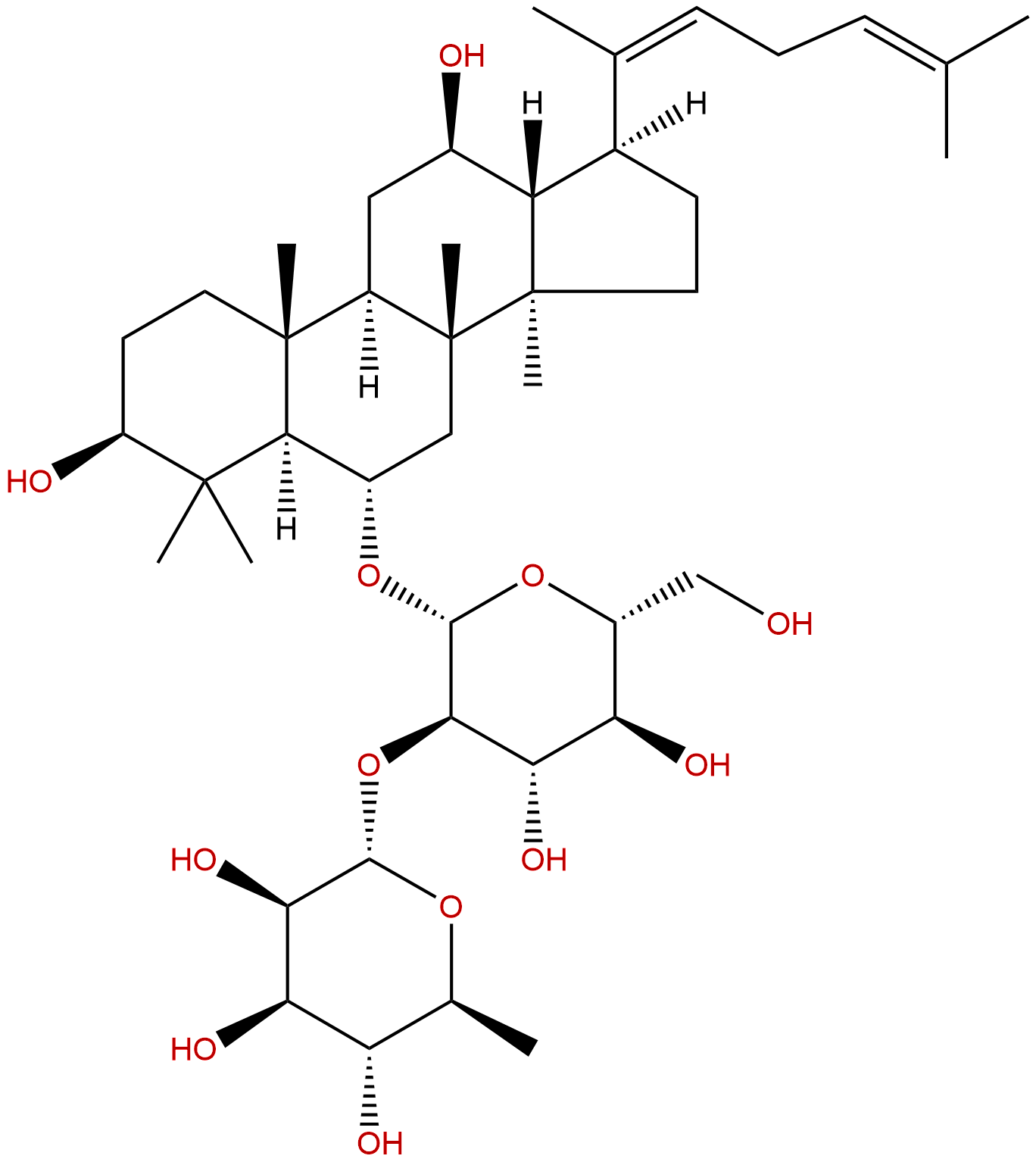


Product name: Ginsenoside Rg4
Synonym name: 20(Z)-Ginsenoside F4
Catalogue No.: BP1650
Cas No.: 126223-28-7
Formula: C42H70O12
Mol Weight: 767.01
Botanical Source:
Physical Description: Powder
Type of Compound: Triterpenoids
Purity: 95%~99%
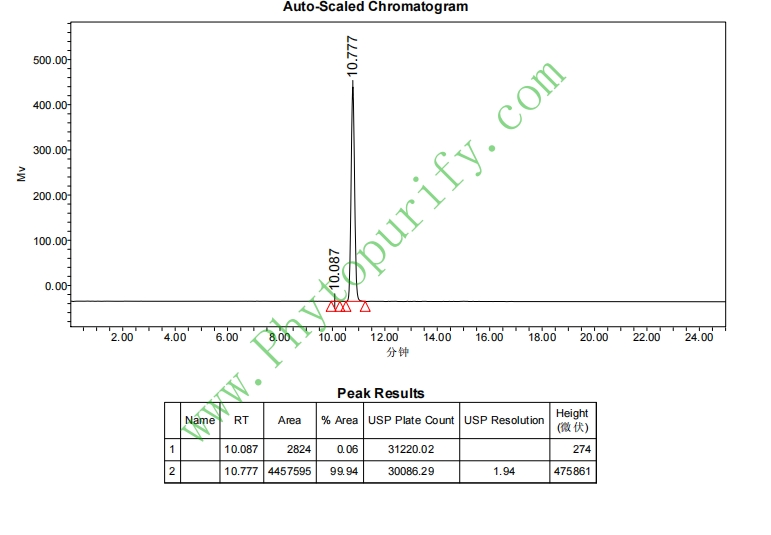
Analysis Method: HPLC-DAD or/and HPLC-ELSD
Identification Method: Mass, NMR
Packing: Brown vial or HDPE plastic bottle
The product could be supplied from milligrams to grams. Inquire for bulk scale.
We provide solution to improve the water-solubility of compounds, thereby facilitating the variety of activity tests and clinic uses.
For Reference Standard and R&D, Not for Human Use Directly.
HPLC of Ginsenoside Rg4
Storage conditions:Short-term storage at 2~8℃, long-term storage at -20 ~ -80℃
Ginsenoside Rg4, as one of the important protopanaxatriol saponins in ginseng, has attracted widespread attention in the field of natural product pharmacology in recent years. Its unique chemical structure endows it with significant biological activity, especially exhibiting excellent potential in regulating cellular signaling pathways, anti-inflammatory and antioxidant effects. Ginsenoside Rg4 not only has good oral biological activity, but also shows significant therapeutic effects on various disease models, especially inflammation, infection, and metabolic diseases such as sepsis and pulmonary inflammation. In addition, the research on ginsenoside Rg4 related molecular targets for tumor diseases such as breast cancer provides a theoretical basis for its development as a potential anti-cancer drug. This article aims to systematically review the chemical structure, pharmacological activity, mechanism of action, pharmacological evaluation, and clinical application prospects of ginsenoside Rg4, with the hope of providing reference for further research and drug development of this natural product.
The molecular formula of ginsenoside Rg4 is C42H72O13, with a molecular weight of 767.0100, and it belongs to the original panaxatriol type ginsenoside. Its core structure is composed of a tetracyclic triterpenoid skeleton, which connects multiple sugar groups and endows it with high polarity and complex three-dimensional structure. The LogP value of Rg4 is 3.4885, indicating that it has moderate lipid solubility, which is beneficial for cell membrane penetration and oral absorption. Its topological polar surface area (TPSA) is 198.7600, indicating its high polarity, which may affect its transmembrane transport and bioavailability. The low water solubility (0.0246) to some extent limits its solubility and biological distribution in the aqueous phase. Low blood-brain barrier permeability indicates limited distribution in the central nervous system. The hERG channel inhibition experiment showed a negative result, indicating a low risk of cardiac toxicity. The Ames mutagenicity test result is 0.0, indicating that its genetic toxicity risk is relatively low and has a good safety basis.
Ginsenoside Rg4 is mainly present in the roots and processed products of Panax ginseng C.A. Meyer. As a traditional Chinese medicinal herb, ginseng has complex saponin components and relatively low Rg4 content, which requires specific extraction and separation techniques to obtain. Common extraction methods include:
Solvent extraction method Using organic solvents such as ethanol or methanol for reflux extraction of dried ginseng powder, followed by concentration and liquid-liquid distribution to remove impurities.
Column chromatography separation Using silica gel or C18 reverse phase column for chromatographic separation, combined with gradient elution technology, can effectively separate and purify Rg4.
Supercritical CO2 extraction Utilizing the high permeability and selectivity of supercritical fluids, the extraction efficiency is high and environmentally friendly.
Enzymatic conversion By catalyzing with enzymes such as β - glucosidase, other ginsenosides are converted into Rg4, increasing the yield.
In recent years, with the development of technology, combined with analysis methods such as high-performance liquid chromatography (HPLC) and mass spectrometry (MS), rapid qualitative and quantitative detection of Rg4 has been achieved, providing technical support for its extraction and purification.
Ginsenoside Rg4 exhibits significant pharmacological activities in various biological functions, including anti-inflammatory, antioxidant, immune regulatory, and anti-tumor effects.
Multiple in vitro and in vivo studies have shown that Rg4 can significantly inhibit the release of inflammatory mediators and reduce the expression levels of inflammatory cytokines such as TNF - α, IL-6, and IL-1 β. It inhibits the activation of NF - κ B by regulating the PI3K/AKT/GSK-3 β signaling pathway, thereby reducing inflammatory response. In sepsis and pulmonary inflammation models, Rg4 significantly reduces lung tissue inflammatory infiltration and oxidative stress, improves tissue damage, and suggests its therapeutic potential in acute inflammatory diseases.
Rg4 can effectively eliminate reactive oxygen species (ROS) and alleviate cellular damage caused by oxidative stress. Research has shown that Rg4 enhances cellular antioxidant capacity and protects cells from oxidative damage by activating intracellular antioxidant enzyme systems such as superoxide dismutase (SOD) and glutathione peroxidase (GPx).
Ginsenoside Rg4 can regulate the function of immune cells, promote the activity of macrophages and lymphocytes, and enhance the body's immune defense ability. At the same time, Rg4 exhibits a bidirectional regulatory effect in regulating immune balance, which can both inhibit excessive inflammatory reactions and enhance the defense function of the immune system.
For breast cancer and other tumor cells, Rg4 shows the effects of inhibiting cell proliferation, inducing apoptosis, and inhibiting migration and invasion. Its anti-tumor effect is related to regulating multiple signaling pathways, including activating AMPK, inhibiting STAT3 signaling pathway, regulating BCL2 family protein expression, and affecting the balance of tumor cell survival and apoptosis. In addition, Rg4 can affect tumor associated transporters such as ABCB1 and ABCG2, potentially reversing tumor drug resistance.
The pharmacological effects of ginsenoside Rg4 involve multiple cellular signaling pathways and key molecular targets, and the specific mechanisms are as follows:
Rg4 can activate PI3K (phosphatidylinositol 3-kinase) and downstream AKT (protein kinase B), promoting cell survival and anti-inflammatory response. The activation of AKT further inhibits GSK-3 β (glycogen synthase kinase 3 β), regulates cellular metabolism and inflammatory response, and reduces tissue damage.
By activating the Nrf2 (nuclear factor erythroid 2-related factor 2) signaling pathway, Rg4 promotes the expression of antioxidant enzymes, clears ROS, and protects cells from oxidative damage.
The multiple regulation of these targets gives Rg4 the advantage of multi-target synergy in anti-tumor therapy.
The pharmacological parameters of ginsenoside Rg4 indicate that it has certain potential for drug development. The high molecular weight (767.0100) and TPSA value suggest that oral absorption may be limited, but its moderate LogP value is beneficial for membrane penetration. Low water solubility is a major challenge in the development of its formulations, which requires improving solubility and bioavailability through techniques such as nanocarriers, liposomes, or solid dispersions.
The low blood-brain barrier permeability indicates that the role of Rg4 in the central nervous system is limited, but this also reduces the potential risk of central neurotoxicity. The hERG channel has no inhibitory effect, indicating good cardiac safety. The Ames test is negative, indicating low genetic toxicity risk and high safety.
In terms of pharmacokinetics, existing studies have shown that Rg4 can reach effective concentrations in plasma after oral administration and has a certain biological half-life, but its metabolic pathway has not been fully elucidated. Further in vivo pharmacokinetic and metabolic studies are needed in the future to clarify their absorption, distribution, metabolism, and excretion characteristics, providing a basis for clinical applications.
Based on the multiple pharmacological activities of ginsenoside Rg4, it has shown broad application prospects in the fields of inflammation, infection, metabolic diseases, and tumor treatment. Especially in acute inflammatory diseases such as sepsis and pulmonary inflammation, Rg4 has potential clinical therapeutic value by regulating immune response and oxidative stress, reducing tissue damage.
In terms of tumor treatment, Rg4's multi-target mechanism provides a theoretical basis for its use as an auxiliary anti-cancer drug, especially for the treatment of breast cancer. The future combination therapy strategy with chemotherapy drugs is expected to improve efficacy and overcome drug resistance.
However, the low water solubility and large molecular weight of Rg4 limit its drug development process, and its bioavailability needs to be improved through pharmaceutical formulation studies. Meanwhile, preclinical safety evaluation and systematic clinical trials still need to be strengthened to verify its efficacy and safety.
Future research should focus on:
Ginsenoside Rg4, as a natural product with multiple biological activities, has shown great potential in anti-inflammatory, antioxidant, immune regulation, and anti-tumor applications due to its unique chemical structure and rich pharmacological functions. Its mechanism of action involves multiple key cellular signaling pathways and molecular targets, reflecting the advantages of natural product multi-target and multi mechanism synergistic therapy. Despite challenges such as poor water solubility and limited bioavailability, with the continuous advancement of formulation technology and pharmacological research, Rg4 is expected to become an innovative drug candidate in the treatment of inflammatory diseases and tumors. In the future, through systematic pharmacokinetic studies and clinical validation, it is expected that ginsenoside Rg4 can be successfully transformed from a natural product to a clinical drug, contributing new therapeutic methods to human health.
