


Synonym name: Ajmalicine oxindole B; Rubradinine
Catalogue No.: BP0947
Cas No.: 509-80-8
Formula: C21H24N2O4
Mol Weight: 368.433
Botanical Source: Uncariae Ramulus cum Uncis
Purity: 95%~99%
Analysis Method: HPLC-DAD or/and HPLC-ELSD
Identification Method: Mass, NMR
Packing: Brown vial or HDPE plastic bottle
Can be supplied from milligrams to grams.
For Reference Standard and R&D, Not for Human Use Directly.
Inquire for bulk scale.
HPLC of Mitraphylline
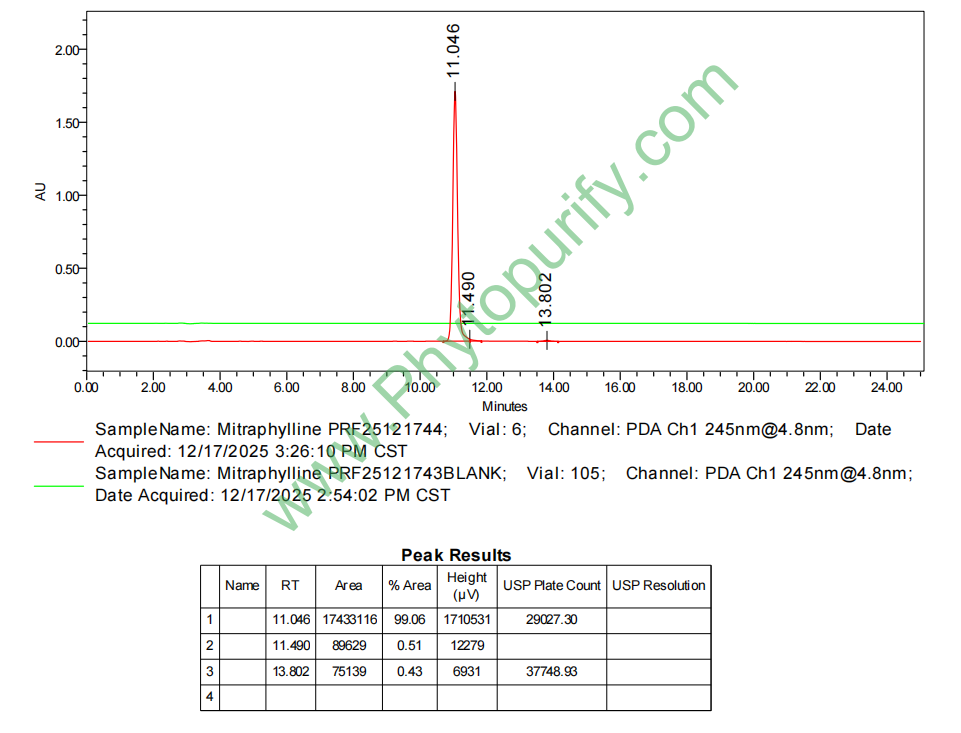
Storage conditions:Short-term storage at 2~8℃, long-term storage at -20 ~ -80℃
Mitraphylline is a pentacyclic indole alkaloid with multiple biological activities, mainly found in Uncaria tomantosa. As one of the main active ingredients of hairy vine, lignin has attracted widespread attention in the field of natural product pharmacology. In recent years, with the in-depth study of the anti-inflammatory, anti-tumor, and anti infective mechanisms of natural products, berberine has become a potential candidate compound for the development of new drugs due to its unique molecular structure and multi-target pharmacological activity.
Hat pillar lignin not only exhibits inhibitory effects on various tumor cells, but also effectively regulates immune responses, inhibits lipopolysaccharide (LPS) - induced activation of human neutrophils and the release of interleukins in the body, demonstrating significant anti-inflammatory and immune regulatory functions. In addition, berberine has shown inhibitory potential against multiple key targets of malaria parasites in anti malaria research, indicating its application value in the development of anti parasitic drugs. This article provides a systematic review of the chemical structure, plant origin, pharmacological activity, mechanism of action, medicinal properties, and clinical application prospects of lignin, aiming to provide scientific basis and theoretical support for its subsequent research and development.
The chemical name of Maozhumu alkaloid is 7-hydroxy-3-methoxy-11-methyl-19-methyl-2,3,4,6,7,8-hexahydro-1H-indole [2,3-a] pyrrolo [3,4-c] pyrrole-5,10-dione, with a molecular formula of C22H28N2O4 and a molecular weight of 368.4330. Its CAS number is 509-80-8. Hat pillar alkaloid belongs to the pentacyclic indole alkaloid, which contains an indole ring system and multiple epoxy bridges in its structure, forming a unique three-dimensional conformation and endowing it with high biological activity.
In terms of physical and chemical properties, the LogP value of pilocarpine is 1.9062, indicating its moderate lipid solubility, which is beneficial for membrane penetration. The polar surface area (TPSA) is 67.8700, indicating that its polarity is moderate and conducive to binding with biological targets. The water solubility is 0.5889, which belongs to the category of moderately water-soluble compounds and is beneficial for distribution and absorption in the body. It is worth noting that berberine has a high blood-brain barrier penetration ability, indicating its potential advantages in the treatment of central nervous system diseases. In addition, berberine does not inhibit hERG channels, and the Ames mutagenicity test result is 0.0, indicating its high safety and low risk of toxic side effects.
The main source of lignin in the hat pillar is Uncaria tomantosa, a traditional medicinal plant distributed in the Amazon rainforest of South America. Due to its rich alkaloid composition and diverse pharmacological activities, hairy vine has been used for a long time to treat diseases such as inflammation, immune disorders, and tumors. As a high content pentacyclic indole alkaloid in the hairy vine, Maozhumu alkaloid is usually isolated and studied as its main active ingredient.
The commonly used methods for extracting lignin from hat pillar include solvent extraction, liquid-liquid distribution, and chromatographic purification. Generally, methanol or ethanol is used as the extraction solvent, and crude extracts are obtained through ultrasound assisted or reflux extraction. Subsequently, impurities were removed using acid-base separation method, and cap lignin was separated and purified using techniques such as silica gel column chromatography and reverse phase high-performance liquid chromatography (RP-HPLC). In recent years, the introduction of supercritical fluid extraction and molecular imprinting technology has improved the extraction efficiency and purity of lignin, providing technical support for its large-scale production.
The research on the anti-inflammatory properties of lignin in the field of hat pillar is relatively in-depth. It can significantly inhibit lipopolysaccharide (LPS) - induced activation of human neutrophils and reduce the release of inflammatory mediators. Research has shown that pilocarpine can inhibit the secretion of pro-inflammatory cytokines such as interleukin (IL-1 β, IL-6) and tumor necrosis factor - α (TNF - α), reducing inflammatory response. In addition, berberine exhibits good immunomodulatory potential by regulating immune cell function and promoting the maintenance of immune homeostasis.
Hat pillar lignin exhibits anti proliferative and apoptosis inducing activities in various tumor cell lines, especially in human glioma and neuroblastoma cell lines where the effect is significant. In vitro experiments have shown that pilocarpine can block the tumor cell cycle, induce cell apoptosis, and inhibit tumor cell migration and invasion. Its anti-tumor mechanism involves the regulation of multiple signaling pathways, including NF - κ B, MAPK, and PI3K/Akt pathways, indicating that berberine has multi-target anticancer potential.
Hat pillar lignan exhibits inhibitory activity against Plasmodium falciparum, with related targets including key proteins such as PFCRT, PFMDR1, PFDHFR, PFK13, PFATP6, PFCYTBC, PFPK, PFCYT, PFCYTb, and PfATG8. By interfering with the drug transport, metabolic enzyme activity, and autophagy mechanism of parasites, pilocarpine effectively inhibits the growth of malaria parasites, demonstrating its potential for development as an anti malarial drug.
The multiple pharmacological effects of pilocarpine are attributed to its regulation of multiple molecular targets. Its anti-inflammatory mechanism mainly involves inhibiting the NF - κ B signaling pathway, reducing the expression of pro-inflammatory cytokines, and alleviating inflammatory damage. Cap lignin can also regulate the MAPK and JAK/STAT pathways, participate in immune regulation and cell survival regulation.
In terms of anti-tumor effects, pilocarpine induces cell apoptosis through the mitochondrial pathway, regulates the expression of Bcl-2 family proteins, activates the caspase enzyme system, and promotes programmed cell death in tumor cells. At the same time, it inhibits the PI3K/Akt pathway, blocks tumor cell proliferation signals, and suppresses tumor growth and metastasis.
The mechanism of anti malaria action involves the inhibition of Plasmodium membrane proteins and metabolic enzymes by berberine. PFCRT and PFMDR1 are drug transporters for malaria parasites, and pilocarpine interferes with their function to prevent the development of drug resistance. PFDHFR and PFK13 are key enzymes, and pilocarpine inhibits their activity, blocking the nucleic acid synthesis and metabolism of parasites. PFATP6 is a calcium ion ATPase, which is affected by pilocarpine and disrupts the calcium homeostasis of parasites, leading to death. In addition, the effect of pilocarpine on PfATG8 suggests that it may interfere with the autophagy process of parasites, further enhancing its anti malarial effect.
The pharmacological parameters of pilocarpine show that it has good potential for drug development. The molecular weight is 368.4330, which is moderate and complies with Lipinski's rule, making it suitable for oral absorption. The LogP value of 1.9062 indicates moderate lipid solubility, which is beneficial for cell membrane penetration and in vivo distribution. The TPSA is 67.8700, indicating its good bioavailability and targeted binding ability.
The high penetration ability of the blood-brain barrier endows the application prospects of berberine in the treatment of central nervous system diseases. The hERG channel inhibition experiment was negative, reducing the risk of cardiac toxicity. The Ames mutagenicity test result is 0, indicating low genetic toxicity risk and good safety.
Pharmacokinetic studies have shown that berberine exhibits good absorption and distribution characteristics in vivo, with stable metabolism and mainly excreted through hepatic metabolism and renal excretion pathways. Its half-life is moderate, supporting the design of daily dosing regimens. Further in vivo pharmacokinetic and toxicological studies are needed in the future to clarify the safe dosage range and metabolic pathways.
As a multi-target and multifunctional natural product, Maozhumu alkaloid has broad clinical application potential. Its anti-inflammatory and immunomodulatory effects make it a powerful candidate drug for treating inflammatory and immune related diseases. Especially in the fields of neuroinflammation and autoimmune diseases, the blood-brain barrier penetration ability of pilocarpine provides it with unique advantages.
In terms of anti-tumor activity, the inhibitory effect of pilocarpine on glioma and neuroblastoma provides a theoretical basis for its tumor treatment development. Combining modern drug delivery systems, such as nanocarriers and targeted drug delivery technology, is expected to enhance their efficacy and bioavailability, while reducing side effects.
Research on anti malaria has shown that berberine can serve as a lead compound for new anti malaria drugs, especially in the context of increasingly severe drug resistance. Its multi-target mechanism of action provides new ideas for overcoming drug resistance. In the future, preclinical and clinical trials need to be conducted to verify its efficacy and safety.
In addition, the structural modification and derivative design of pilocarpine are also future research focuses. By optimizing its pharmacokinetic properties and targeting selectivity through chemical modification, more clinically valuable drug molecules can be developed.
As the main pentacyclic indole alkaloid in Houttuynia cordata, Polygonatum sibiricum has shown extensive medicinal value due to its unique chemical structure and multi-target pharmacological activity. Its multiple biological functions such as anti-inflammatory, anti-tumor, and anti malaria provide valuable resources for the development of natural product drugs. The pharmacological evaluation shows that berberine has good potential for drug development, high safety, and outstanding blood-brain barrier penetration ability.
In the future, by combining modern medicinal chemistry, molecular biology, and pharmacological techniques, we will deeply analyze the mechanism of action of pilocarpine, optimize its drug properties, and carry out systematic preclinical and clinical research, laying a solid foundation for its transformation into clinical application drugs. Hat pillar lignin is expected to become a new natural medicine for treating various complex diseases, promoting the development and innovation of natural product pharmacology.
