


Synonym name: Corynoxine A
Catalogue No.: BP0400
Cas No.: 6877-32-3
Formula: C22H28N2O4
Mol Weight: 384.476
Botanical Source: Alkaloid from Pseudocinchona africana, Uncaria macrophylla and Mitragyna speciosa (Rubiaceae, Naucleaceae)
Purity: 95%~99%
Analysis Method: HPLC-DAD or/and HPLC-ELSD
Identification Method: Mass, NMR
Packing: Brown vial or HDPE plastic bottle
Can be supplied from milligrams to grams.
For Reference Standard and R&D, Not for Human Use Directly.
Inquire for bulk scale.
HPLC of Corynoxine
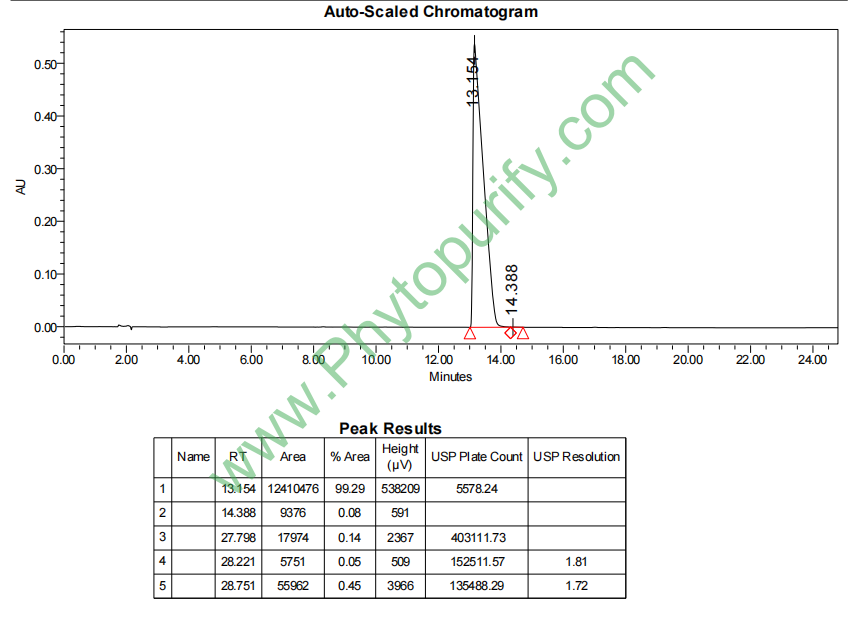
Storage conditions:Short-term storage at 2~8℃, long-term storage at -20 ~ -80℃
Corynoxin (CAS number: 6877-32-3) is a tetracyclic indole alkaloid isolated from Uncaria rhynchhophylla, which has attracted much attention in recent years due to its unique pharmacological activity. As a natural autophagy enhancer, Konosin promotes the clearance of alpha synuclein by regulating the intracellular autophagy pathway, particularly by inhibiting the Akt/mTOR signaling axis, demonstrating potential application value in the treatment of neurodegenerative diseases and tumors. As a malignant tumor with high incidence rate and mortality worldwide, liver cancer involves complex regulation of multiple signal pathways and molecular targets. Konoxin has shown certain therapeutic potential in regulating related targets such as BCL2, STAT3, PIK3CA, AKT1, etc. This article will provide a systematic review of the chemical structure, plant origin, pharmacological activity, mechanism of action, pharmacological evaluation, and clinical application prospects of conoxin, aiming to provide theoretical basis and reference for the in-depth research and drug development of this natural product.
Konosin belongs to the tetracyclic indole alkaloid, with a molecular formula of C22H26N2O4 and a molecular weight of 384.47. Its structural core is a typical indole alkaloid skeleton, containing multiple hydroxyl and nitrogen atoms, endowing it with strong biological activity and high polarity. The LogP value of Konosin is about 2.5, indicating that it has moderate lipid solubility, which is beneficial for membrane penetration but not excessively lipid soluble and affects bioavailability. The topological polar surface area (TPSA) is 87.01 Å ², indicating that it may bind to biomolecules through certain polar interactions. The molecule contains six hydrogen bond receptors, which provide diverse binding sites for its binding to target proteins. The low permeability of the blood-brain barrier indicates limited distribution in the central nervous system, but this may also reduce the risk of central side effects. There is currently no clear data on safety indicators such as hepatotoxicity, cardiotoxicity, and hERG channel inhibition of conoxin, and further systematic toxicological evaluation is needed.
Konosin is mainly derived from Uncaria rhynchhophylla, a commonly used Chinese medicinal herb in the Rubiaceae family and widely distributed in southern China and Southeast Asia. Gouteng is traditionally used to treat hypertension, headaches, and neurological disorders. Its active ingredients include various alkaloids, among which colchicine is one of the important indole alkaloids.
The extraction of Konosin is usually carried out using the alcohol extraction method. Fresh or dried stems and leaves of Uncaria barbata are crushed and then subjected to reflux extraction using ethanol or methanol as solvents. The extracted solution is then purified through multiple steps such as concentration, separation, and column chromatography to obtain high-purity colchicine. In recent years, the application of new technologies such as ultrasound assisted extraction and microwave-assisted extraction has improved extraction efficiency and purity. In addition, the rapid qualitative and quantitative analysis of Konosin was achieved using high-performance liquid chromatography (HPLC) combined with mass spectrometry (MS) technology, providing technical support for its quality control.
The pharmacological activity research of Konosin mainly focuses on its autophagy regulation and anti-tumor potential. A large number of in vitro cell experiments and some animal model studies have shown that colchicine can significantly enhance cellular autophagy levels, promote the degradation of abnormal proteins, and especially have a significant clearing effect on alpha synuclein. This mechanism is of great significance for neurodegenerative diseases such as Parkinson's disease.
In the field of oncology, Konosin exhibits anti liver cancer activity through multi-target regulation. It can inhibit the proliferation, migration, and invasion of liver cancer cells, induce cell apoptosis, and the related mechanisms involve regulating key molecules such as BCL2 family proteins, STAT3 signaling pathway, PI3K/Akt/mTOR axis, etc. In addition, Konosin also has a certain regulatory effect on tumor related targets such as TOP1, TERT, MMP9, EGFR, TP53, and NFKB1, suggesting that it may exert anti-tumor effects through multi-target synergistic effects.
The core mechanism of action of Konosin mainly revolves around autophagy regulation and signaling pathway regulation. By inhibiting the activity of Akt kinase, it downregulates the mTOR signaling pathway, relieves the inhibition of autophagy, and promotes the formation and function of autophagosomes. This mechanism not only helps to eliminate abnormal proteins and damage organelles within cells, but also regulates the metabolic status and survival signals of cells.
In terms of targets related to liver cancer treatment, Konosin exhibits multiple regulatory abilities:
In addition, the effects of Konosin on TOP1 (topoisomerase I) and TERT (telomerase reverse transcriptase) suggest that it may be involved in DNA repair and telomere maintenance mechanisms, further affecting the survival and proliferation of tumor cells.
The pharmacological parameters of Konosin indicate that it has certain potential for drug development. Moderate molecular weight (384.47) and LogP (2.5) comply with Lipinski's rule, which is beneficial for oral absorption and cell membrane penetration. The TPSA is 87.01 Å ², indicating that its polarity is moderate and may have good bioavailability. However, the low blood-brain barrier permeability of Konosin limits its application in central nervous system diseases, but may reduce central side effects in peripheral target therapy.
At present, there is a lack of safety data on the hepatotoxicity, cardiotoxicity, and hERG channel inhibition of conoxin, and there is an urgent need for systematic in vitro and in vivo toxicological studies. In addition, the pharmacokinetic characteristics of Konosin, such as absorption, distribution, metabolism, and excretion (ADME), have not been fully elucidated. Preliminary speculation suggests that its metabolism may involve the liver enzyme system, and due to its alkaloid properties, there may be a certain first pass effect. In the future, in vivo pharmacokinetic studies are needed to clarify its half-life, bioavailability, and metabolites, providing a basis for clinical dosage form design.
Konosin, as a natural autophagy enhancer, has shown unique advantages in the treatment of neurodegenerative diseases such as Parkinson's disease and Alzheimer's disease, especially by promoting the clearance of alpha synuclein and slowing down the process of nerve damage. Although its blood-brain barrier permeability is limited, it is expected to enhance the bioavailability of the central nervous system through structural modification or nanocarrier delivery technology.
In the field of tumor therapy, Konosin has demonstrated synergistic anti-tumor activity against multiple liver cancer related signaling pathways and molecular targets, and has the potential to be developed as an adjuvant therapy for liver cancer. By combining modern medicinal chemistry and pharmacology methods, colchicine can be used as a lead compound for structural optimization, improving its targeting and efficacy while reducing potential toxicity.
Future research should focus on:
As a natural tetracyclic indole alkaloid derived from Uncaria barbata, Konosin has shown broad prospects for drug development due to its significant autophagy enhancing activity and multi-target anti-tumor effects. Although there is currently insufficient research on its toxicology and pharmacokinetics, its unique mechanism of action and good pharmacokinetic parameters have laid a solid foundation for subsequent drug optimization and clinical translation. In the future, through interdisciplinary collaboration, Konosin is expected to become a new natural medicine for the treatment of major diseases such as neurodegenerative diseases and liver cancer, providing new treatment strategies for clinical practice.
