Introduction/Overview
Natural products, as an important treasure trove for drug discovery, play an irreplaceable role in the history of human disease treatment. Among them, alkaloids derived from traditional medicinal plants have always been a hot topic in new drug development due to their structural diversity and significant biological activity. Wilfortine (CAS number: 37239-48-8) is a sesquiterpene alkaloid isolated from plants in the Celastraceae family. Its unique chemical skeleton and extensive pharmacological activities, particularly immunosuppressive and anti-tumor effects, make it an important molecule in the study of natural product pharmacology. Early studies have revealed its potential to inhibit the growth of mouse leukemia cells and exhibit anti human immunodeficiency virus (HIV) activity. In recent years, with the development of molecular biology and structural pharmacology, the understanding of the mechanism of action of Tripterygium wilfordii alkaloids has deepened. Its multi-target anti-tumor properties, especially the interaction with key targets related to apoptosis regulation, signal transduction, and tumor microenvironment (such as MCL1, STAT3, HIF1A, etc.), have shown broad development prospects. This article aims to systematically review the chemical structure, plant origin, pharmacological activity, molecular mechanism of action, pharmacological characteristics, and clinical application potential of Tripterygium wilfordii alkaloids, in order to provide comprehensive academic references for the in-depth research and development of this compound.
Chemical structure and physicochemical properties
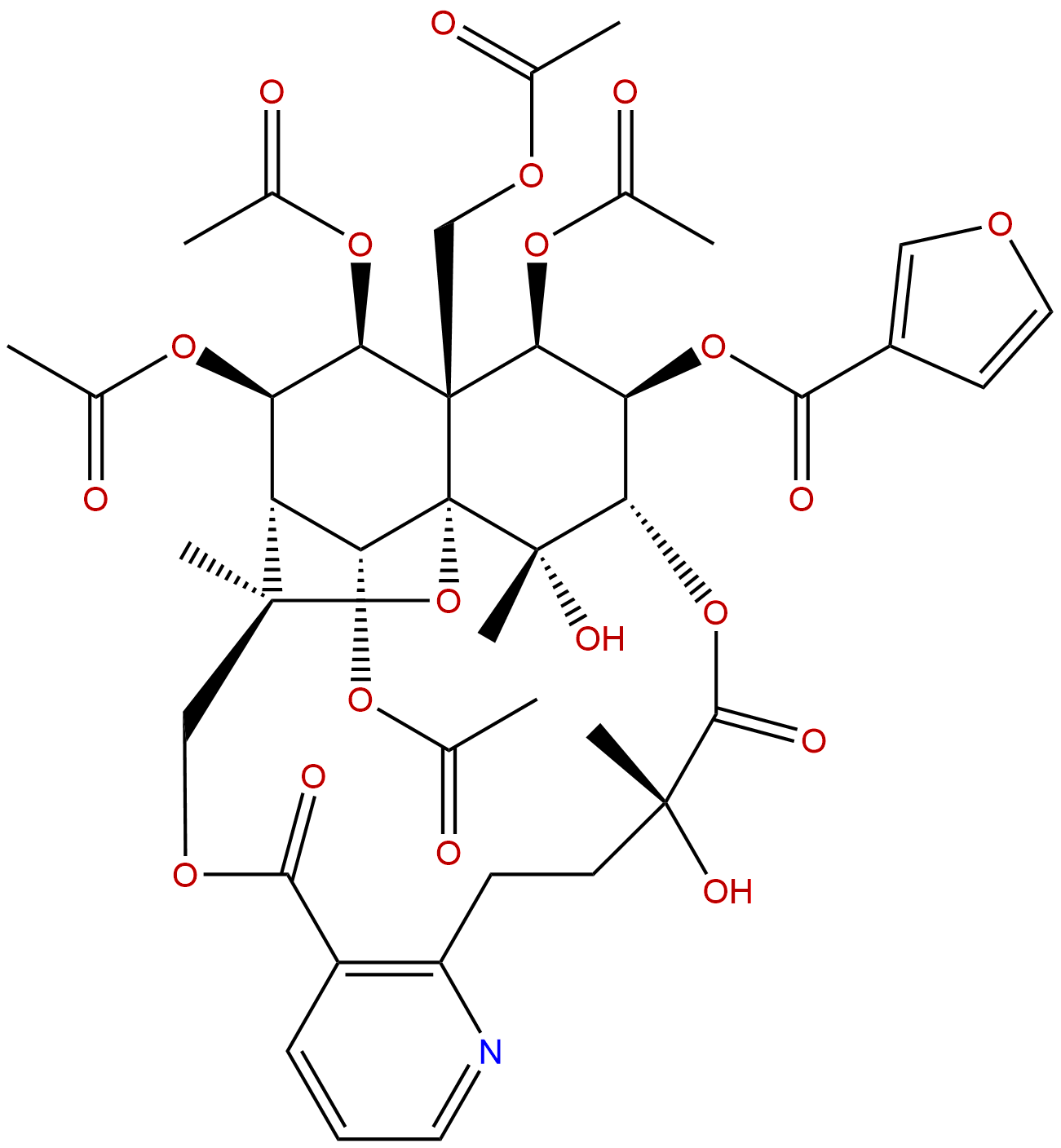
Tripterygium wilfordii alkaloid is a structurally complex sesquiterpene alkaloid with a molecular formula of C41H47NO19 and a molecular weight of 873.8140 Da. Its core structure is composed of sesquiterpene skeleton and alkaloid units connected by ester bonds, forming a highly oxidized polycyclic system. This structure contains multiple hydroxyl, methoxy, and ester bonds, endowing it with specific physical and chemical properties.
From the analysis of parameters related to drug properties, the lipid water partition coefficient (LogP) of Tripterygium wilfordii alkaloids is 1.4010, indicating that they have a certain degree of lipophilicity but are not highly hydrophobic. Its topological polar surface area (TPSA) is as high as 286.1200 Å ², which is mainly attributed to the numerous oxygen and nitrogen atoms in the molecule, forming a large number of hydrogen bond donor and acceptor sites. High TPSA is usually associated with poor cell membrane permeability. Consistent with this, its low water solubility value (approximately 0.0301 mg/mL) suggests limited solubility in aqueous media, which may pose challenges in formulation development. In terms of absorption and distribution, the prediction shows that its blood-brain barrier (BBB) permeability is low, which means it is not easy to enter the central nervous system. This may reduce the potential risk of central neurotoxicity for drugs mainly targeting peripheral system diseases. Preliminary safety assessment shows that the risk of hERG inhibition is negative, indicating a low possibility of causing QT interval prolongation in the heart; The Ames test result is 0.0, indicating that there is no mutagenicity in this testing system, but a more comprehensive genetic toxicity assessment is still needed. Overall, Tripterygium wilfordii alkaloids are a natural product with high molecular weight, polarity, and poor solubility. Their drug like properties face challenges and need to be optimized through structural modification or advanced drug delivery systems to enhance their pharmaceutical properties.
Plant sources and extraction methods
Tripterygium wilfordii Hook. f. and its related plants are the main sources of Tripterygium wilfordii alkaloids, a traditional Chinese medicine. As a famous medicinal plant, Tripterygium wilfordii is commonly used in traditional Chinese medicine to treat autoimmune and inflammatory diseases such as rheumatoid arthritis, nephritis, and skin diseases, but it also has significant toxicity. Tripterygium wilfordii alkaloids are one of the many bioactive components in Tripterygium wilfordii, often coexisting with other diterpenes, triterpenes, and alkaloids.
Its extraction and separation usually follow the conventional process of natural product chemistry. Firstly, dry and crush the root bark or whole plant material of Thunder God Vine. The commonly used initial extraction solvents include methanol, ethanol, or ethanol water mixed solutions with different ratios, and crude extracts are obtained by impregnation, reflux, or ultrasound assisted extraction methods. Subsequently, liquid-liquid extraction segmentation was performed using solvents such as petroleum ether, ethyl acetate, n-butanol, etc. Due to its polarity, Tripterygium wilfordii alkaloids were mainly enriched in n-butanol or water saturated n-butanol extraction sites. Further purification relies on various chromatographic techniques. Silica gel column chromatography is commonly used for preliminary separation, with different polarities of chloroform methanol or dichloromethane methanol gradient elution. Then, fine separation and purification are carried out by combining reversed-phase silica gel (such as C18) column chromatography, Sephadex LH-20 column chromatography and high performance liquid chromatography (HPLC, usually using C18 column, methanol water or acetonitrile water as mobile phase). Structural identification involves the comprehensive use of mass spectrometry (MS), nuclear magnetic resonance (NMR, including 1H NMR, 13C NMR, and 2D NMR techniques), and X-ray single crystal diffraction. In recent years, preparative chromatography techniques such as high-speed counter current chromatography (HSCCC) have also been applied for efficient separation of such complex natural products.
Pharmacological activity research
Tripterygium wilfordii alkaloids exhibit diverse pharmacological activities, among which immunosuppressive and anti-tumor effects are the most prominent.
-
Immunosuppressive effect This is one of the earliest activities of Tripterygium wilfordii alkaloids that received attention. Research has shown that it can significantly inhibit the proliferation of T lymphocytes and B lymphocytes, and reduce the production of inflammatory cytokines such as interleukin-2 and tumor necrosis factor alpha. In various experimental autoimmune disease models, such as adjuvant arthritis and systemic lupus erythematosus mouse models, Tripterygium wilfordii alkaloids have shown similar disease relief effects to the parent plant Tripterygium wilfordii, and their mechanism may be related to regulating immune cell function and signaling pathways.
-
Antitumor activity Tripterygium wilfordii alkaloids exhibit growth inhibition and pro apoptotic effects on various tumor cell lines. Early studies have confirmed its inhibitory effect on mouse leukemia cells (such as P388). Subsequent studies expanded its anti-tumor spectrum, including in vitro proliferation inhibitory activity on breast cancer, liver cancer, lung cancer, colon cancer and other solid tumor cells. Its anti-tumor effect is concentration - and time-dependent.
-
Antiviral activity Research reports that Tripterygium wilfordii alkaloids have certain anti-HIV-1 activity. Its mechanism of action may involve interfering with a certain link in the virus replication cycle, but the specific target still needs to be further elucidated.
-
Other activities Some studies suggest that Tripterygium wilfordii alkaloids may also have anti-inflammatory and anti angiogenic activities, which complement their anti-tumor and immune regulatory effects.
Mechanism of action and molecular targets
The anti-tumor effect of Tripterygium wilfordii alkaloids involves a complex mechanism of multiple targets and pathways, which is consistent with the multifunctional group characteristics of their chemical structure. According to existing research, its targets and mechanisms mainly include the following aspects:
-
Inducing cell apoptosis and regulating Bcl-2 family proteins Tripterygium wilfordii alkaloids can upregulate pro apoptotic proteins (such as Bax) and downregulate anti apoptotic proteins Bcl-2 and MCL1 The expression. MCL1 is a key survival protein in the Bcl-2 family, overexpressed in many tumors and associated with drug resistance. The inhibition of MCL1 by Tripterygium wilfordii alkaloids can effectively reduce mitochondrial membrane potential, promote cytochrome C release, activate caspase cascade reaction, and induce cell apoptosis through the mitochondrial pathway.
-
Inhibition of STAT3 signaling pathway Signal Transduction and Transcription Activation Factor 3(STAT3)STAT3 is a core hub in the occurrence and development of tumors, and its continuous activation promotes cell proliferation, survival, angiogenesis, and immune escape. Tripterygium wilfordii alkaloids have been shown to inhibit the phosphorylation (activation) of STAT3, block its nuclear translocation, and inhibit the transcription of downstream target genes (such as Cyclin D1, Bcl-2, VEGF), thereby suppressing tumor growth.
-
Interference with cell cycle and inhibition of topoisomerase Tripterygium wilfordii alkaloids can cause tumor cell cycle arrest, commonly in the G2/M phase. Its mechanism may be related to inhibition Topoisomerase I (TOP1)and Topoisomerase II alpha (TOP2A)The activity is related. Topoisomerase is a key enzyme in DNA replication and transcription, and its inhibition can lead to DNA damage and replication fork arrest, triggering cell cycle checkpoint activation and cell death.
-
Inhibit tumor invasion and metastasis The invasion and metastasis of tumors depend on the degradation of extracellular matrix by matrix metalloproteinases (MMPs). Tripterygium wilfordii alkaloids can be downregulated Matrix metalloproteinase-2 (MMP2)The expression and activity of tumor cells inhibit their migration and invasion ability.
-
Regulating tumor microenvironment and hormone signaling:
- Inhibition of HIF-1 α pathway Hypoxia inducible factor-1 α(HIF1A)Plays a central role in tumor adaptation to hypoxic microenvironment, regulating angiogenesis, metabolic reprogramming, and more. Tripterygium wilfordii alkaloids may interfere with tumor hypoxia adaptation by inhibiting the stability or transcriptional activity of HIF1A.
- Affects estrogen signaling For hormone dependent tumors (such as breast cancer), tripterygium wilfordii may act on Estrogen receptor alpha (ESR1)Or inhibit key enzymes involved in estrogen synthesis Aromatase (CYP19A1)Active and exert anti estrogenic effects.
- Regulating the MAPK pathway Mitogen activated protein kinase 1(MAPK1/ERK2)It is an important signaling molecule that regulates cell growth and differentiation. The regulation of its activity by Tripterygium wilfordii alkaloids may be involved in the realization of its anti proliferative effect.
In summary, Tripterygium wilfordii alkaloids form a multi pronged anti-tumor network by simultaneously acting on multiple key targets and pathways, including apoptosis regulation (MCL1, BCL2), survival signaling (STAT3), DNA metabolism (TOP1, TOP2A), invasion and metastasis (MMP2), and tumor microenvironment (HIF1A, ESR1, CYP19A1), providing potential advantages for overcoming resistance to single target drugs.
Evaluation of drug properties and pharmacokinetics
Although the pharmacological activity of Tripterygium wilfordii alkaloids is significant, there are obvious shortcomings in their drugability, which limits their direct conversion into clinical drugs.
-
Pharmacokinetic (PK) Challenge At present, there are relatively limited research reports on the pharmacokinetics of Tripterygium wilfordii alkaloids system. Based on its physicochemical properties (high molecular weight, high TPSA, low water solubility), it can be predicted that its oral bioavailability may be low, with issues such as incomplete absorption and significant first pass effects. Its distribution, metabolic pathways, major metabolites, and excretion methods in the body still need to be clarified through standardized pharmacokinetic studies (such as in animal models such as rats and dogs). Especially its ester bond structure may be susceptible to esterase hydrolysis in vivo, affecting the exposure and duration of action of its prototype drug.
-
Safety (toxicity) considerations The plants of the genus Tripterygium have hepatotoxicity, nephrotoxicity, and reproductive toxicity. As one of its components, Tripterygium wilfordii alkaloids must undergo strict safety evaluation. Although the preliminary hERG and Ames test results were negative, comprehensive preclinical toxicology studies, including acute toxicity, long-term repeated administration toxicity, genetic toxicity, reproductive development toxicity, and organ specific toxicity (especially liver and kidney) assessment, are necessary to advance its development. It is crucial to clarify its therapeutic window (the range between effective dose and toxic dose).
-
Pharmaceutical Strategy To improve its water solubility and bioavailability, modern pharmaceutical technology is needed. Possible strategies include: making phospholipid complexes, cyclodextrin inclusion complexes; Preparation of nano drug delivery systems such as nanocrystals, liposomes, and polymer micelles; Or develop into solubilizing agents suitable for injection administration (such as using latent solvents or surfactants). These technologies aim to improve their dissolution rate, enhance membrane permeability, prolong in vivo circulation time, and potentially achieve targeted delivery.
-
Structural modification Reasonable structural modification of Tripterygium wilfordii alkaloids (semi synthesis guided by structure-activity relationship research) is the fundamental way to optimize their pharmacological properties. The goals may include: simplifying the structure to reduce molecular weight and synthesis difficulty; Modify polar groups to balance lipid solubility and water solubility; Modify easily metabolized sites (such as ester bonds) to improve metabolic stability; Reduce toxicity while retaining or enhancing activity.
Clinical application prospects and prospects
The multi-target anti-tumor and immune regulatory properties of Tripterygium wilfordii alkaloids have brought potential application prospects in the fields of tumor therapy and autoimmune diseases, but they face both challenges and opportunities on the road.
-
Potential application directions:
- tumor therapy It is especially suitable for malignant tumors with abnormal activation of STAT3 signaling pathway, high expression of MCL1/Bcl-2 or sensitivity to existing topoisomerase inhibitors, such as certain types of leukemia, lymphoma, breast cancer, liver cancer, etc. It can be used as a monotherapy or in combination with existing chemotherapy drugs or targeted drugs to enhance efficacy and overcome drug resistance.
- Autoimmune diseases Based on its immunosuppressive activity, it may be used to treat rheumatoid arthritis, systemic lupus erythematosus, psoriasis, etc., but its therapeutic efficacy and toxicity risks must be evaluated extremely carefully.
- antiviral therapy Its anti HIV activity deserves further exploration based on in-depth mechanism research and model validation.
-
challenges faced:
- Optimization of drug properties As mentioned earlier, its poor solubility, potential metabolic instability, and potential toxicity are the primary obstacles.
- Target specificity and selectivity The multi-target characteristic is a double-edged sword, as it may bring broad-spectrum activity but also lead to off target effects and unforeseeable toxicity. It is necessary to accurately clarify the structural basis and contribution weights of its interactions with various targets.
- Resources and Synthesis Extracting from plants has low content and complex synthetic routes, making it difficult to meet the needs of large-scale clinical studies. Developing efficient and economical chemical synthesis or biosynthetic methods is key.
-
Future research directions:
- In depth mechanism research Using chemical biology methods such as probe molecules and proteomics to systematically identify their direct targets and draw more accurate molecular action network maps.
- Structure Activity Relationship and Optimization of Lead Compounds The system carries out structural modification, synthesizes a series of derivatives, evaluates their activity, toxicity, and pharmacokinetic properties, in order to obtain lead compounds or candidate drugs with higher activity, lower toxicity, and better pharmacokinetic properties.
- Combination therapy strategy Explore the synergistic effect of Tripterygium wilfordii alkaloids or their optimized derivatives with existing standard therapies (chemotherapy, immune checkpoint inhibitors, etc.), and develop a reasonable combination therapy plan.
- Development of a new delivery system Actively developing targeted drug delivery systems based on their characteristics, such as tumor microenvironment responsive nano formulations, to enhance tumor site accumulation, reduce systemic exposure and toxicity.
Conclusion
As a structurally unique sesquiterpene alkaloid, Tripterygium wilfordii alkaloids play an important role in the development of natural product anti-tumor drugs due to their significant immunosuppressive and broad-spectrum anti-tumor activities, as well as their multi mechanism properties targeting multiple key disease targets such as MCL1, STAT3, TOP1/2A, MMP2, and HIF1A. However, its inherent pharmaceutical defects, such as poor solubility, unsatisfactory pharmacokinetic properties, and potential toxicity risks, are important bottlenecks that restrict its clinical translation. Future research should focus on overcoming these obstacles through the comprehensive application of structural modifications, modern pharmaceutical techniques, and in-depth molecular mechanism analysis. Through interdisciplinary collaboration, combining the active advantages of traditional natural products with modern drug design concepts, Tripterygium wilfordii alkaloids are expected to be developed into a novel multi-target therapeutic drug for the treatment of malignant tumors or autoimmune diseases, or provide valuable chemical templates and pharmacological basis for the design of a new generation of small molecule modulators. Continuous and in-depth research on it will not only help to uncover the value of this specific molecule, but also enrich our understanding of the discovery patterns of complex natural product drugs.