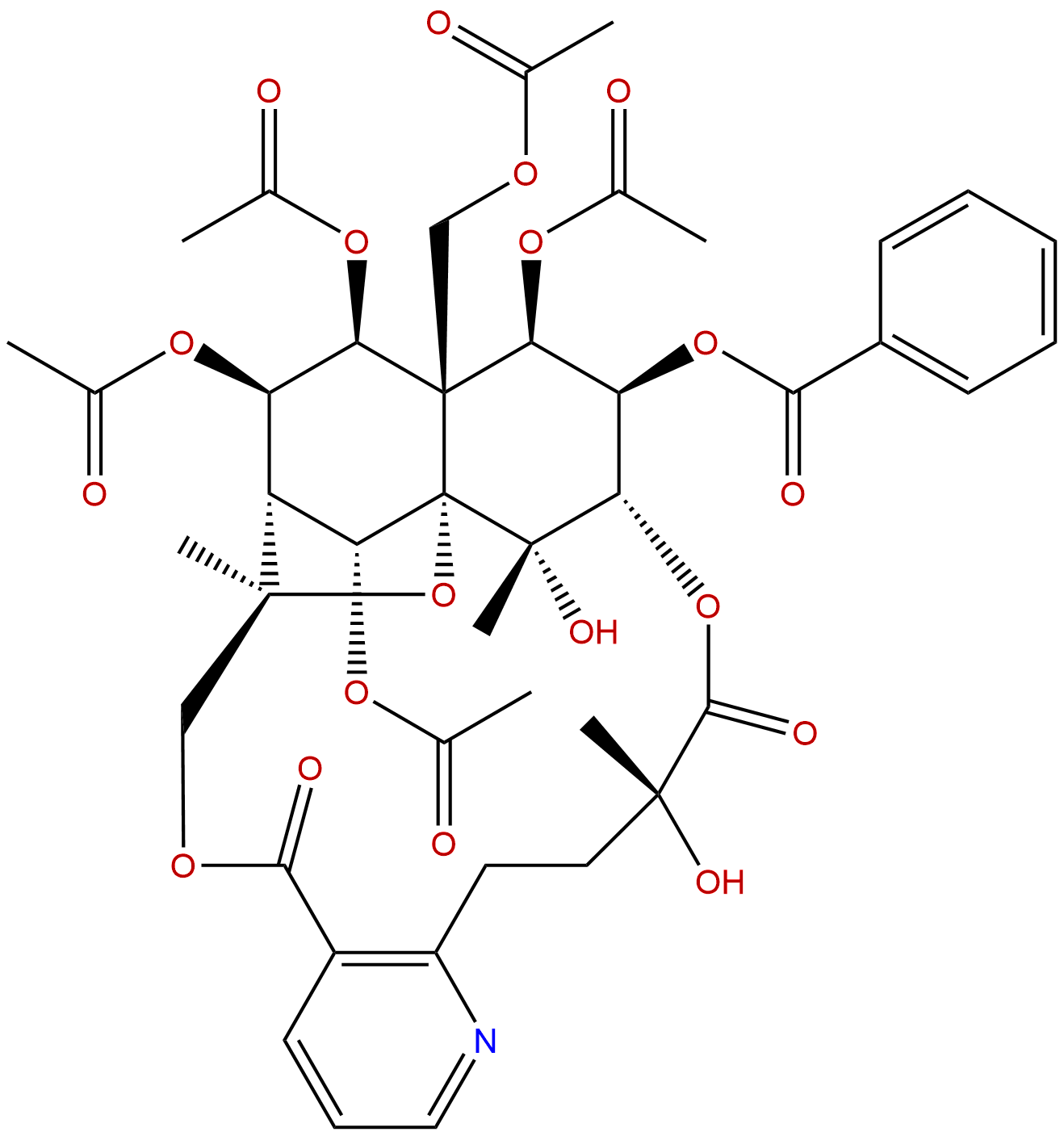


Product name: Wilfordine
Synonym name:
Catalogue No.: BP3398
Cas No.: 37239-51-3
Formula: C43H49NO19
Mol Weight: 883.853
Botanical Source:
Physical Description: Powder
Type of Compound: Sesquiterpenoids
Purity: 95%~99%
Analysis Method: HPLC-DAD or/and HPLC-ELSD
Identification Method: Mass, NMR
Packing: Brown vial or HDPE plastic bottle
The product could be supplied from milligrams to grams. Inquire for bulk scale.
We provide solution to improve the water-solubility of compounds, thereby facilitating the variety of activity tests and clinic uses.
For Reference Standard and R&D, Not for Human Use Directly.
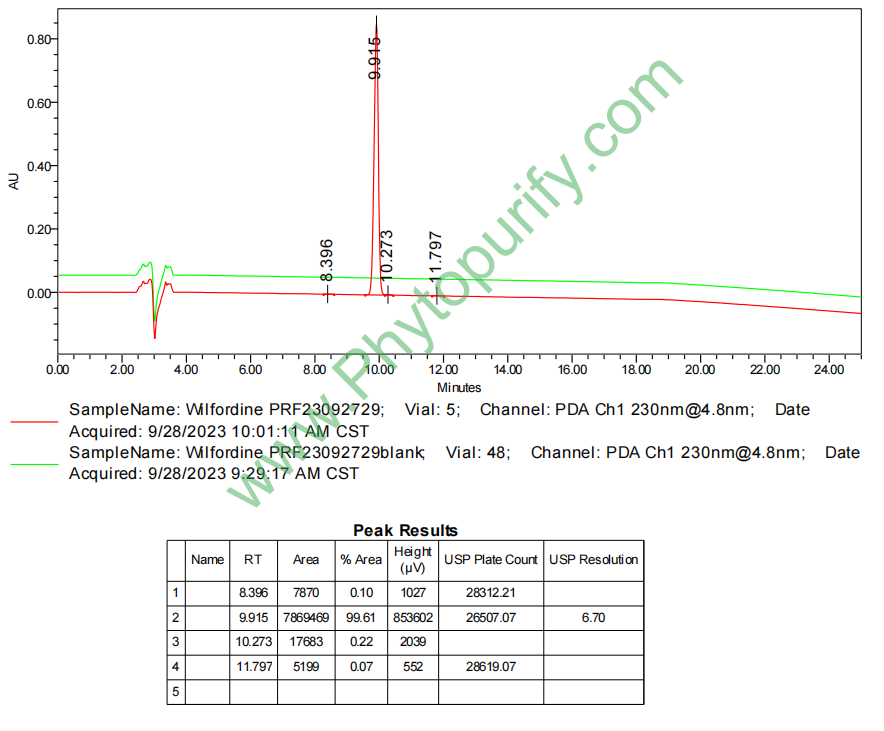
HPLC of Wilfordine
Storage conditions:Short-term storage at 2~8℃, long-term storage at -20 ~ -80℃
272.9800
1.8787
1.8786
.0176
.7272
2.0583
Low
75.2364
7.6198
Yes
No
No
No
No
No
0.0
Yes
Yes
Yes
Yes
Thunder God Vine(Tripterygium wilfordii Hook. f., as a traditional Chinese medicine, has a long history in treating autoimmune diseases such as rheumatoid arthritis, nephritis, and skin diseases. The complex chemical composition of Tripterygium wilfordii alkaloids is the material basis for their multiple pharmacological activities. Among them, as an important class of active ingredients, Tripterygium wilfordii alkaloids are increasingly receiving attention in modern pharmacological research. Wilfordine (CAS number: 37239-51-3) is a sesquiterpene polysaccharide alkaloid with significant biological activity isolated from Tripterygium wilfordii. In recent years, with the deepening understanding of the pathogenesis of autoimmune diseases and inflammation, the search for highly efficient and low toxicity immunomodulators has become a research hotspot. Tripterygium wilfordii alkaloids are considered a highly promising lead compound due to their strong immunosuppressive activity demonstrated in various in vitro and in vivo models. This article aims to systematically review the chemical structure, plant origin, pharmacological activity, molecular mechanism of action, pharmacological characteristics, and clinical application prospects of Tripterygium wilfordii alkaloids, in order to provide comprehensive academic references for the in-depth research and development of this compound.
Tripterygium wilfordii alkaloids belong to the characteristic "Celastraceae" type sesquiterpene polysaccharide alkaloids in the genus Tripterygium. Its molecular formula is C ₄₁ H ₄₅ NO ₁₉, and its molecular weight is 883.8530. The compound has a complex structure, with a highly oxidized sesquiterpene skeleton (usually of the dihydroagarfuran type) at its core. Multiple substituents such as benzoyl and acetoxy groups are connected by ester bonds, and a nitrogen atom is integrated into the structural unit to form alkaloid like properties. This dense esterification structure endows it with unique physicochemical properties.
From the analysis of medicinal parameters, the lipid water partition coefficient (LogP) of Tripterygium wilfordii alkaloids is 1.8787, indicating that they have a certain degree of lipophilicity, but not highly hydrophobic. Its topological polar surface area (TPSA) is as high as 272.9800 Å ², mainly attributed to the numerous ester bonds and potential polar groups such as hydroxyl and carbonyl groups in the molecule. High TPSA typically indicates a strong ability for molecules to form hydrogen bonds with solvents, but it may also affect their transmembrane permeability. Its low water solubility value (0.0176 mg/mL) suggests poor solubility in aqueous media, which may pose challenges in formulation development and in vivo absorption. In the preliminary toxicity prediction, the compound showed no inhibitory effect on hERG potassium channels, indicating a low potential risk of arrhythmia; The Ames test result is 0.0, indicating that it has no direct genetic toxicity. However, these computational predictions need to be rigorously validated through experiments. Its blood-brain barrier permeability is predicted to be "low", which is consistent with its high molecular weight and high polarity surface area, indicating that it mainly acts on the peripheral system, and its direct or side effects on the central nervous system may be limited.
Tripterygium wilfordii alkaloids mainly come from the plant Tripterygium wilfordii in the family Celastraceae(Tripterygium wilfordii)The root. The alkaloid content in the root bark is relatively high. The chemical composition of Tripterygium wilfordii is extremely complex, with alkaloids often coexisting with another major class of active ingredients - Triptolide (diterpenes), and the content is relatively low, which poses difficulties for its separation and purification.
Traditional extraction methods often use solvent extraction. The general process is to crush the dried Thunder God Vine roots, first degreasing them with non-polar solvents such as petroleum ether or cyclohexane to remove fat soluble impurities. Then, polar solvents such as methanol, ethanol, or aqueous ethanol are used for reflux extraction or percolation extraction to extract alkaloids, lactones, and various polar components together. After obtaining the total extract, further separation and purification of Tripterygium wilfordii alkaloids are required. The commonly used methods include:
1. Acid-base treatment method Using the alkalinity of alkaloids, dissolve the total extract in a dilute acidic aqueous solution to dissolve the alkaloids into salts and separate them from neutral and acidic components; Then alkalize to free the alkaloids and extract them with organic solvents such as chloroform and ethyl acetate.
2. Chromatographic separation method This is a key step in obtaining high-purity Tripterygium wilfordii alkaloids. Silica gel column chromatography is commonly used for preliminary separation, with gradient elution using systems such as chloroform methanol and dichloromethane methanol in different ratios. Subsequently, fine purification was carried out by combining reverse phase silica gel (such as C18) column chromatography, preparative high-performance liquid chromatography (HPLC), and other techniques. Modern separation techniques such as high-speed countercurrent chromatography (HSCCC) have also been applied to the preparation and separation of alkaloids from Tripterygium wilfordii due to their advantages of irreversible adsorption.
Due to the complex structure of Tripterygium wilfordii alkaloids, total synthesis is extremely challenging, and currently relies mainly on plant extraction. Therefore, optimizing the extraction process and improving the yield are the fundamental aspects of related research.
Numerous pharmacological studies have shown that the core activity of Tripterygium wilfordii alkaloids is concentrated in their strong immunosuppressive and anti-inflammatory effects, which is highly consistent with their traditional uses.
1. Immunosuppressive effect This is the most prominent pharmacological activity of Tripterygium wilfordii alkaloids. In various immune response models, Tripterygium wilfordii alkaloids have shown significant inhibitory effects.
* Effect on T lymphocytes Tripterygium wilfordii alkaloids can significantly inhibit the activation and proliferation of T lymphocytes. In T cell proliferation experiments induced by ConA or anti-CD3/CD28 antibodies, Tripterygium wilfordii alkaloids exhibited dose-dependent inhibitory effects. It not only inhibits the activation of initial T cells, but also has an inhibitory effect on the function of activated effector T cells.
* Regulation of cytokine network Tripterygium wilfordii alkaloids can profoundly affect the production of immune related cytokines. It typically inhibits the expression and secretion of pro-inflammatory cytokines such as interleukin-2 (IL-2), interferon - γ (IFN - γ), tumor necrosis factor - α (TNF - α), etc. Meanwhile, its regulatory effects on certain anti-inflammatory or regulatory cytokines such as transforming growth factor - β 1 (TGF - β 1) and interleukin-10 (IL-10) are more complex, and may exhibit bidirectional regulation based on cellular environment and disease status.
* Inhibition of humoral immunity In the LPS induced B lymphocyte proliferation model and the sheep red blood cell-induced mouse humoral immune response model, Tripterygium wilfordii alkaloids can also inhibit B cell activation and antibody production.
* Therapeutic effect on animal models of autoimmune diseases In collagen induced arthritis (CIA) rat models, experimental autoimmune encephalomyelitis (EAE) mouse models, and systemic lupus erythematosus (SLE) mouse models (such as MRL/lpr mice), administration of Tripterygium wilfordii alkaloids can significantly alleviate disease symptoms such as joint swelling, inflammatory cell infiltration, elevated neurological function scores, and proteinuria. Its efficacy is closely related to regulating abnormal immune responses.
2. Anti inflammatory effect Independent of immunosuppression, Tripterygium wilfordii alkaloids also exhibit direct anti-inflammatory effects. In macrophage cell lines such as RAW264.7, it can inhibit LPS induced production of nitric oxide (NO), prostaglandin E2 (PGE2), and the aforementioned pro-inflammatory cytokines. In acute or chronic inflammation models induced by carrageenan or Freund's complete adjuvant in rat paw swelling, Tripterygium wilfordii alkaloids also exhibit anti-inflammatory activity.
3. Other activities Some studies suggest that Tripterygium wilfordii alkaloids may have certain anti-tumor activity, especially against some hematological and immune related tumors. Its mechanism may be related to inducing cell apoptosis and inhibiting proliferation, but further research is needed in this area.
The immunosuppressive and anti-inflammatory effects of Tripterygium wilfordii alkaloids are achieved by intervening in multiple key signaling pathways and molecular targets, forming a multi-target, networked mode of action. Based on the provided target information, its core mechanism can be summarized as follows:
1. Inhibit the NF - κ B signaling pathway Nuclear factor kappa B (NF - κ B) is a core transcription factor that regulates inflammation and immune response. Tripterygium wilfordii alkaloids can inhibit the activation of NFKB1 (p50) and its translocation to the nucleus, thereby blocking the gene transcription of downstream pro-inflammatory mediators (such as TNF - α, IL-6, IL-1 β) and chemokines. This is an important molecular basis for its anti-inflammatory effect.
2. Intervention in JAK/STAT signaling pathway Signal transducer and activator of transcription factor 3 (STAT3) is a key molecule involved in cell proliferation, survival, and immune regulation. Tripterygium wilfordii alkaloids can inhibit the phosphorylation (activation) process of STAT3, thereby affecting inflammation and immune responses driven by cytokines such as IL-6. At the same time, it also inhibits the production and signaling of IL-2, which is a key growth factor for T cell proliferation and activation.
3. Key transcription factors regulating T cell differentiation and function:
* Inhibition effect on T cell function Tripterygium wilfordii alkaloids weaken Th1 type immune responses by inhibiting the expression of IFNG (interferon - γ). Meanwhile, it may interfere with gene expression downstream of T cell receptor (TCR) signaling by affecting the activity of NFATC1 (activated T cell nuclear factor 1).
* Affects regulatory T cells (Treg)Fork head box protein P3 (FOXP3) is a specific master transcription factor for Treg cells. The research results on the effect of Tripterygium wilfordii alkaloids on FOXP3 expression are inconsistent, and they may have a bidirectional regulatory effect, that is, they may help restore Treg function under excessive immune activation, while inhibiting its differentiation in other situations. Its regulation of TGFB1 and IL10 may also indirectly affect the generation and function of Tregs.
4. Interference with the Calcinurin signaling pathway Calcium regulated phosphatase is an important signaling molecule for T cell activation. PPP3CA encodes its catalytic subunit A, while CALN1 (Calcinurin 1) is its regulatory subunit. The activation of NFATC1 depends on the dephosphorylation of calcineurin. Tripterygium wilfordii alkaloids may affect this pathway directly or indirectly, thereby inhibiting early activation events of T cells. This partially overlaps with the pathways of action of classical immunosuppressants cyclosporine A and tacrolimus, but the specific points of action may be different.
In summary, Tripterygium wilfordii alkaloids do not act on a single target, but synergistically inhibit multiple pro-inflammatory and immune activation pathways such as NF - κ B, STAT3, and calcineurin NFAT, while regulating key cytokine networks to suppress excessive immune and inflammatory responses at multiple levels. This multi-target characteristic may give it advantages in treating complex autoimmune diseases, but it also increases the complexity of its mechanism of action research.
Although Tripterygium wilfordii alkaloids have shown excellent activity in vitro and animal models, their pharmacological development still faces many challenges, and related systemic pharmacokinetic studies are still relatively limited.
1. Absorption, distribution, metabolism, and excretion (ADME):
* absorb The high molecular weight, high polar surface area, and poor water solubility of Tripterygium wilfordii alkaloids may limit their oral bioavailability. It is likely to belong to Class IV (low solubility, low permeability) in the Biopharmaceutical Classification System (BCS). Formulation technology, such as making nanocrystals, liposomes, solid dispersions, or encapsulating with cyclodextrin, may be key to improving their solubility and absorption.
* distribution The predicted blood-brain barrier permeability is low, indicating that it is mainly distributed in peripheral tissues and organs. Its distribution characteristics in target tissues such as lymphoid tissue and inflammatory sites need to be experimentally confirmed.
* Metabolism and excretion As an ester compound, Tripterygium wilfordii alkaloids are easily hydrolyzed by esterases in the body, which may be the main pathway for their rapid metabolism and elimination in the body. The cytochrome P450 enzyme system in the liver may also be involved in its metabolism. Its metabolites may have activity or toxicity and require clear identification. The prototype drug and its metabolites may be mainly excreted through bile and kidneys. Its half-life in the body may be relatively short, which poses requirements for the design of the dosing regimen.
2. Safety evaluation Plants of the Thunder God Vine genus and their extracts are known to have a wide range of toxicities, including hepatotoxicity, nephrotoxicity, reproductive toxicity, and gastrointestinal reactions. Although Tripterygium wilfordii alkaloids are a single component, their safety profile still needs to be comprehensively evaluated. The calculation prediction suggests that there is no risk of hERG inhibition and genetic toxicity, but this cannot rule out other organ toxicity. Its potent immunosuppressive effect itself may also lead to side effects such as increased risk of infection. The preclinical safety evaluation of acute toxicity, chronic toxicity, reproductive toxicity and other aspects of the system is an indispensable link in its clinical application.
3. Potential for drug interactions As a multi ester structure, it may interact with esterase inhibitors. If metabolized by CYP450, it may interact with drugs that affect the enzyme system. Its immunosuppressive properties may also affect the efficacy of vaccines.
Tripterygium wilfordii alkaloids, as a potent immunosuppressive agent from natural sources, have broad development prospects in the following fields, but there are also clear challenges.
Application Prospects:
1. Treatment of autoimmune diseases This is the most essential indication. Including rheumatoid arthritis, systemic lupus erythematosus, Sjogren's syndrome, psoriasis, inflammatory bowel disease, etc. Its multi-target mechanism of action may be effective for cases where traditional single target drugs are ineffective or resistant.
2. Organ transplantation for anti rejection As a new type of immunosuppressant, it may be used to prevent and treat rejection reactions after allogeneic transplantation, or in combination with existing immunosuppressants to reduce their respective doses and toxicity.
3. Inflammatory related diseases Such as chronic nephritis, asthma, atopic dermatitis, etc.
Challenges faced and future research directions:
1. Structural optimization and derivative development To address issues such as poor water solubility, rapid metabolism, and potential toxicity, a series of derivatives or prodrugs were synthesized through rational structural modifications, with the aim of enhancing activity, improving pharmacokinetic properties, and reducing toxicity. This is an important strategy for the current development of new natural product drugs.
2. Research on a new drug delivery system Using nanotechnology and targeted delivery systems (such as liposomes and polymer micelles targeting inflammatory sites or specific immune cells) to increase target tissue concentration, reduce systemic exposure and side effects.
3. In depth study on the mechanism of action Using chemical biology methods such as affinity fishing and proteomics to search for their direct target proteins, and drawing more accurate molecular action networks, laying the foundation for precision medicine and biomarker development.
4. Comprehensive preclinical and clinical research Complete systematic pharmacological, pharmacokinetic, and safety evaluations that meet the requirements for new drug registration, and gradually advance clinical trials to verify its effectiveness and safety in humans.
Tripterygium wilfordii alkaloids are a natural alkaloid molecule with strong immunosuppressive activity found in Tripterygium wilfordii. It effectively regulates immune cell function and inflammatory cytokine storm through multi-target intervention of key signaling pathways such as NF - κ B, JAK/STAT, and calcineurin, demonstrating therapeutic potential in various autoimmune disease animal models. However, its inherent physicochemical properties (such as poor solubility) and potential toxicity risks, as well as unclear detailed pharmacokinetic behavior, constitute the main bottleneck for its translation into clinical drugs. Future research should focus on optimizing structures through medicinal chemistry, improving delivery efficiency using advanced formulation technologies, and elucidating the complex in vivo action network and toxicity mechanisms using systems biology methods. With the deepening of these studies, Tripterygium wilfordii alkaloids are expected to develop from an excellent natural lead compound into a novel drug for treating autoimmune and inflammatory diseases, providing patients with new treatment options.
