Introduction/Overview
Plant molting hormones are a class of polyhydroxysteroid compounds widely present in ferns and higher plants, named after their structural similarity to insect molting hormones. In recent years, with the deepening of research on natural product chemistry and pharmacology, these compounds have attracted increasing attention from researchers due to their wide range of biological activities, especially their potential in metabolic regulation, anti-inflammatory, neuroprotective, and bone metabolism regulation. 25S Inokosterone (CAS: 19595-18-7), as one of its members, is mainly derived from traditional medicinal plants such as Achyranthes bidentata Blume. Early research focused on its insect molting activity, while modern pharmacological studies have gradually revealed its enormous potential in treating osteoporosis, acute kidney injury, metabolic diseases, and other conditions. This article aims to provide a systematic review of the chemical properties, plant sources, pharmacological activities, molecular mechanisms of action, and medicinal properties of 25S Achyranthes ketone, and to explore its clinical application prospects, in order to provide scientific basis for the deep development and utilization of this natural product.
Chemical structure and physicochemical properties
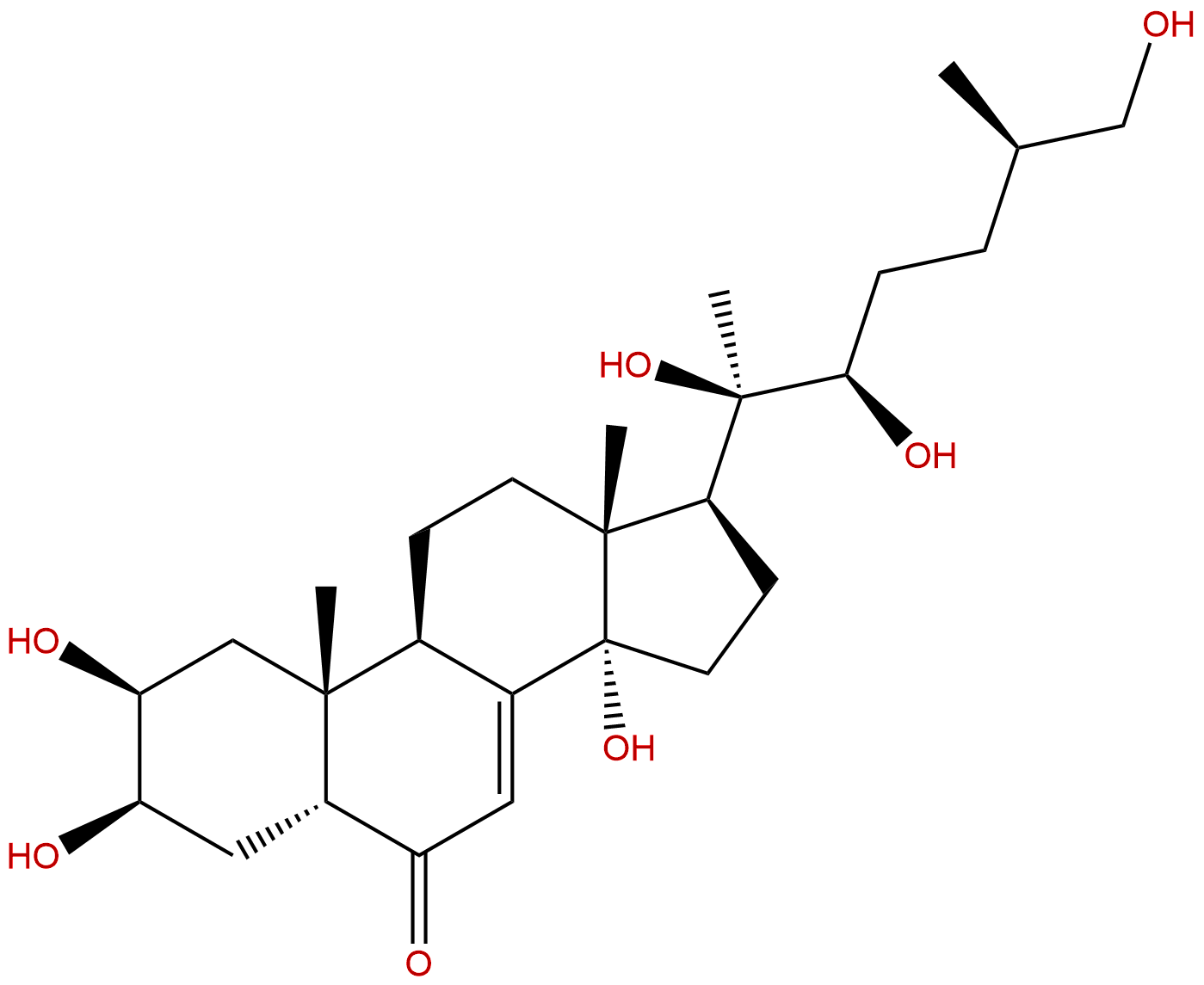
25S Achyranthes ketone is a typical plant molting steroid, with chemical names 2 β, 3 β, 14 α, 20R, 22R, 25-hexahydroxy-5 β - cholestan-7-en-6-one. Its molecular formula is C27H44O8 and its molecular weight is 480.6420. Its core structure is a cholestane skeleton, with cis (5 β - H) coupling in the A/B rings, a ketone group at the C-6 position, and a double bond at the C-7 position, which is one of the key characteristics of its biological activity. Its structure contains six hydroxyl groups (2 β, 3 β, 14 α, 20R, 22R, 25-), giving it strong hydrophilicity. The stereoconfiguration of its C-25 position is S-type, which is a key structural feature that distinguishes it from its stereoisomer 25R Achyranthes ketone and may affect its interaction and biological activity with target proteins.
Based on its structure, 25S Achyranthes ketone exhibits specific physicochemical properties. The calculated lipid water partition coefficient (LogP) is 1.5672, indicating that it has a certain degree of lipophilicity, but overall it still leans towards amphiphilic molecules. The topologically polar surface area (TPSA) is as high as 138.45 Å ², mainly attributed to the presence of multiple hydroxyl groups, indicating strong intermolecular hydrogen bonding ability. The predicted value of water solubility is 0.1309 mg/mL, which belongs to the category of slight solubility, posing a challenge for its formulation development. These basic physicochemical parameters provide important references for subsequent pharmacokinetic studies and formulation design.
Plant sources and extraction methods
25S Achyranthes ketone is mainly found in various medicinal plants of the Achyranthes and Cyathula genera in the Amaranthaceae family. Its main plant sources include:
1. Achyranthes bidentata Blume This is the most commonly used and important source. The dried root of Achyranthes bidentata is a traditional Chinese medicine commonly used for strengthening muscles and bones, removing blood stasis, and promoting meridian circulation. 25S Achyranthes ketone is one of the main active steroid components in its roots.
2. Japanese Achyranthes japonica Nakai As a closely related species, its roots also contain this compound.
3. Head Flower Cup Amaranthus (Cyathula capitata Moq.) and Cyathula officinalis Kuan The roots of these two plants, used as "Sichuan Achyranthes" for medicinal purposes, also contain 25S Achyranthes steroids, but their content and associated components may differ from those of Achyranthes.
The extraction method usually follows the general process of plant steroidal compounds. Firstly, the plant roots are dried and crushed, and then subjected to reflux extraction or ultrasound assisted extraction using organic solvents such as methanol, ethanol, or aqueous ethanol. After vacuum concentration, the crude extract is preliminarily enriched using liquid-liquid extraction (such as ethyl acetate/water distribution). Further purification mainly relies on various chromatographic techniques, including normal phase silica gel column chromatography, reverse phase C18 column chromatography (such as ODS), as well as high performance liquid chromatography (HPLC) and preparative thin layer chromatography (PTLC). Modern technologies such as high-speed countercurrent chromatography (HSCCC) have also been applied for the separation and purification of such compounds due to their high efficiency and avoidance of irreversible adsorption. The optimization of extraction process, such as solvent selection, temperature, and time, is crucial for improving the yield and purity of 25S Achyranthes ketone.
Pharmacological activity research
A large number of pharmacological studies both in vitro and in vivo have shown that 25S Achyranthes ketone has various biological activities, among which bone protection and anti-inflammatory effects are the most prominent.
-
Anti osteoporosis activity This is the most in-depth field of research on 25S Achyranthes ketone. In a postmenopausal osteoporosis rat model induced by ovariectomy (OVX), 25S Achyracetone can significantly increase bone density (BMD), improve bone microstructure (such as increasing the number and thickness of bone trabeculae, reducing separation), and enhance biomechanical properties (such as maximum load and elastic modulus). In vitro experiments have shown that it can promote the proliferation, differentiation, and mineralization of osteoblast cell lines (such as MC3T3-E1, MG-63), while inhibiting the differentiation of osteoclast precursor cells (such as RAW264.7) into mature osteoclasts and their bone resorption function, thereby bidirectionally regulating bone metabolism balance.
-
Anti inflammatory and organ protective activity As described, 25S Achyranthes ketone has protective potential against lipopolysaccharide (LPS) - induced acute kidney injury (AKI). In the LPS induced AKI mouse model, it can significantly reduce serum creatinine and urea nitrogen levels, alleviate renal tissue pathological damage (such as tubular dilation, necrosis, and inflammatory cell infiltration). Its protective effect is closely related to the inhibition of excessive production of pro-inflammatory factors such as TNF - α, IL-1 β, IL-6. In addition, research suggests that it may have a protective effect on inflammation related disease models such as liver injury and lung injury.
-
Other potential activities Preliminary studies also suggest that 25S Achyranthes ketone may have regulatory effects on glucose and lipid metabolism (through pathways such as AMPK), antioxidant stress (activation of Nrf2 pathway), and neuroprotection, but more evidence is needed to support these areas.
Mechanism of action and molecular targets
The multiple pharmacological effects of 25S Achyranthes ketone stem from its regulation of complex cellular signaling networks. According to the provided target information, its mechanism of action can be summarized as follows:
-
Regulating osteogenesis and bone homeostasis:
- AMPK/STAT3/SIRT1 axis Activation of AMPK (PRKAA1) can regulate cellular energy metabolism and may promote osteogenic differentiation through downstream signals such as inhibition of STAT3 overactivation and upregulation of SIRT1, while suppressing inflammatory responses.
- Estrogen receptor beta (ESR2)As a plant derived compound, 25S Achyranthes ketone may exert estrogen like bone protection by binding to ESR2 in a selective estrogen receptor modulator (SERM) manner, avoiding excessive stimulation of the breast and uterus.
- MAPK/SMAD pathway Regulating the phosphorylation levels of MAPK1 (ERK) and SMAD3, affecting the signaling of growth factors such as BMP and TGF - β, thereby regulating the expression of osteogenic related genes such as Runx2 and Osterix.
- Inhibit osteoclastogenesis By inhibiting the nuclear translocation of the key transcription factor RELA (p65) in the NF - κ B pathway and suppressing the MAPK pathway, the expression of the key osteoclast differentiation factor NFATc1 is downregulated, thereby inhibiting osteoclastogenesis.
-
Anti inflammatory and antioxidant properties:
- NF - κ B and STAT3 pathway Inhibiting the activation of RELA and STAT3 is the core of its anti-inflammatory effect, which can effectively reduce the transcription of pro-inflammatory cytokines such as TNF - α and IL-6.
- Nrf2/ARE pathway Activate transcription factor NFE2L2 (Nrf2), promote the expression of downstream antioxidant enzymes (such as HO-1, NQO1), and enhance cellular antioxidant defense capabilities.
- Synthesis of prostaglandin E2 May reduce the production of pro-inflammatory mediator PGE2 by affecting the expression or activity of PTGES (prostaglandin E synthase).
-
Other targets The regulation of protein kinase C δ (PRKCD) may be involved in various processes such as cell apoptosis and differentiation, and its specific role in the action of 25S Achyranthes ketone remains to be elucidated.
In summary, 25S Achyranthes ketone forms the molecular basis for its anti osteoporosis and anti-inflammatory effects through multi-target and multi pathway synergistic effects.
Evaluation of drug properties and pharmacokinetics
Based on the provided pharmacological parameters and existing research, the preliminary evaluation of the pharmacological properties of 25S Achyranthes ketone is as follows:
- Absorption and distribution Moderate LogP values and high TPSA suggest that oral absorption may be moderate, in line with the basic rules of drug likeness, but poor water solubility may limit its dissolution and absorption rate. The blood-brain barrier (BBB) penetration prediction is "low", indicating that it is not easily able to enter the central nervous system. This may reduce the risk of central side effects for drugs that mainly act on the peripheral system (such as bones and kidneys), but also suggests that it is not suitable for the treatment of central nervous system diseases.
- Metabolism and Safety The inhibition prediction of hERG channel is' no ', which preliminarily reduces the potential risk of inducing QT interval prolongation and apical torsion ventricular tachycardia, and the cardiovascular safety warning is low. The Ames test predicted a value of 0.0, indicating that there may be no direct genetic toxicity risk, which is a positive signal. However, these are only computational predictions or preliminary in vitro data, and the exact metabolic pathways (such as CYP450 enzyme involvement), in vivo genetic toxicity, and long-term toxicity still need to be validated through standardized preclinical studies.
- Current status of pharmacokinetic research Currently, there are relatively limited reports on the pharmacokinetic studies of the 25S Achyranthes ketone system. Limited animal experiments (in rats) suggest that oral administration may result in slower absorption, longer peak time (Tmax), and possibly lower absolute bioavailability. Its metabolism in the body may involve reactions such as oxidation and binding of hydroxyl groups (such as glucuronidation, sulfation). These preliminary features suggest that if developed into oral formulations in the future, it may be necessary to improve their solubility and permeability through formulation technologies such as solid dispersions, nanocrystals, phospholipid complexes, etc., in order to enhance their bioavailability.
Clinical application prospects and prospects
25S Achyranthes ketone, as a natural compound with clear bone protection and anti-inflammatory activities, has broad clinical application prospects but also faces challenges.
prospect:
1. New treatment options for osteoporosis Especially for postmenopausal osteoporosis, which regulates bone metabolism through multiple targets and may have SERM like selective advantages, it is expected to be developed into a new type of anti osteoporosis drug or functional food/health product.
2. Adjuvant therapy for acute kidney injury The protective effect of LPS induced AKI provides potential application value for its prevention and treatment of acute kidney injury caused by sepsis, drug nephrotoxicity, and other factors.
3. Collaborative treatment of multiple diseases Its basic anti-inflammatory and antioxidant effects may enable it to play a beneficial role in chronic inflammatory diseases such as osteoarthritis and metabolic syndrome.
Challenges and Prospects:
1. Deep analysis of the mechanism of action The existing target network still needs to be validated in more precise cell and animal models to clarify the details of its direct target (such as target fishing through chemical biology methods) and upstream and downstream signaling pathways.
2. Optimization of drug properties Urgent need for systematic and comprehensive preclinical pharmacokinetic (ADME) and toxicological studies. In response to its poor water solubility and potential low bioavailability, there is a need to strengthen research on new drug delivery systems, such as nano formulations and transdermal drug delivery.
3. Structural modification and development of analogues Using it as a lead compound, reasonable structural modifications (such as derivatization of specific hydroxyl groups) are expected to obtain derivatives with stronger activity, better metabolic properties, and higher targeting.
4. Clinical translational research On the basis of fully completing preclinical research, promoting its entry into clinical trials is the final step in verifying its safety and effectiveness. It can be explored as a single component drug or in combination with traditional Chinese medicine/Western medicine.
Conclusion
25S Achyranthes ketone is an important active plant molting hormone contained in traditional Chinese medicine Achyranthes. Modern pharmacological research has surpassed its initial understanding of insect activity, gradually revealing its significant effects in regulating bone metabolism balance, anti-inflammatory, antioxidant, and other aspects. Its mechanism of action involves multiple key signaling pathways such as AMPK, STAT3, NF - κ B, Nrf2, and estrogen receptors, reflecting the characteristic of multi-target synergistic effects of natural products. Despite facing challenges in drug formulation such as solubility and bioavailability, its good preliminary safety prediction and clear core pharmacological activity have laid a solid foundation for its further development. In the future, by deepening mechanism research, optimizing formulation strategies, exploring structural modifications, and combining rigorous clinical evaluations, 25S Achyranthes ketone is expected to be successfully transformed from a potential natural compound into an innovative drug or high-end health product for the prevention and treatment of diseases such as osteoporosis and acute kidney injury, fully demonstrating the value of modernization and internationalization of traditional Chinese medicine.