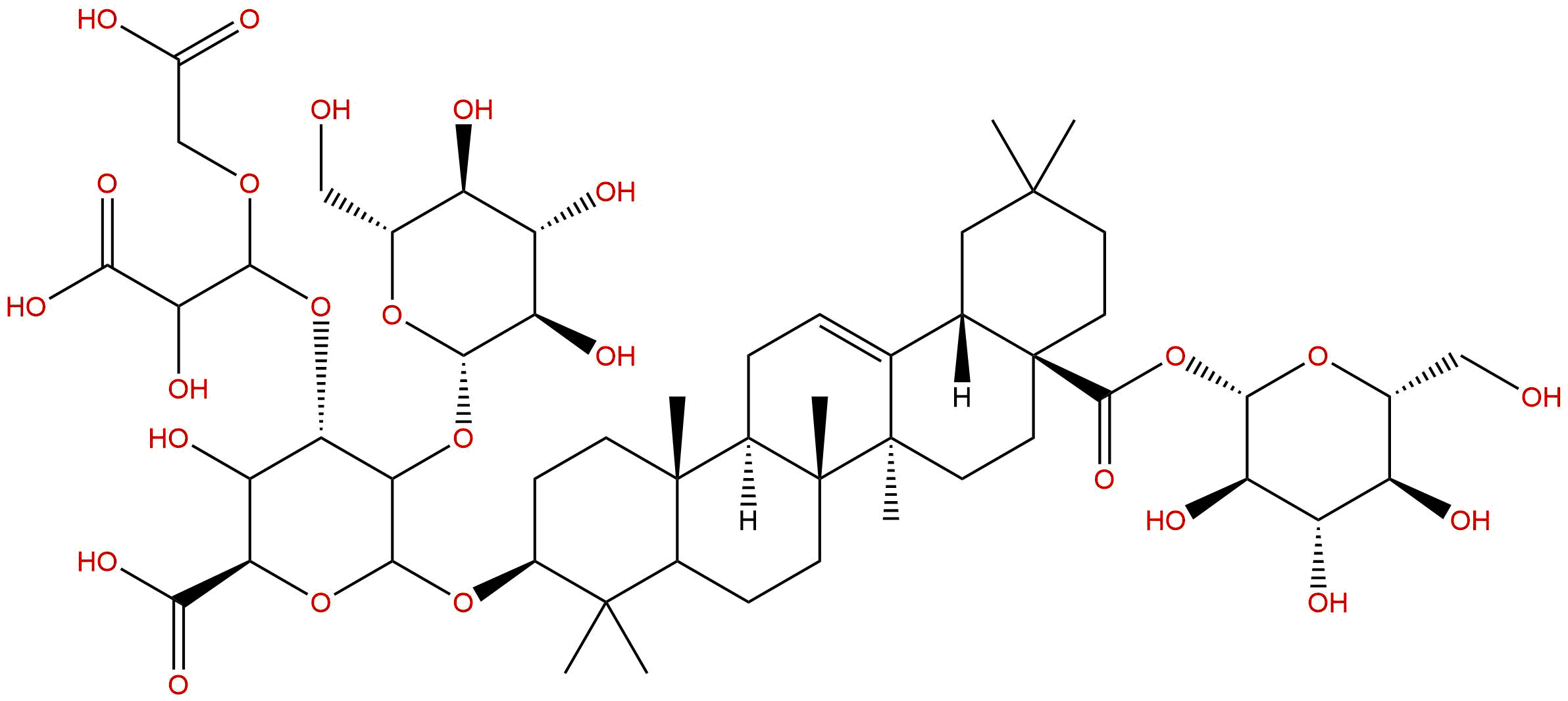


Product name: Achyranthoside D
Synonym name:
Catalogue No.: BP5146
Cas No.: 168009-91-4
Formula: C53H82O25
Mol Weight: 1119.21
Botanical Source:
Type of Compound: Triterpenoids
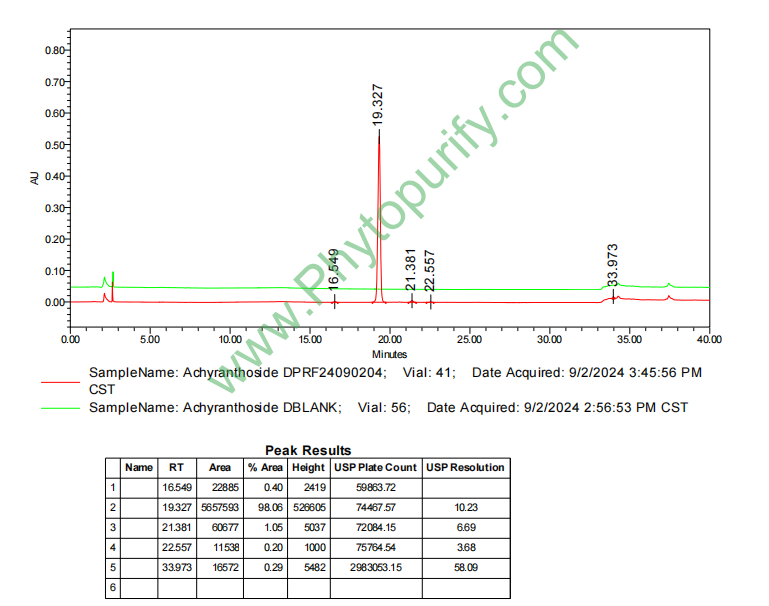
Purity: 95%~99%
Analysis Method: HPLC-DAD or/and HPLC-ELSD
Identification Method: Mass, NMR
Packing: Brown vial or HDPE plastic bottle
Storage: Store in a well closed container, protected from air and light. Put into refrigerate or freeze for long term storage.
Whenever possible, you should prepare and use solutions on the same day. However, if you need to make up stock solutions in advance, we recommend that you store the solution as aliquots in tightly sealed vials at -20℃. Generally, these will be useable for up to two weeks.
The product could be supplied from milligrams to grams
Inquire for bulk scale.
For Reference Standard and R&D, Not for Human Use Directly.
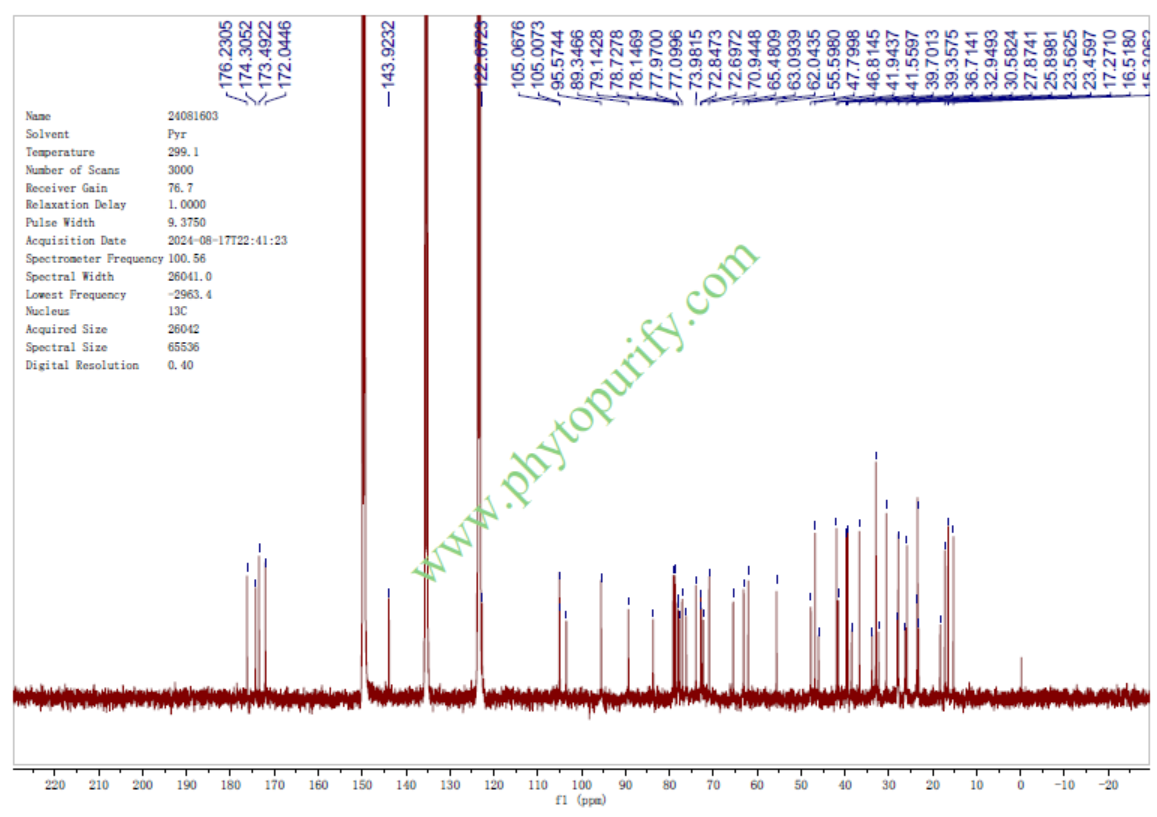
NMR of Achyranthoside D
HPLC of Achyranthoside D
Storage conditions:Short-term storage at 2~8℃, long-term storage at -20 ~ -80℃
405.1100
1.2951
-1.5111
.4729
.4653
.0860
Low
81.2344
6.8352
Yes
No
Yes
No
No
No
0.0
Yes
No
No
No
Achyranthoside D is a natural triterpenoid saponin derived from the plant genus Achyranthes. In recent years, it has received widespread attention due to its significant pharmacological activity, especially its potential application in the field of anti arthritis. Arthritis, as a common chronic inflammatory disease, seriously affects the quality of life of patients. Currently, clinical treatment methods mostly rely on nonsteroidal anti-inflammatory drugs (NSAIDs) and immunosuppressants, which have certain side effects and resistance issues. Therefore, the development of natural medicines with high efficiency and good safety has become a research hotspot. Due to its unique chemical structure and multi-target regulatory effects, Achyranthes bidentata saponins D have shown good anti-inflammatory and cartilage protective effects, providing a new direction for pharmacological research on natural products.
This article will provide a systematic review of the chemical structure and physicochemical properties, plant sources and extraction methods, pharmacological activity research, mechanism of action and molecular targets, pharmacological evaluation, and pharmacokinetic characteristics of Achyranthes bidentata saponin D. Combined with its clinical application prospects, it aims to provide theoretical basis and research reference for the drug development and clinical translation of this natural product.
Achyranthes glycoside D belongs to the triterpenoid saponin class, with a complex molecular formula and a molecular weight of 1119.2140. Its structural core is a triterpenoid skeleton that connects multiple sugar groups, endowing it with high polarity and biological activity. According to existing literature reports, the LogP value of Achyranthes bidentata saponin D is 1.2951, indicating its moderate hydrophobicity, which is beneficial for cell membrane penetration but not too hydrophobic to affect bioavailability. Its topological polar surface area (TPSA) is 405.1100, reflecting the presence of a large number of polar groups on the molecular surface, especially glycosides, which enhances its water solubility. The water solubility index is 0.4729, indicating that it has a certain solubility in water.
The structure of Achyranthes bidentata saponin D contains multiple hydroxyl and glycosidic bonds, which not only affect its physicochemical properties, but also provide diverse binding sites for its binding to biomolecule targets. In addition, the complexity of molecular structure also poses challenges to its pharmacokinetic behavior and metabolic pathways, requiring further in-depth research.
Achyranthes saponins D are mainly isolated from Achyranthes spp. plants. This plant species is widely distributed in parts of Asia and Africa, and its roots are commonly used in traditional Chinese medicine to promote blood circulation, remove blood stasis, and strengthen muscles and bones. Achyranthes bidentata, as the main source plant, contains abundant triterpenoid saponins in its roots, including Achyranthes bidentata saponin D.
The common methods for extracting saponins D from Achyranthes bidentata mainly include:
In recent years, supercritical fluid extraction and membrane separation techniques have also been explored for the extraction and purification of Achyranthes bidentata saponins D, aiming to improve extraction efficiency and environmental friendliness.
Achyranthes saponins D exhibit significant anti-inflammatory and anti arthritis effects in various pharmacological activities. Its main pharmacological effects include:
Anti arthritis effect
Achyranthes saponins D alleviate joint cartilage damage and inflammatory response by regulating the expression of inflammatory factors and degradation enzymes. In vitro and in vivo experiments have shown that Achyranthes bidentata saponins D can significantly inhibit the expression of inflammatory and matrix degradation related factors such as IL-1 β, MMP13, and ADAMTS5 in joint tissues, slow down the degradation of cartilage matrix, and protect the function of chondrocytes.
Anti inflammatory and immune regulation
As a natural triterpenoid saponin, Achyranthes bidentata saponin D can inhibit the release of various pro-inflammatory cytokines, regulate the activity of immune cells, and alleviate inflammatory reactions. Its inhibitory effect on IL1B is particularly significant, reducing the activation of the inflammatory cascade.
Promote cartilage repair
Achyranthes saponins D can upregulate the expression of cartilage matrix protein ACAN and transcription factor SOX9, promote chondrocyte differentiation and matrix synthesis, and facilitate the repair and regeneration of articular cartilage.
Other pharmacological effects
The study also found that Achyranthes bidentata saponins D have certain antioxidant activity, reducing the damage of joint tissue caused by oxidative stress. In addition, the regulatory effect on bone metabolism has also been preliminarily reported, indicating its potential application value in diseases such as osteoporosis.
The anti arthritis effect of Achyranthes bidentata saponins D is mainly achieved through multi-target and multi pathway synergistic regulation, involving the expression regulation of key inflammatory mediators and matrix degrading enzymes:
IL1B (interleukin-1 β)
IL1B is a core factor in the pro-inflammatory response of arthritis, which can induce chondrocytes to produce various degradation enzymes and inflammatory mediators. Achyranthes saponins D alleviate inflammation and block pathological processes by inhibiting the expression and signaling of IL1B.
MMP13 (Matrix Metalloproteinase 13)
MMP13 is a key enzyme in the degradation of cartilage matrix collagen, and overexpression leads to cartilage destruction. Achyranthes saponins D significantly inhibit the activity and expression of MMP13, protecting the integrity of cartilage structure.
ADAMTS5 (integrin releasing metalloproteinase like protease 5)
ADAMTS5 mainly degrades aggrecan polysaccharides in cartilage and is an important mediator of articular cartilage degeneration. Achyranthes saponins D slow down the degradation of cartilage matrix by downregulating ADAMTS5 expression.
ACAN (Aggregation Protein Polysaccharide)
ACAN is an important component of cartilage matrix, maintaining the elasticity and function of cartilage. Achyranthes saponins D can promote the synthesis of ACAN and enhance cartilage repair ability.
SOX9 (transcription factor SOX9)
SOX9 regulates the differentiation of chondrocytes and the expression of matrix proteins, and is a key transcription factor in cartilage formation. Achyranthes saponins D promote the functional recovery of chondrocytes by activating SOX9 expression.
Molecular mechanism studies have shown that Achyranthes bidentata saponins D may exert anti-inflammatory and cartilage protective effects by inhibiting the NF - κ B and MAPK signaling pathways, regulating the expression of these targets. In addition, its regulation of oxidative stress-related pathways also provides theoretical support for its pleiotropy.
The pharmacological parameters of Achyranthes bidentata saponin D show that it has certain potential for drug development:
In terms of pharmacokinetics, existing research is relatively limited. Preliminary in vivo experiments have shown that the absorption of Achyranthes bidentata saponins D is slow after oral administration, with a moderate plasma half-life, and is mainly excreted through liver metabolism. Due to its large molecular weight and high polarity, its bioavailability may be limited, and in vivo exposure needs to be improved through formulation optimization or structural modification.
In the future, systematic research on its metabolic pathways, drug interactions, and in vivo distribution should be strengthened to lay the foundation for clinical applications.
As a natural triterpenoid saponin, Achyranthes bidentata saponin D has shown promising clinical development potential due to its multi-target anti arthritis effects. Its unique advantages in regulating inflammatory factors, protecting cartilage matrix, and promoting cartilage repair make it a promising new adjuvant therapy for arthritis, especially osteoarthritis.
The future clinical application prospects are mainly reflected in the following aspects:
Arthritis treatment
Combined with existing drugs, Achyranthes bidentata saponins D can be used as a natural medicinal ingredient to alleviate symptoms of arthritis, delay pathological progression, and reduce the risk of side effects of NSAIDs and other drugs.
Bone and Joint Protector
By promoting cartilage repair and matrix synthesis, Achyranthes bidentata saponins D are expected to be developed as bone and joint protectants for early intervention in joint degeneration.
Combination therapy strategy
Combined use with other anti-inflammatory or immunomodulatory drugs may have a synergistic effect and improve treatment efficacy.
Development of new dosage forms
Due to its physicochemical properties, it is suitable for developing oral sustained-release formulations, local drug delivery formulations, or nanocarrier systems to optimize drug release and targeting.
However, the clinical translation of Achyranthes bidentata saponin D still faces challenges, including insufficient bioavailability, complex in vivo metabolism, and lack of systematic clinical safety and efficacy data. In the future, pharmacokinetics, toxicology, and preclinical evaluation should be strengthened to promote their clinical application.
As a triterpenoid saponin derived from Achyranthes plants, Achyranthes saponin D has become a hot topic in natural product pharmacology research due to its unique chemical structure and multi-target anti arthritis effects. It exhibits significant biological activity in regulating key molecules such as IL1B, MMP13, ADAMTS5, ACAN, and SOX9, demonstrating good pharmacological potential and safety.
Although the pharmacokinetics and clinical research of Achyranthes bidentata saponin D are still in the preliminary stage, its pharmacological parameters and multiple mechanisms of action provide a solid foundation for it as a candidate anti arthritis drug. In the future, through in-depth mechanism research, drug optimization, and clinical validation, Achyranthes bidentata saponin D is expected to become an important natural medicine in the field of arthritis treatment, bringing new treatment options to patients.
In summary, Achyranthes bidentata saponin D not only enriches the natural anti arthritis drug library, but also provides valuable scientific basis for the development of natural triterpenoid saponins, which deserves continuous investment and attention in basic research and clinical translation.
