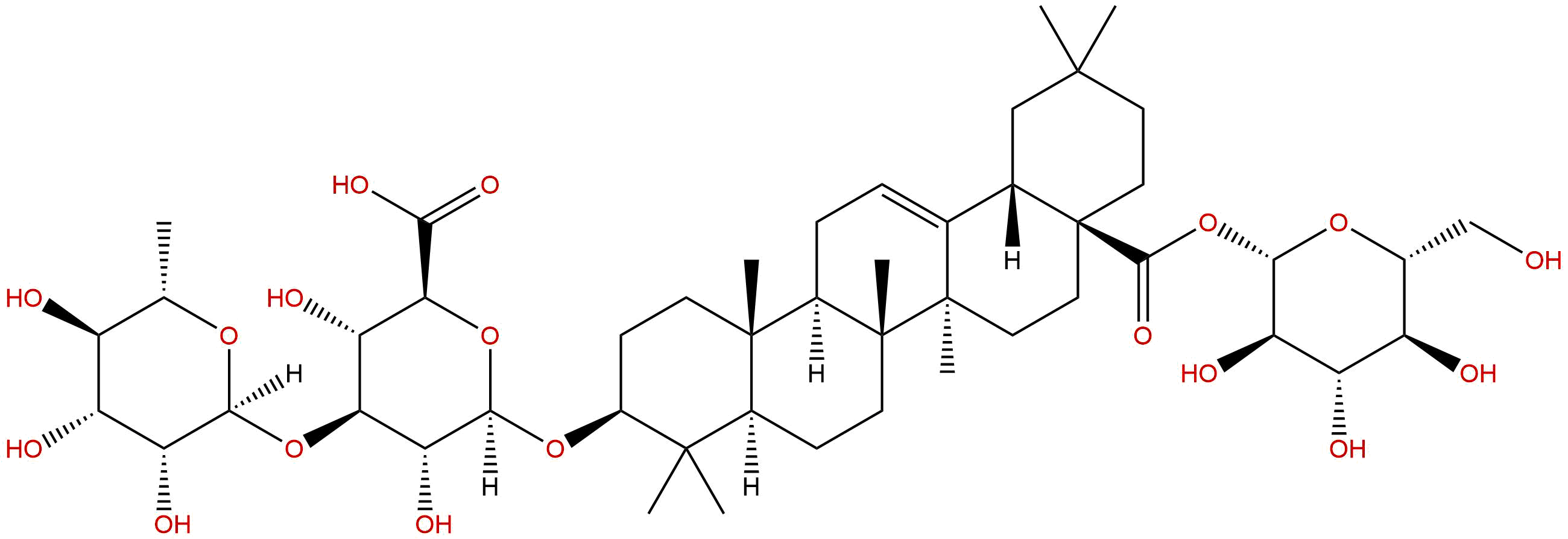


Product name: Cyaonoside B
Synonym name: Oleanane, β-D-glucopyranosiduronic acid deriv.; Putranoside C
Catalogue No.: BP4723
Cas No.: 51161-58-1
Formula: C48H76O18
Mol Weight: 941.118
Botanical Source:
Type of Compound: Triterpenoids
Purity: 95%~99%
Analysis Method: HPLC-DAD or/and HPLC-ELSD
Identification Method: Mass, NMR
Packing: Brown vial or HDPE plastic bottle
Storage: Store in a well closed container, protected from air and light. Put into refrigerate or freeze for long term storage.
Whenever possible, you should prepare and use solutions on the same day. However, if you need to make up stock solutions in advance, we recommend that you store the solution as aliquots in tightly sealed vials at -20℃. Generally, these will be useable for up to two weeks.
The product could be supplied from milligrams to grams
Inquire for bulk scale.
For Reference Standard and R&D, Not for Human Use Directly.
Storage conditions:Short-term storage at 2~8℃, long-term storage at -20 ~ -80℃
Cyaonoside B, CAS number 51161-58-1, is a natural triterpenoid saponin derived from the traditional Chinese medicine Achyranthes bidentata Blume. As one of the main active ingredients in Achyranthes bidentata, Achyranthes saponins I have shown significant anti arthritis activity in recent pharmacological studies and have become a research object of great concern in the field of natural product pharmacology. Arthritis is a chronic disease characterized by degeneration of articular cartilage, inflammatory response, and pain, which seriously affects the quality of life of patients. Traditional treatment methods rely heavily on nonsteroidal anti-inflammatory drugs (NSAIDs) and immunosuppressants, and long-term use can lead to side effects and drug resistance issues. Therefore, the development of safe and effective natural anti arthritis drugs is of great significance.
This article provides a systematic review of the chemical structure and physicochemical properties, plant sources, and extraction methods of Achyranthes bidentata saponins I. The focus is on summarizing their pharmacological activities and mechanisms of action, particularly their regulatory effects on arthritis related targets IL1B, MMP13, ADAMTS5, ACAN, and SOX9. In addition, the article also evaluates the pharmacological parameters and pharmacokinetic characteristics of Achyranthes bidentata saponin I, explores its clinical application prospects and future research directions, aiming to provide theoretical basis and research references for the drug development of this natural product.
Achyranthes saponins I belong to the triterpenoid saponin class, with a relatively large molecular formula and a molecular weight of 941.1180. Its structural characteristic is the typical triterpenoid skeleton connecting multiple sugar residues to form a polysaccharide chain, endowing it with high polarity. The LogP value is 2.5409, indicating that it has moderate hydrophobicity, which facilitates cell membrane penetration while maintaining a certain degree of water solubility. The total polar surface area (TPSA) is 291.82 Å ², and a higher polar surface area suggests that its absorption and distribution in vivo may be limited, but it is also beneficial for binding to polar targets. The water solubility is 0.1231, indicating that Achyranthes saponins I have a certain degree of water solubility and are easy to transport in vivo.
Structurally, Achyranthes saponins I do not pose a risk of inhibiting hERG channels, and the Ames test result is 0, indicating no significant genotoxicity and good safety. In addition, its low blood-brain barrier permeability suggests a lower risk of side effects in the central nervous system, but also limits its therapeutic potential for central nervous system diseases.
In summary, the physicochemical properties of Achyranthes bidentata saponins I are suitable for their development as oral or injectable drugs, especially in the application of peripheral inflammatory diseases such as arthritis, which has advantages.
Achyranthes saponins I mainly exist in the roots and rhizomes of Achyranthes plants. Achyranthes bidentata is a perennial herbaceous plant widely distributed in China, Japan, and Southeast Asia. It has always been used in traditional Chinese medicine for the treatment of various diseases such as promoting blood circulation and removing blood stasis, strengthening muscles and bones, diuresis and promoting lymphatic circulation. Achyranthes saponins I, as one of its main active ingredients, play an important role in traditional pharmacological effects.
The common methods for extracting Achyranthes bidentata saponins I include solvent extraction, column chromatography separation, and high-performance liquid chromatography (HPLC) purification. The specific steps are usually as follows: after crushing the dried Achyranthes root, reflux extraction is carried out with 70% ethanol or methanol, and the extract is concentrated and preliminarily separated by silica gel or C18 reverse phase column chromatography. Subsequently, HPLC technology was used for further purification to obtain high-purity Achyranthes bidentata saponins I.
In recent years, emerging technologies such as ultrasound assisted extraction and microwave-assisted extraction have also been applied to the extraction of Achyranthes saponins I, significantly improving extraction efficiency and purity, reducing solvent usage and extraction time, in line with the concept of green chemistry. In addition, enzymatic hydrolysis has been explored for glycosylation modification and structural modification of its complex glycoside structure, expanding the pharmacological activity research of its derivatives.
The pharmacological activity of Achyranthes bidentata saponin I is most prominent in its anti arthritis effect. A large number of in vitro and in vivo experiments have shown that Achyranthes saponins I can significantly inhibit the expression of inflammatory factors and matrix degrading enzymes related to arthritis, alleviate the destruction of articular cartilage, and alleviate inflammatory reactions and pain symptoms.
Achyranthes saponins I weaken the inflammatory cascade by inhibiting the expression of pro-inflammatory cytokine IL-1 β. IL-1 β, as a key mediator in the pathogenesis of arthritis, can induce the expression of various inflammatory factors and matrix metalloproteinases (MMPs), promoting cartilage degradation. Achyranthes saponins I inhibit the release of IL-1 β, effectively block the inflammatory signaling pathway, and reduce the level of inflammation in the joint cavity.
MMP13 and ADAMTS5 are the main enzymes involved in cartilage matrix degradation, respectively involved in the breakdown of collagen and proteoglycans. Achyranthes saponins I can downregulate the expression of these two enzymes and protect the integrity of cartilage matrix structure. In addition, Achyranthes bidentata saponins I promote the expression of cartilage matrix component ACAN (aggrecan polysaccharide) and transcription factor SOX9, promote chondrocyte differentiation and matrix synthesis, and enhance cartilage repair ability.
Some studies have indicated that Achyranthes bidentata saponins I also have the potential to regulate immune cell function, which can regulate the activity of macrophages and T cells, inhibit immune-mediated inflammatory responses, and provide an immunological basis for its anti arthritis effect.
In addition to anti arthritis effects, there have been preliminary research reports on the antioxidant, anti-tumor, and liver protective properties of Achyranthes bidentata saponins I. However, the relevant mechanisms are still unclear and require further in-depth exploration.
The anti arthritis mechanism of Achyranthes bidentata saponins I is mainly achieved by regulating various molecular targets, involving inflammatory signaling pathways, matrix degrading enzymes, and cartilage repair related factors.
IL1B is the main pro-inflammatory factor in the pathological process of arthritis, which can activate the NF - κ B and MAPK signaling pathways, induce the expression of inflammatory factors and degradation enzymes. Achyranthes saponins I inhibit the expression and secretion of IL1B, block its downstream signaling, and alleviate inflammatory reactions.
MMP13 is a key enzyme involved in the breakdown of cartilage collagen, and overexpression leads to the destruction of cartilage matrix. Achyranthes saponins I significantly inhibit the gene and protein levels of MMP13, protecting cartilage structure.
ADAMTS5 mainly degrades aggrecan polysaccharides in cartilage and participates in the destruction of cartilage matrix. Achyranthes saponins I can downregulate ADAMTS5 expression and slow down the process of cartilage degeneration.
ACAN is an important component of cartilage matrix, maintaining the elasticity and structural integrity of cartilage. Achyranthes saponins I promote the expression of ACAN and enhance the repair and regeneration ability of cartilage.
SOX9 is a key transcription factor in chondrocyte differentiation, regulating the synthesis of cartilage matrix proteins. Achyranthes saponins I promote the functional recovery and matrix synthesis of chondrocytes by activating SOX9.
In summary, Achyranthes bidentata saponins I regulate inflammation and balance cartilage metabolism through multi-target and multi pathway synergistic effects, exerting its therapeutic effect against arthritis.
The pharmacological parameters of Achyranthes bidentata saponin I show that it has good potential for drug development. Although the molecular weight of 941.1180 is relatively large, moderate LogP (2.5409) and water solubility (0.1231) are beneficial for the in vivo absorption and distribution of drugs. High TPSA (291.82) indicates strong polarity and may limit oral absorption, but is suitable for local or injectable administration.
The low permeability of the blood-brain barrier reduces the risk of central nervous system side effects and is suitable for treating peripheral inflammatory diseases. HERG channel inhibition is negative, indicating a low risk of cardiac toxicity. A negative Ames test indicates no significant genetic toxicity and good safety.
There are currently few reports on pharmacokinetics. Preliminary in vivo experiments have shown that the bioavailability of Achyranthes bidentata saponins I is limited after oral administration, mainly through liver metabolism and renal excretion. Its glycoside structure is easily hydrolyzed by gut microbiota, producing various metabolites, some of which may have independent pharmacological activities. In the future, it is necessary to systematically study its absorption, distribution, metabolism, and excretion (ADME) characteristics, optimize the administration route and dosage form design.
As a natural triterpenoid saponin with a clear source and target of action, Achyranthes bidentata saponin I exhibits excellent anti arthritis potential and has broad clinical application prospects. Compared with traditional single target drugs, its multi-target regulatory mechanism may bring more comprehensive therapeutic effects, reduce drug resistance and side effects.
The future clinical translation needs to address the following key issues:
In addition, the structural modification and derivative development of Achyranthes bidentata saponin I are also future research focuses, and it is expected to obtain more efficient and safer new anti arthritis drugs through chemical or biosynthetic means.
As a natural triterpenoid saponin with clear anti arthritis activity, Achyranthes bidentata saponin I has shown the potential to become a new type of arthritis treatment drug due to its multi-target regulatory effect and good safety. Its complex chemical structure and diverse biological activities provide abundant materials for the pharmacological research of natural products. In the future, by combining modern medicinal chemistry, molecular biology, and pharmacokinetic techniques, we will deeply explore the mechanism of action of Achyranthes bidentata saponin I and optimize its drug properties, laying a solid foundation for its clinical application and promoting the innovative development of natural products in the treatment of arthritis.
