Introduction/Overview
Osteoarthritis (OA), as a highly prevalent degenerative joint disease worldwide, involves multiple repetitive processes such as cartilage degradation, synovial inflammation, subchondral bone remodeling, and pain. The current clinical treatment mainly consists of symptomatic treatments such as nonsteroidal anti-inflammatory drugs, analgesics, and intra-articular injections. Although they can alleviate symptoms, they are difficult to reverse the disease progression, and long-term use often accompanies adverse reactions in the gastrointestinal, cardiovascular, and renal tracts. Therefore, exploring active lead compounds with multi-target, high efficiency and low toxicity characteristics from natural products has become an important direction for new drug development. Plant molting hormone, a type of steroid compound with a structure similar to insect molting hormone, has attracted much attention due to its wide range of biological activities. 25R Inokosterone, as a representative plant molting hormone isolated from traditional Chinese medicine Achyranthes, has shown significant potential in pharmacological activity research such as anti osteoarthritis in recent years. This article aims to systematically review the chemical properties, plant sources, pharmacological activities, mechanisms of action, and medicinal properties of 25R Achyranthes ketone, in order to provide comprehensive scientific references for the in-depth research and development of this compound.
Chemical structure and physicochemical properties
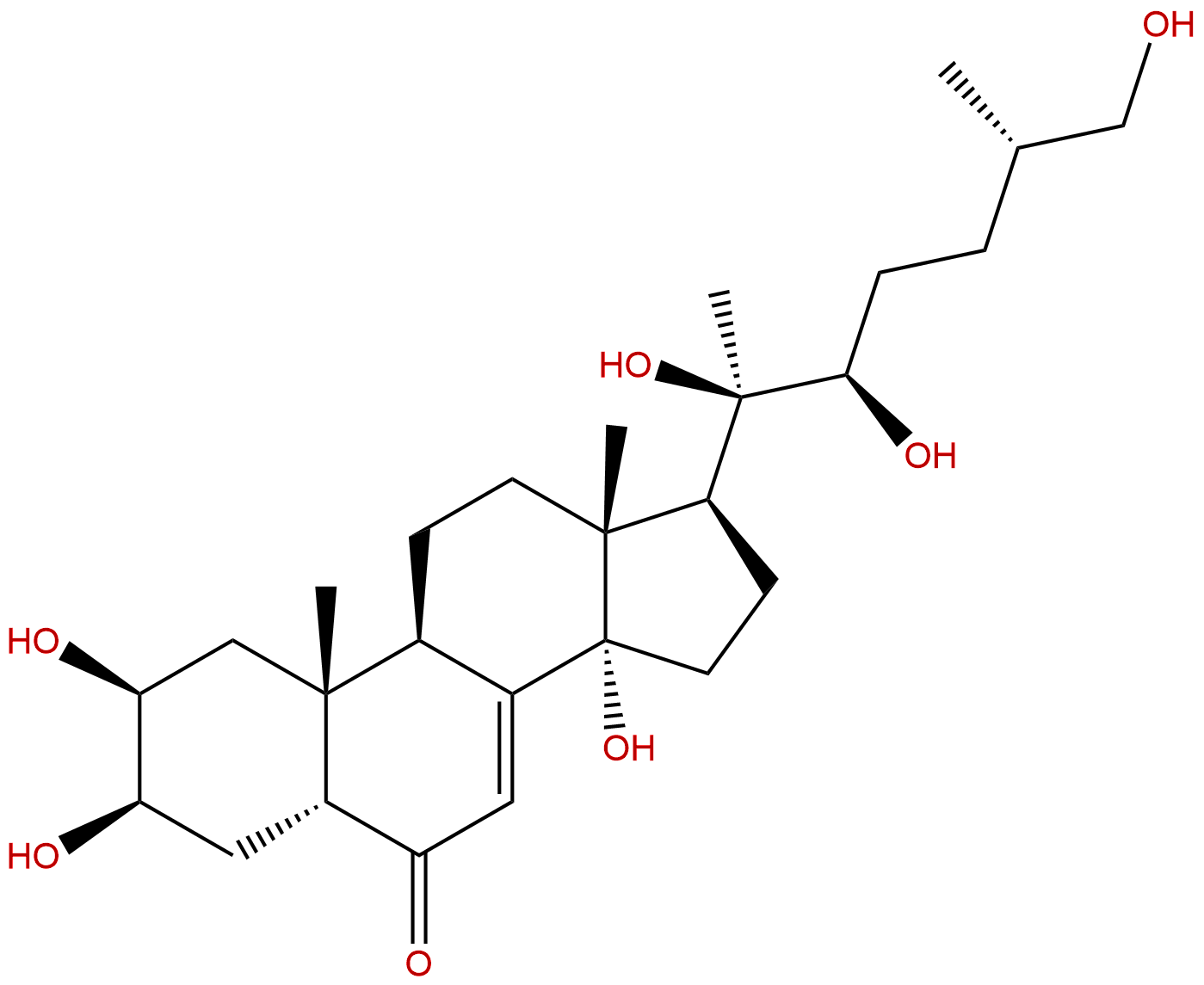
25R Achyranthes ketone, chemical name (2 β, 3 β, 5 β, 22R, 25R) -2,3,14,20,22,26-hexahydroxycholestan-7-en-6-one, CAS number 19682-38-3. Its molecular formula is C27H44O8 and its molecular weight is 480.6420. Structurally, it belongs to the typical plant molting sterol class compounds, with a core structure of a cholestane skeleton and the following key features: 1) A/B rings are cis fused (5 β - H configuration), which is a common feature of many highly active molting hormones; 2) Multiple hydroxyl groups are connected at positions C-2, C-3, C-14, C-20, C-22, and C-26, among which the stereoisomers (R-type) at positions C-22 and C-25 are crucial for their biological activity; 3) The C-6 position is a ketocarbonyl group (6-oxosteroid), and there is a double bond (Δ ⁷) at the C-7 position. These abundant oxygen-containing functional groups determine their unique physicochemical properties.
According to the provided pharmacological parameters, the lipid water partition coefficient (LogP) of 25R Achyranthes ketone is 1.5703, indicating its lipophilicity, but overall it still leans towards amphiphilic properties. Its topological polar surface area (TPSA) is as high as 138.45 Å ², which is closely related to the presence of multiple hydroxyl and carbonyl groups in its molecule, indicating strong hydrogen bonding ability. The water solubility parameter is 0.1301 (usually referring to logS or related values, indicating moderate to low solubility), indicating limited solubility in water, which may require consideration of solubilization strategies in formulation development. The blood-brain barrier permeability is predicted to be "low", which is consistent with the characteristics of most highly polar steroid compounds, indicating a lower risk of central nervous system related side effects. The preliminary toxicity screening showed no inhibition of hERG potassium channels ("no"), and the Ames test result was 0.0 (indicating no mutagenicity), providing preliminary favorable data for its safety.
Plant sources and extraction methods
25R Achyranthes Bidentata Blume is mainly derived from the roots of the traditional Chinese medicine Achyranthes Bidentata Blume. Achyranthes bidentata belongs to the Amaranthaceae family of plants. In traditional Chinese medicine theory, it has the effects of tonifying the liver and kidneys, strengthening muscles and bones, removing blood stasis and promoting blood circulation. It is commonly used to treat symptoms such as lower back and knee pain, muscle and bone weakness, and menstrual disorders. This is highly consistent with its anti osteoarthritis and anti osteoporosis activities in modern research. In addition to Achyranthes, this compound has also been found in other plants such as terrestrial ferns, but Achyranthes remains its main and medicinal source.
The extraction and separation of 25R Achyranthes ketone from plant materials typically involves the use of organic solvent extraction combined with various chromatographic techniques. The classic process is as follows: first, the dried Achyranthes root is crushed, and then subjected to hot reflux or ultrasound assisted extraction with polar solvents such as methanol or ethanol. After concentration, the crude extract is obtained. The crude extract was then subjected to gradient extraction using solvents such as petroleum ether, ethyl acetate, and n-butanol. Plant molting hormone components were mostly enriched in the n-butanol fraction. Further purification depends on column chromatography technology. Silica gel, reverse phase silica gel (such as ODS) or dextran gel (such as Sephadex LH-20) are often used as stationary phases, and chloroform methanol, methanol water and other solvent systems with different proportions are used for gradient elution. High performance liquid chromatography (HPLC), especially preparative HPLC, is a key step in obtaining high-purity 25R Achyranthesterone. Structural identification involves the comprehensive use of nuclear magnetic resonance (NMR, including ¹ H-NMR, ¹ ³ C-NMR, 2D-NMR), mass spectrometry (MS), infrared spectroscopy (IR), and X-ray single crystal diffraction techniques. Among them, NMR plays an irreplaceable role in determining its complex stereoconfiguration (such as the R configuration of C-25). In recent years, new separation technologies such as high-speed countercurrent chromatography have also provided new options for the efficient preparation of such compounds.
Pharmacological activity research
A large number of in vitro and in vivo pharmacological studies have shown that 25R Achyranthes ketone has various biological activities, among which research in osteoarthritis and related fields is the most in-depth and prominent.
1. Anti inflammatory activity: Inflammation is one of the core driving factors in the pathological process of osteoarthritis. Research has shown that 25R Achyranthes ketone can effectively inhibit the excessive production of pro-inflammatory mediators in macrophages (such as RAW264.7) or chondrocytes induced by stimuli such as lipopolysaccharide (LPS) or interleukin-1 β (IL-1 β). It can significantly downregulate the expression of nitric oxide (NO), prostaglandin E2 (PGE2), and key pro-inflammatory cytokines such as tumor necrosis factor - α (TNF - α), IL-6, and IL-1 β. This anti-inflammatory effect is the basis for its alleviation of OA synovitis and chondrocyte inflammatory response.
2. Cartilage protection and anti matrix degradation activity: The excessive degradation of extracellular matrix in chondrocytes is the direct cause of OA cartilage damage. 25R Achyranthes ketone has been shown to inhibit the expression of matrix metalloproteinases (MMPs) in chondrocytes induced by IL-1 β, particularly the activity of MMP-1, MMP-2, MMP-3, MMP-9, and MMP-13. At the same time, it can promote the synthesis of key matrix components such as type II collagen and aggrecan in chondrocytes, maintaining cartilage homeostasis. In animal OA models such as anterior cruciate ligament transection or sodium iodoacetate induced rat/mouse models, this compound effectively reduces cartilage surface erosion and lowers OARSI histological scores, demonstrating clear cartilage protective effects.
3. Antioxidant activation: Oxidative stress plays an important role in apoptosis and aging of OA chondrocytes. 25R Achyranthes ketone can enhance cells' resistance to oxidative stress and reduce the accumulation of reactive oxygen species (ROS). Its antioxidant effect is closely related to the activation of the cell's own antioxidant defense system.
4. Anti apoptotic activity: Apoptosis of chondrocytes is an important characteristic of OA cartilage degeneration. Research has shown that 25R Achyranthes ketone can inhibit chondrocyte apoptosis induced by inflammation or stress, and improve cell survival rate. This function involves the regulation of apoptosis related proteins.
5. Other potential activities: In addition to the activities directly related to OA mentioned above, based on the universal characteristics of plant ecdysteroids, 25R Achyranthes ketone may also have potential activities such as promoting protein synthesis, regulating immunity, and neuroprotection, but these aspects require more specialized research to confirm.
Mechanism of action and molecular targets
The multifaceted protective effects of 25R Achyranthes ketone on osteoarthritis stem from its synergistic regulation of multiple intracellular signaling pathways. Existing research has revealed that it acts on multiple key molecular targets, forming a multi-target action network.
1. Regulating the AMPK/NF - κ B/NLRP3 inflammatory axis: AMP activated protein kinase (AMPK, composed of subunits such as PRKAA1) is a core hub for cellular energy metabolism and inflammation regulation. Research has shown that 25R Achyranthes ketone can activate the AMPK signaling pathway. Activated AMPK can inhibit the activation of nuclear factor kappa B (NF - κ B) and reduce its translocation to the nucleus, thereby downregulating the transcription of inflammatory genes such as TNF - α, IL-6, IL-1 β, COX-2, iNOS, etc. On the other hand, the activation of AMPK can also inhibit the assembly and activation of NLRP3 inflammasomes, reduce the cleavage of caspase-1 (CASP1) and the release of mature IL-1 β, which is directly related to the "CASP1" target information it provides.
2. Inhibition of STAT3 signaling pathway: Signal transducer and activator of transcription factor 3 (STAT3) is another important pro-inflammatory and pro survival signaling pathway that is continuously activated in OA synovium and cartilage. 25R Achyranthes ketone has been shown to inhibit the phosphorylation (activation) of STAT3, block the expression of downstream pro-inflammatory and anti apoptotic target genes, thereby synergistically enhancing anti-inflammatory and pro apoptotic effects.
3. Activate the Nrf2/HO-1 antioxidant pathway: Nuclear factor E2 related factor 2 (NFE2L2/Nrf2) is a key transcription factor that regulates the expression of genes driven by antioxidant response elements (ARE). 25R Achyranthes ketone can promote the transfer of Nrf2 from cytoplasm to nucleus, upregulate the expression of phase II detoxifying enzymes such as heme oxygenase-1 (HO-1) and antioxidant proteins, thereby enhancing the antioxidant capacity of cells and reducing oxidative damage.
4. Regulating apoptosis related proteins Bcl-2 and MMPs: 25R Achyranthes ketone can upregulate the expression of anti apoptotic protein Bcl-2 and downregulate the expression of pro apoptotic proteins such as Bax, thereby maintaining mitochondrial membrane stability, inhibiting cytochrome C release and caspase cascade reaction, and exerting anti chondrocyte apoptosis effects. Its inhibition of matrix degrading enzymes such as MMP-1 and MMP-2 directly protects the cartilage matrix.
5. Affects other inflammatory mediators: There are studies suggesting that it may inhibit the inflammatory network at multiple levels by affecting the initial inflammatory signal mediated by Toll like receptor 4 (TLR4) and the 5-lipoxygenase (ALOX5) pathway (involved in the production of inflammatory mediators such as leukotrienes).
In summary, 25R Achyranosterone forms a comprehensive network of effects from inhibiting inflammation, antioxidation, anti apoptosis to protecting extracellular matrix by simultaneously acting on multiple targets such as AMPK, NF - κ B, STAT3, Nrf2, NLRP3/CASP1, Bcl-2, MMPs, etc. This perfectly explains its significant therapeutic effect in osteoarthritis models and also reflects the advantages of natural product multi-target synergistic effects.
Evaluation of drug properties and pharmacokinetics
Based on the provided parameters and existing research on steroid compounds, a preliminary evaluation of the pharmacological properties of 25R Achyranthes ketone is conducted.
Pharmacokinetic prediction: At present, there are relatively limited reports on the pharmacokinetic studies of the 25R Achyranthes ketone system. Based on its physicochemical properties (molecular weight 480.6, high TPSA, moderate LogP), it can be inferred that:Absorption aspect Its multiple hydroxyl groups may facilitate passive diffusion through intestinal epithelial cells or partial absorption through transporters, but the absolute bioavailability remains to be determined experimentally.Distribution aspect Low blood-brain barrier permeability indicates that it is mainly distributed in peripheral tissues and organs, with little impact on the central nervous system.Metabolic aspect As a steroid compound, it is likely to undergo phase I metabolism (such as oxidation and reduction of hydroxyl groups) and phase II binding reactions (such as glucuronidation and sulfation) in the liver, with its C-6 ketone group and multiple hydroxyl groups being the main metabolic sites.Excretion aspect The prototype drug and its metabolites may be mainly excreted through the kidneys or bile. The specific parameters such as half-life, clearance rate, and tissue distribution need to be obtained through standardized in vivo pharmacokinetic experiments (such as in rats, dogs, or primates).
Advantages and challenges of pharmaceutical properties:
* Advantage:
1. Multi target efficiency As mentioned earlier, its multi-target mechanism of action against the complex pathological network of OA may result in synergistic therapeutic effects.
2. Preliminary safety is good A negative hERG inhibition indicates a low risk of cardiac toxicity, while a negative Ames test suggests no genetic toxicity, providing important safety support for early development.
3. Natural source, with traditional medicinal basis Originating from the commonly used Chinese medicine Achyranthes, it has a certain "traceable" safety history.
* challenge:
1. Solubility and permeability Moderate LogP values and high TPSA may classify it as Class III (high solubility, low permeability) or Class IV (low solubility, low permeability) drugs in the Biopharmaceutical Classification System (BCS), and oral absorption may be a key factor limiting its bioavailability.
2. Metabolic stability Multiple hydroxyl groups in the structure may make it prone to II phase binding metabolism, leading to significant first pass effects and a decrease in blood drug concentration.
3. Potential side effects of steroid skeleton Although the mechanism of action of plant molting hormones is different from that of mammalian hormones, the potential endocrine effects of long-term high-dose use still need to be comprehensively evaluated.
4. Preparation cost Extracting and isolating high-purity compounds from plants is costly, and a complex synthetic route can also affect its economic viability.
Formulation development strategy To enhance its pharmacological properties, the following strategies can be considered in the future: 1) developing prodrugs, modifying their hydroxyl groups through esterification to improve lipid solubility and membrane permeability, and hydrolyzing them into active ingredients in vivo; 2) The use of nano formulations (such as liposomes, nanoparticles, micelles), cyclodextrin inclusion or solid dispersion technologies significantly improves their solubility and bioavailability; 3) Explore local administration routes (such as slow-release formulations for intra-articular injection), bypass first pass effects, and directly act on lesions.
Clinical application prospects and prospects
25R Achyranthes ketone has shown clear clinical application prospects in the prevention and treatment of osteoarthritis.
Direct therapeutic application As an active monomer isolated from the traditional anti OA Chinese medicine Achyranthes, it has the greatest potential to be developed as a new drug for treating osteoarthritis. Its multi-target mechanism of action may not only be limited to relieving pain and inflammation (symptom improvement), but also more likely to intervene in the process of cartilage degeneration (disease modification). Oral or intra-articular injection sustained-release formulations can be developed for early and mid stage OA patients.
Combination therapy and adjuvant therapy Given its unique mechanism of action (such as activation of AMPK, Nrf2), when used in combination with existing NSAIDs or analgesics, it may produce synergistic effects and alleviate certain side effects caused by long-term use of NSAIDs through mechanisms such as antioxidant and anti apoptotic effects. It can also be developed as a cartilage protection supplement.
Expand other indications Based on its extensive pharmacological activities of anti-inflammatory, antioxidant and anti apoptosis, its indications are expected to expand to other inflammatory and degenerative diseases, such as rheumatoid arthritis, tendinitis, osteoporosis, and even metabolic diseases (AMPK is an important target), such as diabetes and its complications. But corresponding preclinical and clinical studies need to be conducted to confirm.
Future research directions:
1. In depth mechanism research By utilizing gene knockout/knockdown technology, molecular docking, and probe techniques, we can more accurately verify its direct interaction with targets such as AMPK and STAT3, and explore its upstream receptors or sensors.
2. Systematic pharmacokinetics and toxicology research Complete standardized preclinical pharmacokinetic (ADME) and safety pharmacological evaluations of long-term toxicity, reproductive toxicity, etc., and clarify their treatment window.
3. Structural optimization and derivative development Using it as a lead compound, structural modifications (such as modification of hydroxyl groups at C-2, C-3, C-22) are carried out to improve metabolic stability, targeting, and oral bioavailability, and to discover derivatives with better activity and drug properties.
4. Clinical translational research After completing sufficient preclinical research, actively promote early clinical trials (Phase I, Phase II) to evaluate their safety, tolerability, and initial efficacy in humans.
Conclusion
As a natural plant molting hormone derived from the traditional Chinese medicine Achyranthes, 25R Achyranthes ketone has shown great potential in anti osteoarthritis research due to its unique chemical structure and multi-target pharmacological mechanism. It exerts a comprehensive effect of anti-inflammatory, antioxidant, anti apoptotic, and cartilage protection by synergistically regulating multiple signaling pathways such as AMPK/NF - κ B/NLRP3, STAT3, and Nrf2, accurately intervening in the complex pathological network of OA. Despite facing challenges in terms of oral bioavailability and drug development, its clear multi-target activity, good initial safety, and rich formulation improvement strategies have laid a solid foundation for its subsequent development. In the future, through in-depth mechanism exploration, systematic pharmacokinetic and toxicological evaluation, rational structural optimization, and active clinical translation, 25R Achyranthes ketone is expected to develop from a promising natural active molecule into an innovative drug for treating osteoarthritis and other related diseases, providing a model for modern research and development of natural products.