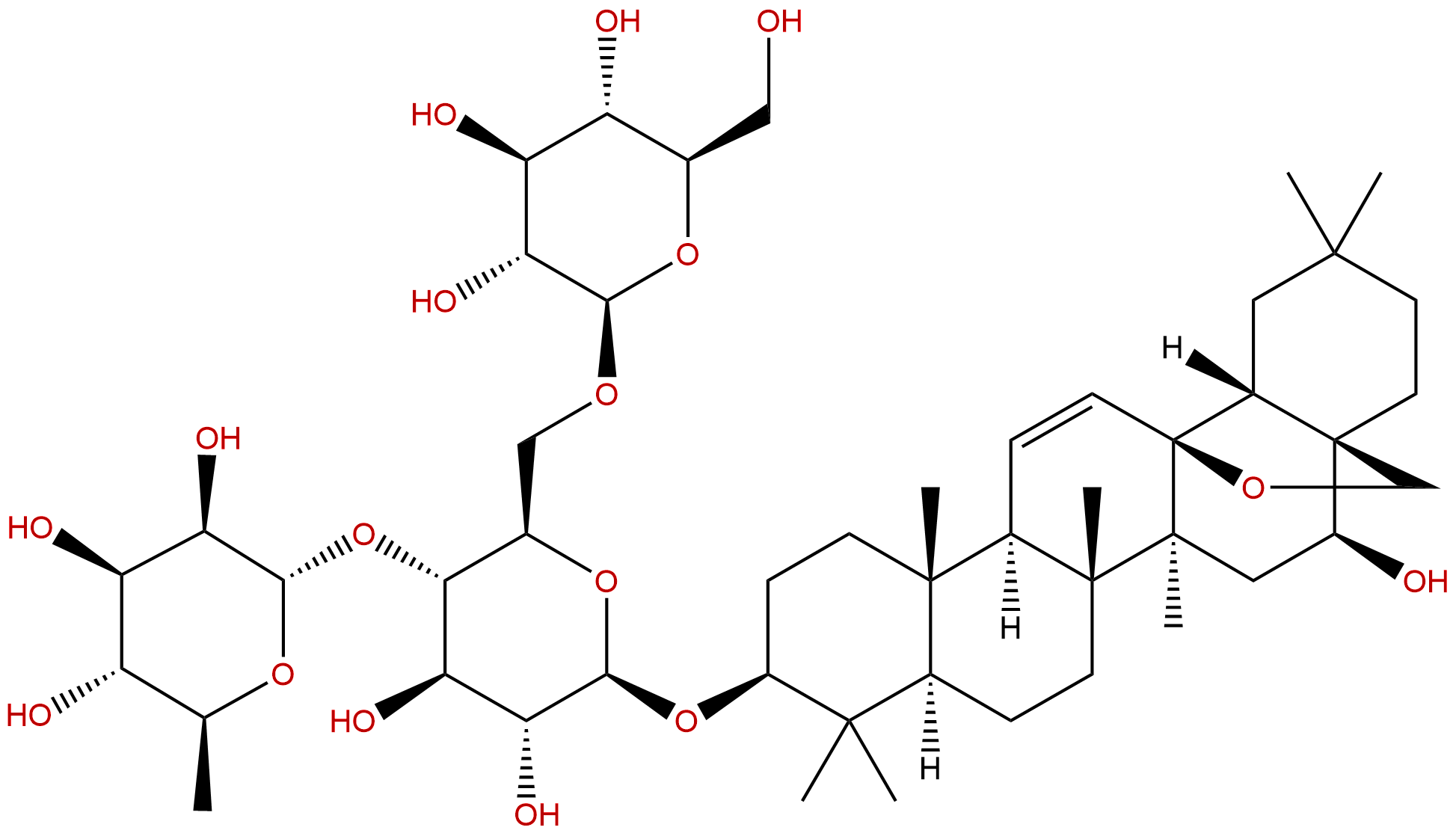


Product name: Saikosaponin C
Synonym name:
Catalogue No.: BP1241
Cas No.: 20736-08-7
Formula: C48H78O17
Mol Weight: 927.135
Botanical Source: Bupleurum falcatum
Physical Description: Powder
Type of Compound: Triterpenoids
Purity: 95%~99%
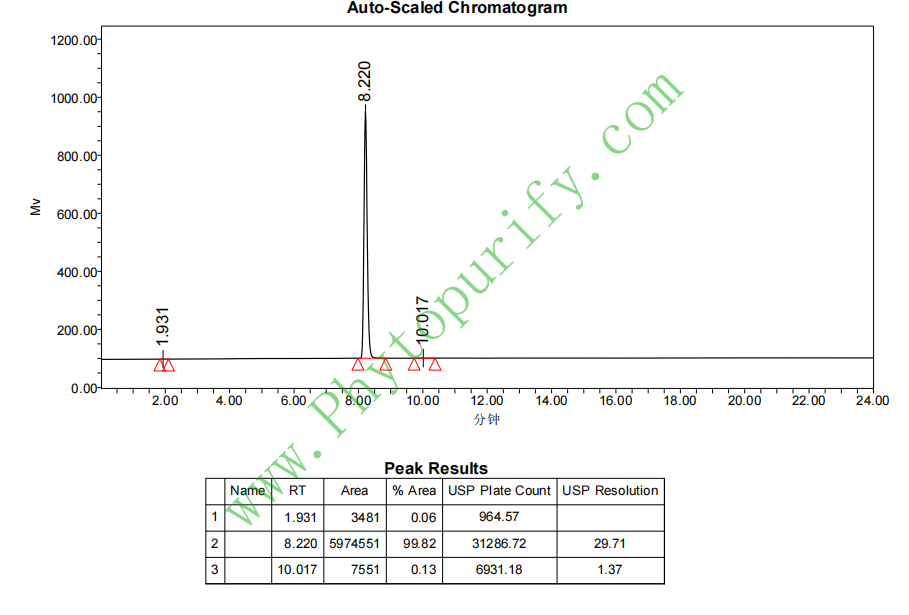
Analysis Method: HPLC-DAD or/and HPLC-ELSD
Identification Method: Mass, NMR
Packing: Brown vial or HDPE plastic bottle
Storage: Store in a well closed container, protected from air and light. Put into refrigerate or freeze for long term storage.
Whenever possible, you should prepare and use solutions on the same day. However, if you need to make up stock solutions in advance, we recommend that you store the solution as aliquots in tightly sealed vials at -20℃. Generally, these will be useable for up to two weeks.
The product could be supplied from milligrams to grams, up to kilograms
Inquire for bulk scale.
Descriptions:
Saikosaponin C (SSC) is one of the saikosaponins that are consisted in a Chinese herb, Radix Bupleuri, it yields a potent effect on inducing human umbilical vein endothelial cells (HUVECs) viability and growth, also induces endothelial cells migration and capillary tube formation. [1]
Saikosaponin C can inhibit lipopolysaccharide-induced apoptosis by suppressing caspase-3 activation and subsequent degradation of focal adhesion kinase in human umbilical vein endothelial cells.[2]
Saikosaponin C seems to have beneficial effects on cellular tau function, it accelerates nerve growth factor (NGF)-mediated neurite outgrowth and increases the assembly of microtubules (MT) and synaptic marker proteins such as synaptophysin and PSD-95, suggests SSc might be a novel therapeutic tool for treating human AD and other neurodegenerative diseases. [3]
Saikosaponin C can cure liver disease.[4]
References:
[1] Shyu K G, Tsai S C, Wang B W, et al. Life Sci, 2004, 76(7):813-26.
[2] Lee T H, Chang J, Kim B M. Biochem Bioph Res Co, 2014, 445(3):615-21.
[3] Tae Ho Lee ?, Sung Ha Park ?, You M H, et al. J Neurochem, 2015, 136(6):1232-45.
[4] Chen Y C, Wang H M, Niu Q X, et al. Molecules, 2016, 21(2):153.
[5] Wang X D, Zhang Z W, Sun X M, et al. J Pharm Practice, 2001, 19(05):298-300.
HPLC of Saikosaponin C
Storage conditions:Short-term storage at 2~8℃, long-term storage at -20 ~ -80℃
266.9100
2.9002
2.9005
.0287
.6076
1.1105
Low
73.1988
7.6034
No
No
No
No
No
No
0.0
Yes
No
Yes
Yes
Saikosaponin C (SS-C), CAS number 20736-8-7, is an oleane type triterpenoid saponin with significant biological activity isolated from the traditional Chinese medicine Bupleurum chinense DC. or Bupleurum scorzonerifolium Willd. As one of the core pharmacological substances for Chaihu to achieve the effects of "harmonizing Shaoyang, soothing liver and relieving depression", Chaihu saponin C has long been of great concern. Modern pharmacological research constantly reveals its extensive pharmacological activities, including anti-inflammatory, immune regulatory, antiviral, antidepressant, and promoting angiogenesis effects. Of particular note is that saikosaponin C has been identified as an orally active matrix metalloproteinase-2 (MMP-2) inducer, which can demonstrate potential therapeutic value in ischemic tissue repair by promoting endothelial cell survival, proliferation, migration, and capillary formation. Meanwhile, its role in inhibiting early stages of hepatitis C virus (HCV) infection and its ability to exert antidepressant effects through multi-target regulation have further expanded its application prospects. This article aims to systematically review the chemical structure, plant origin, pharmacological activity, mechanism of action, pharmacological evaluation, and clinical application prospects of saikosaponin C, in order to provide comprehensive scientific references for the in-depth research and development of this natural product.
Chaihu saponin C belongs to the oleanane type pentacyclic triterpenoid saponin, with a molecular formula of C48H78O17 and a molecular weight of 927.1350. Its basic skeleton consists of hydrophobic aglycones (saikosaponin F) and hydrophilic sugar chains. The sugar chain is connected to the C-3 position of the glycoside through glycosidic bonds, usually composed of one molecule of glucose, one molecule of fucose, and one molecule of rhamnose. This unique glycosylation pattern is a key feature that distinguishes it from other saikosaponins (such as saikosaponin A and D), and deeply affects its physicochemical properties and biological activity.
From the analysis of parameters related to drug properties, the lipid water partition coefficient (LogP) of saikosaponin C is 2.9002, indicating that it has a certain degree of lipophilicity, but not high lipid solubility. Its topological polar surface area (TPSA) is as high as 266.9100 Å ², which is mainly attributed to the abundant hydroxyl and sugar chain structures in the molecule, leading to its high polarity. The water solubility data is 0.0287, which belongs to slightly soluble or poorly soluble in water, consistent with the amphiphilic characteristics of its saponin compounds, and may form micelles in solution. The higher TPSA and molecular weight (>500) limit its ability to passively diffuse through biological membranes (such as the blood-brain barrier), and the predicted blood-brain barrier permeability is "low", which poses a challenge to its efficacy in the central nervous system. However, its hERG inhibition risk is "no", and the Ames test result is 0.0 (negative), indicating a low risk of cardiac toxicity and genetic toxicity, providing favorable early data for its safety evaluation.
Chaihu saponin C mainly comes from the dried roots of various plants in the Bupleurum genus of the Umbelliferae family. The legal source included in the Chinese Pharmacopoeia is the dried roots of Bupleurum chinense DC. or Bupleurum scorzonerifolium Willd. Its content is significantly affected by factors such as species, place of origin, harvest season, and processing methods. Generally speaking, the content of saikosaponin C in the total saponins of Chaihu is lower than that of saikosaponin A and D. However, its specific biological activity makes it an important indicator component for quality control and research and development.
The extraction of saikosaponin C usually follows the general extraction process for saponin components. The conventional methods include:
1. Solvent extraction method The most commonly used methods are ethanol or methanol reflux extraction or ultrasound assisted extraction. High concentration alcohols (such as 70% -95%) can effectively extract saponins. The crude extract was obtained by vacuum concentration of the extraction solution.
2. Purification and Separation The crude extract is usually defatted with petroleum ether or ethyl acetate, and then repeatedly extracted with water saturated n-butanol to obtain total saponins of Bupleurum chinense. Further separation and purification rely on various chromatographic techniques, including macroporous adsorption resin chromatography (such as D101, AB-8 type), silica gel column chromatography, reverse phase silica gel column chromatography (such as ODS), as well as high-performance liquid chromatography (HPLC) and preparative high-performance liquid chromatography (pre HPLC). In recent years, liquid-liquid distribution chromatography techniques such as high-speed countercurrent chromatography (HSCCC) have been increasingly widely used in the separation of saponin monomers due to their high recovery rate and avoidance of irreversible adsorption.
3. appraisal The isolated monomer compounds were structurally confirmed by spectroscopic methods such as nuclear magnetic resonance (NMR, including 1H-NMR, 13C-NMR, 2D-NMR), mass spectrometry (MS), and infrared spectroscopy (IR), and compared with known standards or literature data.
Chaihu saponin C exhibits diverse pharmacological activities, mainly covering the following aspects:
Promoting angiogenesis and tissue repair function This is one of the most highly regarded activities of saikosaponin C. Research has shown that it has oral activity and can significantly induce the expression and activation of MMP-2 in endothelial cells. MMP-2 opens up pathways for endothelial cell migration and neovascularization by degrading the extracellular matrix. At the cellular level, saikosaponin C can promote the proliferation and migration of human umbilical vein endothelial cells (HUVECs), and induce their formation into tubular structures, simulating the process of capillary formation in vivo. In animal models, it has shown the potential to promote collateral circulation establishment, improve blood supply, and reduce tissue damage in ischemic tissue diseases such as lower limb ischemia and myocardial infarction. In addition, in chronic kidney disease models, its pro angiogenic effect may help improve the sparsity of capillaries around renal tubules and delay the progression of fibrosis.
Antiviral effect Chaihu saponin C has an inhibitory effect on hepatitis C virus (HCV) infection, mainly targeting the early stages of viral infection. It may interfere with the attachment, endocytosis, or membrane fusion processes of viral particles, preventing the virus from entering host cells. This provides natural lead compounds for the development of novel anti HCV drugs.
Antidepressant and neuroprotective effects As a classic liver soothing and depression relieving medicine, the antidepressant effect of Chaihu's active ingredients has been validated by modern research. Chaihu saponin C exhibits antidepressant like behavioral effects in various animal models of depression, such as chronic unpredictable mild stress models, forced swimming experiments, and tail suspension experiments. Its function is not limited to a single target, but involves multiple levels such as neurotransmitter system regulation, neurotrophic factor support, and improvement of neural plasticity.
Anti inflammatory and immune regulatory effects As a common saponin compound, saikosaponin C also exhibits anti-inflammatory activity. It can inhibit the excessive production of pro-inflammatory cytokines (such as TNF - α, IL-6, IL-1 β) in macrophages induced by stimuli such as lipopolysaccharide (LPS), and its mechanism is related to the inhibition of inflammatory signaling pathways such as NF - κ B. This is related to its potential application in the treatment of inflammation related diseases such as hepatitis and nephritis.
Other activities The study also suggests that saikosaponin C may have activities such as hepatoprotective and anti-tumor effects, but related research is still in its preliminary stage and further exploration is needed.
The multiple pharmacological activities of saikosaponin C stem from its regulation of complex molecular networks, and its mechanism of action involves multiple signaling pathways and molecular targets.
Mechanism of promoting angiogenesis The core mechanism is to induce the expression of MMP-2 in endothelial cells. Research has shown that saikosaponin C may upregulate the transcription and activity of MMP-2 by activating the phosphatidylinositol 3-kinase/protein kinase B (PI3K/Akt) signaling pathway and the mitogen activated protein kinase (MAPK) pathway (such as ERK1/2). In addition, it may also affect the expression of vascular endothelial growth factor (VEGF) and its receptors, synergistically promoting angiogenesis.
Multi target mechanism of antidepressant effect The antidepressant effect of saikosaponin C reflects the characteristics of multi-target synergy:
Anti HCV mechanism The specific molecular targets of the virus have not been fully elucidated, but research suggests that it may act on the interaction between viral envelope glycoproteins and host cell surface receptors (such as CD81, SR-BI), or interfere with the virus's endocytosis and endosome acidification processes, thereby blocking virus entry.
Despite the rich pharmacological activity of saikosaponin C, its pharmacological development still faces some challenges, and pharmacokinetic studies are relatively limited.
Overall, saikosaponin C is a lead compound with clear multi-target activity, but its pharmacological properties (especially solubility, permeability, and pharmacokinetic properties) need to be optimized. Future research needs to strengthen the systematic study of its in vivo ADME (absorption, distribution, metabolism, excretion) process, and explore the improvement of its drug properties through prodrug strategies, nano formulations (such as liposomes, polymer micelles), or phospholipid complexes.
Based on its unique pharmacological effects, saikosaponin C has broad development prospects in multiple disease fields:
Future research directions should focus on:
* In depth mechanism exploration Using chemical biology methods such as affinity fishing, molecular docking, and gene editing techniques to more accurately identify its direct target proteins.
* structural optimization Based on structure-activity relationship research, structural modifications are made to its sugar chains or glycosides in order to enhance activity, improve pharmacokinetic properties (such as oral bioavailability and blood-brain barrier permeability), and reduce potential toxicity.
* Development of a new drug delivery system Actively developing nano drug delivery systems suitable for saponin compounds, targeting delivery to lesion sites such as ischemic tissues and the brain.
* Preclinical and clinical research Conduct systematic pharmacological, pharmacokinetic, and toxicological studies to provide solid data for its clinical trial application. Explore its value in combination therapy.
Chaihu saponin C is a highly valuable natural active compound discovered from the traditional Chinese medicine Chaihu. It is not only an important material basis for the "soothing the liver and relieving depression" effect of Chaihu, but also a focus of modern new drug research and development due to its unique multiple pharmacological activities such as promoting angiogenesis, antidepressant, and antiviral. Its potential as an orally active MMP-2 inducer in ischemic diseases and its mechanism of exerting antidepressant effects through multi-target regulation are particularly noteworthy. Despite challenges in drug formulation such as solubility, permeability, and pharmacokinetics, these obstacles are expected to be gradually overcome with the in-depth analysis of its mechanism of action, the application of structural optimization strategies, and the development of new drug delivery technologies. The research of saikosaponin C fully reflects the feasibility and great value of seeking modern disease treatment strategies from traditional Chinese medicine. Its future transformation research is expected to bring new treatment options for cardiovascular and cerebrovascular diseases, mental nervous system diseases, viral infectious diseases and other fields.
