
| Catalog No | Package | Original Price | Price | Inventory | Quantity | Operating |
|---|---|---|---|---|---|---|
| BP0707-5mg | 5mg | $420.00 | Sign in |
|


Product name: Hederacolchiside E
Synonym name:
Catalogue No.: BP0707
Cas No.: 33783-82-3
Formula: C65H106O30
Mol Weight: 1367.53
Botanical Source:
Type of Compound:
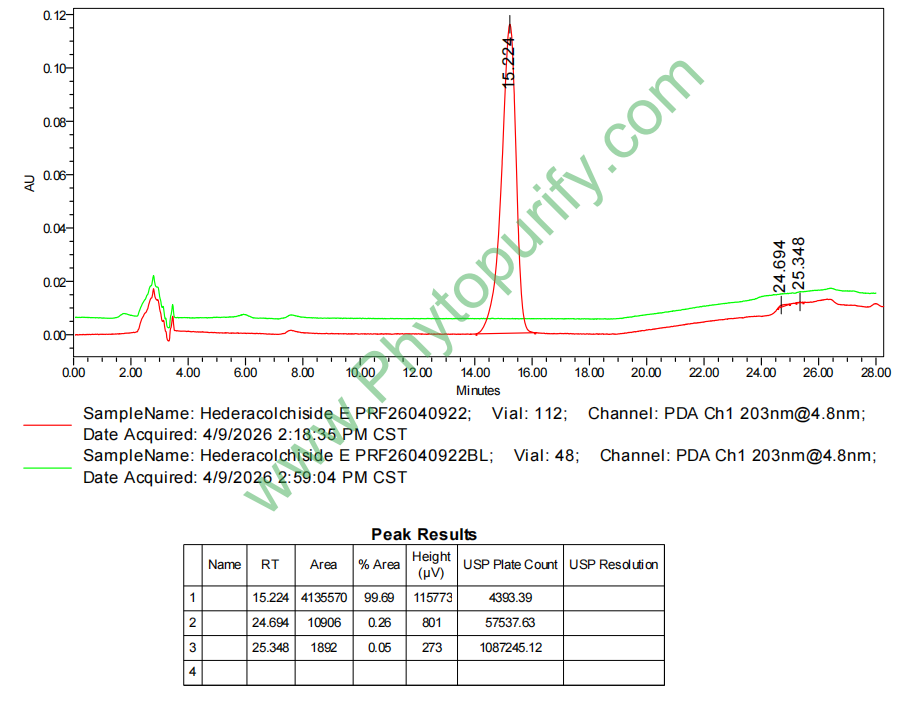
Purity: 95%~99%
Analysis Method: HPLC-DAD or/and HPLC-ELSD
Identification Method: Mass, NMR
Packing: Brown vial or HDPE plastic bottle
Storage: Store in a well closed container, protected from air and light. Put into refrigerate or freeze for long term storage.
Whenever possible, you should prepare and use solutions on the same day. However, if you need to make up stock solutions in advance, we recommend that you store the solution as aliquots in tightly sealed vials at -20℃. Generally, these will be useable for up to two weeks.
The product could be supplied from milligrams to grams
Inquire for bulk scale.
For Reference Standard and R&D, Not for Human Use Directly.
HPLC of Hederacolchiside E
Storage conditions:Short-term storage at 2~8℃, long-term storage at -20 ~ -80℃
471.7400
1.7874
1.7872
.4423
.4670
.1630
Low
67.0958
7.6675
Yes
No
No
No
No
No
0.3
Yes
No
No
No
Natural products, as an important source of drug development, play a crucial role in the development of anti-tumor drugs due to their structural diversity and wide range of biological activities. Hederacolicin E is a triterpenoid saponin compound isolated from Hedera helix, which has received widespread attention in recent years due to its significant anticancer activity. In particular, in the treatment research of breast cancer, Ivy saponin E shows the ability of multi target regulation, involving key pathways such as cell energy metabolism, apoptosis regulation, signal transduction and drug tolerance, showing potential clinical application value.
This article will systematically review the chemical structure, physical and chemical properties, plant sources and extraction methods of Ivy saponin E, focus on its pharmacological activity and mechanism of action, conduct comprehensive evaluation in combination with pharmaceutical parameters, and explore its application prospects and development direction in the treatment of breast cancer, in order to provide theoretical basis and research guidance for the drug development of this natural product.
Ge Ye Ivy Saponin E (CAS No. 33783-82-3) belongs to the triterpenoid saponin class, with a complex molecular formula and a molecular weight of 1367.5330. Its structural core is a pentacyclic triterpenoid skeleton, connecting multiple sugar residues to form a typical saponin structure. This structure endows it with surface activity and biofilm penetration ability, while the diversity of sugar groups enhances its water solubility and targeting ability.
In terms of physical and chemical properties, the LogP value of ivy leaf saponin E is 1.7874, indicating its moderate lipid solubility, which is beneficial for membrane penetration and in vivo distribution. The extremely high topological polar surface area (TPSA) reaches 471.74 Å ², reflecting the strong polarity of the molecule, which may limit its passive diffusion through the cell membrane and affect its oral bioavailability. The water solubility is 0.4423, indicating that it has a certain degree of water solubility and is convenient for formulation development. The low permeability of the blood-brain barrier suggests that it is difficult for it to enter the central nervous system, reducing the risk of central toxicity. The hERG channel inhibition test was negative, indicating a low risk of cardiac toxicity. The Ames test score is 0.3, indicating a low risk of genotoxicity and meeting drug safety requirements.
Overall, saponins E from ivy have both polarity and hydrophobicity, making them suitable for optimizing their pharmacokinetic properties through structural modification or nanocarrier technology.
The main source of ivy saponin E is Hedera helix L., a plant belonging to the ivy genus. This plant is widely distributed in Europe and some parts of Asia and has traditionally been used as an adjuvant therapy for respiratory diseases. As one of its main active ingredients, ivy saponin E exists in leaves and stems.
The extraction method usually uses organic solvent extraction combined with column chromatography separation technology. The specific steps include:
In recent years, supercritical CO ₂ extraction and membrane separation techniques have also been attempted for the extraction of saponins E from ivy leaves to improve purity and environmental friendliness.
Ivy vine saponin E has shown significant anti proliferation and pro apoptosis activities in many tumor cell lines, especially in breast cancer research. In vitro experiments show that this compound can effectively inhibit the proliferation of breast cancer cell lines (such as MCF-7, MDA-MB-231), and induce cell cycle arrest and apoptosis.
Ivy vine saponin E plays an anti breast cancer role through a variety of mechanisms:
In addition to anti-tumor effects, ivy leaf saponin E also exhibits biological activities such as anti-inflammatory and antioxidant effects, which may assist in tumor treatment by regulating the immune microenvironment.
The molecular targets of Ivy saponin E on breast cancer are diverse, involving multiple key nodes such as cell metabolism, signal transduction, apoptosis regulation and drug efflux.
As a cellular energy sensor, AMPK regulates cellular metabolic balance. Glycoside E from ivy leaf activates AMPK, promotes energy metabolism disorders, induces metabolic stress in cancer cells, and inhibits their proliferation.
BCL2 is an anti apoptotic protein, and ivy leaf saponin E downregulates BCL2 expression, promotes changes in mitochondrial membrane permeability, and activates the cell apoptosis program.
The STAT3 signaling pathway plays a crucial role in tumor cell proliferation and immune escape. Glycoside E from ivy leaf inhibits STAT3 phosphorylation, blocks its transcriptional activity, and reduces tumor cell survival rate.
Ivy vine saponin E may affect the hormone dependent growth of breast cancer cells by regulating the expression of ESR2, and provide an auxiliary role in hormone therapy.
These two ATP binding cassette transporters are the main mediators of multidrug resistance in tumor cells. Glycoside E from ivy leaf inhibits its activity, enhances the intracellular concentration of chemotherapy drugs, and improves the therapeutic effect.
To sum up, Ivy saponin E exerts its comprehensive anti breast cancer effect through multiple targets and pathways.
The pharmacological evaluation of Ge Ye Ivy saponin E shows that it has certain development potential, but there are also challenges.
At present, the in vivo pharmacokinetic data of saponins E from ivy leaf are limited. Preliminary animal experiments have shown that its oral bioavailability is low, the plasma half-life is moderate, and it is mainly cleared through liver metabolism. In the future, systematic ADME (absorption, distribution, metabolism, excretion) research needs to be conducted, combined with drug carrier technology to enhance its in vivo stability and targeting.
Glycoside E from ivy leaves showed low toxicity both in vitro and in vivo, with no significant acute or cardiac toxicity observed, laying the foundation for further clinical development.
As a multi target anti breast cancer natural product, Ivy vine saponin E has broad clinical application potential.
As a natural triterpene saponin with unique structure and significant biological activity, Ivy vine saponin E shows the potential of multi target regulation in the treatment of breast cancer. Its excellent safety and diverse mechanisms of action make it an important candidate for the development of natural anti-cancer drugs. However, the pharmacokinetic limitations caused by high molecular weight and polarity still need to be overcome through drug design and innovative drug delivery systems. In the future, through in-depth pharmacological mechanism research and clinical transformation exploration, Ivy vine saponin E is expected to become an innovative drug in the field of breast cancer treatment, bringing new treatment options to patients.
