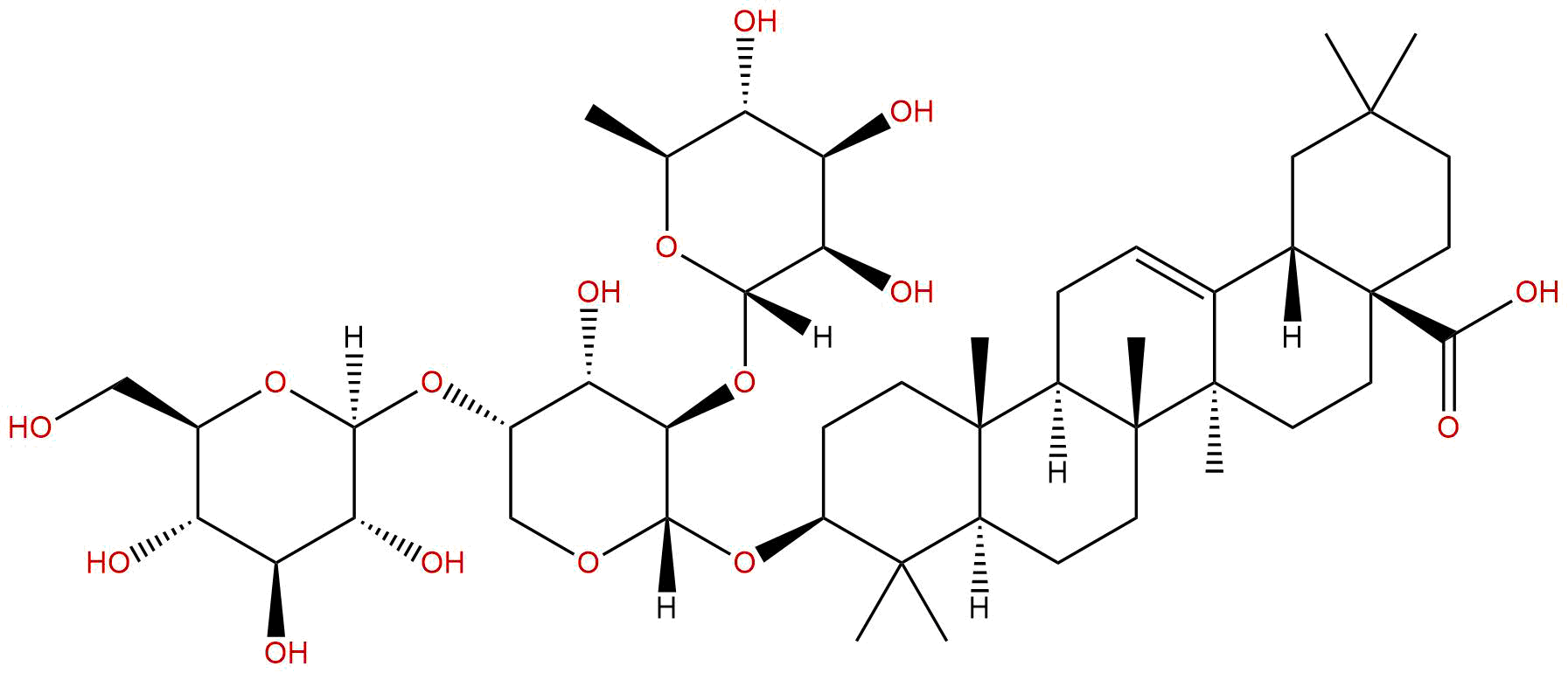


Synonym name: Raddeanoside R13
Catalogue No.: BP0706
Cas No.: 106577-39-3
Formula: C47H76O16
Mol Weight: 897.109
Botanical Source: Hedera colchica and Thinouia coriacea
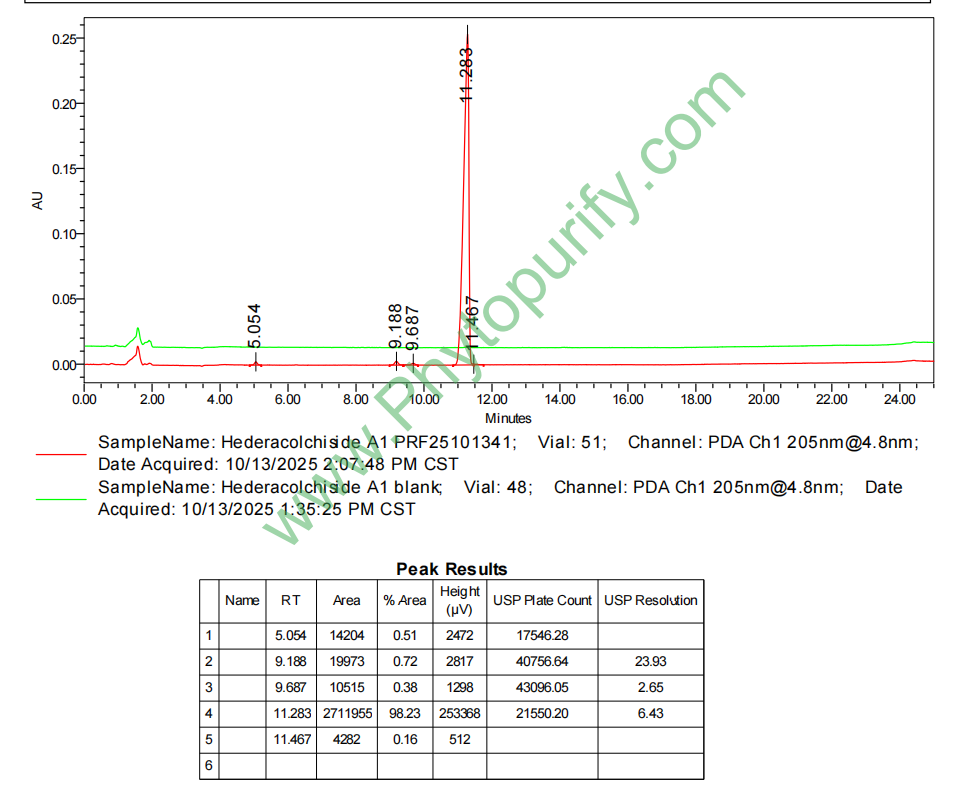
Purity: 95%~99%
Analysis Method: HPLC-DAD or/and HPLC-ELSD
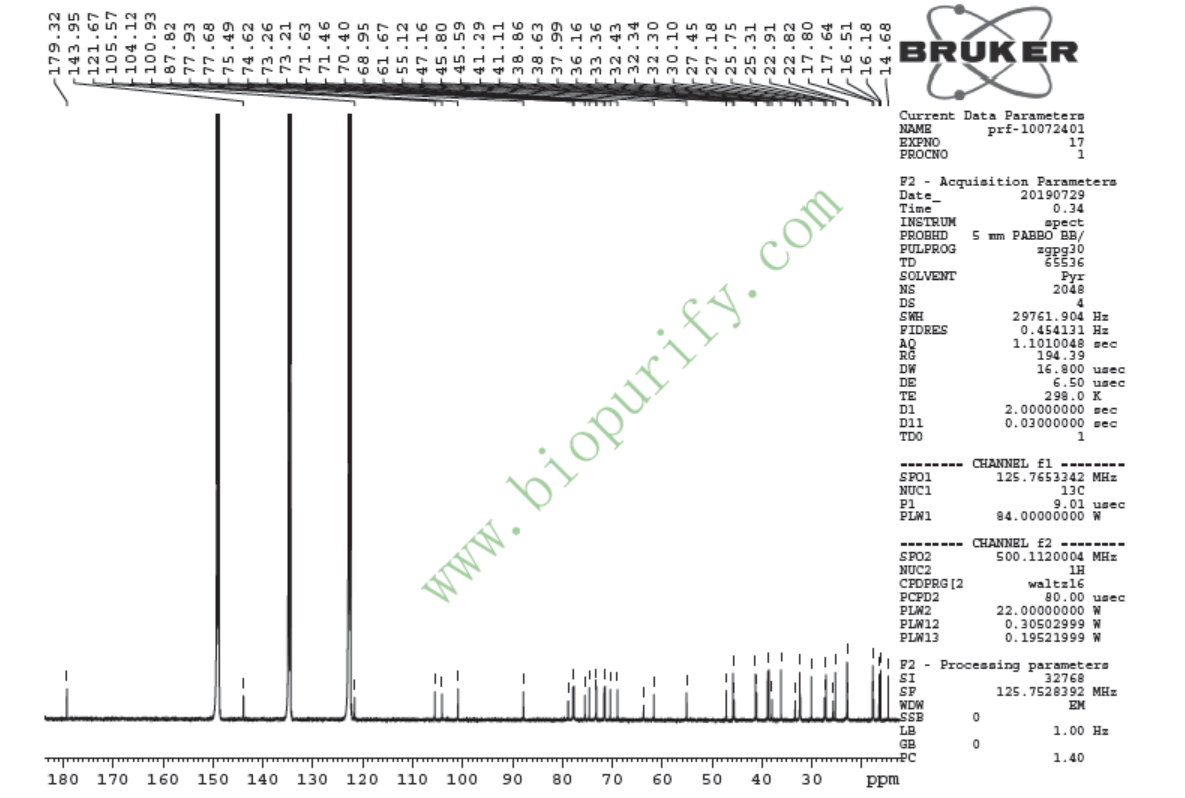
Identification Method: Mass, NMR
Packing: Brown vial or HDPE plastic bottle
Can be supplied from milligrams to grams.
For Reference Standard and R&D, Not for Human Use Directly.
Inquire for bulk scale.
NMR of Hederacolchiside A1
HPLC of Hederacolchiside A1
Storage conditions:Short-term storage at 2~8℃, long-term storage at -20 ~ -80℃
Hederacolchiside A1 (CAS number: 106577-39-3) is a traditional Chinese medicine derived from the white headed Weng (scientific name:)Pulsatilla chinensis)Natural triterpenoid saponins. In recent years, with the deepening development of natural product pharmacology, Black Sea Ivy Saponin A1 has received widespread attention due to its significant anti-tumor and antiparasitic activities. It induces tumor cell apoptosis and inhibits tumor cell proliferation by regulating the PI3K/Akt/mTOR signaling pathway, while exhibiting good inhibitory effects on parasites such as schistosomiasis. As a malignant tumor with high incidence and poor prognosis worldwide, liver cancer is limited by existing treatment methods such as drug resistance and toxic side effects. Natural products are an important source of new anti-tumor drugs, and the study of Black Sea Ivy Saponin A1 provides new ideas for the treatment of liver cancer.
This article reviews the chemical structure and physicochemical properties, plant sources, and extraction methods of Black Sea Ivy Saponin A1. It systematically summarizes its pharmacological activity and mechanism of action, with a focus on exploring its molecular targets and drug evaluation in the treatment of liver cancer. Finally, it looks forward to its clinical application prospects and future research directions, aiming to provide theoretical basis and reference for the drug development and clinical translation of this natural product.
Black sea ivy saponin A1 is a complex triterpenoid saponin with a molecular formula of C47H74O17 and a molecular weight of 897.1090. Its structure contains a triterpenoid skeleton that connects multiple sugar residues, endowing it with high polarity and biological activity. The glycosidic bonds and hydroxyl groups in the molecular structure have a significant impact on its water solubility and biocompatibility.
In terms of physical and chemical properties, the LogP value of Black Sea Ivy Saponin A1 is about 2.90, indicating that it has moderate lipid solubility and is conducive to membrane penetration. Its polar surface area (TPSA) is 254.52 Å ², and a higher TPSA value suggests strong polarity and hydrogen bonding ability, which may limit its ability to pass through the blood-brain barrier (actual blood-brain barrier permeability is low). The water solubility is 0.0768 mg/mL, indicating that its solubility in water is limited, but it still has some solubility and is suitable for in vivo distribution. The hERG channel inhibition experiment showed a negative result, indicating a low risk of cardiac toxicity. The Ames test result is 0.0, indicating no significant mutagenicity and good safety.
Black Sea Ivy Saponin A1 is mainly extracted from the roots of Paeonia lactiflora. Bai Tou Weng is a plant of the Ranunculaceae family, widely distributed in northern China and East Asia. In traditional Chinese medicine, its roots are commonly used as medicine, which has the effects of clearing heat, detoxifying, reducing swelling, and relieving pain.
During the extraction process, the dried roots of Paeonia lactiflora are usually extracted using an alcohol extraction method (such as 70% ethanol), followed by separation and purification through liquid-liquid distribution, column chromatography (silica gel, C18 reverse phase column), and high-performance liquid chromatography (HPLC) techniques. The purified Black Sea Ivy Saponin A1 can be structurally confirmed by mass spectrometry (MS), nuclear magnetic resonance (NMR) and other methods. In recent years, the application of new technologies such as ultrasound assisted extraction and microwave-assisted extraction has improved extraction efficiency and purity, and reduced production costs.
Black sea ivy saponin A1 exhibits significant anti proliferative effects in various tumor cell lines, especially in liver cancer cells (such as HepG2, Huh7) with strong cytotoxicity. In vitro experiments have shown that the compound can significantly inhibit the proliferation of liver cancer cells, induce cell cycle arrest, and promote cell apoptosis. Animal model studies further confirm its inhibitory effect on the growth of liver cancer tumors, with minimal toxic side effects.
Schistosomiasis is a tropical parasitic disease caused by parasites of the Schistosoma genus, posing a serious threat to public health and safety. Black sea ivy saponin A1 exhibits bactericidal effects on adult and larval schistosomiasis, and can affect the survival and reproductive ability of parasites. Both in vitro and in vivo experiments have shown that it can effectively reduce parasitic load, alleviate pathological damage caused by infection, and has potential value for the development of anti schistosomiasis drugs.
In addition to anti-tumor and antiparasitic activities, Black Sea Ivy Saponin A1 also exhibits certain anti-inflammatory, immunomodulatory, and antioxidant effects, which may synergistically promote its overall pharmacological performance.
The anti-tumor mechanism of Black Sea Ivy Saponin A1 is mainly achieved by regulating the PI3K/Akt/mTOR signaling pathway. This pathway plays a central role in cell proliferation, apoptosis, and metabolic regulation, and abnormal activation is common in various tumors, especially liver cancer.
The specific mechanism includes:
In addition, Black Sea Ivy Saponin A1 further inhibits the PI3K/Akt signaling pathway by regulating PIK3CA (the catalytic subunit of PI3K), achieving a comprehensive anti-tumor effect.
The molecular weight of Black Sea Ivy Saponin A1 is relatively high (897.1090), and its TPSA is also high (254.52 Å ²), indicating its strong polarity, which may affect oral bioavailability and cell membrane permeability. Its LogP value is about 2.9, indicating moderate lipid solubility, which is beneficial for intracellular distribution. However, its water solubility is low (0.0768 mg/mL), and its solubility in vivo is limited. It may need to be optimized through formulation to improve bioavailability.
The low permeability of the blood-brain barrier suggests its limited distribution in the central nervous system, reducing the potential risk of neurotoxicity. The hERG channel inhibition experiment was negative, indicating a low risk of cardiac toxicity. The Ames test results showed no mutagenicity and good safety.
In terms of pharmacokinetics, there is currently limited research on this compound. Preliminary data suggests that it is metabolically stable in vivo and mainly processed through the liver metabolic enzyme system. Further research on in vivo absorption, distribution, metabolism, and excretion (ADME) is needed in the future to clarify its pharmacokinetic characteristics and potential drug interactions.
Black sea ivy saponin A1, as a natural product with multiple targets and mechanisms, exhibits excellent anti-tumor and antiparasitic activities, especially in the field of liver cancer treatment with broad application prospects. It induces tumor cell apoptosis, inhibits proliferation and metastasis by regulating PI3K/Akt/mTOR and related signaling pathways, making up for the shortcomings of traditional chemotherapy drugs.
Future research should focus on the following aspects:
Black Sea Ivy Saponin A1, as a natural triterpenoid saponin derived from Paeonia lactiflora, exhibits significant pharmacological activity in the fields of anti-tumor and antiparasitic effects due to its unique chemical structure and multi-target regulatory ability. It achieves proliferation inhibition and apoptosis induction of liver cancer cells by regulating the PI3K/Akt/mTOR signaling pathway and related molecular targets, and has good safety and potential as a drug. Although there are still some challenges in pharmacokinetics and clinical application, with the deepening of research and technological progress, Black Sea Ivy Saponin A1 is expected to become an important candidate for the new generation of natural anti-tumor drugs, providing new strategies and choices for the treatment of diseases such as liver cancer and schistosomiasis. Future systematic research and clinical translation work will be key to driving its drug development.
