Introduction/Overview
Humulone, also known as alpha lupulic acid, is a characteristic secondary metabolite mainly present in the female inflorescence of hops (Humulus lupulus L.). As a representative of isoprene substituted triphenylphenol derivatives, it is not only a key contributor to the bitterness and flavor of beer, but also an increasingly hot topic in the field of natural product pharmacology research due to its extensive and significant biological activity. Traditionally, hops have been used for calming the nerves, antibacterial and anti-inflammatory purposes. However, modern pharmacological research has gradually revealed the potential value of its active ingredient, humulone, in various aspects such as anti-inflammatory, neural regulation, anti-tumor and bone protection. Especially its dual role as a selective cyclooxygenase-2 (COX-2) inhibitor and gamma aminobutyric acid type A (GABAA) receptor positive regulator provides a unique molecular basis for its application in inflammatory diseases, anxiety, insomnia, and cancer. This article aims to systematically review the chemical properties, plant sources, pharmacological activities, mechanisms of action, and medicinal properties of humulone, and to provide prospects for its future research and application.
Chemical structure and physicochemical properties
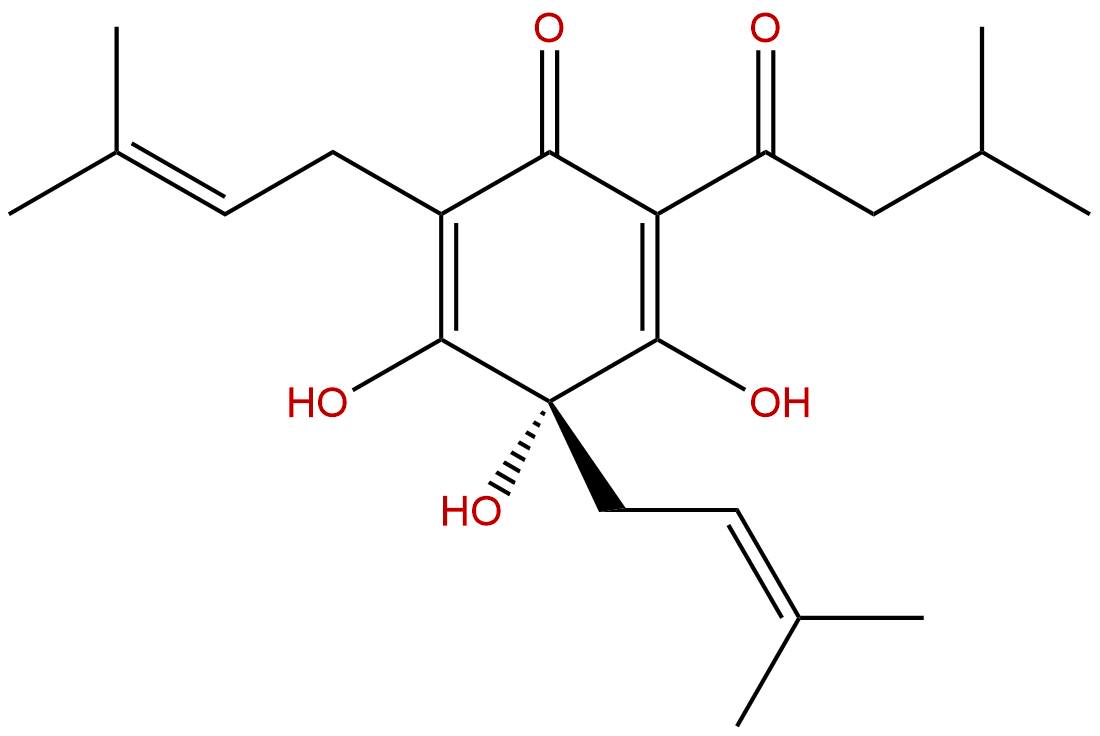
The chemical name of humulone is (6aS, 10aS) -3,5,6-trihydroxy-4,6a, 9,10a - tetramethyl-6,6a, 7,8,9,10,10a, 10b-octahydrobenzo [c] chromen-1-one, and its CAS number is 26472-41-3. Its molecular formula is C21H30O5 and its molecular weight is 362.4600.
Structurally, humulone belongs to the isoprenylated triphenylphenol derivative. Its core skeleton consists of a triphenylphenol ring (A ring) and a fused ring system (B, C rings) formed by side chain linking with isopentenyl groups. This unique structure gives it a β - trinone system (1,3-dicarbonyl structure), which is crucial for its antioxidant activity and chelating ability with metal ions. The molecule contains 5 hydrogen bond acceptors (3 hydroxyl groups, 2 carbonyl oxygen groups), 3 hydrogen bond donors, and a topological polar surface area (TPSA) of 86.1800 Å ². The calculated lipid water partition coefficient (LogP) is 4.15, indicating that humulone has moderate lipophilicity, which is beneficial for its penetration of cell membranes, but may also affect its water solubility and oral bioavailability. At room temperature, humulone is a light yellow to amber colored crystal or powder that is sensitive to light, heat, and oxygen. It is particularly prone to isomerization or degradation under alkaline conditions, converting into products such as isohumulone. This characteristic needs special attention in beer brewing and sample processing.
Plant sources and extraction methods
The main plant source of humulus lupulus ketone is the hops (Humulus lupulus L.) of the genus Humulus in the family Moraceae, which are particularly enriched in the glands of its female inflorescence (cobra gland). In hops, humulone, coumarin, and adhumulone together form the main components of alpha acids, with coumarin typically accounting for the highest proportion (about 35-70%) and being the core indicator determining hop quality and bitterness intensity.
The extraction of humulone from hops mainly relies on its lipophilicity. The traditional and commonly used methods in industry include:
1. Organic solvent extraction method Use solvents such as dichloromethane, ether, ethyl acetate, or ethanol for Soxhlet extraction or leaching. This method has high efficiency, but may extract a large amount of impurities such as wax and chlorophyll, requiring further purification steps (such as silica gel column chromatography, preparative high-performance liquid chromatography, etc.).
2. Supercritical carbon dioxide extraction method This is currently the most advanced and environmentally friendly extraction technology. By adjusting the pressure and temperature of supercritical CO2, alpha acids (including humulone) can be selectively extracted without solvent residue, resulting in high product purity and better retention of the natural configuration of thermosensitive components.
3. Alkaline aqueous solution extraction acidification precipitation method Using the weak acidity of alpha acid, it is extracted by converting it into a water-soluble salt using alkaline aqueous solutions (such as sodium hydroxide and sodium carbonate solutions), and then acidified to re precipitate the alpha acid. This method has a lower cost, but the steps are cumbersome, and the strong acid and alkali environment may lead to partial isomerization of humulone.
The crude product extracted usually requires multiple chromatographic separations and recrystallization to obtain high-purity humulone monomers for in-depth pharmacological and pharmacokinetic studies.
Pharmacological activity research
Numerous in vitro and in vivo studies have confirmed that humulone has diverse pharmacological activities, demonstrating the potential for multi-target action.
-
Anti inflammatory and analgesic activity Humulus ketone is a key component of the anti-inflammatory effect of hops. Research has shown that it can significantly inhibit the production of prostaglandin E2 (PGE2) and nitric oxide (NO) in macrophages and monocytes stimulated by lipopolysaccharide (LPS) or phorbol ester (PMA). Its anti-inflammatory activity is closely related to the selective inhibition of cyclooxygenase-2 (COX-2), while its inhibitory effect on structural COX-1 is weaker. This characteristic is similar to some nonsteroidal anti-inflammatory drugs (NSAIDs), but derived from natural products, it may have a better safety profile. In the rat paw swelling and other inflammatory models induced by carrageenan, humulone showed clear anti-inflammatory and analgesic effects.
-
Neuropsychiatric system activity Fencao ketone has a regulatory effect on the central nervous system. At low micromolar concentrations, it can act as a positive allosteric modulator of GABAA receptors, enhancing the chloride ion influx mediated by GABA (the main inhibitory neurotransmitter in the central nervous system), thereby producing sedative, anti anxiety, and sleep promoting effects. This provides a scientific basis for the traditional use of hops to treat anxiety and insomnia. In addition, its antioxidant and anti-inflammatory properties may also have a protective effect on oxidative stress and neuroinflammation in neurodegenerative diseases such as Alzheimer's disease.
-
Antitumor activity Humulone can inhibit proliferation and induce apoptosis in many cancer cell lines, including breast cancer, prostate cancer, colon cancer and leukemia cells. Its anti-tumor mechanism involves multiple aspects:Inducing cell apoptosis(By activating the caspase cascade reaction and regulating the Bcl-2/Bax protein ratio);Inhibit angiogenesis(Inhibiting endothelial cell lumen formation by downregulating the expression of vascular endothelial growth factor VEGF);Dual effects of antioxidant and pro oxidant Under specific conditions, it can produce reactive oxygen species, leading to oxidative damage to cancer cells; and Inhibition of survival promoting signaling pathways such as nuclear factor kappa B (NF - κ B)。
-
Inhibition of bone resorption and bone protection Fencao ketone has been identified as a bone resorption inhibitor. It can inhibit the differentiation and activity of osteoclasts, and reduce the formation of bone pits. The mechanism may be related to the inhibition of NF - κ B ligand (RANKL) - induced NF - κ B and MAPK signaling pathways, as well as the downregulation of key transcription factors in osteoclasts such as c-Fos and NFATc1. This suggests that humulone has potential value in the prevention and treatment of osteoporosis.
-
Antioxidant and antibacterial activity The β - trinone structure of humulone makes it an effective free radical scavenger and metal ion chelating agent, which can protect cells from oxidative damage. At the same time, it has a significant inhibitory effect on various Gram positive bacteria such as Staphylococcus aureus and Bacillus subtilis, which is both the reason why hops are traditionally used as preservatives and provides clues for their application in the field of anti infection.
Mechanism of action and molecular targets
The multiple pharmacological activities of humulone stem from its interactions with multiple molecular targets, forming a multi-target action network.
-
Selective cyclooxygenase-2 (COX-2) inhibition This is the core mechanism of its anti-inflammatory effect. COX-2 is a key enzyme induced in inflammatory response, responsible for catalyzing the production of prostaglandin inflammatory mediators from arachidonic acid. Fencao ketone competitively inhibits the catalytic activity of COX-2 by reversibly or irreversibly binding to its active site, thereby reducing the production of pro-inflammatory mediators such as PGE2. Its selectivity may stem from the unique fit between its molecular structure and the COX-2 active cavity.
-
GABAA receptor positive allosteric regulation Fencao ketone can bind to allosteric sites on GABAA receptors that are different from benzodiazepines and barbiturates, enhancing the binding affinity between GABA and receptors or increasing the frequency/duration of chloride channel opening after GABA activation, thereby amplifying central inhibitory signals and producing sedative and anti anxiety effects.
-
Regulating the NF - κ B signaling pathway NF - κ B is a core transcription factor that regulates inflammation, cell survival, and proliferation. Fencao ketone can inhibit the activity of I κ B kinase (IKK), prevent the phosphorylation and degradation of I κ B, thereby inhibiting the nuclear translocation of NF - κ B and the transcription of downstream target genes (such as COX-2, VEGF, cytokines, etc.), which is crucial in its anti-inflammatory, anti angiogenic, and apoptosis inducing effects.
-
Inducing the generation of reactive oxygen species (ROS) and mitochondrial pathway apoptosis In tumor cells, humulone may cause excessive accumulation of ROS by interfering with the mitochondrial electron transport chain or inhibiting antioxidant enzymes, leading to a decrease in mitochondrial membrane potential, release of cytochrome c, and activation of caspase-9 and caspase-3, initiating the intrinsic apoptotic pathway.
-
Inhibiting the RANKL signaling pathway In osteoclasts, humulone inhibits the downstream NF - κ B, MAPK (ERK, JNK, p38), and AKT pathways by interfering with the TRAF6 mediated signal transduction triggered by the binding of RANKL and its receptor RANK, ultimately suppressing the expression of the key osteoclast differentiation factor NFATc1 and inhibiting bone resorption.
Evaluation of drug properties and pharmacokinetics
Based on its physicochemical properties and preliminary biological data, a preliminary evaluation of the pharmacological properties of humulone is conducted
-
Absorption, distribution, metabolism, excretion (ADME)The moderate lipophilicity (LogP~4.15) of humulone is beneficial for its gastrointestinal absorption, but absolute oral bioavailability data is limited. Its larger molecular weight and more hydrogen bonds may limit its passive diffusion efficiency. Preliminary pharmacokinetic studies (mainly in animal models) have shown that it is absorbed quickly after oral administration, but the blood drug concentration is low, which may be related to its first pass metabolism and extensive tissue distribution. It can cross the blood-brain barrier, but its permeability is predicted to be low (BBB: Low), which seems contradictory to its central sedative effect and may suggest that its active metabolites or low concentrations can take effect. Fencao ketone is mainly metabolized by the liver cytochrome P450 enzyme system (such as CYP1A2, CYP3A4) in the body, undergoing reactions such as hydroxylation, demethylation, and glucuronidation, and ultimately excreted through the kidneys or bile. Its pharmacokinetic characteristics require more systematic human studies to clarify.
-
Preliminary evaluation of safety Existing data indicates that humulone exhibits good safety at pharmacological concentrations.Hepatotoxicity Predicted as low,cardiotoxicity and HERG channel inhibition The risk is no, which provides a positive signal for its cardiovascular safety. However, it Ames test The result is unknown, and the potential genetic toxicity needs further evaluation. As COX-2 inhibitors, long-term or high-dose use still requires attention to their potential effects on the gastrointestinal tract and kidneys, although their natural sources and selectivity may bring advantages.
-
Drug Challenge:
- chemical stability Sensitivity to light, heat, and pH poses challenges for formulation development and storage.
- Poor water solubility: Affects its dosage form design and bioavailability.
- Multi target characteristics Both advantages (pleiotropy) and potential unexpected side effects require precise disease model validation.
- Lack of systematic preclinical and clinical pharmacokinetic/toxicological data This is the biggest bottleneck in pushing it towards clinical application.
Clinical application prospects and prospects
The multiple pharmacological activities of humulone have demonstrated its broad application prospects in multiple therapeutic fields, but at the same time, it also faces many challenges from laboratory to clinical translation.
Potential application directions:
1. Chronic inflammatory diseases As a natural source selective COX-2 inhibitor, it can be used for the treatment or adjuvant therapy of diseases such as osteoarthritis and rheumatoid arthritis, and may have better gastrointestinal safety than traditional NSAIDs.
2. Anxiety and sleep disorders Based on its GABAA receptor regulatory effect, it can be developed into a novel natural sleep aid or anti anxiety functional food or plant medicine, especially suitable for patients who are intolerant to the side effects of benzodiazepines.
3. Cancer adjuvant therapy and chemoprevention Its anti proliferative, pro apoptotic, and anti angiogenic effects make it possible to use it as an adjuvant in combination with conventional chemotherapy/radiotherapy to enhance efficacy and reduce side effects. It is also worth exploring its role in preventing cancer (chemoprevention).
4. osteoporosis The characteristic of inhibiting osteoclast activity provides new ideas for the development of natural medicines or dietary supplements for the prevention or treatment of osteoporosis.
5. Functional foods and cosmetics With its antioxidant and antibacterial properties, it can be used to develop health foods and skincare products with anti-aging and anti-inflammatory effects.
Future research prospects:
1. Structural optimization and derivative development In response to its poor stability and low water solubility, chemical modifications (such as prodrugs, salts, or synthetic analogues) are used to improve its drug properties, while exploring the structure-activity relationship and searching for derivatives with higher activity and stronger selectivity.
2. Research on Delivery System By utilizing nanotechnology (such as liposomes, nanoparticles, micelles) or cyclodextrin inclusion techniques, the stability, water solubility, and targeting of humulone can be improved, enhancing its bioavailability and therapeutic efficacy.
3. In depth study on the mechanism of action Using proteomics, chemical proteomics and other techniques, comprehensively map the interaction protein network of humulone, discover its new molecular targets, and elucidate the precise mechanism of its multi-target synergistic effect.
4. Preclinical and clinical research of the system Strictly following drug development standards, complete comprehensive pharmacological, pharmacokinetic, and toxicological evaluations, especially long-term toxicity, reproductive toxicity, and carcinogenicity studies. On this basis, clinical trials will be conducted for specific indications (such as mild anxiety and inflammatory pain) to verify their safety and effectiveness.
5. Research on Compound Preparations Exploring the synergistic effects of humulone with other natural products or drugs (such as other hop ingredients, valerian, etc.), developing compound formulations, may achieve better therapeutic effects at lower doses.
Conclusion
Fencao ketone, as a natural compound derived from hops, exhibits significant pharmacological activities in multiple dimensions such as anti-inflammatory, neural regulation, anti-tumor, and bone protection due to its unique chemical structure. Its mechanism of action involves selective inhibition of COX-2, positive regulation of GABAA receptors, regulation of NF - κ B and other key signaling pathways, reflecting the complexity advantage of multi-target action of natural products. Despite facing challenges in terms of chemical stability, water solubility, and systemic pharmacokinetics, with the deepening development of modern medicinal chemistry, pharmacology, and molecular pharmacology, humulone and its derivatives are expected to transform from an ancient plant component into modern drugs or high-performance functional ingredients for treating inflammation related diseases, neurological and psychiatric disorders, osteoporosis, and even cancer through structural modification, development of novel delivery systems, and rigorous clinical research. Continuous and in-depth research on it not only helps to explore the scientific value of traditional medicinal plants, but also provides valuable natural molecular templates and ideas for the discovery of innovative drugs.