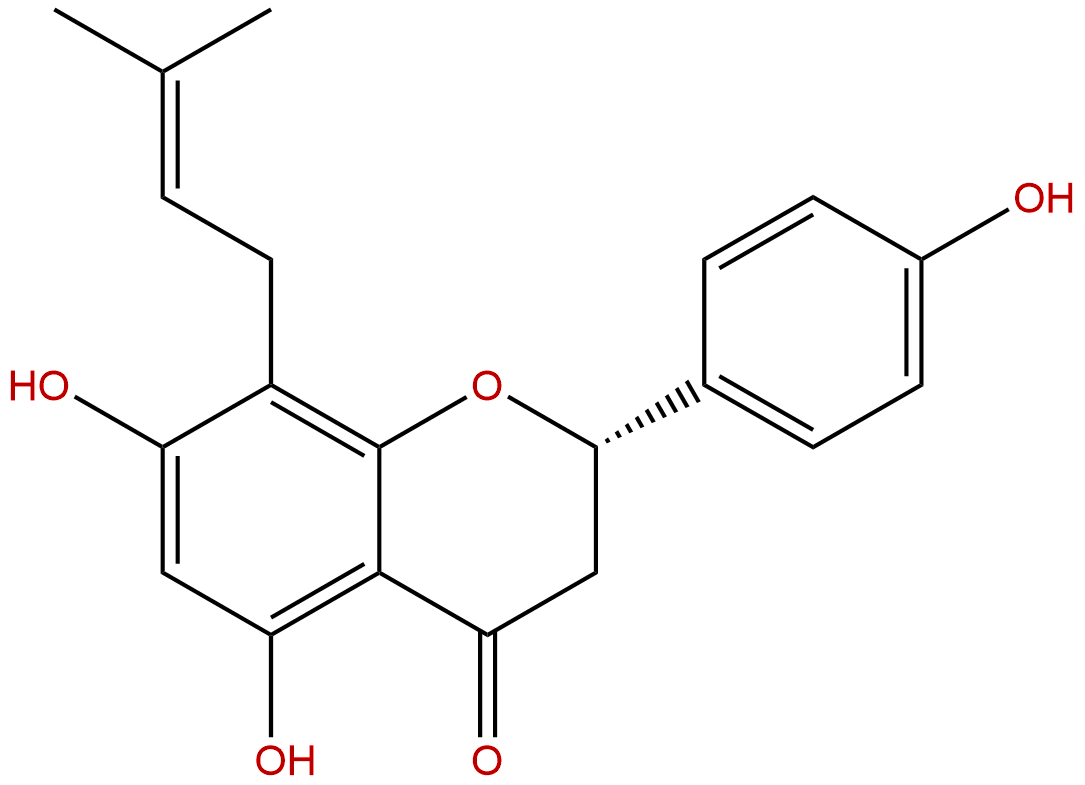


Product name: 8-Prenylnaringenin
Synonym name: (+/-)-8-Prenylnaringenin; 68682-02-0
Catalogue No.: SBP02804
Cas No.: 53846-50-7
Formula: C20H20O5
Mol Weight: 340.375
Botanical Source:
Physical Description:
Type of Compound: Flavonoids
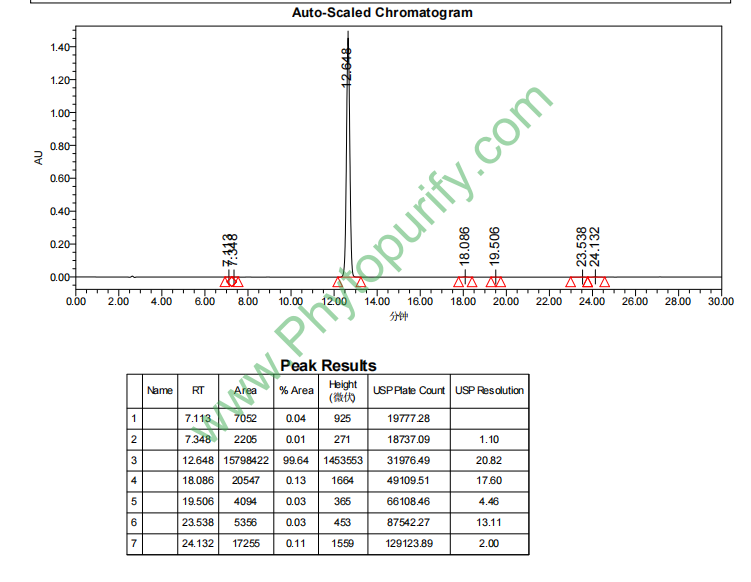
Purity: 95%~99%
Analysis Method: HPLC-DAD or/and HPLC-ELSD
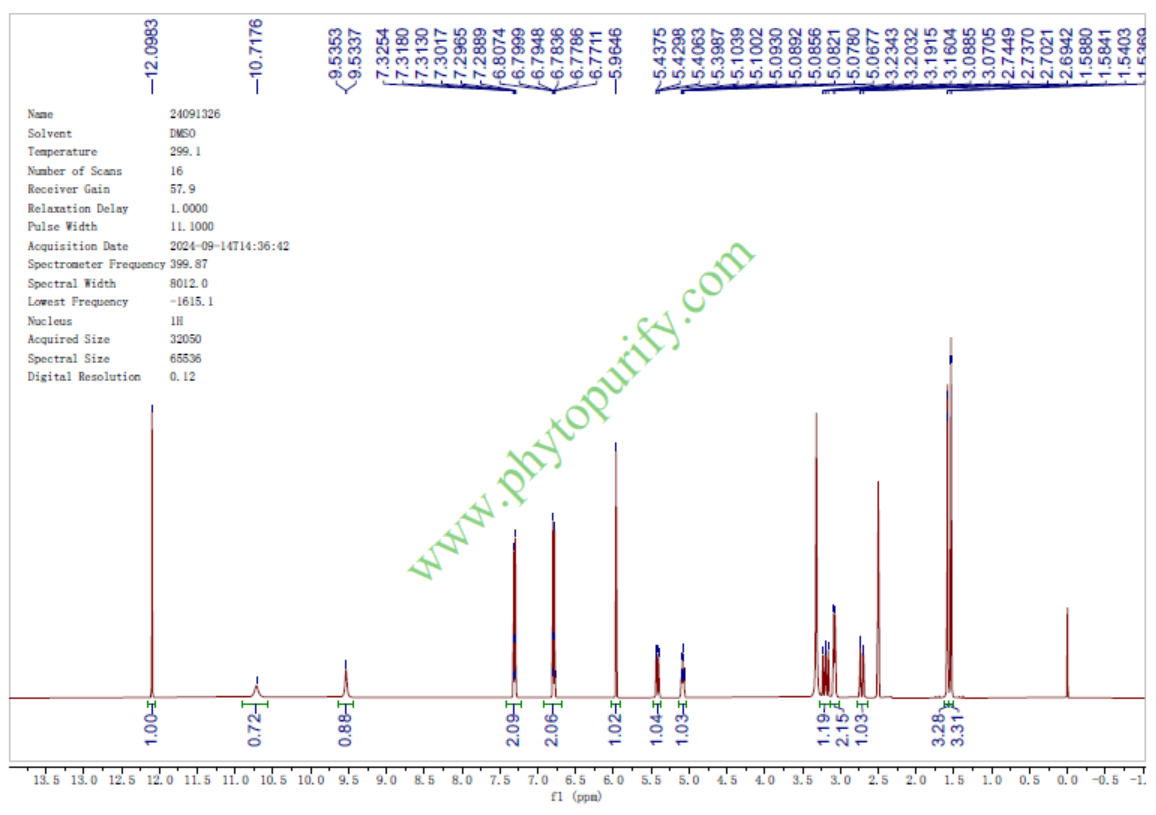
Identification Method: Mass, NMR
Packing: Brown vial or HDPE plastic bottle
Storage: Store in a well closed container, protected from air and light. Put into refrigerate or freeze for long term storage.
The product could be supplied from milligrams to grams
Inquire for bulk scale.
For Reference Standard and R&D, Not for Human Use Directly.
Description:
8-Prenylnaringenin is a phytoestrogen with high estrogenic activity, it shows more potent effects on promoting osteoblastic bone formation and inhibiting osteoclastic bone resorption by ERα instead of ERβ than the two classic phytoestrogens: genistein and daidzein. 8-Prenylnaringenin at all assayed doses (0.001-20 µM) presumably improves mitochondrial function, whereas a high dose of XN (5 µM) worsens the functionality of this organelle.
References:
Strahlenther Onkol. 2015 May;191(5):429-36.
8-prenylnaringenin and tamoxifen inhibit the shedding of irradiated epithelial cells and increase the latency period of radiation-induced oral mucositis : cell culture and murine model.
The major component in the pathogenesis of oral radiation-induced mucositis is progressive epithelial hypoplasia and eventual ulceration. Irradiation inhibits cell proliferation, while cell loss at the surface continues. We conceived to slow down this desquamation by increasing intercellular adhesion, regulated by the E-cadherin/catenin complex. We investigated if 8-Prenylnaringenin (8-PN) or tamoxifen (TAM) decrease the shedding of irradiated human buccal epithelial cells in vitro and thus delay the ulcerative phase of radiation-induced mucositis in vivo.
METHODS AND RESULTS:
In vitro, aggregates of buccal epithelial cells were irradiated and cultured in suspension for 11 days. 8-PN or TAM were investigated regarding their effect on cell shedding. In vivo, the lower tongue surface of mice was irradiated with graded single doses of 25 kV X-rays. The incidence, latency, and duration of the resulting mucosal ulcerations were analyzed after topical treatment with 8-PN, TAM or solvent. 8-PN or TAM prevented the volume reduction of the irradiated cell aggregates during the incubation period. This was the result of a higher residual cell number in the treated versus the untreated irradiated aggregates. In vivo, topical treatment with 8-PN or TAM significantly increased the latency of mucositis from 10.9 to 12.1 and 12.4 days respectively, while the ulcer incidence was unchanged.
CONCLUSIONS:
8-PN and TAM prevent volume reduction of irradiated cell aggregates in suspension culture. In the tongues of mice, these compounds increase the latency period. This suggests a role for these compounds for the amelioration of radiation-induced mucositis in the treatment of head and neck tumors.
Planta Med. 2015 Mar;81(4):305-11.
Neurodifferentiating potential of 8-prenylnaringenin and related compounds in neural precursor cells and correlation with estrogen-like activity.
Neurodegenerative diseases are an increasing burden for our ageing societies; there is an as yet unmet need for the development of effective therapies. Neurogenesis, i.e., the generation of new neurons in the adult brain from neural stem cells, has received increasing attention since it offers the potential for endogenous brain repair and functional regeneration. Adult neurogenesis is partially under the control of sex hormones such as estradiol, and boosting neurogenesis with estradiol in animals correlates with cognitive improvement. 8-Prenylnaringenin imitates as highly potent phytoestrogen the effects of estradiol.
METHODS AND RESULTS:
Here, we studied the potential of 8-Prenylnaringenin, 6-prenylnaringenin, and related compounds on differentiation induction in vitro using neural precursor cells transiently transfected with a doublecortin promoter luciferase construct, which was recently shown to indicate neuronal fate and differentiation. The flavanones 8-Prenylnaringenin and 6-prenylnaringenin showed slight activity in this assay but significant activity by immunostaining. Although the estrogen-like activities of 8-Prenylnaringenin and 6-prenylnaringenin are very different, the activity in differentiation induction is similar. Interestingly, also some prenylflavonoids with extended prenyl groups, e.g., a geranyl group, showed increased differentiation activity, while estrogen-like activity is decreased.
CONCLUSIONS:
This allows the conclusion that estrogen-like activity of prenylflavanones does not correlate directly with the activity of differentiation induction in neural precursor cells.
HPLC of 8-Prenylnaringenin
HNMR of 8-Prenylnaringenin
Storage conditions:Short-term storage at 2~8℃, long-term storage at -20 ~ -80℃
94.8300
3.5000
3.2000
Low
Unknown
Unknown
Unknown
Unknown
Unknown
Unknown
8-Prenylnaringenin (8-PN) is a natural product of isopentenyl flavonoids with significant biological activity, mainly derived from hops(Humulus lupulus)Obtained through separation. As an orally active compound, 8-PN has attracted much attention due to its multi-target and multi pathway pharmacological effects, especially in the fields of antioxidant, bone health, metabolic diseases, and tumor treatment, showing broad research and application prospects. This article aims to systematically review the chemical structure, origin, pharmacological activity, mechanism of action, and pharmacological evaluation of 8-PN, and explore its potential and future development direction in preclinical research.
The chemical structure of 8-PN belongs to the flavonoid compounds modified with isopentenyl groups, with a molecular formula of C ₂₀ H ₂₄ O ₅ and a molecular weight of 340.37. Its structural feature is that the 8th position of the naringin skeleton is connected to an isopentenyl side chain, and this structural modification significantly enhances its biological activity and lipid solubility. In terms of physical and chemical properties, the LogP value of 8-PN is about 3.5, indicating its moderate lipid solubility, which is beneficial for cell membrane penetration and oral absorption. The topological polar surface area (TPSA) is 94.83 Å ² and the number of hydrogen bond acceptors is 5, indicating its hydrophilicity and binding ability in vivo. The low permeability of the blood-brain barrier suggests that its role in the central nervous system may be limited. There is currently no clear data on its safety indicators such as hepatotoxicity, cardiotoxicity, and hERG channel inhibition, and further systematic evaluation is needed.
8-PN mainly comes from hops(Humulus lupulus)Hops, also known as hops, are essential raw materials in the beer brewing process and serve as natural reservoirs for various bioactive flavonoids. Although the content of 8-PN is not as high as other active ingredients in hops such as picric acid, its biological effects are more significant. The extraction method usually uses organic solvents such as ethanol and methanol for extraction, combined with liquid chromatography (HPLC) separation and purification technology to obtain high-purity 8-PN. In recent years, supercritical CO ₂ extraction and membrane separation technology have also been applied to improve extraction efficiency and purity. In addition, the study of biosynthetic pathways provides a theoretical basis for the bioengineering synthesis of 8-PN, which is expected to achieve large-scale production in the future.
8-PN activates the Nrf2 (nuclear factor erythroid 2 related factor 2) signaling pathway, upregulates various antioxidant enzymes such as superoxide dismutase (SOD1, SOD2), glutathione peroxidase (GPX1), catalase (CAT), and heme oxygenase-1 (HMOX1), effectively reducing intracellular reactive oxygen species (ROS) levels and alleviating oxidative stress damage. In addition, 8-PN can regulate the activity of matrix metalloproteinases (MMP1, MMP3), protect extracellular matrix stability, and delay tissue aging process.
As a natural plant estrogen, 8-PN has a significant regulatory effect on bone metabolism. It promotes bone formation and inhibits bone resorption by activating estrogen receptor alpha (ESR1) and Sirt1 protein. 8-PN can also activate the AMPK pathway, regulate the expression balance of osteoprotegerin (OPG, TNFRSF11B) and nuclear factor kappa B receptor activator ligand (RANKL, TNFSF11), inhibit osteoclast activity, and prevent bone loss. Animal model studies have shown that 8-PN can effectively improve bone density and delay the progression of osteoporosis.
8-PN regulates the expression of lipid metabolism related genes, including peroxisome proliferator activated receptor gamma (PPAR gamma), fatty acid synthase (FASN), adiponectin receptor 1 (ADIPOR1), and lipase activated protein kinase (LIPE), by activating the AMPK signaling pathway, promoting lipolysis and energy metabolism. It has shown significant weight control and adipose tissue improvement effects on obese animal models, indicating its potential application value in metabolic syndrome and related diseases.
8-PN exhibits multi-target anticancer activity in glioblastoma and colon cancer. It blocks tumor cell proliferation and survival signals by inhibiting the PI3K/Akt/mTOR signaling pathway; Simultaneously regulating the activity of cyclin dependent kinases (CDK2, CDK4), inducing tumor cell cycle arrest and apoptosis. In colon cancer, 8-PN also regulates Wnt/β - catenin (CTNNB1) signaling, promotes the functional recovery of tumor suppressor protein p53 (TP53), and inhibits tumor progression. In addition, the anti angiogenic effect of 8-PN inhibits the expression of vascular endothelial growth factor receptor 2 (KDR), limits tumor angiogenesis, and blocks tumor nutrient supply.
8-PN has the activity of regulating the levels of luteinizing hormone (LH) and follicle stimulating hormone (FSH), demonstrating the endocrine regulatory function of phytoestrogens. This characteristic makes it of great significance in the study of menopausal syndrome and related endocrine disorders in women.
The multi-target mechanism of 8-PN mainly involves the following key pathways:
PI3K/Akt signaling pathway 8-PN activates PI3K (PIK3CA) and its downstream Akt (AKT1), regulating cell survival, metabolism, and proliferation processes. In tumor cells, 8-PN achieves anti proliferative and pro apoptotic effects by inhibiting this pathway.
AMPK pathway As an energy sensing enzyme, AMPK (PRKAA1) promotes lipid metabolism and mitochondrial function, improves metabolic abnormalities and obesity status when activated by 8-PN.
Regulation of oxidative phosphorylation complexes 8-PN upregulates mitochondrial oxidative phosphorylation complexes (II, III, V), enhances cellular energy metabolism efficiency, reduces ROS production, and protects cells from oxidative damage.
Sirt1 activation By activating the deacetylase Sirt1, 8-PN, it regulates cell apoptosis, inflammation, and metabolic homeostasis, promoting bone and muscle health.
Nrf2 antioxidant pathway 8-PN activates Nrf2, induces expression of antioxidant enzymes, and enhances cellular antioxidant defense capabilities.
Wnt/β - catenin signaling In colon cancer, 8-PN regulates the activity of CTNNB1, affecting cell proliferation and differentiation.
cell cycle regulation By regulating the activity of CDK2 and CDK4, 8-PN induces cell cycle arrest and inhibits tumor cell proliferation.
Angiogenesis inhibition Inhibit KDR expression and block tumor angiogenesis.
The synergistic effects of these multiple targets and pathways have shown significant therapeutic potential for 8-PN in various disease models.
The molecular weight and lipid solubility parameters of 8-PN meet the basic requirements of oral small molecule drugs and have good cell membrane penetration. However, its low blood-brain barrier permeability limits its application in central nervous system diseases. The moderate number of hydrogen bond receptors is conducive to binding with target proteins. Currently, there is a lack of systematic data on safety indicators such as hepatotoxicity, cardiotoxicity, and genotoxicity (Ames test), and further toxicological research is needed.
In terms of pharmacokinetics, previous studies have shown that 8-PN has good bioavailability after oral administration, but its metabolic pathway and in vivo distribution are not fully understood. The content of 8-PN in hops is relatively low, and its metabolism in vivo may involve extensive involvement of liver enzymes. In the future, it is necessary to combine pharmacokinetic and pharmacodynamic studies to optimize dosage forms and administration regimens, and enhance clinical application potential.
8-PN, as a natural plant estrogen, has shown broad application prospects in the prevention and treatment of osteoporosis, regulation of metabolic diseases, and adjuvant therapy for tumors. Its antioxidant and anti-inflammatory properties make it potentially valuable in the prevention and treatment of chronic degenerative diseases and geriatric diseases. Especially in the management of menopausal syndrome in women, 8-PN may become a safe and effective alternative to hormone therapy.
Future research should focus on the following aspects:
safety evaluation Conduct toxicology and long-term safety studies on the system to clarify the toxic side effect spectrum of 8-PN.
Pharmacokinetic optimization Enhance its bioavailability and targeting through structural modification or formulation techniques.
In depth analysis of the mechanism Using multi omics techniques to reveal its functional network and promote the development of precise treatment strategies.
Clinical trial advancement Design a reasonable clinical study to verify its efficacy and safety in the treatment of osteoporosis, metabolic syndrome, and tumors.
Biological synthesis and industrialization Develop biosynthetic technology to achieve large-scale production of 8-PN, reduce costs, and promote its clinical translation.
8-Isopentenyl Naringin, as a multifunctional natural isopentenyl flavonoid, has demonstrated potential applications in various fields such as antioxidant, bone health, metabolic regulation, and anti-tumor due to its unique chemical structure and multi-target pharmacological activity. Although the current understanding of its safety and pharmacokinetics is not sufficient, with the continuous development of modern pharmacology and natural product chemistry, 8-PN is expected to become an important candidate molecule for natural product drug development. In the future, through in-depth mechanism research and clinical validation, 8-PN is expected to provide new strategies and choices for the prevention and treatment of related diseases.
