


Synonym name: "2',4,4'-Trihydroxy-6'-methoxy-3'-prenylchalcone";569-83-5
Catalogue No.: BP1458
Cas No.: 6754-58-1
Formula: C21H22O5
Mol Weight: 354.402
Physical Description: Orange powder
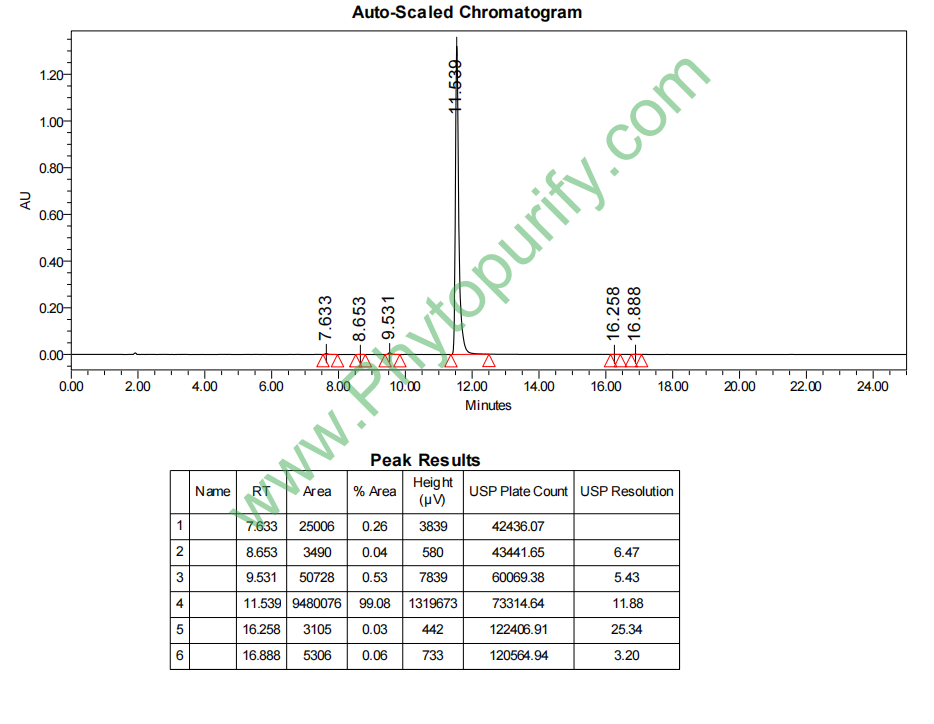
Purity: 95%~99%
Analysis Method: HPLC-DAD or/and HPLC-ELSD
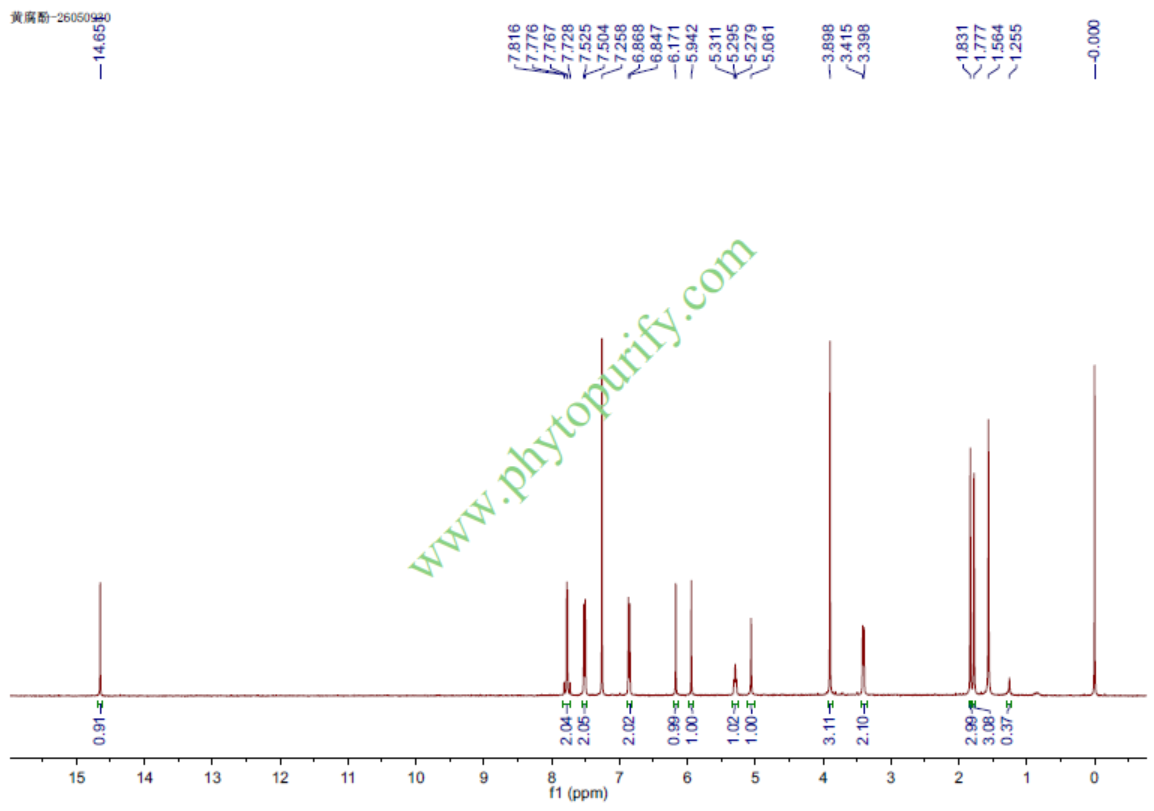
Identification Method: Mass, NMR
Packing: Brown vial or HDPE plastic bottle
Can be supplied from milligrams to grams. Inquire for bulk scale.
For Reference Standard and R&D, Not for Human Use Directly.
HPLC of Xanthohumol
HNMR of Xanthohumol
Storage conditions:Short-term storage at 2~8℃, long-term storage at -20 ~ -80℃
Xanthohumol (CAS number: 6754-58-1) is a natural flavonoid compound isolated from hops (Humulus lupulus L.). As a unique polyphenolic component in hops, humic acid has attracted widespread attention in the field of natural product pharmacology in recent years due to its diverse biological activities and potential medicinal value. Huangfufen not only exhibits significant anti-tumor and anti angiogenic activities, but also has inhibitory effects against various viruses, including bovine viral diarrhea virus (BVDV), rhinovirus, herpes simplex virus types 1 and 2 (HSV-1, HSV-2), and cytomegalovirus (CMV). In addition, humic acid exhibits excellent anti-inflammatory and metabolic regulatory potential by inhibiting key enzymes such as diacylglyceryl acyltransferase (DGAT), cyclooxygenase-1 (COX-1), and cyclooxygenase-2 (COX-2).
This article will provide a systematic review of the chemical structure and physicochemical properties, plant sources, and extraction methods of humic acid. It will analyze in detail its pharmacological activity and mechanism of action, explore its molecular basis for anti-tumor and antiviral effects based on molecular targets, evaluate its drug properties and pharmacokinetic characteristics, and explore its potential and challenges for future clinical applications. The aim is to provide theoretical basis and reference for further research and development of humic acid.
Huangfufen belongs to the flavonoid class of compounds, specifically a derivative of isoflavones. Its molecular formula is C21H22O5 and its molecular weight is 354.4020. The molecular structure of humic acid contains multiple phenolic hydroxyl and methoxy groups, endowing it with strong antioxidant capacity. Its chemical structural characteristics include a combination of a flavonoid skeleton and a side chain, which contains an alpha, beta unsaturated ketone structure on the side chain, which is of great significance for its biological activity.
In terms of physical and chemical properties, the LogP value of humic acid is 4.3428, indicating its high lipid solubility, which is beneficial for penetrating cell membranes but may limit its water solubility. Its topological polar surface area (TPSA) is 86.9900, indicating that it has certain polar groups that facilitate binding with biomolecules. Low water solubility (0.0615 mg/mL) poses a certain challenge to its bioavailability. Huangfufen has low blood-brain barrier permeability, indicating its limited distribution in the central nervous system. Importantly, humic acid does not exhibit hERG channel inhibitory activity and the Ames mutagenicity test results are negative, indicating its high safety and low potential risk of arrhythmia.
Xanthohumol is mainly present in the female flowers of hops, especially in the pollen sacs and pollen glands where its content is relatively high. Hops, as an important raw material in beer production, have complex chemical compositions, among which humic acid is a flavonoid polyphenol with abundant content and significant biological activity.
The traditional method for extracting humic acid mainly uses organic solvents such as ethanol, methanol, or ethyl acetate for extraction, combined with modern technologies such as ultrasound assisted extraction (UAE) and microwave-assisted extraction (MAE) to improve extraction efficiency and purity. After liquid-liquid separation, column chromatography, and high-performance liquid chromatography (HPLC) purification of the extract, high-purity humic acid can be obtained. In recent years, supercritical carbon dioxide extraction (SFE-CO2) technology has also been applied to the extraction of humic acid from hops, which has the advantages of green environmental protection and strong selectivity.
The optimization of extraction process not only affects the yield of humic acid, but also relates to the stability of its bioactive components and the feasibility of subsequent medicinal development. Research has shown that extraction conditions such as solvent polarity, temperature, time, and hop variety have a significant impact on the content of humic acid.
Huangfufen exhibits significant cell proliferation inhibition and pro apoptotic effects in various tumor cell lines. Its anti-tumor activity covers breast cancer, prostate cancer, colorectal cancer, liver cancer and other solid tumors. In vitro studies have shown that humic acid can inhibit the proliferation, migration, and invasion of tumor cells, induce cell cycle arrest, and apoptosis by regulating multiple signaling pathways.
The growth and metastasis of tumors depend on the formation of new blood vessels. Xanthohumol inhibits the proliferation and lumen formation of endothelial cells, blocking tumor angiogenesis. Its mechanism of action involves downregulating the expression of vascular endothelial growth factor (VEGF) and its receptors, inhibiting related signaling pathways, and reducing angiogenesis activity in the tumor microenvironment.
Xanthohumol exhibits broad-spectrum antiviral activity, particularly against bovine viral diarrhea virus (BVDV), rhinovirus, herpes simplex virus types 1 and 2 (HSV-1, HSV-2), and cytomegalovirus (CMV). Its antiviral mechanism may include interfering with the virus replication cycle, inhibiting virus protein synthesis, and blocking the binding of the virus to host cells.
As an inhibitor of COX-1 and COX-2, humic acid has significant anti-inflammatory effects, which can reduce the production of inflammatory mediators and alleviate inflammatory reactions. In addition, by inhibiting DGAT activity, humic acid participates in lipid metabolism regulation, demonstrating potential therapeutic value for metabolic syndrome and fatty liver diseases.
The multi-target mechanism of action of humic acid is the basis for its broad pharmacological activity. Regarding its anti-tumor effects, humic acid regulates various key proteins and signaling pathways:
In addition, humic acid exerts anti-inflammatory and anti angiogenic effects by inhibiting COX-1 and COX-2, reducing prostaglandin synthesis. Its inhibitory effect on DGAT regulates lipid synthesis and affects energy metabolism.
In terms of antiviral activity, humic acid may exert antiviral activity by blocking virus entry into host cells, inhibiting virus gene expression and protein synthesis through multiple mechanisms.
The pharmacological evaluation of humic acid shows that it has certain potential, but there are also challenges. Its high lipid solubility (LogP 4.34) facilitates membrane penetration, but its low water solubility (0.0615 mg/mL) limits its oral bioavailability. The low permeability of the blood-brain barrier means its application is limited in central nervous system diseases.
In terms of safety, humic acid does not inhibit hERG channels, reducing the risk of arrhythmia, and the Ames test is negative, indicating a low risk of mutagenicity and good safety.
Pharmacokinetic studies have shown that humic acid is metabolized rapidly in vivo, mainly through the liver metabolic enzyme system, with a first pass effect. The activity and toxicity of its metabolites still need further research. To improve its pharmacokinetic properties, researchers have attempted to use pharmaceutical strategies such as nanocarriers, liposomes, and solid dispersions to enhance its solubility and bioavailability.
As a multifunctional natural product, humic acid has a wide range of pharmacological activities, especially in the fields of anti-tumor and antiviral activities, showing great potential. The future clinical application prospects are mainly reflected in the following aspects:
Development of anti-tumor drugs Combined with the multi-target mechanism of action of humic acid, it can be developed as an adjuvant or combination chemotherapy drug, especially for hormone dependent and drug-resistant tumor types. Further preclinical and clinical studies will verify its efficacy and safety.
antiviral therapy Regarding viral infections such as HSV and CMV, humic acid has the potential to be used as a novel antiviral drug or adjuvant therapy, especially in the context of increasingly prominent virus resistance issues.
Anti inflammatory and metabolic diseases The COX inhibition and lipid metabolism regulation effects of humic acid provide new ideas for its treatment in inflammatory diseases and metabolic syndrome.
Drug formulation innovation The development of nanotechnology and novel drug delivery systems will be key to enhancing the clinical application value of humic acid, which has low water solubility and insufficient bioavailability.
Although humic acid has shown good activity in vitro and animal models, its clinical translation still faces challenges such as pharmacokinetics, dose optimization, long-term safety, and efficacy verification. In the future, multi center and multi-stage clinical trial design should be strengthened, combined with modern medicinal chemistry and pharmaceutical technology, to promote the transition of humic acid from laboratory to clinical use.
As an important natural flavonoid product in hops, humic acid has shown extensive anti-tumor, antiviral, and anti-inflammatory potential due to its unique chemical structure and multi-target pharmacological activity. Its mechanism of action involves the regulation of multiple key cellular signaling pathways and enzymes, providing a rich molecular basis for the development of new natural medicines. The evaluation of drug properties shows that humic acid has good safety, but its pharmacokinetic characteristics such as water solubility and bioavailability still need to be optimized.
In the future, with the deepening of extraction and purification technology, innovation in drug formulations, and clinical research, humic acid is expected to become a star compound in the field of natural product pharmacology, promoting the transformation of natural flavonoid drugs into clinical applications. Continuous basic and applied research will open up new paths for the drug development and disease treatment of humic acid.
