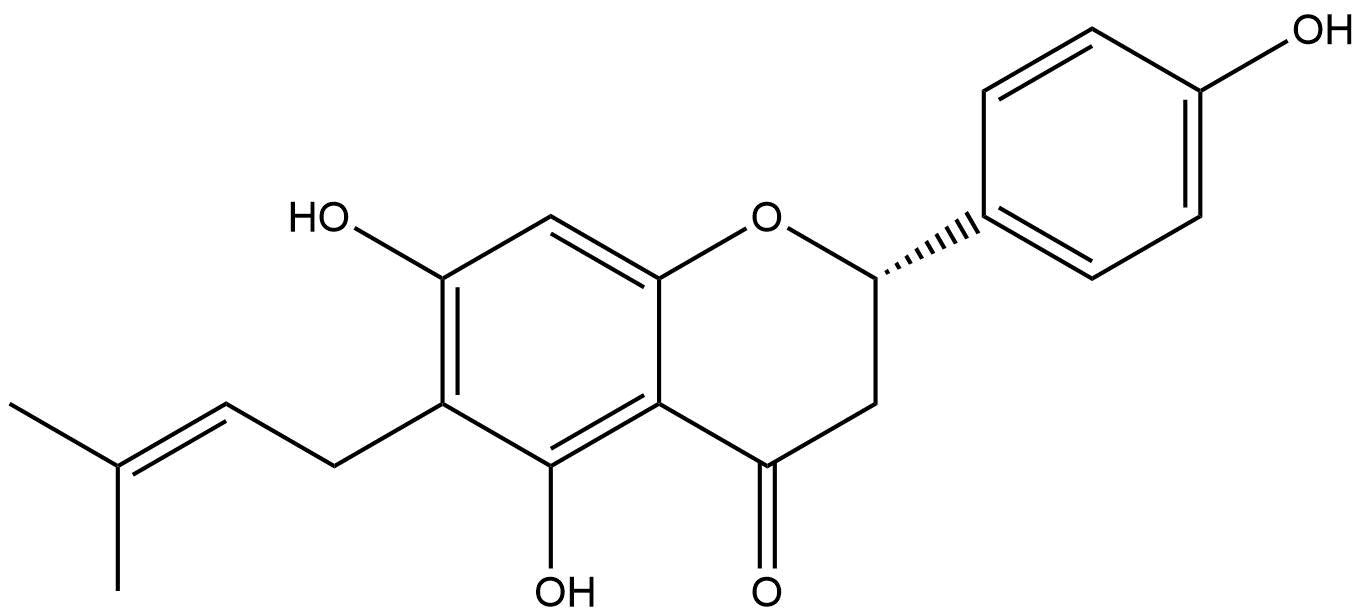


Product name: 6-Prenylnaringenin
Synonym name: (+/-)-6-Prenylnaringenin,68682-01-9
Catalogue No.: BP4041
Cas No.: 68236-13-5
Formula: C20H20O5
Mol Weight: 340.375
Botanical Source: Humulus lupulus Linn.
Physical Description: Powder
Type of Compound: Flavonoids
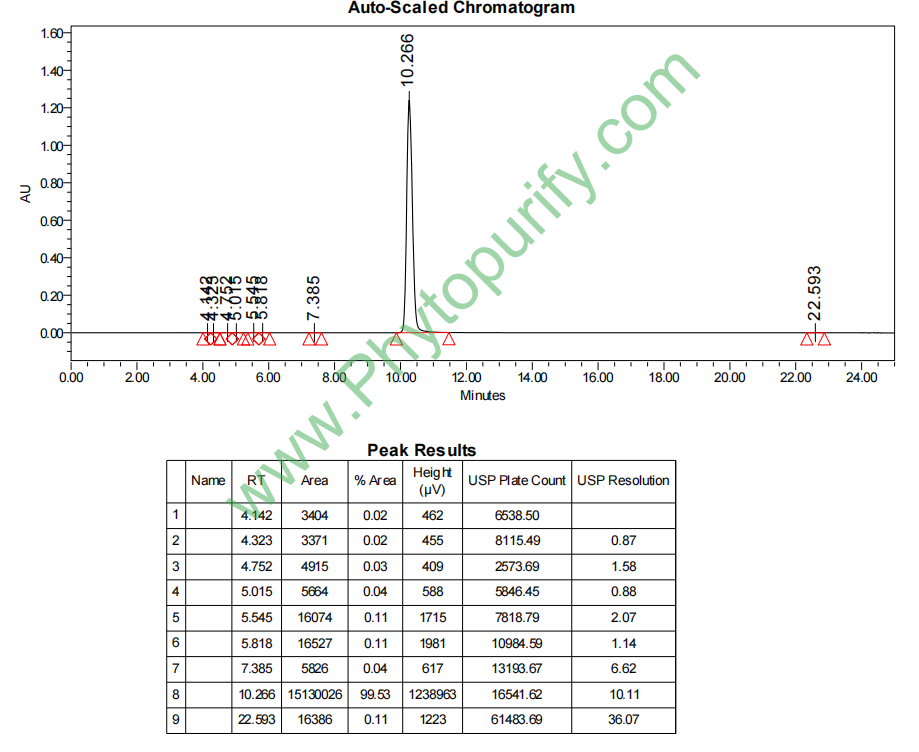
Purity: 95%~99%
Analysis Method: HPLC-DAD or/and HPLC-ELSD
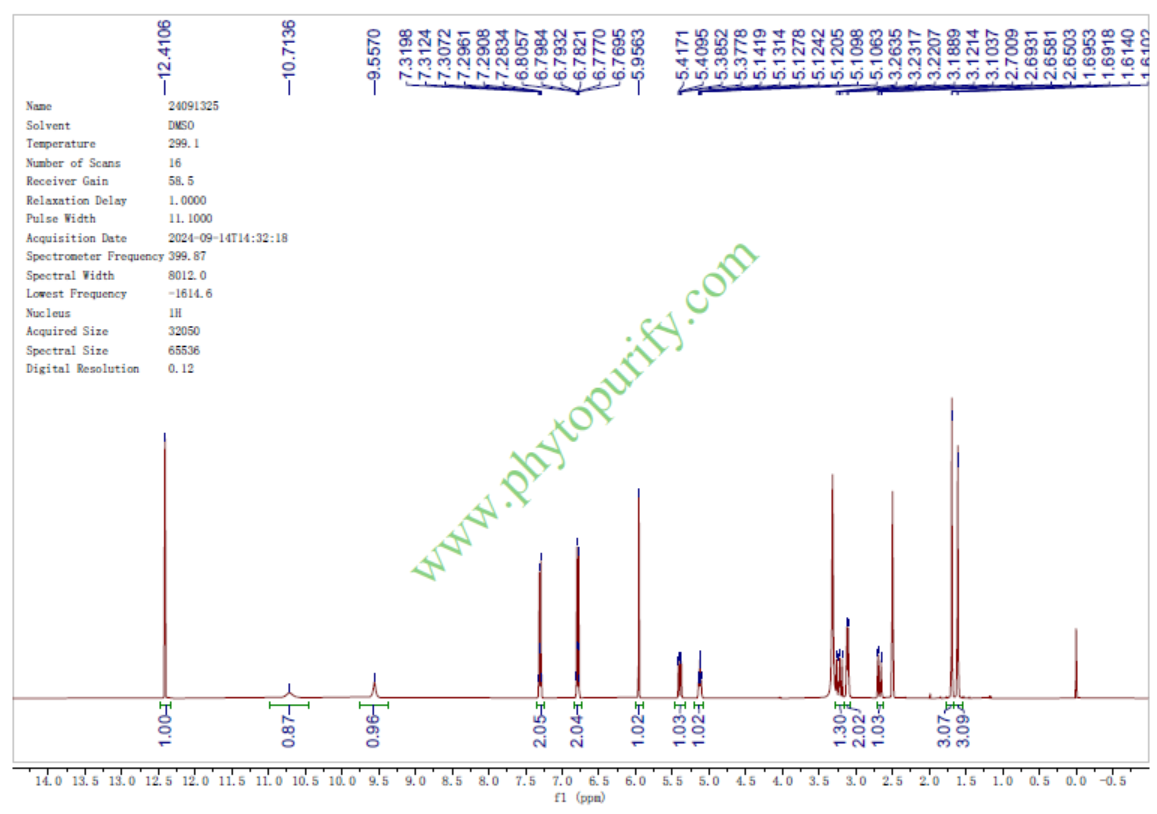
Identification Method: Mass, NMR
Packing: Brown vial or HDPE plastic bottle
Storage: Store in a well closed container, protected from air and light. Put into refrigerate or freeze for long term storage.
Whenever possible, you should prepare and use solutions on the same day. However, if you need to make up stock solutions in advance, we recommend that you store the solution as aliquots in tightly sealed vials at -20℃. Generally, these will be useable for up to two weeks.
The product could be supplied from milligrams to grams
Inquire for bulk scale.
For Reference Standard and R&D, Not for Human Use Directly.
HPLC of 6-Prenylnaringenin
HNMR of 6-Prenylnaringenin
Storage conditions:Short-term storage at 2~8℃, long-term storage at -20 ~ -80℃
86.9900
3.9335
3.7800
.1436
2.7122
20.4224
Low
91.4510
3.1818
No
No
Yes
No
Yes
No
0.0
No
Yes
Yes
No
Natural products, as an important source of drug discovery, have long played an irreplaceable role in human health maintenance and disease treatment. Flavonoids, as one of the main categories of secondary metabolites in plants, have attracted much attention due to their structural diversity and wide range of biological activities. Among numerous flavonoids, naringenin, as a typical dihydroflavonoid, is widely present in citrus fruits and exhibits various pharmacological activities such as antioxidant, anti-inflammatory, and anti-tumor. However, the low bioavailability of natural naringin in the body limits its clinical application potential.
In recent years, isoprenylated flavonoids have become a research hotspot due to their enhanced lipid solubility and improved biological activity. The introduction of prenyl group not only changes the physical and chemical properties of the parent compound, but also endows it with new biological functions. 6-Prenylnaringenin (CAS number: 68236-13-5) is a derivative formed by introducing an isoprene group at the C-6 position of the naringenin skeleton. This structural modification significantly alters the pharmacological activity spectrum of the compound, making it a research focus in the field of natural product pharmacology.
6-Isopentenyl naringin belongs to trihydroxyflavanone compounds and has a typical flavanone core structure. It is worth noting that the compound has been identified as a T-type calcium channel blocker, providing a new theoretical basis for its application in the treatment of cardiovascular and neurological diseases. In addition, 6-isoprenyl naringin exhibits significant antioxidant activity and has great potential in the prevention and treatment of oxidative stress-related diseases by regulating multiple key targets such as TYR, MMP1, NFE2L2, NRF2, SOD1, CAT, GPX1, HMOX1, MMP3, and SOD2.
This article will provide a systematic review of the research progress of 6-isoprenyl naringin from multiple dimensions, including chemical structure, plant origin, pharmacological activity, mechanism of action, pharmacological evaluation, and clinical application prospects. The aim is to provide comprehensive scientific basis for the in-depth research and development of this natural product.
The chemical structure of 6-isopentenyl naringin is based on the flavanone core, and its systematic name is 5,7,4 '- trihydroxy-6- (3-methyl-2-butenyl) flavanone. Structurally, the compound has the following characteristics:
Flavanone parent nucleus Composed of A ring (benzene ring), C ring (oxygen-containing heterocyclic ring), and B ring (benzene ring), the C ring is a saturated pyranone structure, the C2 position is the chiral center, and the naturally occurring configuration is the (2S) - configuration.
Hydroxyl substitution mode There is a hydroxyl group at the C5 and C7 positions of ring A and at the C4 'position of ring B, forming a typical 5,7,4' - trihydroxy substitution pattern. This substitution pattern is a common feature of many bioactive flavonoids.
Isoprene substitution Connect a 3-methyl-2-butenyl (isoprene) side chain at the C6 position of ring A. This side chain is composed of five carbon atoms and contains a double bond, giving the molecule stronger lipophilicity and membrane affinity.
Molecular formula and molecular weight The molecular formula is C20H20O5 and the molecular weight is 340.3750 g/mol.
Based on computational chemistry and experimental measurements, the key physicochemical properties of 6-isoprenyl naringenin are as follows:
Lipid water partition coefficient (LogP): 3.9335. This value indicates that the compound has moderate to high lipid solubility, which is beneficial for transmembrane transport and interaction with lipid membranes. Compared with the parent compound naringin (LogP of approximately 2.5-3.0), the introduction of isoprene groups significantly improved lipid solubility.
Polarized surface area (TPSA): 86.9900 Å ². TPSA is an important parameter for predicting oral absorption and blood-brain barrier penetration ability, and compounds with TPSA<140 Å ² are generally considered to have good oral absorption potential. The TPSA value of 6-isoprenyl naringin indicates its good oral bioavailability potential.
Water solubility:0.1436 mg/mL。 This compound has a low solubility in water and is classified as a poorly soluble compound, which is consistent with its high LogP value. Low water solubility may limit its formulation development and in vivo absorption, and needs to be improved through formulation technology.
Blood-brain barrier penetrability: Low. According to calculations, the ability of 6-isoprenyl naringin to penetrate the blood-brain barrier is relatively low, which to some extent limits its direct application in central nervous system diseases, but may also reduce central nervous system related side effects.
HERG inhibition: No. HERG potassium channel inhibition is an important predictor of drug cardiac toxicity, and this compound does not inhibit hERG channels, indicating its good cardiac safety.
Ames test: 0.0. The Ames test result is negative, indicating that the compound does not have significant mutagenicity and has a low risk of genetic toxicity.
These physicochemical property parameters provide important reference for the drug development of 6-isoprenyl naringenin, while also pointing out the challenges that need to be overcome, especially in terms of water solubility and bioavailability optimization.
6-Isopentenyl naringin has a relatively limited distribution in nature and mainly exists in certain specific plant genera and species. The main known sources of plants currently include:
Mulberry plants: Mulberry genus(Morus)Plants are an important source of 6-isoprenyl naringin. Mulberry tree(Morus alba)The compound is present in the root bark, stem bark, and leaves of the plant. Mulberry bark (the root bark of mulberry trees) is used in traditional Chinese medicine to treat diseases such as cough and edema, and the isoprenoid flavonoids contained in it are considered one of its active ingredients.
Leguminous plants Some leguminous plants such as licorice(Glycyrrhiza)The presence of 6-isoprenyl naringin was also detected in the sample. Licorice is widely used in traditional medicine, and its chemical composition is complex, with isoprenoid flavonoids being one of its characteristic components.
Rutaceae plants Citrus genus(Citrus)Although plants are rich in naringin, the content of 6-isoprenyl naringin is relatively low. However, there may be accumulation of this compound in certain specific varieties or specific tissue sites.
Other sources In recent years, through plant chemistry research, it has been found that snake bed seeds(Cnidium monnieri)Fructus Psorale(Psoralea corylifolia)6-Isopentenyl naringin or its analogues have also been found in medicinal plants.
It is worth noting that the content of 6-isoprenyl naringin in plants is usually low and is influenced by various factors such as growth environment, harvesting time, and variety differences. Therefore, the development of efficient extraction and enrichment methods is crucial for the research and application of this compound.
Researchers have developed various methods for the extraction of 6-isoprenyl naringin, including:
Traditional solvent extraction method Soak or reflux extract plant materials using organic solvents such as methanol, ethanol, ethyl acetate, etc. This method is simple to operate, but it has disadvantages such as low extraction efficiency, high solvent consumption, and poor selectivity. Purification usually requires a combination of subsequent liquid-liquid extraction or column chromatography separation.
Ultrasound assisted extraction Utilizing the cavitation effect and mechanical vibration of ultrasound to accelerate the destruction of plant cell walls and the dissolution of active ingredients. This method can significantly shorten the extraction time, improve the extraction efficiency, and operate at a lower temperature, which is beneficial for the retention of thermosensitive components.
Microwave assisted extraction By utilizing the penetrating and selective heating properties of microwaves, the internal temperature of plant cells rapidly increases, promoting the release of target compounds. This method has the advantages of short extraction time, low solvent dosage, and high yield.
Supercritical fluid extraction Using supercritical CO ₂ as the extraction solvent, the solubility of the target compound can be selectively extracted by adjusting the pressure and temperature. This method is green and environmentally friendly, with high purity of the extracted product, but the equipment cost is relatively high.
Enzyme assisted extraction Using cellulase, pectinase and other enzymes to hydrolyze plant cell wall components, reducing mass transfer resistance and improving the extraction rate of effective ingredients. This method has mild conditions and is suitable for extracting thermosensitive components.
In the purification process after extraction, commonly used methods include silica gel column chromatography, ODS reverse phase column chromatography, preparative high-performance liquid chromatography (pre HPLC), and high-speed countercurrent chromatography (HSCCC). Among them, HSCCC has shown unique application value in the separation and purification of isoprenoid flavonoids due to its high separation efficiency, good sample recovery rate, and low solvent consumption.
Oxidative stress is the common pathological mechanism of the occurrence and development of many diseases, including cardiovascular diseases, neurodegenerative diseases, diabetes and its complications, cancer and aging process. 6-Isopentenyl naringin, as a polyphenolic compound, exhibits significant antioxidant activity, and its mechanism of action involves multiple levels.
Direct free radical scavenging ability The phenolic hydroxyl group in the 6-isoprenyl naringenin molecule can directly neutralize reactive oxygen species (ROS) and reactive nitrogen species (RNS), such as superoxide anion radicals (O ₂⁻·), hydroxyl radicals (· OH), peroxynitrite (ONOO ⁻), etc. Research has shown that the introduction of isoprene groups enhances the electron donor ability of the parent compound, thereby improving the free radical scavenging activity.
Chelation of metal ions Transition metal ions such as Fe ² ⁺ and Cu ² ⁺ are catalysts for Fenton and Haber Weiss reactions, which can promote the generation of hydroxyl radicals. 6-Isopentenyl naringin chelates metal ions through its ortho phenolic hydroxyl structure, inhibiting metal ion mediated oxidation reactions.
Regulation of antioxidant enzyme activity This compound can upregulate the expression and activity of various antioxidant enzymes, including superoxide dismutase (SOD1, SOD2), catalase (CAT), glutathione peroxidase (GPX1), and heme oxygenase-1 (HMOX1). These enzymes form the core of the endogenous antioxidant defense system in cells.
Activation of Nrf2/ARE signaling pathway Nuclear factor E2 related factor 2 (NFE2L2/NRF2) is a key transcription factor that regulates the expression of antioxidant genes. 6-Isopentenyl naringin promotes the dissociation of NRF2 and Keap1, causing nuclear translocation and activating antioxidant response elements (ARE), thereby initiating the transcription of downstream antioxidant enzyme genes.
Chronic inflammation is a common feature of many diseases, and 6-isoprenyl naringin has also shown potential anti-inflammatory activity. Research has shown that this compound can inhibit the production of pro-inflammatory cytokines such as tumor necrosis factor - α (TNF - α), interleukin-6 (IL-6), and interleukin-1 β (IL-1 β), while downregulating the expression of cyclooxygenase-2 (COX-2) and inducible nitric oxide synthase (iNOS). These anti-inflammatory effects may be related to the inhibition of the nuclear factor kappa B (NF - κ B) signaling pathway.
Matrix metalloproteinases (MMPs) are a class of zinc dependent endopeptidases that participate in the degradation and remodeling of the extracellular matrix. The abnormal expression of MMP1 and MMP3 is closely related to pathological processes such as skin photoaging, arthritis, tumor invasion and metastasis. 6-Isopentenyl naringin can inhibit the expression and activity of MMP1 and MMP3, indicating its potential application value in anti skin aging and anti-tumor metastasis.
6-Isopentenyl naringin has been identified as a T-type calcium channel blocker, which is its unique pharmacological feature that distinguishes it from other flavonoids. T-type calcium channels (Cav3.1, Cav3.2, Cav3.3) play important roles in neuronal excitability regulation, cardiac pacing, vascular tone regulation, and tumor cell proliferation. The blocking effect of this compound on T-type calcium channels may be related to its potential applications in the treatment of neurological diseases, arrhythmias, and cancer.
In addition to the aforementioned activities, 6-isoprenyl naringin also exhibits various pharmacological activities such as anti-tumor, antibacterial, antiviral, and neuroprotective effects. For example, in various tumor cell lines, this compound can induce cell cycle arrest and apoptosis; In the neural cell model, it has shown a protective effect against oxidative stress-induced nerve damage.
The pharmacological activity of 6-isoprenyl naringin involves multiple molecular targets and signaling pathways, forming a complex network of interactions. Based on existing research, its main molecular targets include:
NRF2/NFE2L2 As the main regulator of antioxidant response, NRF2 is one of the core targets of 6-isoprenyl naringin. This compound promotes the stabilization and nuclear translocation of NRF2 by modifying the cysteine residue of Keap1, thereby activating the expression of a series of antioxidant genes.
SOD1 and SOD2 Superoxide dismutase is a key enzyme for clearing superoxide anions. SOD1 (Cu/Zn SOD) mainly exists in the cytoplasm, while SOD2 (Mn SOD) mainly exists in mitochondria. 6-Isopentenyl naringin upregulates the expression of these two enzymes and enhances the cell's defense against oxidative stress.
CAT Catalase catalyzes the decomposition of hydrogen peroxide into water and oxygen, and is the main enzyme for intracellular hydrogen peroxide clearance. This compound indirectly upregulates the expression of CAT by activating the NRF2 pathway.
GPX1 Glutathione peroxidase 1 utilizes reduced glutathione (GSH) to reduce hydrogen peroxide and organic peroxides. 6-Isopentenyl naringin enhances cellular antioxidant capacity by maintaining GSH levels and upregulating GPX1 expression.
HMOX1 Heme oxygenase-1 catalyzes the degradation of heme into biliverdin, carbon monoxide, and free iron, and has antioxidant, anti-inflammatory, and cell protective effects. This compound significantly induces the expression of HMOX1 through the NRF2 dependent pathway.
MMP1 and MMP3 Matrix metalloproteinases are involved in extracellular matrix degradation. 6-Isopentenyl naringin exerts anti photoaging and anti-tumor invasion effects by inhibiting the AP-1 and NF - κ B signaling pathways, downregulating the expression of MMP1 and MMP3.
TYR Tyrosinase is the rate limiting enzyme for melanin synthesis. This compound may have whitening and anti pigmentation effects by inhibiting TYR activity or downregulating its expression.
The pharmacological effects of 6-isoprenyl naringin involve the regulation of multiple signaling pathways:
The pharmacological activity of 6-isoprenyl naringin is closely related to its structural characteristics:
The role of isoprene group The isoprene group at the C6 position significantly enhances the lipid solubility and membrane affinity of the compound, facilitating binding to the hydrophobic pocket of the target protein. In addition, isoprene groups may participate in interactions with target proteins such as Keap1, enhancing the activation of the NRF2 pathway.
Hydroxyl substitution mode 5,7,4 '- trihydroxy substitution is a key structural feature for flavonoids to exhibit antioxidant activity. The hydroxyl groups at positions C5 and C7 participate in metal ion chelation, while the hydroxyl group at position C4 'provides free radical scavenging ability.
C2 chiral center The (2S) - configuration is a naturally occurring configuration that may be crucial for stereoselective binding to target proteins.
Based on computational pharmacology and experimental data, the pharmacological characteristics of 6-isoprenyl naringin are as follows:
Drug Evaluation According to Lipinski's five rules (molecular weight<500, LogP<5, hydrogen bond donor<5, hydrogen bond acceptor<10), 6-isopentenyl naringin fully meets the requirements for drug likeness. Its molecular weight is 340.3750, LogP is 3.9335, the number of hydrogen bond donors is 3, and the number of hydrogen bond acceptors is 5, all within the ideal range.
ADME properties:
- absorb A moderate LogP value indicates good membrane permeability. But the water solubility is low (0.1436 mg/mL), which may limit oral absorption. It is necessary to improve dissolution and bioavailability through formulation techniques such as solid dispersions, lipid nanoparticles, cyclodextrin inclusion complexes, etc.
- distribution Moderate lipid solubility is beneficial for tissue distribution, but low blood-brain barrier penetration may limit the utilization of central nervous system targets.
- Metabolism Flavonoids typically undergo extensive phase II metabolism, including glucuronidation and sulfation. The presence of isoprene groups may affect metabolic pathways and rates.
- excretion Expected to be mainly excreted through bile and urine.
safety assessment:
- HERG inhibition Negative, low risk of cardiac toxicity.
- Ames test Negative, low risk of genetic toxicity.
- cytotoxicity It exhibits low cytotoxicity and good selectivity in normal cells.
At present, there is relatively limited systematic research on the pharmacokinetics of 6-isoprenyl naringin in vivo, but based on studies of similar compounds, its pharmacokinetic characteristics can be inferred
Oral bioavailability Due to water solubility and first pass effects, oral bioavailability may be low. The introduction of isoprene groups may increase metabolic stability, but the specific effects need further investigation.
Plasma protein binding rate Highly lipophilic compounds typically have a high plasma protein binding rate, which may affect the concentration and distribution of free drugs.
metabolic pathway The main metabolic pathways include glucuronidation and sulfation of C5, C7, and C4 'hydroxyl groups, as well as oxidative metabolism of isoprene side chains.
half-life Based on structurally similar isoprenoid flavonoids, it is speculated that the half-life may be in the range of several hours.
To overcome the pharmaceutical challenge of 6-isoprenyl naringin, the following formulation strategies can be considered:
Lipid nanocarrier Liposomes, solid lipid nanoparticles, and nanostructured lipid carriers can improve the oral bioavailability of poorly water-soluble drugs.
Cyclodextrin inclusion complex Using β - cyclodextrin and its derivatives for encapsulation to improve solubility and stability.
Phospholipid complex The formation of phospholipid complexes can improve the oral absorption of lipophilic drugs.
Prodrug design Introducing cleavable functional groups at hydroxyl sites to improve water solubility and metabolic stability.
Based on the pharmacological activity spectrum of 6-isoprenyl naringin, it has potential application value in the following disease fields:
Oxidative stress-related diseases: including cardiovascular diseases (atherosclerosis, myocardial ischemia-reperfusion injury), neurodegenerative diseases (Alzheimer's disease, Parkinson's disease), diabetes and its complications, chronic kidney disease, etc. By activating the NRF2 pathway and enhancing the antioxidant defense system, this compound may exert a protective effect.
Skin photoaging and pigmentation By inhibiting the expression of MMP1 and MMP3, as well as regulating TYR activity, 6-isoprenyl naringin has potential for development in the fields of anti-aging and whitening of the skin.
Inflammatory diseases Such as arthritis, inflammatory bowel disease, etc., their anti-inflammatory activity may provide therapeutic benefits.
arrhythmia As a T-type calcium channel blocker, this compound may have therapeutic effects on certain types of arrhythmias.
Cancer adjuvant therapy By inducing tumor cell apoptosis and inhibiting invasion and metastasis, it may be used as a chemotherapy sensitizer or adjuvant therapy drug.
Although 6-isoprenyl naringin exhibits various pharmacological activities, its clinical translation still faces many challenges:
The issue of bioavailability Low water solubility and first pass effect are the main obstacles limiting its oral application. Need to develop efficient delivery systems or prodrug strategies.
Lack of pharmacokinetic data Currently, there is a lack of systematic in vivo pharmacokinetic studies, including absorption, distribution, metabolism, excretion (ADME) characteristics and metabolite identification.
Target selectivity and specificity This compound acts on multiple targets and may cause off target effects. Further research is needed to investigate its binding modes and selectivity with various targets.
In vivo efficacy verification Most pharmacological activity studies are based on in vitro experiments, and in vivo pharmacological validation is not yet sufficient.
Large scale preparation The development of chemical or biological synthesis methods is key to achieving large-scale production due to the low content of natural sources.
structural optimization Design and synthesize derivatives with higher activity and selectivity based on structure-activity relationship research.
Formulation development Explore strategies such as nanomedicine, phospholipid complexes, and prodrugs to improve bioavailability.
Research on multi-target mechanism Using systems pharmacology and network pharmacology methods, comprehensively analyze its mechanism of action.
Pharmacodynamic and pharmacokinetic studies in vivo Establish appropriate animal models and systematically evaluate their in vivo effects and pharmacokinetic characteristics.
safety evaluation Conduct systematic toxicology research, including acute toxicity, chronic toxicity, reproductive toxicity, etc.
Application of Synthetic Biology Efficiently produce this compound in microbial or plant cell factories using metabolic engineering and synthetic biology techniques.
6-Isopentenyl naringin, as a natural isoprenoid flavanone, occupies an important position in the field of natural product pharmacology due to its unique chemical structure and multifaceted pharmacological activities. This compound exhibits multiple pharmacological effects such as antioxidant, anti-inflammatory, and anti-aging by regulating antioxidant targets such as NRF2, SOD, CAT, GPX1, and HMOX1, as well as inhibiting the activities of MMP1, MMP3, and TYR. Especially the discovery of its T-type calcium channel blocking activity provides new candidate molecules for the treatment of cardiovascular and neurological diseases.
From the perspective of drug development, 6-isoprenyl naringin conforms to the drug like rules and has a good preliminary safety assessment. However, low water solubility and potential bioavailability remain the main obstacles to its clinical translation. Future research needs to focus on solving formulation development and pharmacokinetic optimization problems based on a deep understanding of its mechanism of action.
With the continuous advancement of natural product drug research and development technology, especially the rapid development of computational chemistry, systems pharmacology, and nanoformulation technology, 6-isoprenyl naringin is expected to move from laboratory research to clinical application, providing new options for the prevention and treatment of oxidative stress-related diseases, skin diseases, and cardiovascular diseases. Meanwhile, the study of this compound also provides an important reference example for the development of isoprenoid flavonoids, promoting continuous innovation in the field of natural product drug discovery.
