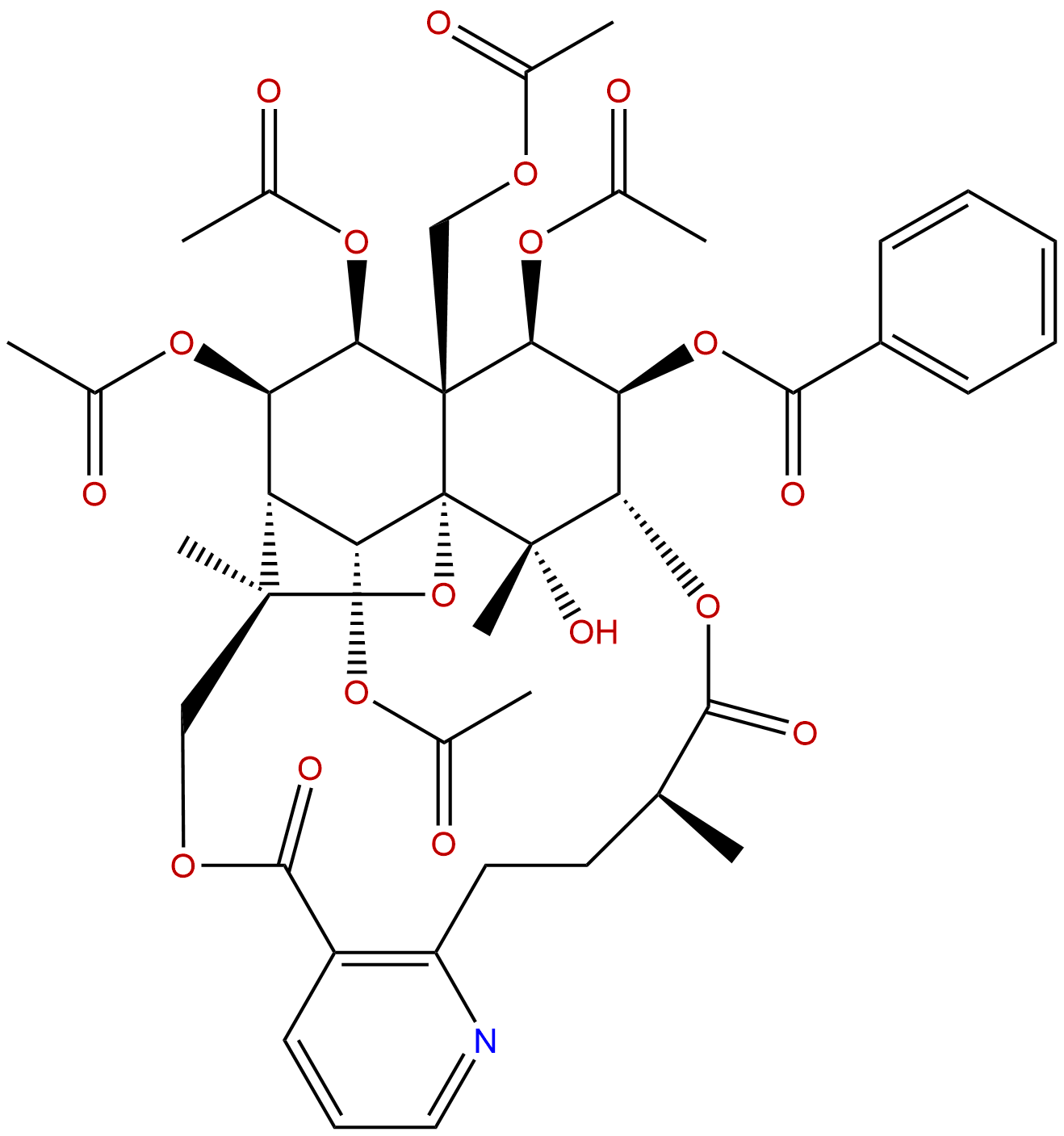


Product name: Wilforine
Synonym name:
Catalogue No.: BP1588
Cas No.: 11088-09-8
Formula: C43H49NO18
Mol Weight: 867.854
Botanical Source: Alkaloid from Tripterygium wilfordii and Maytenus senegalensis (Celastraceae)
Physical Description: Powder
Type of Compound: Sesquiterpenoids
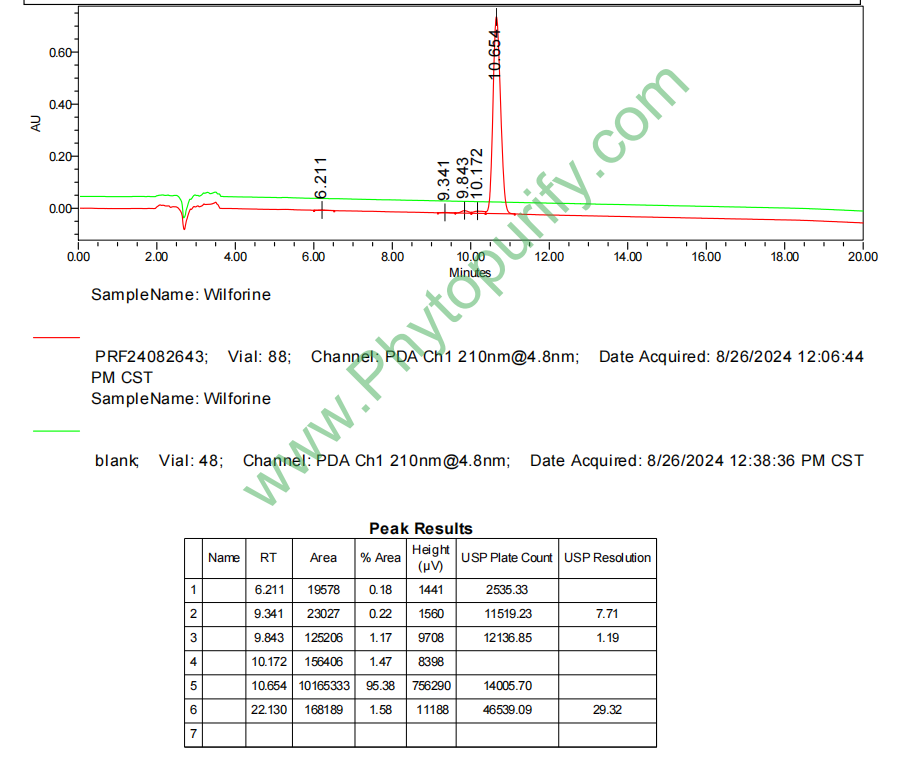
Purity: 95%~99%
Analysis Method: HPLC-DAD or/and HPLC-ELSD
Identification Method: Mass, NMR
Packing: Brown vial or HDPE plastic bottle
The product could be supplied from milligrams to grams. Inquire for bulk scale.
We provide solution to improve the water-solubility of compounds, thereby facilitating the variety of activity tests and clinic uses.
For Reference Standard and R&D, Not for Human Use Directly.
Description:
Wilforine has anti-inflammatory effect, which might be mediated by down-regulation of the expression of inflammatory factors TNF-α, IL-6 and NO. It also has insecticidal activity by inhibiting the Na+-K+-ATPase in the central nervous system.
References:
J Microbiol Biotechnol. 2014 Jun 28;24(6):823-34.
Establishment of Tripterygium wilfordii Hook. f. Hairy root culture and optimization of its culture conditions for the production of triptolide and wilforine.
METHODS AND RESULTS:
In order to solve the shortage of natural Tripterygium wilfordii Hook. f. plant resource for the production of the important secondary metabolites triptolide and Wilforine, hairy roots were induced from its root calli by Agrobacterium rhizogenes. Induced hairy roots not only could be maintained and grown well in hormone-free half-strength Murashige and Skoog medium but also could produce sufficient amounts of both triptolide and Wilforine. Although hairy roots produced approximately 15% less triptolide than adventitious roots and 10% less Wilforine than naturally grown roots, they could grow fast and could be a suitable system for producing both secondary metabolites compared with other tissues. Addition of 50 micrometer methyl jasmonate (MeJA) could slightly affect hairy root growth, but dramatically stimulated the production of both triptolide and Wilforine, whereas 50 micrometer salicylic acid had no apparent effect on hairy root growth with slightly stimulatory effects on the production of both secondary metabolites. Addition of precursor nicotinic acid, isoleucine, or aspartic acid at the concentration of 500 micrometer had varying effects on hairy root growth, but none of them had stimulatory effects on triptolide production, and only the former two had slightly beneficial effects on Wilforine production. The majority of triptolide produced was secreted into the medium, whereas most of the produced Wilforine was retained inside of hairy roots.
CONCLUSIONS:
Our studies provide a promising way to produce triptolide and Wilforine in T. wilfordii hairy root cultures combined with MeJA treatment.
HPLC of Wilforine
Storage conditions:Short-term storage at 2~8℃, long-term storage at -20 ~ -80℃
252.7500
2.2767
2.2769
.0118
.7854
3.5787
Low
80.2081
7.5251
No
No
No
No
No
No
0.0
Yes
No
Yes
Yes
Natural products, as an important source of drug discovery, play an irreplaceable role in the history of human disease treatment. Among them, it originates from the traditional Chinese medicine Tripterygium wilfordii(Tripterygium wilfordii Hook. f.'s various bioactive ingredients have attracted much attention due to their significant immunosuppressive and anti-inflammatory effects. Wilforine (CAS number: 11088-09-8) is a sesquiterpene pyridine alkaloid with a complex chemical structure isolated from Tripterygium wilfordii, belonging to the class of dihydroagarfuran sesquiterpene macrolides. Early research mainly focused on its potential as a plant-based insecticide, but in recent years, with the deepening of pharmacological research, the biological activities of Tripterygium wilfordii alkaloids in anti-inflammatory, immune regulation, and anti fibrosis have gradually been revealed, especially in the treatment of major chronic diseases such as rheumatoid arthritis and pulmonary fibrosis, showing broad application prospects. This article aims to systematically review the chemical characteristics, plant sources, pharmacological activities, mechanisms of action, pharmacological evaluation, and clinical application potential of Tripterygium wilfordii alkaloids, in order to provide comprehensive scientific references for the in-depth research and development of this natural product.
Tripterygium wilfordii alkaloids are complex organic heterocyclic compounds with a chemical formula of C43H49NO18 and a molecular weight of 867.8540. Its core skeleton is dihydroagarofuran sesquiterpene, which connects multiple substituent groups through ester bonds to form a pyridine alkaloid with macrocyclic lactone characteristics. The structure contains a pyridine ring, multiple benzoate and acetate groups, which have a decisive impact on its biological activity and physicochemical properties.
From the analysis of parameters related to drug properties, the lipid water partition coefficient (LogP) of Tripterygium wilfordii alkaloids is 2.2767, indicating that they have a certain degree of lipophilicity but are not highly hydrophobic. Its topological polar surface area (TPSA) is as high as 252.7500 Å ², mainly due to the presence of a large number of ester bonds and heteroatoms (O, N) in the molecule, resulting in high molecular polarity. This characteristic also affects its water solubility, with a calculated value of only 0.0118 mg/mL, making it a poorly soluble compound. The high TPSA and low water solubility jointly determine its limited transmembrane transport capacity, and oral bioavailability may face challenges. In terms of preliminary safety prediction, the compound's lack of inhibition on hERG potassium channels suggests a low risk of cardiac toxicity. The Ames test result of 0.0 indicates that it is non mutagenic, providing a favorable safety starting point for its further development. In addition, its blood-brain barrier permeability is predicted to be "low", indicating that it may not easily enter the central nervous system, which may help reduce central nervous system side effects for treatments primarily targeting peripheral system diseases such as rheumatoid arthritis.
Tripterygium wilfordii alkaloids mainly come from the plant Tripterygium wilfordii in the family Celastraceae(Tripterygium wilfordii)The root bark also has a small distribution in the stem and leaves. As a traditional Chinese medicine, Tripterygium wilfordii has a history of hundreds of years of application, mainly used to treat autoimmune and inflammatory diseases such as rheumatoid arthritis, nephritis, and skin diseases.
The extraction and separation of Tripterygium wilfordii alkaloids is a complex process that usually follows the following steps:
1. Extract Organic solvents such as ethanol, methanol, or chloroform are commonly used for reflux extraction or cold soaking extraction of dried Thunder God Vine root bark powder. Ethanol is a commonly used extraction solvent due to its relatively low toxicity and high extraction efficiency. In recent years, modern technologies such as ultrasound assisted extraction and microwave-assisted extraction have also been applied to improve extraction efficiency and shorten extraction time.
2. Rough classification The extract obtained by concentrating the extract is extracted sequentially with solvents of different polarities such as petroleum ether, ethyl acetate, and n-butanol. Tripterygium wilfordii alkaloids are mainly enriched in the ethyl acetate or n-butanol extraction sites.
3. Separation and Purification: The active site is further separated by column chromatography. Common fillers include silica gel, reverse silica gel (such as ODS), macroporous adsorption resin (such as D101) and dextran gel (such as Sephadex LH-20). By repeated column chromatography, combined with thin layer chromatography (TLC) or high-performance liquid chromatography (HPLC) for monitoring and guidance, high-purity Tripterygium wilfordii alkaloid monomer can ultimately be isolated. Preparation based high-performance liquid chromatography (prep HPLC) is currently the most effective method for obtaining high-purity standard samples.
4. appraisal The purified compound was structurally confirmed by spectroscopic techniques such as nuclear magnetic resonance (NMR, including 1H-NMR, 13C-NMR, 2D-NMR), mass spectrometry (MS), infrared spectroscopy (IR), and ultraviolet spectroscopy (UV).
Due to the complex alkaloid composition and numerous structurally similar compounds in Tripterygium wilfordii, isolation and purification are difficult, which is also one of the bottlenecks restricting its in-depth research and development. Therefore, developing efficient and environmentally friendly extraction and separation processes, as well as exploring the production of Tripterygium wilfordii alkaloids through synthetic biology or cell culture techniques, are important research directions for the future.
The pharmacological activity research of Tripterygium wilfordii alkaloids has expanded from early insecticidal activity to a wide range of biomedical fields, with its core activities focused on anti-inflammatory, immunomodulatory, and anti fibrotic aspects.
The pharmacological effects of Tripterygium wilfordii alkaloids involve a complex regulatory network of multiple targets and pathways, especially in the pathological stage of rheumatoid arthritis (RA). According to existing research, its mechanism of action mainly revolves around the following key targets and pathways:
In summary, Tripterygium wilfordii alkaloids synergistically act on multiple targets such as AMPK, TLR4, STAT3, IDO1, forming a comprehensive network that inhibits inflammation initiation, blocks signal transduction, regulates immune balance, and protects tissue structure. This may be the molecular basis for its treatment of complex diseases such as RA and pulmonary fibrosis.
Although the pharmacological activity of Tripterygium wilfordii alkaloids is clear, their drug like and pharmacokinetic (PK) properties are obstacles that must be overcome for their clinical application.
In order to improve its pharmacological properties, future research focuses should include developing novel drug delivery systems (such as nanocrystals, liposomes, solid dispersions, self microemulsions, etc.) to enhance solubility and bioavailability; Conduct systematic pharmacokinetic pharmacodynamic (PK-PD) correlation studies; And conduct comprehensive preclinical safety evaluations.
The clinical application prospects of Tripterygium wilfordii alkaloids are mainly based on their significant therapeutic effects on autoimmune diseases and fibrotic diseases.
Potential indications:
Development Strategy and Challenges:
prospect With the continuous deepening of understanding of the mechanism of action of Tripterygium wilfordii alkaloids, as well as the development of drug delivery technology and synthetic biology, this ancient natural molecule is showing new vitality. In the future, through interdisciplinary collaboration and ensuring safety and effectiveness, Tripterygium wilfordii alkaloids are expected to move from the laboratory to clinical practice, providing new treatment options for numerous patients with refractory immune inflammatory and fibrotic diseases.
As a representative sesquiterpene pyridine alkaloid in Tripterygium wilfordii, Tripterygium wilfordii alkaloids have shown great research value and application potential in the fields of anti-inflammatory, immune regulation, and anti fibrosis due to their unique chemical structure and multi-target pharmacological activity. From a chemical structure perspective, it is a complex molecule that presents both physical and chemical challenges as well as opportunities for biological activity; From a pharmacological perspective, it forms a synergistic network by regulating key signaling pathways such as AMPK, TLR4/NF - κ B, JAK/STAT. Although its poor pharmacological properties and potential toxicity are currently the main bottlenecks in development, this also provides clear optimization directions for pharmaceutical chemistry, pharmacy, and pharmacology research. In summary, Tripterygium wilfordii alkaloids are a highly promising natural product lead compound, and their further in-depth research and transformation development not only help to explore the modern scientific connotation of traditional Chinese medicine, but also may bring new breakthroughs to the treatment of major chronic diseases worldwide.
