South American toad venom (Marinobufagin): exploration of new targets for heart failure treatment from toad venom
1. Overview
Marinobufagin (CAS number: 470-42-8) is an important bioactive substance cardiotonic steroid The compound belongs to the bufadinolide family of toads. It originated from species of toads in South America, such as the sea toad(Bufo marinus, now known as Rhinella marina)And Bufo rubescens It was isolated from the venom of toad venom. Similar to well-known cardiac glycoside drugs such as digoxin, South American toad venom is proficient in inhibiting the growth of cells on the cell membrane Na+/K+- ATPase The sodium potassium pump exerts its cardiotonic effect. However, unlike plant derived cardiac glycosides, it functions as a endogenous Steroid hormones have also been found to exist in mammals (including humans), opening up a new perspective for the study of their physiological and pathological significance.
In recent years, research on South American toad venom has expanded from traditional toxicology and natural product chemistry to areas such as cardiovascular physiology, the pathogenesis of hypertension and heart failure. It has been proven to be effective Vasoconstrictor And it can regulate fluid balance. Of particular note, studies have shown that its levels are elevated in various cardiovascular disease models, such as salt sensitive hypertension and preeclampsia, suggesting that it may not only be an exogenous toxin, but also an endogenous regulatory factor involved in the disease process. Therefore, the South American toad venom essence and its target Na+/K+- ATPase are becoming popular research targets for developing new drugs for the treatment of heart failure and hypertension. This article will systematically elaborate on this unique natural product from the aspects of its chemical structure, source, pharmacological mechanism, drug evaluation, and research prospects.
2. Chemical structure and physicochemical properties
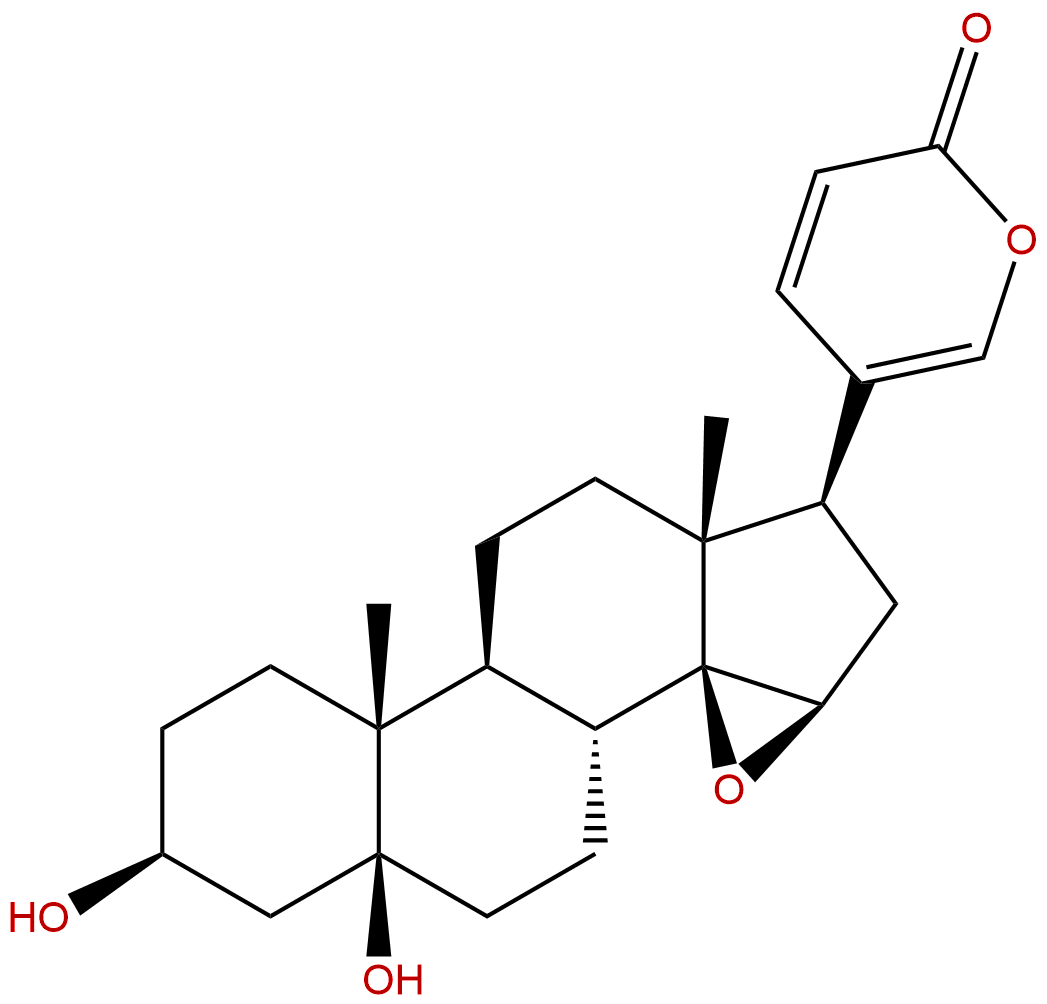
The molecular formula of South American toad venom is C24H32O5 The molecular weight is 400.5150 g/mol Its structure belongs to 5 β - toad dihydroxylactone This is its characteristic steroid skeleton: a steroid nucleus (cyclopentane dihydrophenanthrene) is connected to an unsaturated hexagonal lactone ring (α - pyranone ring) at position C-17. This structure is the basis of its strong cardiac activity. SMILES string(C[C@]12CC[C@H](O)C[C@@]1(O)CC[C@@H]1[C@@H]2CC[C@]2(C)[C@@H](c3ccc(=O)oc3)C[C@H]3O[C@]132)Accurately describing its complex stereochemical configuration, including multiple chiral centers, is crucial for its specific binding to target proteins.
From the analysis of drug parameters, it can be concluded that The coefficient of lipid water partition (LogP) is approximately 2.97 This indicates that the compound has moderate lipophilicity, which is beneficial for its penetration into cell membranes.The topological polar surface area (TPSA) is 83.2 Å ²Relatively low, this usually benefits the membrane permeability and oral absorption of the compound. its Low water solubility (approximately 0.0127 mg/mL)This is a common characteristic of many steroid compounds, which may need to be improved through salt formation or the use of solubilizers in formulation development. The key pharmacokinetic parameters show that The permeability of Caco-2 cells is 5.54 (× 10 ⁻⁶ cm/s)Belongs to highly permeable compounds;Prediction of blood-brain barrier (BBB) penetration as' high 'This means that it may be able to enter the central nervous system, which could provide opportunities for treating central related diseases and increase the risk of neurotoxicity.The plasma protein binding rate (PPB) is as high as 82.5%This will affect its free drug concentration and internal distribution volume.
3. Plant sources and traditional applications
Strictly speaking, South American toad venom is not derived from plants, but from animal derived products. Its main source is Chansu That is, the dry secretions of the ear glands and skin glands of toads (especially various species of Bufonidae). In traditional Chinese medicine classics, toad venom is recorded to have the effects of detoxification, pain relief, and awakening the mind. It is commonly used to treat conditions such as carbuncle, sore throat, heat stroke, and dizziness. In traditional medicine, toad venom is often used in extremely small doses as medicine or topically. Due to its narrow therapeutic window and high toxicity, its use requires extreme caution.
As one of the various active bufogenins in toad venom, South American bufogenin is the main toxic and active ingredient. Ancient people may not have been aware of its specific chemical entity, but they gained experience in utilizing its psychoactive effects through practice. The history of discovering cardiac stimulants from toxic biological secretions is similar to the process of discovering digoxin from foxglove. Modern pharmacological research has revealed the material basis of these traditional applications, namely the powerful effects of bufotoxin based compounds in toad venom on the heart. However, compared to digitalis derivatives, bufotoxin based compounds have stronger effects and greater toxicity, which limits their direct development as drugs, but also inspires researchers to conduct in-depth research on their mechanisms of action and structural optimization to separate efficacy and toxicity.
4. Pharmacological activity and mechanism of action
The core pharmacological activity of South American toad venom essence is Heart strengthening effect Its mechanism of action is similar to classical cardiac glycoside drugs, but it also has its unique features.
4.1 Main target: Na+/K+- ATPase
South American toad venom is clearly classified as EC 3.6.3.9 (Na+/K+- ATPase) inhibitor Na+/K+- ATPase is a key ion transport protein present on almost all animal cell membranes. It utilizes the energy generated by ATP hydrolysis to pump 3 Na+ions out of the cell and 2 K+ions into the cell, thereby maintaining the resting membrane potential and ion homeostasis of the cell.
South American toad venom binds with high affinity to the extracellular region of the alpha subunit of Na+/K+- ATPase. Its binding results in partial inhibition of the enzyme's function. In myocardial cells, this inhibition produces a series of chain reactions:
1. Temporary increase in intracellular Na+concentration Due to the obstruction of Na+pumping.
2. Na+/Ca ²+Exchange Complex (NCX) Reverse Mode Activation The elevated intracellular Na+reduces the transmembrane Na+concentration gradient, driving NCX to transport more Ca ²+into the cell (or reduce Ca ²+efflux).
3. Elevated intracellular Ca ²+concentration The Ca ²+stored in the sarcoplasmic reticulum increases and releases more Ca ²+upon action potential triggering.
4. Enhanced myocardial contractility (positive inotropic effect)The increase in intracellular Ca ²+concentration enhances the sensitivity of myocardial filaments to Ca ²+, resulting in stronger myocardial contraction.
4.2 Target subtype specificity
The database shows that the targets of South American toad venom include ATP1A1、ATP1A2、ATP1B1、ATP1B3、ATP1B2 These are different subtypes of Na+/K+- ATPase:
- Alpha subunit (ATP1A)It is a catalytic subunit and also the main binding site for ligands (such as South American toad venom). ATP1A1 is widely expressed, while ATP1A2 is mainly expressed in heart and brain tissues. Different subtypes have varying sensitivities to cardiac steroids.
- β subunit (ATP1B)It is a regulatory subunit involved in the membrane localization and stability of enzymes.
The selectivity of South American toad venom towards specific subtypes may determine its different effects in the heart, blood vessels, kidneys, and central nervous system.
4.3 Association with heart failure
heart failure It is the most relevant disease in the study of South American toad venom. Traditionally, cardiac glycosides (such as digoxin) enhance the contractility of failing hearts and improve symptoms through the aforementioned mechanisms. As an endogenous substance, the level of South American toad venom may change in patients with heart failure. Some studies suggest that under certain pathological conditions (such as excessive capacity load), the body may compensatorily produce more endogenous cardiac steroids (including South American bufotalin) to maintain cardiac output. However, long-term high levels will lead to sustained inhibition of Na+/K+- ATPase, leading to intracellular Ca ²+overload (leading to arrhythmia), continuous vasoconstriction (increasing afterload) and renal sodium retention (increasing preload), which will instead exacerbate the vicious cycle of heart failure. Therefore, regulating the Na+/K+- ATPase axis of South American toad venom (such as using its antibodies or receptor antagonists) has become a new strategy for treating certain types of heart failure, especially those related to volume overload.
4.4 Other pharmacological effects
- Vasoconstrictive effect By inhibiting Na+/K+- ATPase on vascular smooth muscle cells, it causes an increase in intracellular Ca ²+similar to myocardial cells, leading to vascular constriction. This is related to its role in the pathology of hypertension.
- The complex effects of diuresis/antidiuretic therapy In the kidneys, low-dose may produce diuretic effects by affecting ion transport in renal tubular epithelium, while high-dose or pathological effects are more complex.
- As an endogenous hormone It is classified as a steroid hormone and may exert a broader cellular regulatory effect through signaling pathways other than Na+/K+- ATPase, such as activating non pump functions such as Src kinase, affecting processes such as cell proliferation and fibrosis.
5. Evaluation of drug properties
Based on the provided pharmacological parameters, we can conduct a preliminary evaluation of the potential of South American bufotalin as a drug lead compound, and combine it with Lipinski's Five Rules Conduct analysis.
Lipinski Rule of Five Evaluation:
1. Molecular weight (MW)<500 Da:400.5 Da, Comply with。
2. Lipid water partition coefficient (LogP)<5:2.97, compliant。
3. Hydrogen bond donor (HBD) number<5: According to the structural formula, there are 2 hydroxyl groups (OH),HBD=2, Comply with。
4. The number of hydrogen bond acceptors (HBA) is less than 10: there are 5 oxygen atoms (O) in the molecule,HBA=5, Comply with。
South American toad venom fully complies with Lipinski's five rules, indicating that it has good properties Oral absorption potential。
Specific parameter analysis:
- Permeability and absorption The high Caco-2 permeability (5.54) and effective Peff value (2.99) further confirm its good intestinal absorption potential. Moderate LogP and lower TPSA are key to achieving high permeability.
- distribution High BBB penetration is its prominent feature. This is an advantage for drugs aimed at targeting the central nervous system, but it also means that close attention needs to be paid to the central side effects (such as nausea, vomiting, visual impairment, and other common central toxicity of cardiac glycosides). A high plasma protein binding rate (82.5%) can affect the onset and duration of drug efficacy.
- Metabolism and toxicity This is the main challenge in the commercialization of South American toad venom extract.
- Genotoxicity The data shows that it chromosome aberration The test is positive ("yes"), which is a serious issue Red Alert This indicates that South American toad venom may have genotoxicity, damage DNA, and pose a potential carcinogenic risk, greatly limiting its direct development as a drug.
- Ames test Negative (0.0) indicates no mutagenicity, but chromosomal abnormalities are more clinically relevant.
- HERG inhibition'No' is a positive signal indicating a lower risk of causing QT interval prolongation and apical torsion ventricular tachycardia in the heart, but this does not rule out the possibility of arrhythmia through other mechanisms such as intracellular Ca ²+overload.
- Organ toxicity Data shows that it may cause Serum alkaline phosphatase (Ser_LK) and alanine aminotransferase (Ser_LT) Elevated, indicating potential risk of liver damage.
- Feasibility of synthesis The SyneAccessibility score (5.26) reflects a moderate level of difficulty in synthesizing or obtaining from natural sources.
Summary South American Toad Venom Pharmacokinetic properties (ADME) It performs well in terms of oral absorption and distribution characteristics. However, it Toxicity characteristics Especially the potential Genotoxicity and hepatotoxicity This poses a significant and potentially insurmountable obstacle to its direct development as a drug. Therefore, it is more suitable as Pharmacological tool compounds and Lead structures for drug design Future research directions should focus on utilizing Structural modification By retaining its strong cardiac activity while eliminating or significantly reducing its genotoxicity and other toxicities, rational drug design is achieved through "toxicity stripping".
6. Research Status and Application Prospects
At present, research on South American toad venom mainly focuses on the following directions:
- As a disease biomarker A large number of preclinical and clinical studies are exploring the use of South American bufogenin Salt sensitive hypertension, preeclampsia, and heart failure associated with chronic kidney disease Waiting for changes in the level of illness. Using it as a biomarker for predicting disease progression, evaluating therapeutic efficacy, or distinguishing disease subtypes is an important direction with significant clinical translational value.
- Elucidate its endogenous physiological and pathological roles Studying its secretion regulation mechanism under normal fluid regulation and stress state, as well as its impact on cell growth, fibrosis, and inflammation through the "signal transduction" function (non pump function) of Na+/K+- ATPase, will help to deepen the understanding of the pathogenesis of related diseases.
- Developing therapeutic antibodies Given its endogenous pathogenic effects, researchers have attempted to develop specificity for South American bufotalin neutralizing antibody In animal models, such antibodies can effectively lower blood pressure, alleviate cardiac fibrosis, and improve kidney function, providing a novel biological treatment strategy for diseases associated with elevated levels.
- Structure based drug design Using South American toad venom as a template, structural optimization and modification were carried out to obtain a novel small molecule Na+/K+- ATPase regulator with comparable or superior activity but significantly reduced toxicity. This is the classic path for the development of new natural product drugs.
- Exploring new therapeutic fields In recent years, studies have suggested that cardiac steroids may have selective toxicity to certain cancer cells, and the anti-tumor activity of South American toad venom is also being explored. However, the genetic toxicity risk of this direction requires extra caution.
Application Prospects The possibility of directly using South American toad venom as a drug is extremely low, but its scientific value is beyond doubt. It is like a double-edged sword, both for understanding cardiovascular physiology and pathology Key Key It is also a warning of the toxicity risks of natural products Typical Example The most likely application prospects include: ① South American Toad Venom Neutralizing Antibody Becoming a new drug for treating specific cardiovascular and kidney diseases; ② Starting from it, developed through modern medicinal chemistry methods Safe and effective derivative compounds③ Use it as Biomarkers accompanying diagnosis Used to guide personalized treatment. In summary, the continuous research on South American toad venom will continue to drive progress in our understanding of cardiac drugs, endogenous regulatory factors, and disease mechanisms.