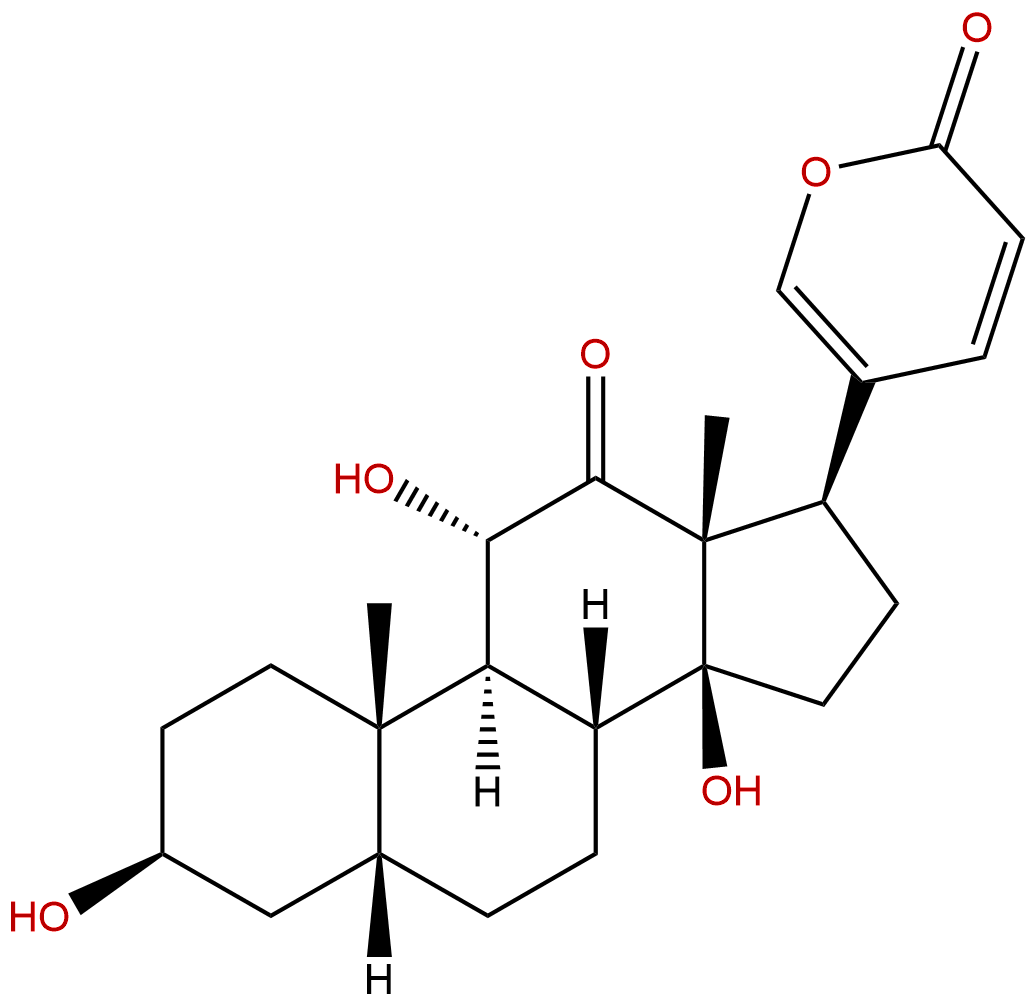


Synonym name: Arenobufogenin
Catalogue No.: BP0190
Cas No.: 464-74-4
Formula: C24H32O6
Mol Weight: 416.514
Botanical Source: secretion of Bufo arenarum
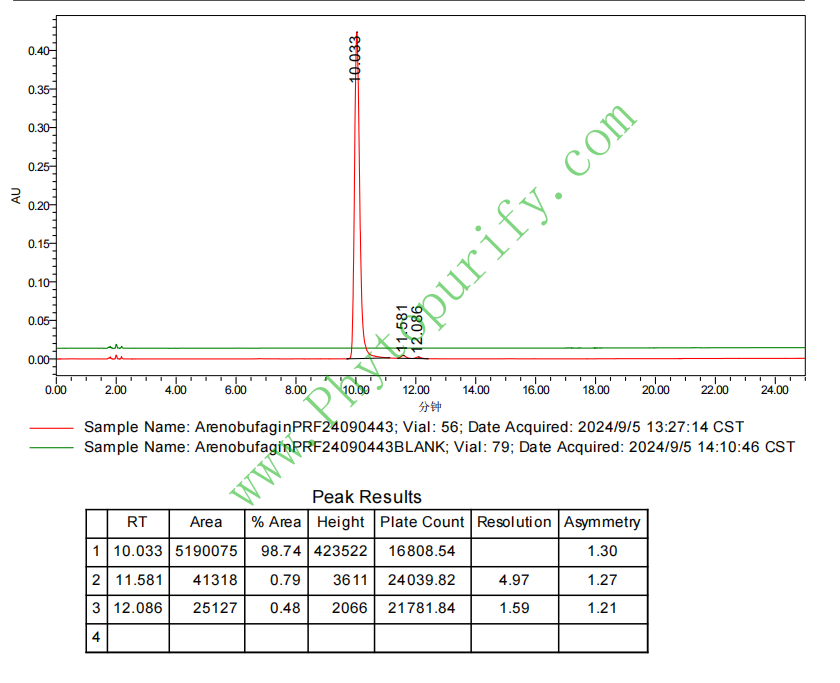
Purity: 95%~99%
Analysis Method: HPLC-DAD or/and HPLC-ELSD
Identification Method: Mass, NMR
Packing: Brown vial or HDPE plastic bottle
Can be supplied from milligrams to grams.
For Reference Standard and R&D, Not for Human Use Directly.
Inquire for bulk scale.
Description:
Arenobufagin is a potent Na + /K + pump inhibitor, and is also a specific inhibitor of VEGF-mediated angiogenesis. Arenobufagin has antineoplastic effect that involves cross talk between apoptosis and autophagy via inhibition of the PI3K/Akt/mTOR pathway.
References:
Carcinogenesis. 2013 Jun;34(6):1331-42.
Arenobufagin, a natural bufadienolide from toad venom, induces apoptosis and autophagy in human hepatocellular carcinoma cells through inhibition of PI3K/Akt/mTOR pathway.
Hepatocellular carcinoma (HCC) is a deadly form of cancer without effective chemotherapy so far. Currently, only sorafenib, a multitargeted tyrosine kinase inhibitor, slightly improves survival in HCC patients.
METHODS AND RESULTS:
In searching for natural anti-HCC components from toad venom, which is frequently used in the treatment of liver cancer in traditional Chinese medicine, we discovered that Arenobufagin, a bufadienolide from toad venom, had potent antineoplastic activity against HCC HepG2 cells as well as corresponding multidrug-resistant HepG2/ADM cells. We found that Arenobufagin induced mitochondria-mediated apoptosis in HCC cells, with decreasing mitochondrial potential, as well as increasing Bax/Bcl-2 expression ratio, Bax translocation from cytosol to mitochondria. Arenobufagin also induced autophagy in HepG2/ADM cells. Autophagy-specific inhibitors (3-methyladenine, chloroquine and bafilomycin A1) or Beclin1 and Atg 5 small interfering RNAs (siRNAs) enhanced Arenobufagin-induced apoptosis, indicating that Arenobufagin-mediated autophagy may protect HepG2/ADM cells from undergoing apoptotic cell death. In addition, we observed the inhibition of phosphatidylinositol 3-kinase (PI3K)/Akt/mammalian target of rapamycin (mTOR) pathway by Arenobufagin. Interestingly, inhibition of mTOR by rapamycin or siRNA duplexes augmented Arenobufagin-induced apoptosis and autophagy. Finally, Arenobufagin inhibited the growth of HepG2/ADM xenograft tumors, which were associated with poly (ADP-ribose) polymerase cleavage, light chain 3-II activation and mTOR inhibition.
CONCLUSIONS:
In summary, we first demonstrated the antineoplastic effect of Arenobufagin on HCC cells both in vitro and in vivo. We elucidated the underlying antineoplastic mechanisms of Arenobufagin that involve cross talk between apoptosis and autophagy via inhibition of the PI3K/Akt/mTOR pathway. This study may provide a rationale for future clinical application using Arenobufagin as a chemotherapeutic agent for HCC.
J Chromatogr B Analyt Technol Biomed Life Sci. 2013 Nov 15;939:86-91.
Quantitative determination of arenobufagin in rat plasma by ultra fast liquid chromatography-tandem mass spectrometry and its application in a pharmacokinetic study.
A rapid, sensitive, and selective ultra fast liquid chromatography-tandem mass spectrometry method was developed for quantitative determination of Arenobufagin in rat plasma.
METHODS AND RESULTS:
Sample pretreatment involved a one-step protein precipitation with methanol using 0.1mL rat plasma. The separation was carried out on a Shim-pack XR-ODS II (75mm×2.0mm, i.d. 2.1μm) column with gradient elution at a flow rate of 0.30mLmin(-1). The mobile phase was acetonitrile and 0.1% formic acid in water. A post-column switching valve was applied to reduce the matrix effect. The detection was performed on a triple-quadruple tandem mass spectrometer in the multiple reaction monitoring mode after electrospray ionization. Linear calibration curves for Arenobufagin were obtained over the concentration range 1.056-1056ngmL(-1), with a lower limit of quantification of 1.056ngmL(-1). The intra-day and inter-day precision values were lower than 15% and the accuracy ranged from 5.4% to 9.8% at all quality control levels.
CONCLUSIONS:
The method was successfully applied to the determination and pharmacokinetic study of Arenobufagin in rat plasma following intraperitoneal administration.
HPLC of Arenobufagin
Storage conditions:Short-term storage at 2~8℃, long-term storage at -20 ~ -80℃
Arenobufagin (CAS number: 464-74-4) is a typical natural product of bufadienolactones, belonging to the steroid lactone family. Its structure is closely related to butyrolactone and has significant biological activity, especially in the field of tumor treatment, showing extremely high research value. In recent years, with the deepening development of natural product pharmacology, sand toad venom essence has become one of the hotspots in the development of anti-tumor drugs due to its unique pharmacological mechanism and multi-target regulatory ability. This article systematically reviews the latest research progress on the chemical structure and physicochemical properties, sources and extraction methods, pharmacological activity and mechanism of action, pharmacological evaluation, clinical application prospects, etc. of sand toad venom essence, aiming to provide theoretical basis and reference for further research and development of this compound.
Sha Chan Poison Essence is a typical steroid lactone with a molecular formula of C24H34O6 and a molecular weight of 416.51. Its structural core is a typical four ring steroid skeleton with lactone rings and multiple hydroxyl groups, endowing it with high stereoselectivity and biological activity. Its LogP value is 1.76, indicating moderate lipid solubility, which is beneficial for membrane penetration. The topological polar surface area (TPSA) is 107.28 Å ², and the number of hydrogen bond acceptors is 6, indicating its strong hydrophilicity and binding potential in intermolecular interactions. Sand toad venom is difficult to penetrate the blood-brain barrier (BBB), which to some extent reduces the risk of central nervous system toxicity, but also limits its application in central nervous system diseases.
It is worth noting that sand toad venom has a risk of cardiac toxicity, manifested by hERG channel inhibitory activity, which suggests that it needs to focus on cardiac safety evaluation in the drug development process. In addition, the hepatotoxicity and genotoxicity (Ames test results) are not yet clear and require further systematic research.
Sand toad venom mainly comes from the secretion of the venom glands of toads (Bufo spp.), especially the skin venom of species such as Chinese toads (Bufo gargarizans) and black spotted toads (Bufo melanostictus), which are rich in content. Toad venom, as an important component of the traditional Chinese medicinal herb "Chansu", has a long history and wide medicinal value.
The extraction method usually includes the following steps: first, collect fresh toad venom, dry it, and extract it with organic solvents (such as methanol, ethanol); Subsequently, liquid-liquid distribution and column chromatography (silica gel, reverse phase C18 column) techniques were used for separation and purification; Finally, the purity and structure were confirmed by modern analytical methods such as high-performance liquid chromatography (HPLC) and mass spectrometry (MS). In recent years, the application of ultrasound assisted extraction and microwave-assisted extraction technologies has improved extraction efficiency and purity, reduced production costs, and provided technical support for the large-scale preparation of sand toad venom essence.
Sand toad venom extract, as a natural bufadienolide, exhibits significant anti-tumor activity. A large number of in vitro cell experiments and in vivo animal model studies have shown that salvianolic acid has inhibitory effects on various tumor cells, especially hepatocellular carcinoma (HepG2) and its multidrug-resistant strains (HepG2/ADM), which exhibit high sensitivity. Its anti-tumor effects include:
Inducing cell apoptosis Sha Chan Poison Essence promotes programmed cell death of tumor cells by activating endogenous apoptosis pathways, manifested as loss of mitochondrial membrane potential, increased generation of reactive oxygen species (ROS), and upregulation of apoptosis related proteins (such as Caspase-3, Bax) expression.
Regulating autophagy Sand toad venom can induce autophagy in tumor cells, regulate the expression of autophagy related proteins (LC3-II, Beclin-1), promote the clearance of intracellular metabolic waste, and enhance cell mortality.
Inhibit cell proliferation and migration By blocking key cell cycle proteins, inhibiting tumor cell proliferation, and reducing cell migration and invasion ability.
Angiogenesis is a crucial process for tumor growth and metastasis. As a VEGF mediated angiogenesis specific inhibitor, Sha Chan Poison Essence can significantly inhibit the proliferation, migration, and lumen formation of vascular endothelial cells. Its mechanism of action mainly involves inhibiting the VEGFR-2 signaling pathway, blocking the downstream PI3K/Akt/mTOR pathway, reducing the expression of angiogenesis related factors, limiting angiogenesis in the tumor microenvironment, and inhibiting tumor growth.
Although sand toad venom is mainly known for its anti-tumor activity, it has potential regulatory effects on hyperglycemic targets such as EHMT2, AMPK, SGLT2, etc., suggesting that it may have certain application prospects in the field of metabolic diseases. However, current research is relatively limited and further in-depth exploration is needed.
The pharmacological mechanism of Sha Chan Poison Essence is complex, involving multiple signaling pathways and molecular targets, mainly including:
Na+/K+ATPase inhibition
Sha Chan Poison Essence is a potent Na+/K+pump inhibitor that can inhibit the activity of Na+/K+ATPase by binding to its alpha subunit, leading to an increase in intracellular sodium ion concentration and subsequently affecting calcium ion homeostasis, inducing cell apoptosis and necrosis. This mechanism is an important basis for its cytotoxicity and cardiotoxicity.
Inhibition of PI3K/Akt/mTOR signaling pathway
This pathway plays a central regulatory role in cell growth, proliferation, autophagy, and apoptosis. Sha Chan Poison Essence inhibits the activity of PI3K kinase, blocks the phosphorylation of Akt and mTOR, regulates downstream effector molecules, promotes tumor cell apoptosis and autophagy, and inhibits tumor growth.
VEGFR-2 signaling pathway blockade
Sand toad venom specifically inhibits the activation of vascular endothelial growth factor receptor 2 (VEGFR-2), blocks downstream signaling, inhibits angiogenesis, reduces tumor blood supply, and limits tumor spread.
Multi target regulation
In addition to the main targets mentioned above, sand toad venom may also affect various proteins and enzymes related to metabolism, inflammation, and cell cycle, such as EHMT2, UBP2, PAI1, AMPK, SGLT2, etc., demonstrating its multi-target and multi pathway pharmacological properties.
The pharmacological evaluation of Sand Toad Poison Essence shows certain advantages and challenges:
As a natural steroid lactone, Sha Chan Poison Essence has shown broad clinical application prospects due to its significant anti-tumor activity and multi-target regulatory ability. Currently, research on sand toad venom mainly focuses on the treatment of solid tumors such as hepatocellular carcinoma, and has shown outstanding performance in overcoming multidrug resistant tumors, with the potential to become a new type of anti-cancer drug.
Future clinical development should focus on the following aspects:
Security optimization
To address the issue of cardiac toxicity, structural modifications, dosage form optimization, or combination therapy strategies are used to reduce the risk of cardiac toxicity and improve safety.
Drug delivery system development
By utilizing advanced drug delivery technologies such as nanocarriers and liposomes, the bioavailability and targeting of sand toad venom essence can be improved, the anti-tumor effect can be enhanced, and systemic toxic side effects can be reduced.
Multi indication development
Explore its potential applications in metabolic diseases (such as hyperglycemia) and vascular related diseases, in addition to tumors, and broaden the scope of clinical indications.
Clinical trial advancement
Accelerate the transition from preclinical research to clinical trials, systematically evaluate its efficacy, safety, and pharmacokinetic characteristics, and promote it as a clinically available anti-tumor drug.
As a unique natural product of bufadienolactone, Sha Chan Poison Essence exhibits significant anti-tumor activity and anti angiogenic effects due to its potent Na+/K+pump inhibition and multi-target regulation of the PI3K/Akt/mTOR and VEGFR-2 signaling pathways. Its potential in the treatment of hepatocellular carcinoma and multidrug-resistant tumors endows it with significant value as a new generation of anticancer drugs. However, cardiac toxicity and pharmacokinetic properties remain the main challenges for its clinical application. In the future, through structural optimization, delivery system improvement, and interdisciplinary collaborative research, it is expected to promote the clinical translation of sand toad venom and benefit more cancer patients. In summary, as a model for pharmacological research on natural products, sand toad venom extract deserves continuous and in-depth exploration and development.
