Introduction/Overview
Heart failure (HF), as the main manifestation of cardiovascular disease in the end stage worldwide, has become a major public health challenge due to its high incidence rate, high mortality and heavy medical burden. The current standard drug therapy, such as angiotensin-converting enzyme inhibitors, beta blockers, etc., can improve symptoms and delay the course of the disease, but cannot reverse myocardial injury, and some patients may have drug resistance or adverse reactions. Therefore, exploring heart failure treatment drugs with novel mechanisms of action and high efficiency and low toxicity from natural products has always been an important direction for drug development. Cardiotonic glycoside drugs, such as digoxin, were once an important cornerstone in this field. They exert positive inotropic effects by inhibiting Na+/K+- ATPase on the myocardial cell membrane, but their narrow therapeutic window and susceptibility to arrhythmia have limited their widespread application. This has prompted researchers to focus on natural cardiac steroids with diverse structures and unique activities.
Arenobufagin 3-hemisulate (CAS: 30219-16-0) is a natural cardiac active molecule derived from the traditional medicinal animal, toads. As a semi ester derivative of Arenobufagin, it not only inherits the potent positive inotropic effects of bufogenin ligands, but its unique esterification structure may also bring differentiated pharmacological properties and better drug properties. In recent years, with the development of molecular pharmacology and systems biology techniques, the understanding of its mechanism of action has far exceeded traditional Na+/K+- ATPase inhibition, involving multiple pathways such as energy metabolism regulation, epigenetic modification, and oxidative stress regulation, and is associated with multiple potential therapeutic targets such as AMPK, EHMT2, PTPN1, etc. This article aims to systematically review the chemical properties, plant sources, pharmacological activities, multi-target mechanisms of action, pharmacological evaluation, and application prospects in the treatment of heart failure of sand toad venom essence 3-octanedioic acid half ester, in order to provide comprehensive academic references for the in-depth research and development of this compound.
Chemical structure and physicochemical properties
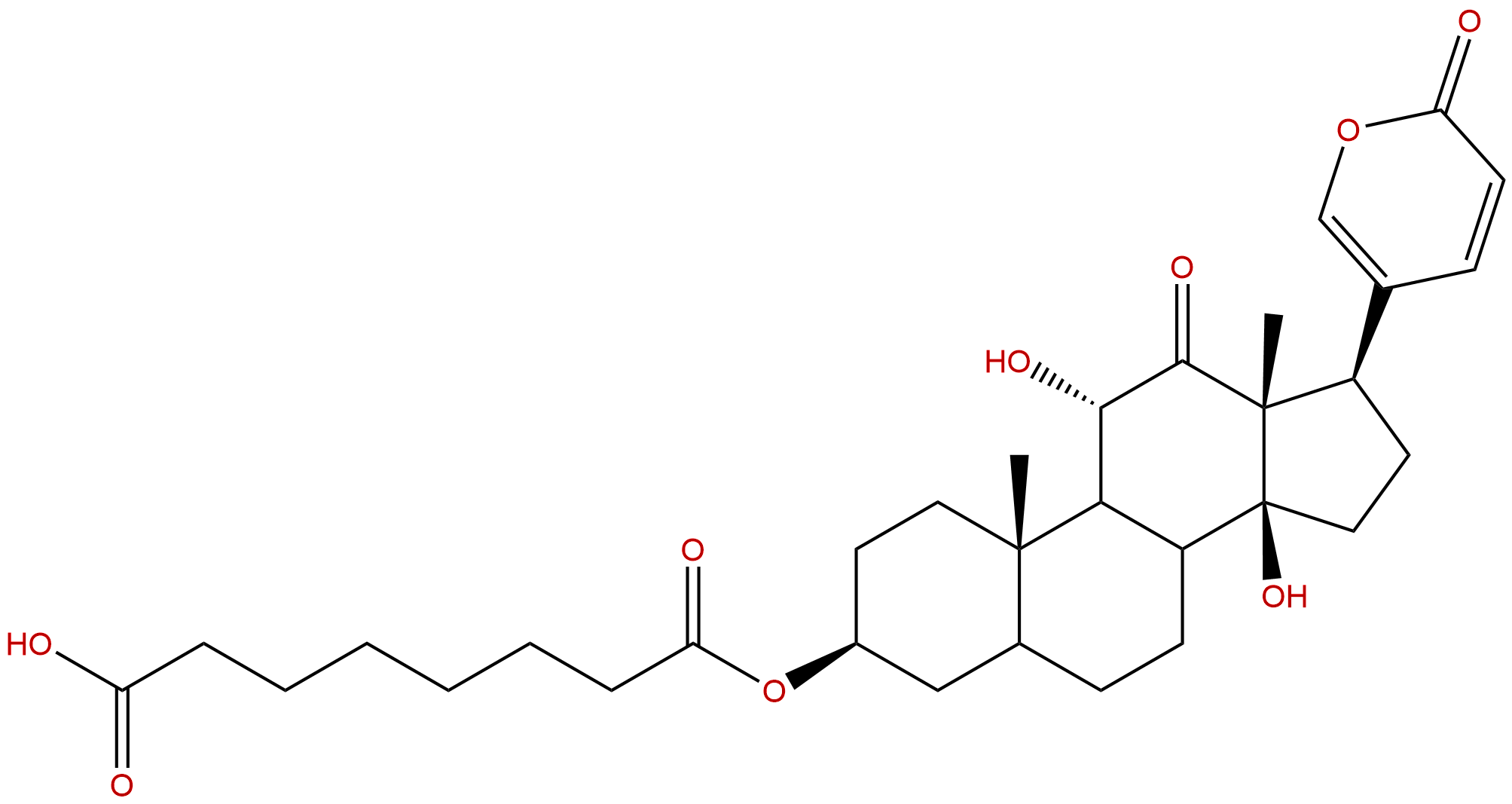
Sand toad venom essence 3-octanedioic acid half ester is a structurally modified toad venom ligand based cardiac steroid compound. The parent nucleus of the sand toad venom belongs to the bufadianolide family and has a classic steroid skeleton: A/B rings are cis fused, B/C rings are trans, C/D rings are cis, and an α - pyrone hexagonal lactone ring is connected at C-17, which is the key pharmacophore for its strong cardiac activity. Compared with the original form of sand toad venom essence, the significant feature of sand toad venom essence 3-octanedioic acid half ester is that its C-3 hydroxyl group forms a half ester bond with suberic acid (1,8-octanedioic acid). This structural modification introduces additional carboxyl groups and longer fatty chains, significantly altering the physicochemical properties of the molecule.
According to the provided pharmacological parameters, its molecular weight is 572.6950, which belongs to the category of medium molecular weight compounds. The calculated LogP value is 3.2705, indicating that the compound has moderate lipophilicity, which facilitates its penetration of cell membranes and binding to targets. However, excessive lipid solubility may also affect water solubility and distribution. Its topological polar surface area (TPSA) is 151.3400 Å ², which is relatively large and mainly derived from multiple oxygen atoms in the molecule (hydroxyl, carbonyl, lactone ring, and oxygen on ester bonds). The water solubility value is 0.0176 (usually measured in mg/mL or mol/L, indicating low solubility), which is consistent with higher LogP values and larger steroid hydrophobic frameworks, suggesting that solubilization strategies may need to be considered in formulation development. These basic physicochemical parameters provide preliminary basis for its subsequent pharmacokinetic behavior and formulation design.
Plant sources and extraction methods
Sand toad venom essence 3-octanedioic acid half ester is not widely present in all toads, it is mainly derived from Japanese toads(Bufo japonicus)Extracted from skin secretions and their glands (such as postauricular glands). Toad skin is a natural 'warehouse' for these active compounds, used to defend against natural enemies. Its extraction and separation is a complex process, usually following the following steps:
- Raw material collection and pretreatment Collect skin secretions or whole glandular tissue of Japanese toads, freeze dry or shade dry them, and crush them into coarse powder.
- Solvent extraction Methanol, ethanol, or alcohol water mixed solvents with different ratios are commonly used to leach or reflux extract crude powder, dissolving lipid soluble and moderately polar toad venom ligand components.
- Preliminary separation After vacuum concentration of the extract, liquid-liquid extraction (such as degreasing with petroleum ether and extracting the target component with chloroform or ethyl acetate) or macroporous adsorption resin columns are used for enrichment and preliminary purification.
- Chromatographic separation and purification This is a crucial step in obtaining high-purity monomers. Silica gel column chromatography is commonly used, with gradient elution using chloroform methanol or petroleum ether ethyl acetate systems in different ratios. Subsequently, fine separation and purification were performed using reverse phase high performance liquid chromatography (RP-HPLC, commonly C18 column, with methanol water or acetonitrile water as mobile phase). Sand toad venom essence 3-octanedioic acid half ester can be separated from other toad venom ligands and analogues based on its polarity and chromatographic behavior.
- Identification and characterization The molecular weight of the purified compound was determined by mass spectrometry (MS), and its detailed structure was analyzed by nuclear magnetic resonance spectroscopy (NMR, including 1H NMR and 13C NMR), especially to confirm the connection position (C-3 position) of the succinic acid half ester, and compared with known literature data or standards for final confirmation.
Modern biotechnology, such as the cultivation of toad glandular cells, provides a potential alternative for the sustainable acquisition of such rare active ingredients, but currently traditional extraction and isolation are still the main methods.
Pharmacological activity research
The core pharmacological activity of sand toad venom essence 3-octanedioic acid half ester revolves around its cardiotonic effect, but recent studies have found that its activity spectrum is more extensive.
-
Heart strengthening and anti heart failure effects This is its most classic and primary activity. In ex vivo cardiac perfusion and animal models of heart failure (such as coronary artery ligation induced heart failure model and doxorubicin induced cardiomyopathy model), shabufalin-3-octanedioic acid half ester showed significant enhancement of myocardial contractility (positive inotropic effect) and improvement of cardiac pumping function. Compared with digoxin, some studies suggest that it may have different potency intensity and duration of action. Its positive inotropic effect does not depend on beta adrenergic receptors and belongs to the non catecholamine class of cardiac stimulants.
-
Antitumor activity Many toad venom based compounds have been reported to have anti-tumor potential. In vitro studies, bufotalin 3-octanoate hemiester showed the effects of birth growth inhibition and apoptosis induction on a variety of tumor cell lines (such as liver cancer, lung cancer, breast cancer cells). The mechanism may involve inducing cell cycle arrest, activating apoptotic signaling pathways, and inhibiting tumor cell migration and invasion. It is worth noting that its targets ABCB1 and ABCG2 are important multidrug resistance proteins, suggesting that this compound may have the potential to reverse tumor multidrug resistance.
-
Neuroprotection and anti-inflammatory activity By acting on targets such as APP (amyloid precursor protein), this compound has shown potential neuroprotective effects in Alzheimer's disease cell models. In addition, by regulating inflammatory mediators such as ALOX15 (lipoxygenase), it may have a certain anti-inflammatory effect, which has positive implications for the chronic low-grade inflammatory state associated with heart failure.
-
Other potential activities The potential role of MAOA (monoamine oxidase A) suggests that it may affect neurotransmitter metabolism; The association with ESR2 (estrogen receptor beta) suggests the possibility of hormone regulatory activity. These diverse activities provide clues for their multi-purpose development, but core research still focuses on the treatment of heart failure.
Mechanism of action and molecular targets
The mechanism of action of Sand Toad Poison Essence 3-Octanedioic Acid Hemiester is complex and exhibits multi-target characteristics, which explains its broad pharmacological activity.
-
Classic target: allosteric regulation of Na+/K+- ATPase (NKA)As a member of the cardiac steroid family, its basic mechanism of action is still related to the inhibition of Na+/K+- ATPase (NKA) on the myocardial cell membrane. Inhibition of NKA leads to an increase in intracellular Na+concentration, which in turn reduces Ca2+efflux or promotes Ca2+influx through Na+/Ca2+exchangers (NCX), ultimately causing the sarcoplasmic reticulum to release more Ca2+and enhance myocardial contraction. However, unlike digoxin and other drugs, the modification of its C-3 position with a half ester of succinic acid may alter the binding affinity and mode with NKA subtypes, resulting in different pharmacological and safety characteristics.
-
Core regulator of energy metabolism: AMPK (PRKAA1) activation Adenosine activated protein kinase (AMPK) is a core sensor for cellular energy homeostasis. Research has shown that sand toad venom essence 3-octanedioic acid half ester can activate AMPK. In heart failure, myocardial energy metabolism disorder (shifting from fatty acid oxidation to glycolysis) is an important pathological link. Activation of AMPK can promote fatty acid oxidation, glucose uptake, and mitochondrial biosynthesis, improve myocardial energy supply, while inhibiting protein synthesis and cell growth to combat pathological myocardial hypertrophy. This provides a metabolic regulatory mechanism beyond simple positive muscle strength for the treatment of heart failure.
-
Epigenetic regulatory target: EHMT2 (G9a) inhibition EHMT2 (often referred to as G9a) is a histone methyltransferase that primarily catalyzes the dimethylation of histone H3 lysine 9 (H3K9me2), typically associated with gene transcriptional repression. Inhibition of EHMT2 can reactivate a series of protective genes that are abnormally silenced in heart failure, such as antioxidant and anti apoptotic genes. The inhibitory effect of sand toad venom essence 3-octanedioic acid half ester on EHMT2 provides a novel mechanistic perspective for its improvement of myocardial remodeling through epigenetic reprogramming.
-
Signal pathway regulation target: PTPN1 (PTP1B) inhibition Protein tyrosine phosphatase 1B (PTP1B) is a negative regulator of the insulin and leptin signaling pathways, and its overactivity is associated with insulin resistance and myocardial metabolic disorders. Inhibition of PTPN1 can enhance insulin signaling, improve myocardial glucose utilization, and may exert cardioprotective effects by regulating endoplasmic reticulum stress and inflammatory responses.
-
Other related targets:
- APP It may indirectly affect neuronal function and be associated with its neuroprotective activity by regulating the metabolism of amyloid precursor proteins.
- MAOA Affects the degradation of monoamine neurotransmitters such as serotonin and norepinephrine, which may regulate sympathetic nervous system activity.
- ABCB1/ABCG2 As a substrate or regulator of these efflux pumps, it affects the pharmacokinetics of itself and co administered drugs, and is associated with multidrug resistance.
- ALOX15 Regulating arachidonic acid metabolism and affecting the production of inflammatory mediators such as leukotrienes.
- ESR2 Possible tissue-specific effects mediated by estrogen receptor beta.
In summary, Sha Chan Poison Essence 3-Octanedioic Acid Hemiester exerts an anti heart failure effect through synergistic action on multiple key targets such as NKA, AMPK, EHMT2, PTPN1, etc., from multiple dimensions such as enhancing myocardial contraction, improving energy metabolism, reversing abnormal epigenetic modifications, and regulating cell signaling, forming a multi-target and multi pathway action network.
Evaluation of drug properties and pharmacokinetics
Based on the provided preliminary data and research on similar compounds, a preliminary evaluation of the pharmacological properties of Shachanzhujin-3-octanedioic acid half ester is conducted
-
Preliminary analysis of drug properties The molecular weight of 572.7 conforms to Lipinski's "Five Rules" and slightly exceeds the upper limit of oral drug molecular weight (<500), which is common in natural products. The LogP value of 3.27 is within the ideal range (1-5), and the TPSA value of 151.3 is slightly higher than the threshold (~140 Å ²) that is generally considered easy to penetrate the cell membrane, but still within an acceptable range. Low water solubility (0.0176) is its main physical property weakness, which may affect the formulation design for oral absorption and injection administration.
-
Preliminary safety indicators:
- HERG inhibition'No' is a positive signal indicating a relatively low risk of potential cardiac toxicity (inducing apical torsion ventricular tachycardia), which is different from many other cardiac glycoside drugs and may be related to their unique structural modifications.
- Ames test A value of 0.0 usually indicates that no mutagenicity was observed under testing conditions, suggesting a low risk of genetic toxicity. However, further in vitro and in vivo genetic toxicity tests are needed to confirm this.
-
Pharmacokinetic (PK) prediction and challenges:
- absorb Moderate lipophilicity is beneficial for passive transmembrane absorption, but low water solubility may limit its dissolution rate in the gastrointestinal tract, becoming the main limiting factor for oral bioavailability. It may be necessary to use formulation technologies such as solid dispersions, nanocrystals, liposomes, etc. to improve dissolution.
- distribution Medium molecular weight, moderate lipophilicity, expected to be widely distributed in the body. Its "blood-brain barrier: low" penetration ability may reduce central nervous system side effects for drugs that mainly act on peripheral organs (heart), which is an advantageous characteristic.
- Metabolism and excretion As a steroid skeleton compound, it is expected to be mainly metabolized by the liver cytochrome P450 (CYP) enzyme system, and the ester bond at C-3 position may be hydrolyzed by esterases to generate the original form of sand toad venom. Whether it is a substrate of ABCB1/ABCG2 will significantly affect its brain distribution and bile/intestinal excretion. Detailed in vitro metabolic phenotype and in vivo metabolite identification studies are required.
- Half life and dosing regimen At present, there is a lack of specific data, and animal pharmacokinetic studies are needed to determine its elimination half-life in order to design a reasonable dosing interval.
Clinical application prospects and prospects
As a natural cardiotonic compound with multi-target effects, shabufalin-3-octanedioic acid half ester has shown unique application potential in the field of heart failure treatment.
-
As a new candidate drug for anti heart failure Its core prospect lies in the development of a new drug for the treatment of acute and chronic heart failure, especially suitable for patients who have poor response or develop resistance to traditional inotropic drugs. Its multi mechanism effects (positive muscle strength+metabolic improvement+anti remodeling) may bring more comprehensive improvements in cardiac function and long-term prognostic benefits. Compared with digoxin, its non hERG inhibitory properties suggest a potentially wider therapeutic window and lower risk of arrhythmia, but this requires rigorous preclinical and clinical safety evaluations to confirm.
-
The role in combination therapy strategies Given its unique target of action (such as AMPK, EHMT2), when used in combination with existing standard therapeutic drugs (such as ARNI, SGLT2 inhibitors), it may produce synergistic effects and provide a new treatment option for refractory heart failure.
-
Expansion in other disease areas Its anti-tumor and neuroprotective activities provide possibilities for its application in oncology (especially in reversing multidrug resistance), neurodegenerative diseases, and other fields, and can be used as a research direction for the new use of old drugs.
-
Challenges faced and future research directions:
- In depth study on the mechanism of action It is necessary to systematically validate the logic and dominant mechanism of its multi-target network in animal models and human cardiomyocytes that are closer to human diseases.
- Comprehensive optimization of drug properties Low water solubility is the primary technical challenge to be solved. It is crucial to improve its PK properties through prodrug design (further modification to enhance solubility or targeting), innovative formulations, and other means.
- Preclinical safety evaluation of the system Although the preliminary data is optimistic, a complete GLP toxicology study is still needed to evaluate its long-term toxicity target organs, maximum tolerated dose, reproductive toxicity, etc.
- Clear intellectual property and quality control As a natural product, its chemical synthesis or semi synthesis pathway, crystal structure, and quality standards need to be clearly defined to lay the foundation for industrialization.
- Exploring the potential of precision medicine Study whether its efficacy is related to specific heart failure phenotypes (such as preserved ejection fraction HFpEF vs reduced ejection fraction HFrEF) and genetic polymorphisms (such as target gene variations) to achieve personalized medication.
Conclusion
Sand toad venom essence 3-octanedioic acid half ester, a natural cardiac steroid compound derived from Japanese toads, not only inherits the cardiac activity of traditional toad venom ligands with its unique C-3 octanedioic acid half ester chemical structure, but also demonstrates innovative therapeutic potential through multi-target regulation of myocardial energy metabolism, epigenetics, and cell signaling pathways such as AMPK, EHMT2, PTPN1, etc. The preliminary safety characteristics of non hERG inhibition and Ames negativity provide hope for overcoming the narrow window of classical cardiac glycoside therapy. Despite challenges in drug formulation, particularly in terms of water solubility, these obstacles are expected to be overcome through modern pharmaceutical chemistry and formulation strategies. In the future, through in-depth analysis of the mechanism of action, systematic preclinical development, and rigorous clinical trials, it is expected that shabufogenin-3-octanedioic acid half ester will transform from an ancient natural active molecule into a modern innovative drug for the treatment of heart failure and other related diseases, providing patients with new treatment options. Its research and development process once again confirms the enormous value of discovering multi-target and multi mechanism lead compounds from traditional medicinal resources.