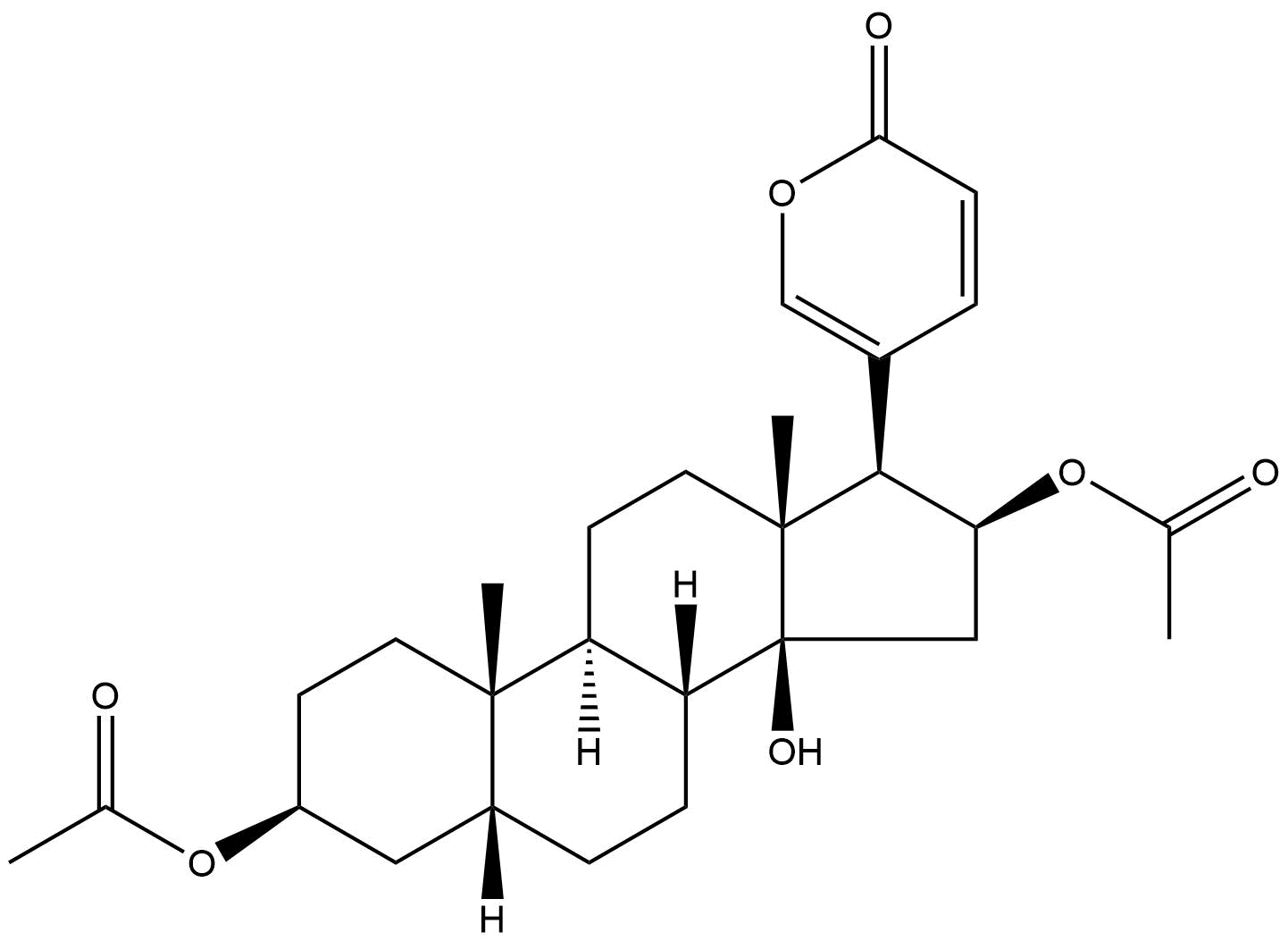


Product name: 3-O-Acetylbufotalin
Synonym name: Bufotalin 3-acetate
Catalogue No.: BP2069
Cas No.: 4029-69-0
Formula: C28H38O7
Mol Weight: 486.605
Botanical Source: Bufonis Venenum
Type of Compound: Steroids
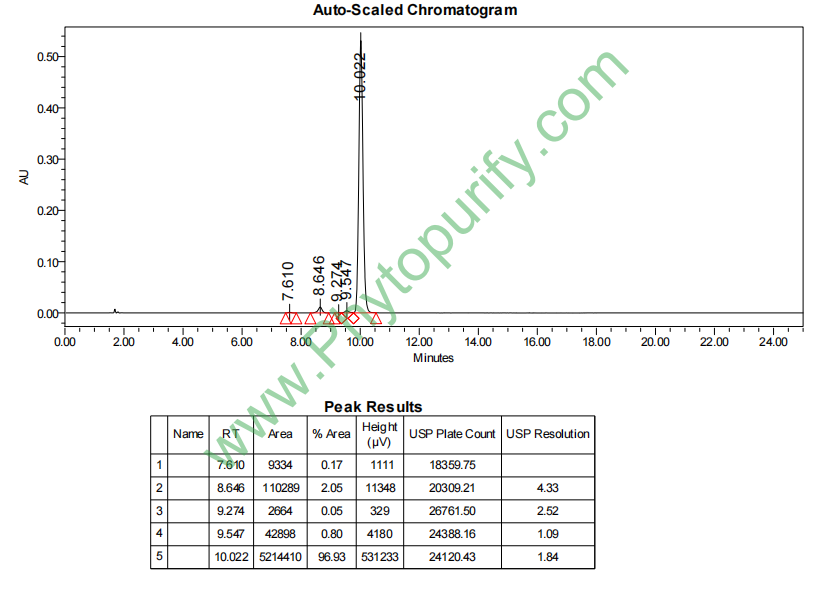
Purity: 95%~99%
Analysis Method: HPLC-DAD or/and HPLC-ELSD
Identification Method: Mass, NMR
Packing: Brown vial or HDPE plastic bottle
Storage: Store in a well closed container, protected from air and light. Put into refrigerate or freeze for long term storage.
Whenever possible, you should prepare and use solutions on the same day. However, if you need to make up stock solutions in advance, we recommend that you store the solution as aliquots in tightly sealed vials at -20℃. Generally, these will be useable for up to two weeks.
The product could be supplied from milligrams to grams
Inquire for bulk scale.
Chengdu Biopurify Phytochemicals Ltd. is a leading company in the research, development, manufacture and marketing of High Quality Phytochemicals and Extracts(especially Active Ingredients from Traditional Chinese Medicine,TCM), Natural Active Pharmaceutical Ingredients worldwide.
The main services:
A. Supply active ingredients and reference standards of TCM, from mgs to kgs scale
B. Custom extraction and purification, target Herb Active Ingredients
C. Custom synthesis and semi-synthesis for Natural Active Ingredients
D. CR(contract research), CM(contract manufacture) and PD(process development) services from lab scale, pilot scale to commercial scale(GMP is also available)
E. TCM compounds library for drug screen,more than 3000 compounds available, many of them are rare and unique.
HPLC of 3-O-Acetylbufotalin
Storage conditions:Short-term storage at 2~8℃, long-term storage at -20 ~ -80℃
103.0400
3.3764
3.3761
.0096
3.7193
3.8990
High
87.2124
4.6442
No
No
No
No
Yes
No
0.0
No
No
No
Yes
3-O-Acetylbufotalin is an important natural product of bufadienolactones, which has received widespread attention in recent years due to its significant biological activity, especially anticancer potential. As one of the active ingredients in toad secretions, 3-acetylbufotalin not only exhibits multi-target regulatory ability, but also shows potential value in the treatment research of cardiovascular diseases such as heart failure. This article provides a systematic review of the chemical structure, physicochemical properties, sources, and extraction methods of 3-acetylbufotalin. It delves into its pharmacological activity and mechanism of action, evaluates its pharmacological properties and pharmacokinetic characteristics, and looks forward to its clinical application prospects.
3-acetylbufotalin belongs to the class of bufadienolactones, with a molecular formula of C28H42O7 and a molecular weight of 486.6050. This compound contains a typical steroid skeleton in its structure, supplemented by acetylated hydroxyl modifications, giving it unique chemical properties. Its LogP value is 3.3764, indicating that it has moderate lipid solubility and is conducive to cell membrane penetration. The topological polar surface area (TPSA) is 103.0400, indicating that it has a certain polarity and is conducive to binding with biomolecules. The low water solubility (0.0096 mg/mL) suggests that an appropriate carrier or solvent system may be needed in vivo to enhance its bioavailability. The high blood-brain barrier permeability indicates that the compound has potential central nervous system activity. The hERG channel inhibition experiment showed a negative result, indicating a low risk of cardiac toxicity. The Ames mutagenicity test showed 0.0, indicating that the compound has a low risk of genetic toxicity.
3-acetylbufotalin mainly comes from the skin secretions of toads, especially species such as the Chinese toad (Bufo gargarizans) and the black spotted toad (Bufo melanostictus). Toad secretions are rich in various toad toxin steroids, and 3-acetylbufotalin, as one of its derivatives, has high content and biological activity.
The extraction process usually adopts solvent extraction combined with column chromatography separation technology. The specific steps include: first, using ethanol or methanol to extract the skin secretions of toads and extract the crude extract containing bufotoxin; Subsequently, the target compound was further purified by silica gel column chromatography or high-performance liquid chromatography (HPLC), utilizing its polarity difference to achieve separation. In recent years, ultrasound assisted extraction and supercritical CO2 extraction techniques have also been applied to improve extraction efficiency and purity. In addition, the identification methods mainly rely on modern analytical techniques such as mass spectrometry (MS), nuclear magnetic resonance (NMR), and infrared spectroscopy (IR) to ensure the structural accuracy and purity of the extract.
The pharmacological activity research of 3-acetylbufotalin mainly focuses on its anti-cancer and cardiovascular protective effects.
A large number of in vitro cell experiments have shown that 3-acetylbufotalin has a significant inhibitory effect on a variety of cancer cell lines, including but not limited to lung cancer, breast cancer, liver cancer and gastric cancer cells. Its anti-cancer mechanism involves inducing cell apoptosis, inhibiting cell proliferation, blocking cell cycle, and inhibiting tumor cell migration and invasion. In vivo tumor model studies have also confirmed that it can significantly delay tumor growth and reduce tumor burden. In addition, 3-acetylbufotalin exhibits low systemic toxicity within a certain dose range, demonstrating good safety.
In recent years, the potential therapeutic value of 3-acetylbufotalin in cardiovascular diseases such as heart failure has gradually been revealed. It participates in myocardial energy metabolism, oxidative stress response, inflammation regulation, and cell apoptosis by regulating various key targets such as AMPK (PRKAA1), EHMT2, APP, PTPN1, MAOA, ESR2, ABCB1, ALOX15, ABCG2, and FEN1, thereby improving myocardial function and reducing the pathological progression of heart failure.
The mechanism of action of 3-acetylbufotalin is complex and involves multi-target synergistic regulation, mainly involving the following aspects:
AMPK (5 'AMP activated protein kinase) is a key regulatory factor in cellular energy metabolism, and its activity regulation is crucial for the energy balance of myocardial cells. 3-acetylbufotalin can activate AMPK, promote fatty acid oxidation and glucose metabolism, alleviate myocardial energy metabolism disorders, and improve heart failure status.
EHMT2 (histone methyltransferase G9a) is an important epigenetic regulatory factor involved in the inhibition of gene expression. 3-acetylbufotalin exerts cardioprotective effects by regulating EHMT2 activity, affecting the expression of genes related to cardiomyocyte proliferation and apoptosis.
MAOA (monoamine oxidase A) participates in the metabolism of neurotransmitters and regulates cardiac autonomic nervous function. The regulation of MAOA by 3-acetylbufotalin can help improve the imbalance of cardiac nerve regulation and alleviate symptoms of heart failure.
ABCB1 and ABCG2 are important drug efflux pumps that affect the absorption, distribution, and excretion of drugs. The regulation of these two transporters by 3-acetylbufotalin may affect its own and other drug pharmacokinetic characteristics, suggesting potential interactions in combination therapy.
FEN1 (ribozyme 1) is involved in DNA repair and replication processes, and 3-acetylbufotalin exerts anticancer effects by regulating FEN1, affecting the DNA damage repair ability of tumor cells, enhancing cell apoptosis.
In summary, 3-acetylbufotoxin exhibits complex and effective pharmacological mechanisms by modulating cardiovascular and tumor related pathological processes through the synergistic effects of multiple targets and pathways.
The pharmacological evaluation of 3-acetylbufotalin shows that it has good potential for development. Its molecular weight (486.6) and LogP (3.38) both comply with Lipinski's rule, indicating that it has good oral bioavailability. The TPSA is 103.04, indicating that its polarity is moderate and beneficial for binding to the target.
Low water solubility is a major challenge in the development of its formulations, requiring the use of nanocarriers, liposomes, or solid dispersions to improve solubility and bioavailability. Its high blood-brain barrier permeability provides the possibility of treating central nervous system diseases, but potential central neurotoxicity also needs to be considered.
In terms of safety, the hERG channel inhibition test was negative, reducing the risk of arrhythmia; The Ames test showed no mutagenicity and low risk of genetic toxicity.
Pharmacokinetic studies have shown that 3-acetylbufotalin is widely distributed in the body, especially enriched in heart and liver tissues, which is consistent with its pharmacological targets. Its metabolism is mainly carried out through the liver cytochrome P450 enzyme system, and the activity and toxicity of metabolites need further research. Moderate half-life, supporting daily dosing regimen design.
Based on its significant anti-cancer activity and cardiovascular protection, 3-acetylbufotalin has broad prospects for clinical translation. The potential of 3-acetylbufotalin as a candidate drug or combination therapy is worth exploring in the field of cancer, especially for refractory tumors. In the treatment of heart failure, its multi-target regulation of myocardial energy metabolism and cellular function may become an important supplement to new treatment strategies.
Future research should focus on:
Pharmacokinetic and Safety Systematic Review This includes in-depth research on long-term toxicology, metabolite activity, and potential drug interactions.
Optimization of dosage form and exploration of administration route Improve its water solubility and bioavailability, and develop formulations suitable for clinical applications.
Preclinical and clinical trial design Clarify the effective dosage range and evaluate its efficacy and safety in cancer and cardiovascular disease patients.
Molecular level analysis of the mechanism of action Using multi omics techniques to further reveal its multi-target action network and guide the design of precise treatment plans.
Research on Combination Medication Strategy Explore synergistic effects with existing anti-cancer drugs and heart failure treatment drugs to enhance treatment efficacy.
3-acetylbufotalin, as a natural product of bufadienolactone, has shown great potential in the fields of anti-cancer and cardiovascular disease treatment due to its unique chemical structure and multi-target pharmacological activity. Its good pharmacological parameters and safety evaluation have laid the foundation for clinical translation. In the future, through in-depth mechanism research, pharmacokinetic optimization, and clinical validation, 3-acetylbufotalin is expected to become an important representative of natural product drug development, providing new ideas and means for the treatment of related diseases.
