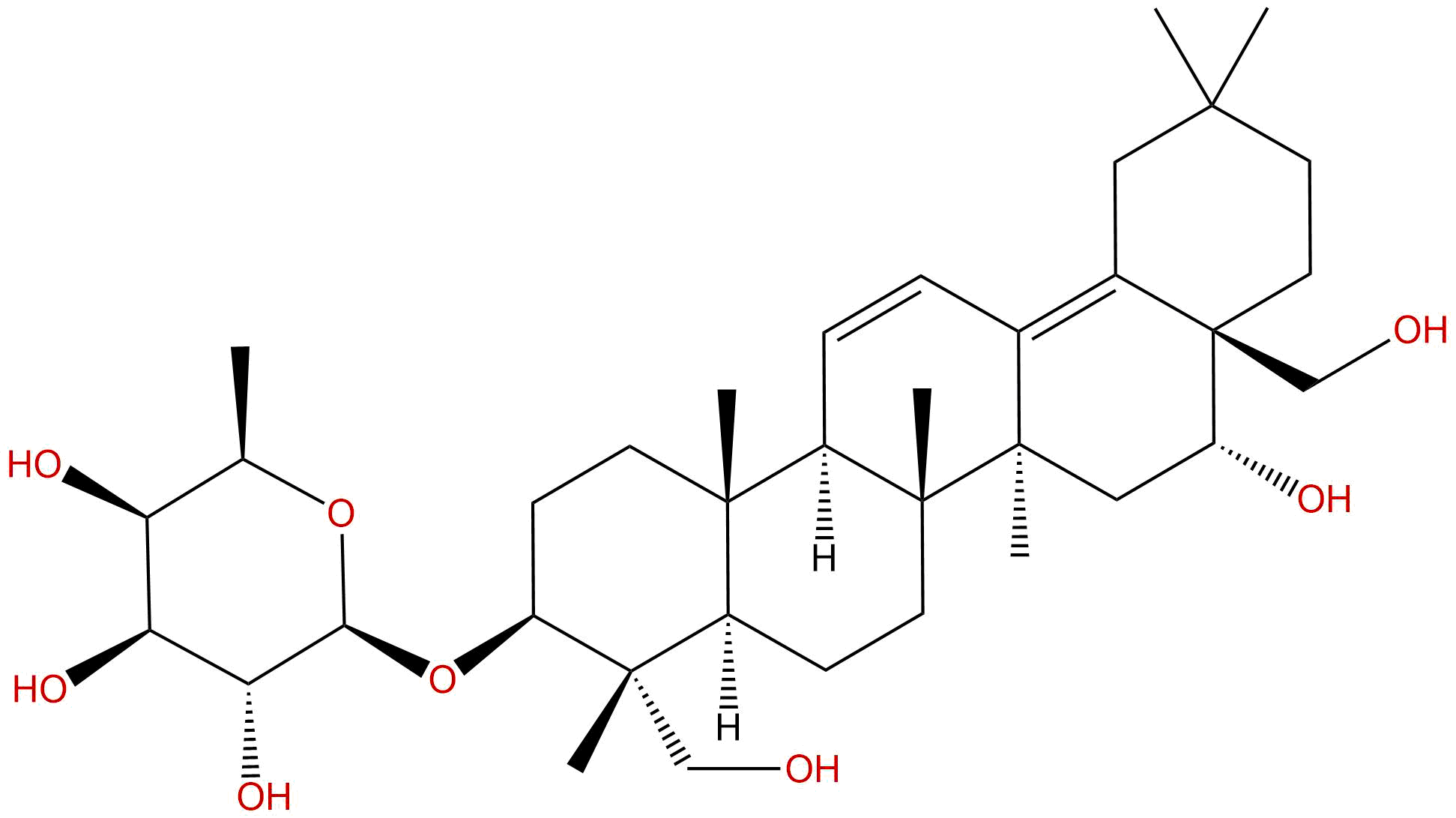


Product name: Prosaikogenin D
Synonym name: Prosapogenin D
Catalogue No.: BP2120
Cas No.: 103629-72-7
Formula: C36H58O8
Mol Weight: 618.852
Botanical Source: Bupleuri Radix
Type of Compound: Triterpenoids
Purity: 95%~99%
Analysis Method: HPLC-DAD or/and HPLC-ELSD
Identification Method: Mass, NMR
Packing: Brown vial or HDPE plastic bottle
Storage: Store in a well closed container, protected from air and light. Put into refrigerate or freeze for long term storage.
Whenever possible, you should prepare and use solutions on the same day. However, if you need to make up stock solutions in advance, we recommend that you store the solution as aliquots in tightly sealed vials at -20℃. Generally, these will be useable for up to two weeks.
The product could be supplied from milligrams to grams
Inquire for bulk scale.
For Reference Standard and R&D, Not for Human Use Directly.
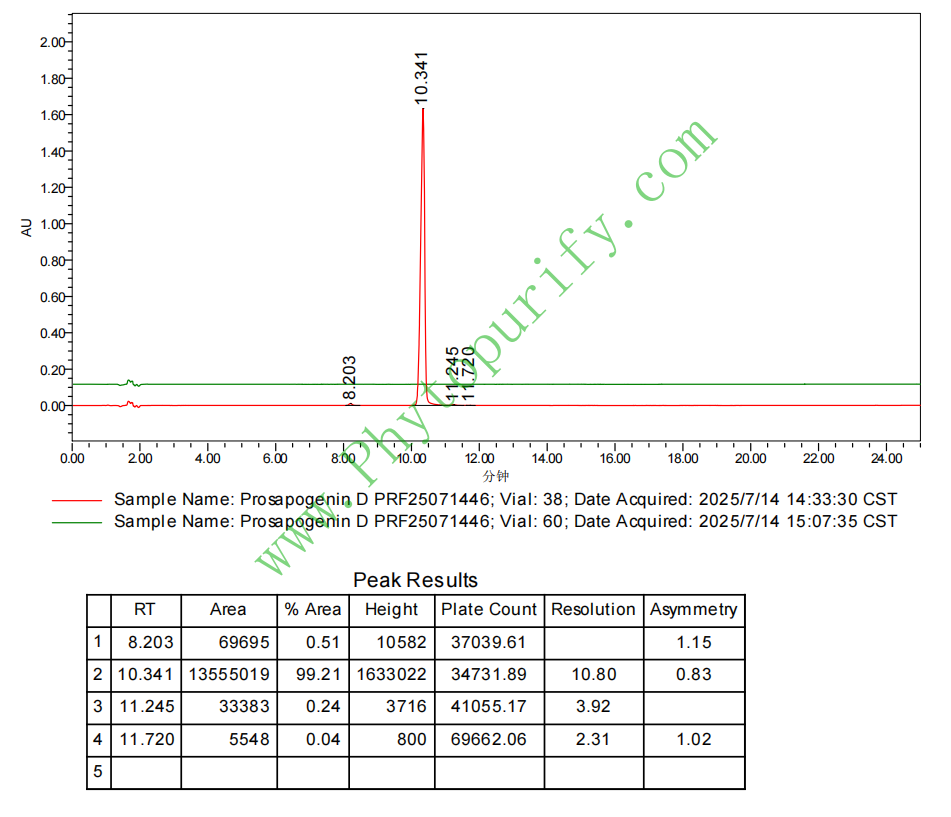
HPLC of Prosaikogenin D
Storage conditions:Short-term storage at 2~8℃, long-term storage at -20 ~ -80℃
139.8400
3.9407
3.9407
.0072
.8856
.9609
Low
79.4217
5.6021
No
No
No
No
No
No
0.0
Yes
No
No
Yes
Prosaikogenin D (CAS number: 103629-72-7) is a secondary metabolite extracted from the roots of traditional Chinese medicine Bupleurum spp., belonging to the triterpenoid saponin class. Chaihu, as an important medicinal herb in classic Chinese medicine formulas, has always been widely used in the treatment of various diseases such as liver and gallbladder diseases, fever, inflammation, etc. In recent years, with the deepening of pharmacological research on natural products, saikosaponin D has gradually become a research hotspot in the fields of pharmacology and drug development due to its significant anti-cancer activity and regulatory effect on chronic hepatitis related targets.
Chronic hepatitis, as one of the main causes of liver cirrhosis and hepatocellular carcinoma worldwide, involves complex immune inflammatory responses and abnormal cellular signaling pathways in its pathological process. Chaihu saponin D exhibits potential anti-inflammatory and immunomodulatory effects by regulating various inflammatory factors and signaling pathway targets, such as TLR4, TNF, IL6, NFKB1, etc., providing new ideas for the treatment of chronic hepatitis and related liver diseases. In addition, the pharmacological parameters of saikosaponin D show that it has good pharmacokinetic characteristics and safety, laying the foundation for its clinical translation.
This article provides a systematic review of the chemical structure and physicochemical properties, plant sources and extraction methods, pharmacological activity and mechanism of action, pharmacological evaluation and pharmacokinetic characteristics of saikosaponin D. It also explores its clinical application prospects in the treatment of chronic hepatitis and tumors, aiming to provide reference for natural product pharmacology and new drug development.
Chaihu saponin D is a typical triterpenoid saponin with a molecular formula of C36H-58O10 and a molecular weight of 618.8520. Its structural core is a pentacyclic triterpenoid skeleton, connected by multiple sugar residues, giving it high polarity and complex stereoisomers. The LogP value of saikosaponin D is 3.9407, indicating that it has moderate hydrophobicity, which is beneficial for penetrating cell membranes without being too hydrophobic and affecting solubility. Its topological polar surface area (TPSA) is 139.84 Å ², reflecting strong polarity and potential hydrogen bond donor and acceptor abilities, which is of great significance for its binding to biological targets.
In terms of water solubility, the solubility of saikosaponin D is relatively low, only 0.0072 mg/mL, indicating its limited solubility in aqueous phase, which may have a certain impact on its oral bioavailability. The low permeability of the blood-brain barrier indicates limited distribution in the central nervous system, which helps to reduce the risk of central nervous system toxicity. The hERG channel inhibition test result was negative, indicating that saikosaponin D is not likely to cause prolonged QT interval in the heart and has high safety. The Ames mutagenicity test showed 0.0, indicating no significant mutagenicity and meeting the baseline requirements for safe drugs.
The chemical structure of saikosaponin D is complex, with multiple hydroxyl and sugar modifications, which not only affect its physicochemical properties but also determine its interaction mode with biomolecules, providing a molecular basis for its multi-target pharmacological activity.
Bupleurum chinense saponins D mainly come from the roots of plants in the Bupleurum genus, especially Bupleurum chinense DC. and Bupleurum scorzonerifolium Willd., which have higher levels. Chaihu, as a traditional Chinese medicine, is rich in various triterpenoid saponins in its roots, and Chaihu saponin D is one of the important secondary metabolites.
Traditional extraction methods typically involve alcohol extraction combined with liquid-liquid partitioning and column chromatography techniques. The specific steps include:
In recent years, modern extraction and purification methods such as supercritical fluid extraction, membrane separation technology, and molecular imprinting technology have also been attempted to be applied to the efficient extraction of saikosaponin D, aiming to improve yield and purity and reduce production costs.
The pharmacological activities of saikosaponin D mainly focus on anti-cancer and anti-inflammatory immune regulation. Numerous in vitro cell experiments and in vivo animal model studies have shown that saikosaponin D can effectively inhibit the proliferation of various tumor cells, induce cell apoptosis, and regulate the inflammatory microenvironment of the liver, with potential therapeutic value for chronic hepatitis.
Saikosaponin D has significant inhibitory effect on many tumor cell lines, such as hepatocellular carcinoma, breast cancer, colorectal cancer, etc. The mechanism involves:
Chaihu saponins D exhibit significant anti-inflammatory effects in chronic hepatitis models, mainly by regulating key inflammatory factors and signaling pathways
Chaihu saponin D has also been found to affect the expression of HBsAg, suggesting its potential role in the treatment of hepatitis B virus infection and related liver diseases.
The multi-target mechanism of action of saikosaponin D is the basis of its pharmacological activity. Its main targets and mechanisms of action are as follows:
TLR4, as a key receptor of the innate immune system, mediates inflammatory signaling transduction. Chaihu saponins D inhibit TLR4 expression and its downstream MyD88 dependent signaling pathway, block NFKB activation, reduce the release of pro-inflammatory cytokines, and alleviate liver inflammation.
NFKB1 is a transcription factor that regulates inflammation and immune response. Chaihu saponins D inhibit the nuclear translocation and DNA binding activity of NFKB1, reduce the transcription of inflammatory mediators such as TNF and IL6, and alleviate chronic inflammation.
Chaihu saponin D downregulates the expression of TNF - α, IL-2, and IL-6, inhibits the activation of inflammatory cells and the excessive response of immune cells, and protects liver cells from inflammatory damage.
GPX1 is an important antioxidant enzyme, and saikosaponin D enhances the activity of GPX1, strengthens the antioxidant capacity of liver cells, and reduces cell damage caused by oxidative stress.
TGFB1 plays a central role in the process of liver fibrosis. Chaihu saponins D inhibit the expression and signaling of TGFB1, slow down the progression of liver fibrosis, and improve liver structure and function.
The inhibition of HBsAg expression by saikosaponin D suggests that it may affect the replication and infection process of hepatitis B virus. Meanwhile, saikosaponin D regulates IFN γ levels and enhances the body's antiviral immune response.
In summary, saikosaponin D achieves its anti-inflammatory, anti-tumor, and immune regulatory functions through multi-target and multi pathway synergistic effects, reflecting complex pharmacological network characteristics.
The pharmacological evaluation of saikosaponin D shows that it has good potential for drug development. Its molecular weight is 618.8520, slightly higher than the Lipinski rule recommendation of 500 or less, but considering the complexity of natural products and polysaccharide modifications, this value is still within an acceptable range. The LogP value of 3.94 indicates that it has moderate lipid solubility, which is beneficial for cell membrane penetration.
Low water solubility (0.0072 mg/mL) may limit its oral absorption, but formulation optimization (such as nanocarriers, solid dispersions) is expected to improve bioavailability. Low blood-brain barrier permeability reduces the risk of central nervous system side effects. HERG inhibition was negative and Ames test showed no mutagenicity, indicating its high safety.
In terms of pharmacokinetics, existing studies have shown that saikosaponin D has a long half-life in vivo, mainly metabolized through the liver, and excreted mainly through bile. Its biotransformation products may include deglycosylation and hydroxylation products, which may retain some pharmacological activity. Further in vivo pharmacokinetic studies are needed in the future to clarify its absorption, distribution, metabolism, and excretion (ADME) characteristics, in order to guide dosage form design and dose adjustment.
As a natural product, saikosaponin D, combined with its multiple anti-inflammatory, anti-tumor, and immunomodulatory activities, has demonstrated broad clinical application potential. Especially in the treatment of chronic hepatitis and liver fibrosis, saikosaponin D has the potential to become a novel adjuvant therapy for liver disease by regulating key inflammatory factors and signaling pathways.
In addition, the anticancer activity of saikosaponin D provides a possibility for its application in tumor therapy. In the future, targeted drugs and immunotherapy can be combined to develop combination therapy strategies and improve treatment efficacy. Its good safety and low toxicity characteristics also provide assurance for long-term medication.
However, the low water solubility and bioavailability of saikosaponin D are the main bottlenecks for clinical translation. It is necessary to improve its pharmacokinetic performance through drug chemical modification, nanotechnology, sustained-release formulations, and other means. Meanwhile, the preclinical safety evaluation and clinical trial design of the system are key steps towards its clinical application.
Future research should focus on:
Chaihu saponin D, as an important natural triterpenoid saponin in Chaihu, exhibits significant anti-cancer and anti-inflammatory immunomodulatory potential due to its unique chemical structure and multi-target pharmacological activity. Its application prospects in the treatment of chronic hepatitis and liver fibrosis are broad, and it has good safety and drug basis.
Despite facing challenges such as poor water solubility and low bioavailability, with the advancement of modern pharmaceutical formulation technology and molecular pharmacology, saikosaponin D is expected to become an important candidate molecule in the field of natural product drug development through rational drug design and clinical development. Future in-depth research will provide a solid scientific basis for its clinical application, promoting the transformation and application of saikosaponin D in the treatment of liver disease and tumors.
