


Product name: Berberine hydrochloride
Synonym name: Berberinium chloride
Catalogue No.: BP0252
Cas No.: 633-65-8
Formula: C20H18ClNO4
Mol Weight: 371.817
Botanical Source:
Physical Description: Powder
Type of Compound: Alkaloids
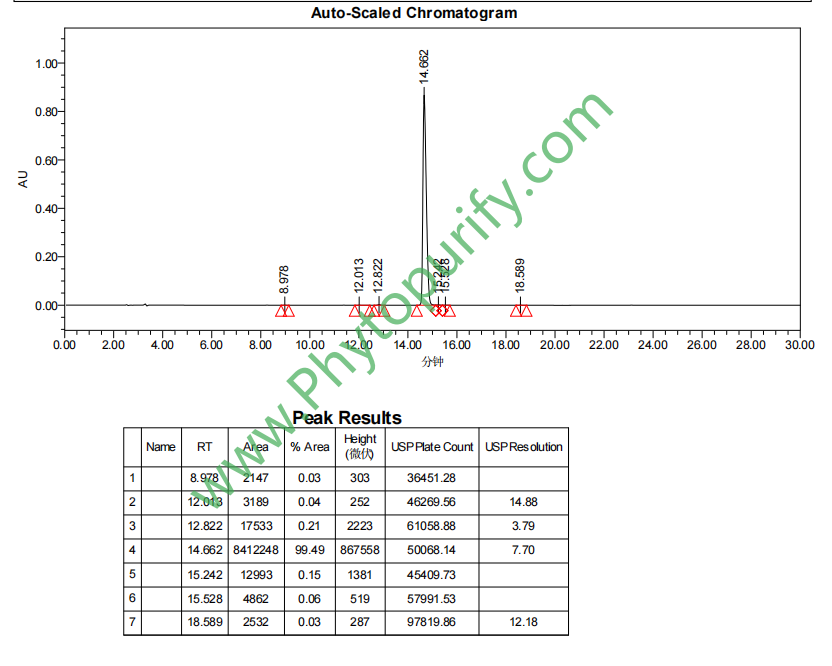
Purity: 95%~99%
Analysis Method: HPLC-DAD or/and HPLC-ELSD
Identification Method: Mass, NMR
Packing: Brown vial or HDPE plastic bottle
Storage: Store in a well closed container, protected from air and light. Put into refrigerate or freeze for long term storage.
Whenever possible, you should prepare and use solutions on the same day. However, if you need to make up stock solutions in advance, we recommend that you store the solution as aliquots in tightly sealed vials at -20℃. Generally, these will be useable for up to two weeks.
The product could be supplied from milligrams to grams, up to kilograms
Inquire for bulk scale.
Descriptions:
Berberine hydrochloride (berberine), a natural plant alkaloid derived from Chinese herbal medicine, is characterized by diverse pharmacological effects, such as anticancer and lower elevated blood glucose, it can prevent adhesion by downregulating ICAM-1 and reduce inflammation by inhibiting the TAK1/JNK and TAK1/NF-κB signaling after abdominal surgery, which brings out a good therapeutic approach for the development of clinical application for postoperative abdominal adhesion and inflammation.[1]
Berberine hydrochloride is a conventional component in Chinese medicine, and is characterized by a diversity of pharmacological effects, has anticancer activity and
the chance of regulating glucose and lipid metabolism in cancer cells showing more potential than ever. [2]
Berberine hydrochloride is an alkaloid with little or no fluorescence in water,in sodium dodecylsulfate solutions, the fluorescence intensity of this compound is enhanced several folds by ion-pairing with the anion of the surfactant. [3]
Berberine hydrochloride can significantly attenuate neutrophil infiltration, suppress myeloperoxidase activity, decrease NO, TNF-αand IL-1βproduction, inhibits the phosphorylation of the NF-κB p65 subunit and the degradation of its inhibitor, IκBα, thus, exerts potent anti-inflammatory effects on LPS-induced mouse endometritis and may be a potential therapeutic agent for endometritis.[4]
Berberine hydrochloride has significant reductive ability and radicals scavenging effects, especially on ABTS, hydroxyl radicals and DPPH radicals.[5]
Sensory evaluation of the taste of berberine hydrochloride could be used an Electronic Tongue.[6]
Berberine hydrochloride has antifungi activity.[7]
References:
[1] Zhang Y, Li X, Zhang Q, et al. J Pharmacol Exp Ther, 2014, 349(3):417-26.
[2] Wen T, Li Y, Chen M, et al. Int J Nanomed, 2011, 6(default):1773-7.
[3] Iwunze M O. Monatshefte Fuer Chemie/chemical Monthly, 2000, 131(5):429-35.
[4] Fu K, Lv X, Li W, et al. Int Immunopharmacol, 2014, 24(1):128-32.
[5] Luo A, Fan Y, Luo A, et al. J Med Plant Res, 2011, 5(16):3702-7.
[6] Wang Y, Feng Y, Wu Y, et al. Fitoterapia, 2013, 86(4):137-43.
[7] Nakamoto K, Sadamori S, Hamada T. J Prosthet Dent, 1990, 64(6):691-4.
[8] Xiang L I, Liu G Y, Jian-Li M A, et al. Pharmaceutical Journal of Chinese Peoples Liberation Army, 2013(05):458-60.
HPLC of Berberine hydrochloride
Storage conditions:Short-term storage at 2~8℃, long-term storage at -20 ~ -80℃
40.8000
.2341
.2341
.2766
2.9123
23.2093
High
25.3265
2.9166
Yes
No
Yes
No
Yes
Yes
2.4
No
No
No
No
Berberine hydrochloride (CAS: 633-65-8), also known as Natural Yellow 18, is a traditional Chinese herbal medicine derived from Huanglian(Coptis chinensis Isoquinoline quaternary ammonium alkaloids extracted from plants such as Franch. As the core pharmacological substance of Huanglian, which exerts the effects of clearing heat, drying dampness, purging fire, and detoxifying, berberine has a thousand year history of clinical application in traditional Chinese medicine. Modern pharmacological research has revealed that berberine hydrochloride has far more than traditional antibacterial effects. It has demonstrated extensive and profound pharmacological activities in metabolic diseases, cardiovascular diseases, neurodegenerative diseases, and even tumor prevention and treatment. What is particularly noteworthy is that although its oral bioavailability is low, in vitro and in vivo studies have confirmed that it can exert therapeutic benefits through multi-target and multi pathway synergistic effects, making it a unique and important molecule in the field of natural product drug development. This article aims to systematically review the chemical properties, pharmacological activities, molecular mechanisms of action, pharmacological properties, and clinical application prospects of berberine hydrochloride, in order to provide a comprehensive scientific perspective for the in-depth research and development of this classic compound.
The chemical name of berberine hydrochloride is 5,6-dihydro-9,10-dimethoxybenzo [g] -1,3-benzodioxolane [5,6-a] quinazine hydrochloride dihydrate. Its molecular formula is C ₂₀ H ₁₈ ClNO ₄ · 2H ₂ O, with a molecular weight of 336.3670. Structurally, it belongs to the berberine alkaloid class, with a rigid planar structure composed of isoquinoline and benzodioxolane fused together, and a positively charged quaternary ammonium nitrogen atom. This unique structure is the material basis for many of its biological activities.
Its physical and chemical properties significantly affect its biological behavior. The calculated lipid water partition coefficient (LogP) is approximately 0.2341, indicating that it is an amphiphilic molecule, but more inclined towards hydrophilicity. The topological polar surface area (TPSA) is 40.8000 Å ², which is relatively low. The water solubility data is 0.2766 mg/mL, indicating a certain but limited solubility in water, which is related to its quaternary ammonium salt form. However, the solubility and permeability of its hydrochloride form in the gastrointestinal tract are still not ideal, resulting in poor oral absorption and low bioavailability (usually less than 1%). To improve this deficiency, researchers have developed different salt forms or novel delivery systems such as berberine sulfate (HY-N0716B), aiming to enhance its solubility and bioavailability. In addition, the calculation predicts that its blood-brain barrier permeability is "high", which provides the possibility for it to act on central nervous system targets such as BACE1. Preliminary safety assessment shows that its Ames test value is 2.4, indicating a low risk of mutagenicity and no significant hERG potassium channel inhibitory activity, suggesting a low risk of cardiac toxicity.
Berberine is widely present in various plants, including the Ranunculaceae plant Coptis chinensis(Coptis chinensis)Sanjiaoye Huanglian(C. deltoidea)Cloud Connection(C. teeta)The rhizome and three needles of Berberidaceae plants(Berberis spp.)The poppy family plant Quercus lactiflora(Chelidonium majus)Wait. Among them, Huanglian is regarded as an authentic medicinal herb, with the highest content of berberine, which is the main raw material for commercial extraction.
The traditional extraction method is mainly based on the alkalinity of berberine and its salt solubility characteristics. Common processes include:
1. Acid water extraction method Using the solubility of berberine hydrochloride in water, soak or percolate the medicinal herbs in dilute sulfuric acid or hydrochloric acid, and then perform acidification precipitation or salt precipitation to obtain crude products.
2. Alkalization organic solvent extraction method Alkalize the medicinal herbs with lime milk to free berberine, then extract with organic solvents (such as benzene and chloroform), and the extract crystallizes after acid water back extraction.
3. Alcohol extraction acid precipitation method: Use ethanol or methanol for reflux extraction, add acid water to dissolve after recovering alcohol, and adjust pH to precipitate after filtration.
Modern extraction and separation technologies are dedicated to improving efficiency, purity, and environmental friendliness, such as Ultrasonic assisted extraction、Microwave assisted extraction、Supercritical fluid extraction and Purification technology of macroporous adsorption resin These methods can significantly shorten the extraction time, improve the yield and purity of the target components. The crude berberine extracted can be further refined through methods such as recrystallization and column chromatography (such as silica gel and alumina chromatography) to obtain high-purity berberine hydrochloride, which meets the needs of medicine and scientific research.
The pharmacological activity spectrum of berberine hydrochloride is extremely broad, surpassing its initial antibacterial positioning and becoming a "versatile" with the potential to treat multiple diseases.
The multiple pharmacological effects of berberine stem from its interactions with multiple molecular targets within cells, forming a complex network. The mechanism of action for targets related to cardiovascular disease can be summarized as follows:
The mode of action of berberine is often described as "multi-target fine-tuning", which means that it does not strongly inhibit or activate a single target, but simultaneously affects multiple interrelated targets and pathways with moderate intensity, synergistically restoring the body's steady-state balance.
The pharmacological properties of berberine hydrochloride exhibit significant "contradictory" characteristics: its in vitro activity is broad and clear, but its pharmacokinetic properties in vivo are not ideal.
Improvement strategy To improve its medicinal properties, research focuses on:
1. Structural modification Synthesize berberine derivatives, such as bisbenzylisoquinoline derivatives, to improve lipid solubility and activity.
2. Formulation innovation:
* New type of salt Berberine sulfate (HY-N0716B) has been reported to increase solubility and bioavailability.
* Nano delivery system Including liposomes, nanoparticles, micelles, solid lipid nanoparticles, etc., the oral bioavailability and targeting are significantly improved through mechanisms such as enhancing intestinal lymphatic transport, evading P-gp efflux, and prolonging circulation time.
* Phospholipid complex Berberine phospholipid complex can effectively increase its lipid solubility and promote absorption.
3. Combined administration Combined with P-gp inhibitors such as cyclosporine A and certain flavonoids, it can reduce intestinal efflux and improve absorption.
The clinical application of berberine hydrochloride is expanding from traditional intestinal infections such as bacterial dysentery and gastroenteritis to the field of chronic complex diseases.
Berberine hydrochloride, a yellow crystal derived from the ancient Chinese medicine Huanglian, has been infused with new vitality after thousands of years of clinical practice and decades of modern scientific research. It has evolved from a single antibacterial compound to a multifunctional pharmacological molecule that acts on multiple key targets such as AMPK, TLR4, BACE1, PTP1B, etc., demonstrating unique value in the prevention and treatment of major chronic diseases such as cardiovascular metabolic diseases, neurodegenerative diseases, and tumors. The paradox of "low bioavailability but high in vivo activity" precisely reveals the complexity of its systemic role through indirect regulation, gut microbiota regulation, and other multi-level mechanisms. Although there are still challenges in the aspects of drug performance and clinical evidence level, with the innovation of delivery technology, the in-depth clarification of mechanism of action and the promotion of high-quality clinical research, it is very likely that berberine hydrochloride will successfully transform from a traditional natural product into one of the basic drugs in modern medicine to treat complex diseases, perfectly interpreting the development concept of traditional Chinese medicine of "inheriting the essence, preserving integrity and innovation". Its research process also provides a classic paradigm for discovering multi-target lead compounds from traditional drugs.
