


Synonym name:
Catalogue No.: BP0475
Cas No.: 25459-91-0
Formula: C19H18NO4+
Mol Weight: 324.355
Botanical Source: Quaternary alkaloid from the stem, roots and tubers of Stephania miyiensis and Thalictrum javanicum (Ranunculaceae)
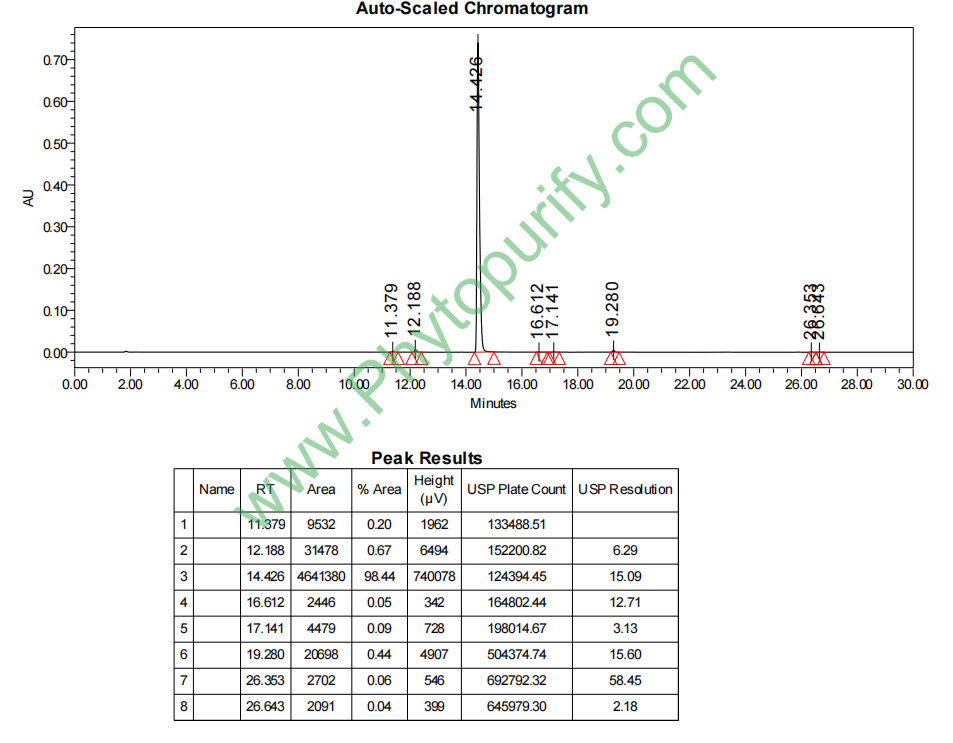
Purity: 95%~99%
Analysis Method: HPLC-DAD or/and HPLC-ELSD
Identification Method: Mass, NMR
Packing: Brown vial or HDPE plastic bottle
Can be supplied from milligrams to grams.
For Reference Standard and R&D, Not for Human Use Directly.
Inquire for bulk scale.
HPLC of Demethyleneberberine
Storage conditions:Short-term storage at 2~8℃, long-term storage at -20 ~ -80℃
Demethylneberberine (CAS number: 25459-91-0), as an important metabolic derivative of berberine, has attracted widespread attention in recent years due to its unique pharmacological activity and good safety. As a natural product, demethylated berberine not only has significant antioxidant and anti-inflammatory effects, but also effectively penetrates the blood-brain barrier, targets mitochondria to regulate cellular metabolism, and demonstrates potential therapeutic value in neurodegenerative diseases, metabolic syndrome, and inflammatory diseases. In addition, demethylated berberine has shown certain activity in the inhibition of drug-resistant strains, indicating its potential application prospects in the field of anti infection. This article provides a systematic review of the chemical structure, sources, pharmacological activities, mechanisms of action, pharmacological properties, and clinical application potential of demethylberberine, aiming to provide comprehensive reference materials for researchers in related fields.
The molecular formula of demethylated berberine is C20H18NO4, with a molecular weight of 324.3560, belonging to the flavonoid alkaloid structure. Its structural feature is the removal of methylene bridging rings from berberine molecules, resulting in a more flexible molecular conformation compared to berberine. The LogP value of this compound is 0.2412, indicating its low lipid solubility and water solubility of 0.5223, demonstrating good hydrophilicity and facilitating in vivo distribution and absorption. The topological polar surface area (TPSA) is 62.8 Å ², indicating that it has certain membrane permeability, especially the ability to penetrate the blood-brain barrier. Although the blood-brain barrier permeability is evaluated as "low", the moderate polarity and size of its molecular structure allow it to enter the central nervous system to some extent. It is worth noting that demethylated berberine does not inhibit hERG channels, reducing the risk of cardiac toxicity. The Ames test result is 0.9, indicating that its genotoxicity risk is low and has a good safety basis.
The main source of demethylated berberine is the metabolic transformation products of berberine alkaloids in the traditional Chinese medicine plant Berberis spp. Berberine is widely present in traditional Chinese medicinal herbs such as Coptis chinensis and Phellodendron amurense, and demethylated berberine is mostly a derivative formed during in vivo metabolism or secondary metabolism in plants. The content of demethylated berberine extracted directly from plants is relatively low. Berberine is usually used as a precursor and prepared by chemical or biocatalytic methods for demethylation reaction.
Common extraction methods include:
Solvent extraction Using methanol, ethanol, or aqueous solutions for reflux extraction of plant medicinal materials, a crude extract containing berberine was preliminarily obtained.
chromatographic separation Separation and purification of crude extract using high-performance liquid chromatography (HPLC), column chromatography, and other techniques to obtain demethylated berberine.
Chemical conversion By using alkaline conditions or specific enzyme catalysis to convert berberine into demethylated berberine, the yield and purity can be improved.
In recent years, the development of biosynthetic engineering and enzymatic catalysis technology has provided new ideas for the large-scale preparation of demethylated berberine, especially for efficient and green synthesis through microbial fermentation or enzymatic reactions.
The pharmacological activities of demethylated berberine mainly focus on antioxidant, anti-inflammatory, lipid metabolism regulation, and antibacterial aspects, covering research on various disease models.
Methylberberine can effectively eliminate reactive oxygen species (ROS) and alleviate oxidative stress damage. Its antioxidant effect mainly targets mitochondria, protects mitochondrial membrane potential, reduces the production of ROS in mitochondria, and thus prevents cell apoptosis and tissue damage. Both in vitro and in vivo experiments have shown that demethylated berberine significantly enhances the activity of intracellular antioxidant enzymes (such as superoxide dismutase (SOD) and glutathione peroxidase (GPx)) and reduces the level of lipid peroxidation product (MDA).
Demethylated berberine regulates the expression of inflammatory factors such as tumor necrosis factor alpha (TNF - α), interleukin-6 (IL-6), and nitric oxide synthase (iNOS) by inhibiting the nuclear factor kappa B (NF - κ B) and mitogen activated protein kinase (MAPK) signaling pathways, effectively reducing the inflammatory response. In multiple inflammatory models, such as the lipopolysaccharide induced macrophage inflammation model, demethylated berberine exhibits significant anti-inflammatory effects.
Methylberberine can activate the 5 'AMP activated protein kinase (AMPK) signaling pathway, promote fatty acid oxidation, inhibit lipid synthesis, and improve lipid metabolism disorders. Animal experiments have shown that demethylated berberine can reduce serum total cholesterol, triglycerides, and low-density lipoprotein cholesterol (LDL-C), and has a protective effect on metabolic diseases such as obesity and non-alcoholic fatty liver disease.
The emergence of drug-resistant bacteria is a major challenge to global public health. Methylberberine exhibits certain inhibitory effects on multiple drug-resistant strains, including DNA gyrase (GYRA), dihydrofolate reductase (DHFR), penicillin binding protein (PBP2A), and other related targets. By interfering with the key enzyme activity of bacteria, demethylated berberine can enhance the efficacy of antibiotics and reduce the occurrence of drug resistance.
The multi-target mechanism of action of demethylated berberine is the basis of its pharmacological activity, mainly involving the following aspects:
Mitochondria are the main source of intracellular ROS, and demethylated berberine enters mitochondria to stabilize mitochondrial membrane potential, reduce ROS release caused by abnormal electron transport chains, protect mitochondrial function, and prevent cellular oxidative damage and apoptosis.
Methylberberine can activate AMPK, a key regulatory factor in cellular energy metabolism, promote fatty acid β - oxidation, inhibit fat synthesis related enzymes (such as fatty acid synthase FAS), regulate energy balance, and improve metabolic abnormalities.
Demethylberberine inhibits the phosphorylation and degradation of I κ B α, blocks the nuclear translocation of NF - κ B, and reduces the expression of pro-inflammatory cytokines. At the same time, inhibiting the activation of MAPK family members (ERK, JNK, p38) reduces inflammatory signaling and exerts anti-inflammatory effects.
Demethylberberine inhibits bacterial DNA replication and metabolism by binding to key enzymes such as bacterial DNA gyrase (GYRA) and dihydrofolate reductase (DHFR), thereby suppressing bacterial growth. In addition, acting on the penicillin binding protein PBP2A enhances the activity of β - lactam antibiotics and has potential inhibitory effects on methicillin-resistant Staphylococcus aureus (MRSA) and other resistant strains.
Demethylberberine has shown great potential in drug development. Its molecular weight is moderate (324.3560), with a low LogP value (0.2412) and good water solubility (0.5223), which is beneficial for oral absorption and in vivo distribution. The TPSA value is 62.8 Å ², which meets the requirements for penetrating cell membranes and the blood-brain barrier. Although the blood-brain barrier permeability is evaluated as low, evidence of its role in central nervous system diseases still exists.
In terms of safety, demethylated berberine does not inhibit hERG channels and reduces the risk of cardiac toxicity. The Ames test results show that its genotoxicity risk is low, supporting its safety as a drug candidate molecule.
Pharmacokinetic studies have shown that demethylberberine is rapidly absorbed after oral administration, with a moderate plasma half-life and the ability to reach effective concentrations. Its metabolic pathway is mainly through the liver enzyme system, and the activity and toxicity of metabolites need further research. The in vivo distribution data shows that it can enter brain tissue, supporting its application in neurological diseases.
Due to its multi-target and multi mechanism pharmacological activity, demethylated berberine has shown extensive clinical application potential. Its antioxidant and anti-inflammatory effects make it have potential therapeutic value in neurodegenerative diseases (such as Alzheimer's disease, Parkinson's disease), metabolic diseases (such as non-alcoholic fatty liver, diabetes) and chronic inflammatory diseases.
In addition, the inhibitory effect of demethylated berberine on drug-resistant bacteria provides new ideas for the field of anti infection, especially in the context of increasingly severe antibiotic resistance. demethylated berberine can be used as an adjuvant drug to enhance the efficacy of traditional antibiotics and delay the development of resistance.
Future research should focus on:
In depth pharmacokinetic and toxicological research Clarify its metabolic pathway and long-term safety.
Optimize formulations and administration methods Improve bioavailability and targeting.
Preclinical and clinical trial design Verify its efficacy and safety in various diseases.
Exploration of Combination Medication Strategy Synergistic effect with existing drugs to improve treatment efficacy.
Biological synthesis and chemical modification Develop structurally optimized derivatives to enhance activity and selectivity.
As a natural product derivative, demethylated berberine has demonstrated broad application prospects in the fields of antioxidant, anti-inflammatory, lipid metabolism regulation, and resistance to drug-resistant bacteria due to its unique chemical structure and diverse pharmacological activities. Its good pharmacological parameters and safety foundation provide solid support for the development of new drugs. With the continuous elucidation of molecular mechanisms and the advancement of clinical research, demethylated berberine is expected to become a new candidate drug for the treatment of various diseases, promoting the development of natural product pharmacology. In the future, interdisciplinary cooperation should be strengthened, modern drug research and development technologies should be integrated, and the clinical translation of demethylated berberine should be promoted to benefit the vast number of patients.
