


Product name: Berbamine
Synonym name: Berbenine
Catalogue No.: BP0249
Cas No.: 478-61-5
Formula: C37H40N2O6
Mol Weight: 608.735
Botanical Source: Phellodendri chinensis cortex
Physical Description:
Type of Compound: Alkaloids
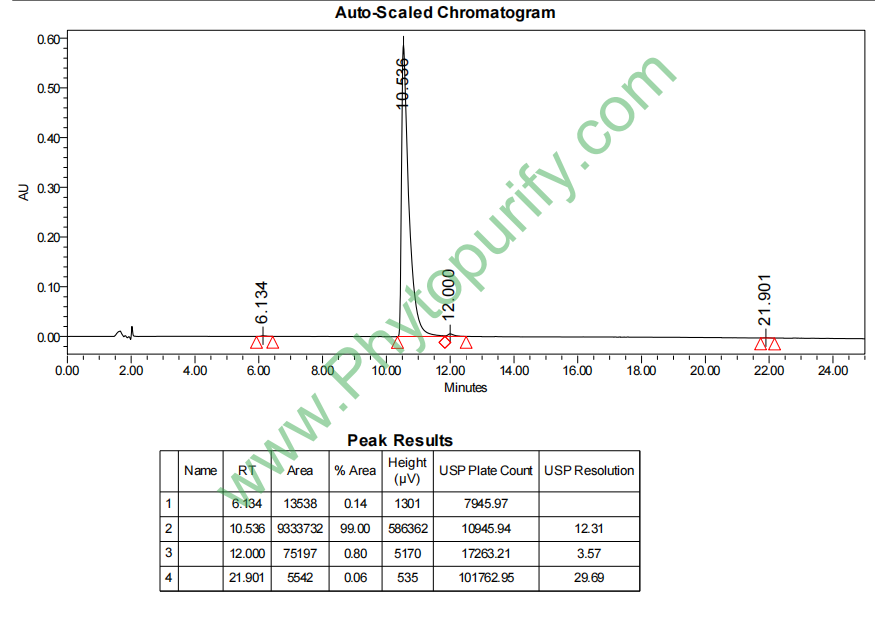
Purity: 95%~99%
Analysis Method: HPLC-DAD or/and HPLC-ELSD
Identification Method: Mass, NMR
Packing: Brown vial or HDPE plastic bottle
Storage: Store in a well closed container, protected from air and light. Put into refrigerate or freeze for long term storage.
Whenever possible, you should prepare and use solutions on the same day. However, if you need to make up stock solutions in advance, we recommend that you store the solution as aliquots in tightly sealed vials at -20℃. Generally, these will be useable for up to two weeks.
The product could be supplied from milligrams to grams
Inquire for bulk scale.
Chengdu Biopurify Phytochemicals Ltd. is a leading company in the research, development, manufacture and marketing of High Quality Phytochemicals and Extracts(especially Active Ingredients from Traditional Chinese Medicine,TCM), Natural Active Pharmaceutical Ingredients worldwide.
The main services:
A. Supply active ingredients and reference standards of TCM, from mgs to kgs scale
B. Custom extraction and purification, target Herb Active Ingredients
C. Custom synthesis and semi-synthesis for Natural Active Ingredients
D. CR(contract research), CM(contract manufacture) and PD(process development) services from lab scale, pilot scale to commercial scale(GMP is also available)
E. TCM compounds library for drug screen,more than 3000 compounds available, many of them are rare and unique.
HPLC of Berbamine
Storage conditions:Short-term storage at 2~8℃, long-term storage at -20 ~ -80℃
72.8600
5.7795
5.1437
.0059
4.7215
19.9985
Low
91.5576
5.7402
No
No
Yes
Yes
No
No
0.0
Yes
No
No
Yes
Natural products, as an important treasure trove for drug discovery and development, play an irreplaceable role in the history of human disease treatment. Among them, isoquinoline alkaloids have always been a hot topic in medicinal chemistry and pharmacology research due to their structural diversity and wide range of biological activities. Berbamine, as a typical bisbenzylisoquinoline alkaloid, has expanded its pharmacological activity research from traditional anti-inflammatory and antibacterial fields to multiple modern medical frontiers such as anti-tumor, immune regulation, cardiovascular protection, and analgesia since its identification. Especially in terms of its potential role in pain management, it involves the regulation of multiple key targets such as transient receptor potential vanillic acid subtype 1 (TRPV1), cannabinoid receptor 1 (CNR1), tumor necrosis factor (TNF), etc., demonstrating a multi pathway and multi-target characteristic of action, providing valuable lead compounds for the development of new analgesics. This article aims to systematically review the chemical properties, plant sources, and pharmacological activities of beriberamine, with a focus on its mechanism of action and molecular target network in pain related diseases. It also evaluates and prospects its pharmacological properties and clinical application prospects.
Berberine (CAS number: 478-61-5) is a bisbenzylisoquinoline alkaloid with a molecular formula of C37H40N2O6 and a molecular weight of 608.7350. Its core structure is composed of two isoquinoline units connected by a double benzyl bond, forming a unique rigid skeleton and multiple chiral centers, which provides a structural basis for its specific interactions with various biological targets.
From the analysis of physical and chemical properties, the lipid water partition coefficient (LogP) of berberine is 5.7795, indicating its strong lipophilicity. Its topological polar surface area (TPSA) is 72.8600 Å ², which is relatively small. These two parameters together determine the poor water solubility of berberiberamine, with a calculated value of approximately 0.0059 mg/mL, which to some extent limits the improvement of its bioavailability. In pharmacokinetic predictions, the ability of berberiberamine to penetrate the blood-brain barrier was evaluated as "low", suggesting that it may not easily enter the central nervous system to exert direct effects. However, its regulation of the peripheral nervous system and immune system may still be the basis for its important activities such as analgesia. In terms of safety warning, in vitro experiments suggest that there may be a risk of hERG potassium channel inhibition (positive), which is associated with potential arrhythmogenic side effects and is a key focus in subsequent structural optimization. It is gratifying that the Ames test result is 0.0, which preliminarily indicates that there is no mutagenicity in this testing system and the risk of genetic toxicity is low.
Berberidaceae and Menispermaceae are mainly derived from various plants in the Berberidaceae and Menispermaceae families. The most famous source among them is the three needles of traditional Chinese medicine (such as Berberis macrophylla) Berberis soulieana Fine leaved Berberis B. poiretii Etc.) and self-defense(Aristolochia fangchi)Wait. In these plants, berberine often coexists with other alkaloids such as berberine and palmatine.
The traditional extraction method mainly relies on solvent extraction. Usually, dried plant roots or stem bark are crushed and soaked or percolated in acidic aqueous solutions (such as dilute sulfuric acid or hydrochloric acid) to dissolve alkaloids into salts. Subsequently, the filtrate is alkalized (such as ammonia water, lime water) to free the alkaloids, and then extracted with organic solvents (such as chloroform, dichloromethane, or ethanol). After concentration, the total alkaloids are obtained. The further purification of berberine requires the use of column chromatography technology, often using silica gel, alumina or macroporous resin as the stationary phase, gradient elution with chloroform methanol mixed solvents in different ratios, combined with thin-layer chromatography (TLC) or high-performance liquid chromatography (HPLC) monitoring, to ultimately obtain high-purity berberine monomers. Modern extraction techniques such as ultrasound assisted extraction, microwave-assisted extraction, and supercritical fluid extraction have also been applied to improve extraction efficiency and reduce solvent consumption.
The pharmacological activity research of berberine shows extensive and in-depth characteristics, and its effects go far beyond the early recognition of antibacterial and anti-inflammatory properties.
The analgesic mechanism of berberine is complex, involving the regulation of multiple key targets in the pain pathway, forming a multi-target action network:
Inhibit inflammatory mediators and related enzymes:
Regulating ion channels and receptors:
Affects the neurotransmitter system:
In summary, berberine exerts a synergistic analgesic effect by simultaneously acting on multiple processes such as the production of inflammatory mediators, nociceptive ion channels, neurotransmitter systems, and neuroimmune regulation. This multi-target characteristic may make it more advantageous than single target drugs in treating complex chronic pain, especially pain accompanied by obvious inflammation or neuropathy.
Although berberine has a wide range of pharmacological activities, its medicinal properties face certain challenges, mainly due to its physicochemical properties.
Overall, berberiberamine is a lead compound with clear activity but requires optimization of pharmacological parameters. Future research requires systematic preclinical pharmacokinetic (ADME) studies and structural modifications using medicinal chemistry methods to improve water solubility and reduce hERG inhibition risk while retaining pharmacophores, thereby enhancing its development potential.
The clinical application prospects of berberine are broad, but the road still needs to be explored solidly.
Berberine, as a bisbenzylisoquinoline alkaloid derived from traditional medicinal plants, has shown new vitality in modern pharmacological research due to its unique chemical structure and multi-target pharmacological properties. Especially in the field of pain treatment, it demonstrates great potential for multi pathway collaborative analgesia by regulating multiple key targets such as TRPV1, CNR1, TNF, PTGS1/PTGES, etc. Although the current pharmaceutical challenges it faces, such as poor water solubility and potential cardiac toxicity, cannot be ignored, these challenges are precisely the issues that modern pharmaceutical chemistry and pharmacy can focus on addressing. Through in-depth analysis of its mechanism of action, systematic pharmacokinetic studies, and rational structural optimization, berberine and its derivatives are expected to be developed into new drugs for the treatment of chronic pain, autoimmune diseases, and adjuvant anti-tumor therapy, thus better transforming the intelligence of natural products into therapeutic methods that benefit humanity. Continuous and in-depth research on it is not only an exploration of an active molecule, but also a vivid practice of the natural product drug development model.
