


Product Name: Oxyberberine
Synonym name: Berlambine
Catalogue No.: BP0259
Cas No.: 549-21-3
Formula: C20H17NO5
Mol Weight: 351.358
Botanical Source: Alkaloid from Arcangelisia gusanlung, Berberis lambertii, other Berberis spp. and Mahonia japonica
Purity: 95%~99%
Analysis Method: HPLC-DAD or/and HPLC-ELSD
Identification Method: Mass, NMR
Packing: Brown vial or HDPE plastic bottle
Can be supplied from milligrams to grams.
For Reference Standard and R&D, Not for Human Use Directly.
Inquire for bulk scale.
HPLC of Oxyberberine
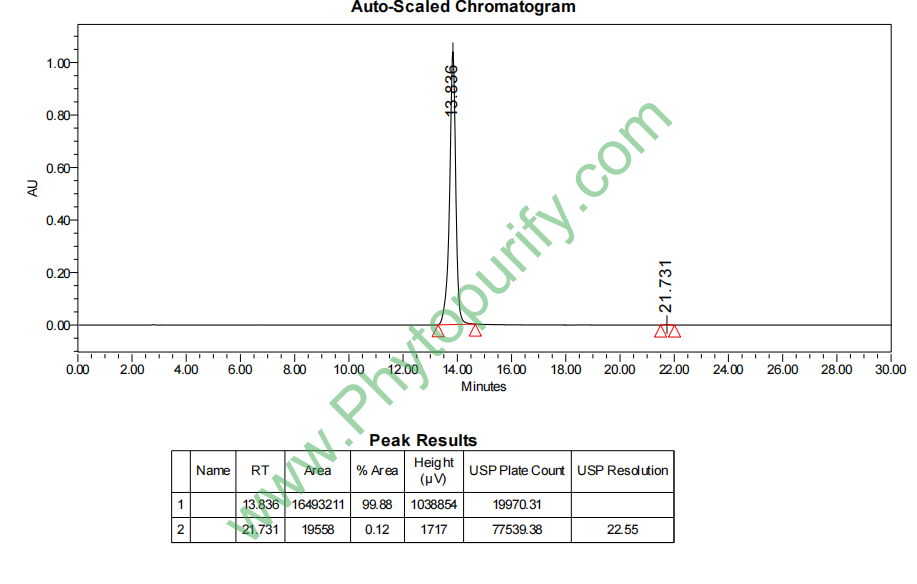
Storage conditions:Short-term storage at 2~8℃, long-term storage at -20 ~ -80℃
Oxyberberine (CAS number 549-21-3), also known as Berlambine, is an oxidized derivative of natural quinoline alkaloids. Due to its significant biological activity and potential medicinal value, it has received widespread attention in the field of natural product pharmacology in recent years. As an orally effective heme oxygenase-1 (HO-1) agonist, berberine oxide can activate the antioxidant defense mechanism of cells by regulating multiple cellular signaling pathways, especially the PI3K/Akt/AMPK signaling axis, exhibiting multiple pharmacological effects such as anti-inflammatory, antioxidant, neuroprotective, and improvement of metabolic abnormalities. Its therapeutic potential in type 2 diabetes, traumatic brain injury (TBI), inflammatory bowel disease and other chronic disease models provides a solid theoretical basis for its clinical transformation.
This article provides a systematic review of the chemical structure and physicochemical properties, plant sources and extraction methods, pharmacological activity and mechanism of action, drug evaluation and pharmacokinetic characteristics of berberine oxide. Combined with its target effects in related diseases, it explores its clinical application prospects and development directions, aiming to provide reference for subsequent research and drug development.
Berberine oxide is an oxidation product of isoquinoline alkaloids, with a molecular formula of C20H17NO5 and a molecular weight of 351.36. Its structural features include an oxidized isoquinoline skeleton with multiple hydroxyl and methoxy substituents, endowing it with high polarity and biological activity. Its LogP value is about 1.49, indicating that it has moderate lipid solubility, which is conducive to cell membrane penetration but not easily affected by excessive lipid solubility and bioavailability. The topological polar surface area (TPSA) is 79.47 Å ² and the number of hydrogen bond acceptors is 6, indicating its excellent ability to form intermolecular hydrogen bonds, which is of great significance for its binding to protein targets.
The low blood-brain barrier permeability of berberine oxide suggests that its direct action in the central nervous system may be limited, but its indirect neuroprotective effect through regulating peripheral signaling pathways is more likely. There is currently no clear data on its safety indicators such as hepatotoxicity, cardiotoxicity, and hERG channel inhibition, and further systematic evaluation is needed.
Berberine oxide mainly exists in Berberis spp. and related plants, and is a product of the oxidation and transformation of berberine in plants or during extraction and processing. Common sources of plants include Chinese medicinal herbs such as Coptis chinensis and Berberis vulgaris. Traditional extraction methods often use alcohol solvents (such as ethanol and methanol) combined with acid-base adjustment to obtain crude extracts through techniques such as reflux extraction, ultrasound assisted extraction, or microwave-assisted extraction.
During the purification process, liquid-liquid distribution, column chromatography (silica gel, C18 reverse phase column), and high-performance liquid chromatography (HPLC) techniques are commonly used to separate and purify berberine oxide. In recent years, the application of supercritical fluid extraction and green solvent extraction technologies is expected to improve extraction efficiency and purity, and reduce environmental pollution.
The pharmacological activities of berberine oxide are mainly reflected in its antioxidant, anti-inflammatory, neuroprotective, and metabolic regulation aspects.
Antioxidant effect
Berberine oxide significantly enhances the activity of antioxidant enzymes such as superoxide dismutase (SOD) and glutathione peroxidase (GSH Px) by inducing the expression of heme oxygenase-1 (HO-1), reducing the generation of reactive oxygen species (ROS) and protecting cells from oxidative stress damage. It activates the PI3K/Akt/AMPK signaling pathway, promoting the overall enhancement of the intracellular antioxidant defense system.
anti-inflammatory effect
Berberine oxide inhibits the nuclear factor kappa B (NF - κ B) signaling pathway, reduces the expression of pro-inflammatory factors such as TNF - α, IL-6, and IL-1 β, and alleviates inflammatory responses. This effect is particularly significant in chronic inflammation models such as inflammatory bowel disease.
Neuroprotective effect
In traumatic brain injury (TBI) and neurodegenerative disease models, berberine oxide exhibits good neuroprotective potential by reducing oxidative stress and inflammatory response, protecting nerve cell survival, and improving neurological function recovery.
Anti diabetes effect
Berberine oxide can improve insulin sensitivity, regulate glucose metabolism, and lower blood sugar levels. Its targets involve key metabolic enzymes such as AMPK (PRKAA1), glucokinase (GCK), protein tyrosine phosphatase 1B (PTPN1), etc., to promote glucose uptake and utilization, and inhibit the occurrence of diabetes related complications.
The multi-target mechanism of berberine oxide mainly revolves around its regulation of oxidative stress and inflammatory pathways:
Heme oxygenase-1 (HO-1) activation
HO-1, as an important antioxidant enzyme in cells, catalyzes the breakdown of hemoglobin to produce carbon monoxide, iron ions, and biliverdin, and has antioxidant and anti-inflammatory effects. Berberine oxide enhances cellular defense by activating HO-1 expression.
Regulation of PI3K/Akt/AMPK signaling pathway
Berberine oxide activates the PI3K/Akt pathway, promoting cell survival and metabolic regulation, while activating AMPK as a key regulator of energy metabolism, promoting the balance of glucose metabolism and lipid metabolism, and improving metabolic syndrome status.
Inhibition of NF - κ B signaling pathway
Berberine oxide inhibits the nuclear translocation of NF - κ B, reduces the release of inflammatory mediators, and alleviates chronic inflammatory reactions.
Related target proteins
Studies have shown that oxyberberine acts on a variety of targets related to type 2 diabetes and related metabolic diseases, including AMPK (PRKAA1), glucokinase (GCK), anti apoptotic protein MCL1, amyloid precursor protein (APP), protein tyrosine phosphatase 1B (PTPN1), tyrosinase (TYR), DNA repair enzyme APEX1, aldose reductase AKR1B1 and transcription factor NFE2L2, reflecting the characteristics of multi target coordinated regulation.
The pharmacological parameters of berberine oxide show that it has certain potential for drug development:
Molecular weight and physicochemical properties
Molecular weight 351.36, belonging to the medium molecular weight range; LogP 1.49, Indicating that its lipid solubility is moderate and beneficial for oral absorption; The TPSA is 79.47, indicating that it has good polarity balance and is conducive to biofilm permeation.
Blood-brain barrier permeability
The prediction is low, which may limit its direct application in the central nervous system, but it is more likely to exert neuroprotective effects through peripheral regulatory mechanisms.
safety evaluation
At present, there is no clear data on liver toxicity, cardiac toxicity, hERG channel inhibition, and genotoxicity (Ames test), and further systematic toxicological research is needed.
Pharmacokinetic characteristics
There are few existing literature reports on its absorption, distribution, metabolism, and excretion (ADME) characteristics, and a systematic study is needed. Given its oral efficacy, future research should focus on its bioavailability, metabolic pathways, and potential drug interactions.
Berberine oxide has shown broad clinical application prospects due to its multi-target and multi mechanism pharmacological activities
Type 2 diabetes and metabolic syndrome
By activating AMPK signaling pathway, improving insulin sensitivity and glucose metabolism, oxyberberine is expected to become an adjuvant drug for diabetes and its complications.
Neuroprotection and Brain Injury
In traumatic brain injury and neurodegenerative diseases, berberine oxide has the potential to be developed as a neuroprotective agent by reducing nerve damage and promoting functional recovery through its antioxidant and anti-inflammatory effects.
Inflammatory diseases
It inhibits the inflammatory response mediated by NF - κ B, making it potentially therapeutic in chronic inflammatory diseases such as inflammatory bowel disease.
Future research should strengthen preclinical pharmacokinetic and toxicological studies of berberine oxide, optimize dosage forms and administration regimens, and conduct systematic clinical trials to verify its safety and efficacy. At the same time, based on its multi-target mechanism of action and combined with modern drug design technology, structurally modified derivatives are developed to enhance its efficacy and drug properties.
Berberine oxide, as a natural source of heme oxygenase-1 agonist, has shown significant potential in antioxidant, anti-inflammatory, neuroprotective, and metabolic regulation fields due to its unique chemical structure and diverse pharmacological activities. Through regulating PI3K/Akt/AMPK and NF - κ B and other key signal pathways, it plays a multi target synergistic role, providing a new idea for the treatment of type 2 diabetes, traumatic brain injury and inflammatory diseases.
Although research on its safety and pharmacokinetics is still limited, with further research, berberine oxide is expected to become an important candidate molecule in the development of natural product drugs. In the future, combining modern medicinal chemistry and pharmacology techniques, systematically evaluating its clinical application value will promote its clinical translation and benefit more patients.
