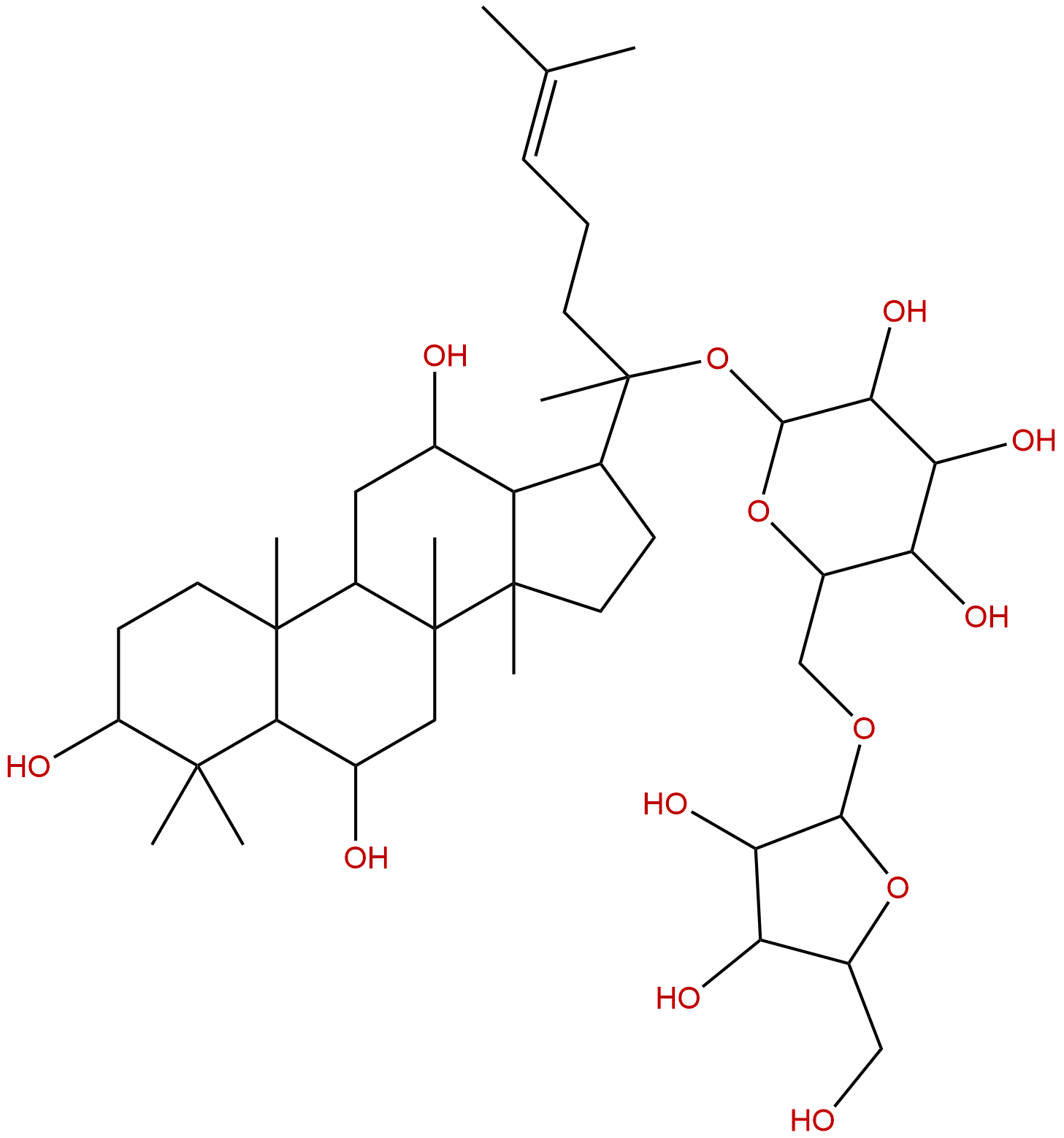


Product name: Ginsenoside F5
Synonym name:
Catalogue No.: BP3165
Cas No.: 189513-26-6
Formula: C41H70O13
Mol Weight: 770.998
Botanical Source:
Physical Description:
Type of Compound: Triterpenoids
Purity: 95%~99%
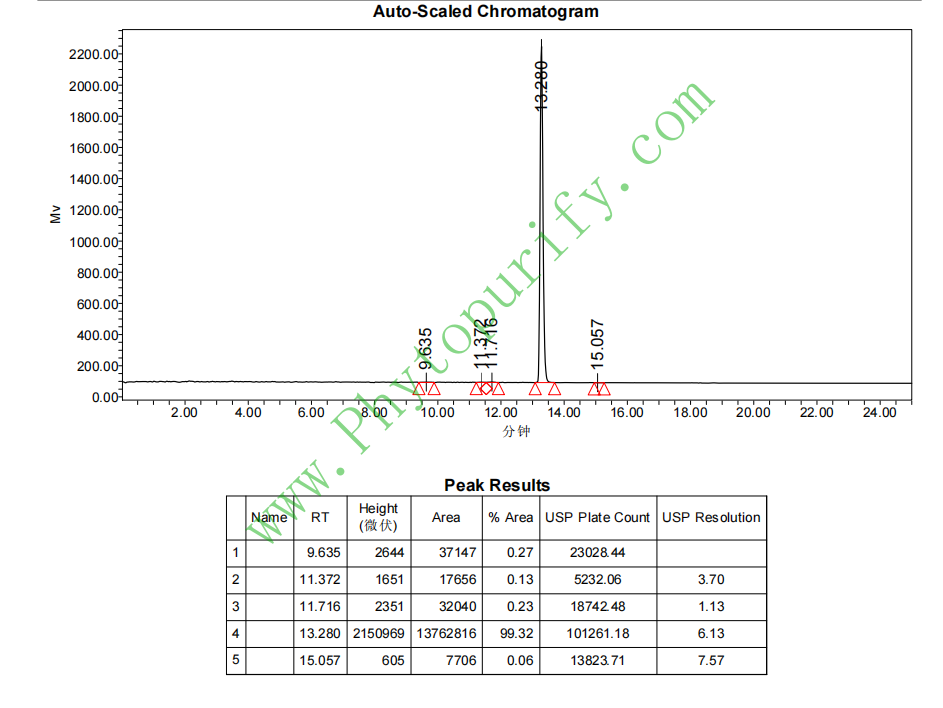
Analysis Method: HPLC-DAD or/and HPLC-ELSD
Identification Method: Mass, NMR
Packing: Brown vial or HDPE plastic bottle
The product could be supplied from milligrams to grams. Inquire for bulk scale.
We provide solution to improve the water-solubility of compounds, thereby facilitating the variety of activity tests and clinic uses.
For Reference Standard and R&D, Not for Human Use Directly.
HPLC of Ginsenoside F5
Storage conditions:Short-term storage at 2~8℃, long-term storage at -20 ~ -80℃
218.9900
2.9360
2.9363
.0376
.5583
.2944
Low
71.2503
5.9630
No
No
No
No
No
No
0.0
Yes
No
No
No
Ginseng (Panax ginseng C.A. Mey.), as a traditional precious medicinal herb, has been proven to have the effects of "strengthening the body and strengthening the foundation" and "promoting intelligence and calming the mind" through thousands of years of practice. Modern pharmacological research reveals that the main active ingredient of ginseng, ginsenosides, is the material basis for its extensive pharmacological effects. Ginsenosides are a class of triterpenoid saponins with diverse structures, which are mainly classified into damaane type (such as Rb1, Rg1) and oleanane type (such as Ro) based on their glycoside skeleton. Ginsenoside F5 (CAS: 189513-26-6) is a rare saponin monomer isolated and identified from ginseng in recent years, which has attracted much attention due to its unique chemical structure and significant biological activity. Early studies have found that ginsenoside F5 can significantly inhibit the proliferation of human promyelocytic leukemia HL-60 cells by inducing apoptosis, suggesting its potential anti-tumor activity. More noteworthy is that with the deepening of research, ginsenoside F5 has shown multi-target and multi pathway regulatory potential in the field of neuroprotection, involving key pathological links in neurodegenerative diseases such as Alzheimer's disease (AD) and Parkinson's disease (PD), such as β - amyloid protein (A β) deposition, tau protein hyperphosphorylation, oxidative stress, and neuroinflammation. This article aims to systematically review the chemical characteristics, plant sources, pharmacological activities, and specific mechanisms and molecular targets of the neuroprotective effect of ginsenoside F5, and evaluate and prospect its pharmacological properties and future clinical application prospects.
The molecular formula of ginsenoside F5 is C41H70O13, with a molecular weight of 770.9980 Da. Its chemical structure belongs to the dammarane type triterpenoid saponin, which is a deglycosylated metabolite or derivative of the original ginsenediol type saponins (such as Rb1, Rc, Rb2) in the gut microbiota or in vitro processing. Compared with common prototype saponins, the sugar chain composition of ginsenoside F5 is relatively simplified, usually connected with monosaccharide units such as glucose and arabinose. This structural difference directly affects its physicochemical properties and bioavailability.
In terms of physicochemical properties, calculations and experimental data indicate that the lipid water partition coefficient (LogP) of ginsenoside F5 is approximately 2.9360, indicating a certain lipophilicity. However, compared to its precursor saponins (such as Rb1, with lower LogP), its ability to penetrate cell membranes may be enhanced. Its topological polar surface area (TPSA) is 218.9900 Å ², and the larger TPSA value is due to multiple hydroxyl groups and oxygen atoms on the sugar ring in the molecule, which to some extent limits its passive transmembrane diffusion efficiency. The water solubility data is 0.0376 mg/mL, which belongs to the category of slightly soluble to poorly soluble. This is a common feature of most saponin compounds and also one of the challenges they face in oral absorption. These basic physicochemical parameters provide important basis for its subsequent pharmacokinetic behavior and formulation design.
Ginsenoside F5 mainly comes from plants of the Panax genus in the Araliaceae family, especially traditional medicinal herbs such as Panax ginseng and Panax quinquefolius. In plants, the content of ginsenoside F5 is usually much lower than that of major saponins such as Rb1 and Rg1, and it belongs to trace or rare saponins. It can be directly isolated from plant raw materials, and more commonly prepared through biological or chemical transformations of other high content saponins.
Direct extraction and separation Using traditional natural product chemistry methods. Firstly, the ginseng roots and stems are dried and crushed, and then subjected to reflux or ultrasonic extraction using methanol, ethanol, or ethanol water mixed solvents. The crude extract was initially enriched with saponin fractions using macroporous adsorption resins (such as D101, AB-8), and then subjected to repeated separation and purification using various chromatographic techniques including normal phase silica gel column chromatography, reverse phase ODS column chromatography, high performance liquid chromatography (HPLC), and preparative liquid chromatography (pre HPLC). The structure was identified using techniques such as nuclear magnetic resonance (NMR) and mass spectrometry (MS). This method has a long process, low yield, and high cost.
Biotransformation method This is a more efficient and promising way to obtain ginsenoside F5. Selective deglycosylation of prototype ginsenosides (such as ginsenoside Rb1, Rc, etc.) using specific microorganisms (such as intestinal bacteria, fungi) or enzymes (such as glycosidase). By optimizing the bacterial strain, enzyme source, and reaction conditions (pH, temperature, time), the substrate can be converted to ginsenoside F5 in a targeted and efficient manner. This method has mild conditions, good selectivity, and conforms to its physiological process of metabolism in vivo, making it an important strategy for large-scale preparation of rare saponins.
Chemical conversion method Treat the prototype saponins with acid, alkali, or chemical reagents, and remove some sugar groups through hydrolysis reaction. However, this method has poor selectivity and is prone to producing by-products, which may damage the structure of saponins and limit its application.
The pharmacological activity research of ginsenoside F5 has expanded from its initial anti-tumor activity to multiple fields such as neuroprotection, anti-inflammatory, and antioxidant effects, among which neuroprotective effects are currently a research hotspot.
Antitumor activity Groundbreaking research has confirmed that ginsenoside F5 can significantly inhibit the growth of HL-60 leukemia cells, and its mechanism is closely related to inducing cell apoptosis. Subsequent studies have also observed similar effects in other tumor cell lines, suggesting its broad-spectrum anti-tumor potential. Its function may involve activation of the mitochondrial pathway, upregulation of death receptor signaling, and cell cycle arrest.
Neuroprotective activity (core pharmacological action):
Other activities Preliminary studies also suggest that ginsenoside F5 may have effects such as improving insulin resistance, protecting myocardial cells, and regulating immunity, but further research is needed.
The neuroprotective effect of ginsenoside F5 is not achieved through a single target, but through a synergistic network of multiple targets and pathways. Based on existing research, its key mechanisms of action and molecular targets can be summarized as follows:
Regulating apoptosis and balance of survival:
Intervention in the core pathological process of AD:
Activate endogenous defense system:
Regulating key signaling pathways:
In summary, ginsenoside F5 exerts multidimensional neuroprotective effects by synergistically targeting multiple targets such as BCL2, CASP9, APP/ACE1, MAPT, GSK3 β, ACHE, NFE2L2, SIRT1, and MAPK1, including inhibiting apoptosis, reducing A β production and tau phosphorylation, enhancing antioxidant, anti-inflammatory, and promoting neuronal survival.
Although the pharmacological activity of ginsenoside F5 is clear, its drug likeness still faces challenges and requires comprehensive evaluation.
Preliminary evaluation based on physical and chemical parameters Its molecular weight (~771 Da) is slightly higher than the conventional upper limit of the Rule of Five for drugs (500 Da), but still within an acceptable range. The LogP value (~2.94) indicates moderate lipophilicity. However, high TPSA (~219 Å ²) and low water solubility (0.0376 mg/mL) are the main obstacles to its oral absorption, which may lead to low bioavailability.
Prediction and Analysis of ADMET Properties:
Current status of pharmacokinetic research At present, there are relatively few research reports on the pharmacokinetics of ginsenoside F5 system. Referring to other structurally similar ginsenosides (such as Rb1, Rg1), it can be inferred that ginsenoside F5 may undergo transformation under the action of gut microbiota after oral administration, with limited absorption of the original drug, lower blood drug concentration, and possibly a later peak time. The key parameters such as its in vivo distribution, protein binding rate, main metabolic pathways, and elimination half-life urgently need to be elucidated through standardized pharmacokinetic studies. Strategies to improve its bioavailability include the development of nano formulations (such as liposomes, polymer micelles), phospholipid complexes, prodrug modifications, or combination with absorption enhancers.
Ginsenoside F5, as a natural small molecule with multi-target neuroprotective potential, has shown unique application prospects in the prevention and treatment of neurodegenerative diseases, especially Alzheimer's disease.
therapeutic potential:
challenges faced:
Future research directions:
Ginsenoside F5, as a rare active saponin discovered from traditional Chinese medicine ginseng, has become a highly promising candidate molecule in the field of neurodegenerative disease drug development due to its unique advantage of exerting neuroprotective effects through multiple targets and pathways. It not only demonstrates clear efficacy in combating the core pathological features of AD in cellular and animal models, but its relatively good preliminary safety prediction also lays the foundation for its subsequent development. However, the road from lead compounds to successful drugs is still long, and their inherent physical and chemical property defects, especially the blood-brain barrier permeability problem, are the key challenges that lie ahead. Future research should focus on breaking through delivery bottlenecks through collaborative innovation between medicinal chemistry and pharmacy; At the same time, using systems biology and chemical biology methods to more accurately depict its functional network and direct targets. I believe that with the continuous deepening of research and the development of technology, ginsenoside F5 or its optimized derivatives have the potential to provide new hope for the prevention and treatment of neurodegenerative diseases, and are also a vivid example of the modernization of traditional Chinese medicine and the research and development of new natural product drugs.
